

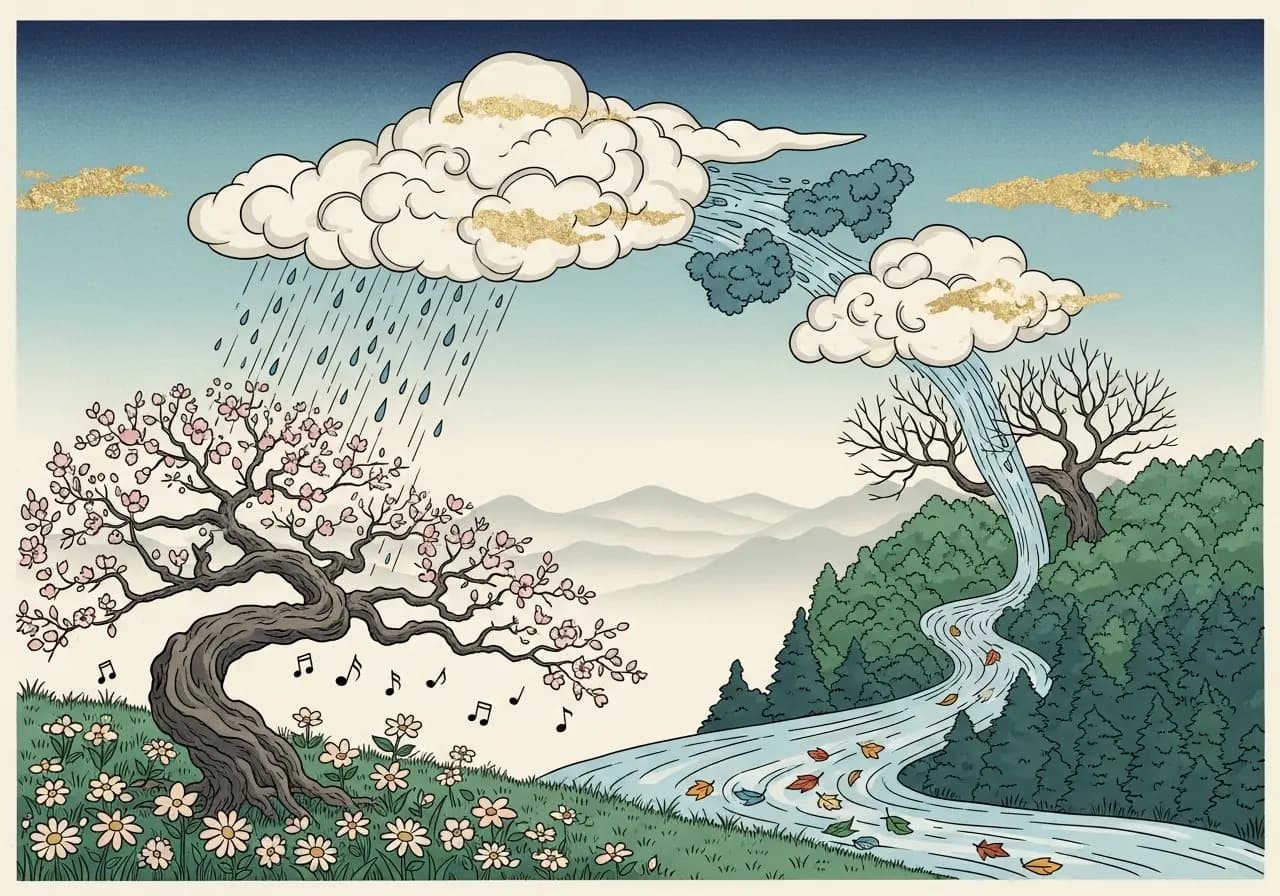
What Happens When We Die
Episode 29 of the Secular Buddhism Podcast
Hello. You are listening to the Secular Buddhism Podcast, and this is episode number 29. I'm your host, Noah Rasheta, and today I'm talking about what happens when we die.
Welcome
Welcome back to the Secular Buddhism Podcast, a weekly podcast that focuses on Buddhist concepts, topics, and teachings presented for a secular-minded audience. Remember: "Do not try to use what you learn from Buddhism to be a Buddhist. Use it to be a better whatever you already are." That's one of my favorite quotes from the Dalai Lama, so please keep that in mind as you listen to this episode.
If you enjoy the podcast, please share it with others, write a review, or give it a rating on iTunes. If you're in a position to be able to, I'd encourage you to consider making a one-time donation or becoming a monthly contributor to the podcast by visiting SecularBuddhism.com.
Let's Jump In
Now let's jump into this week's topic. A common question I get when teaching workshops about Buddhism is: "What happens when we die?" It's a big question. It's a very big question.
The short answer is: change. Change is what happens when we die.
To understand the Buddhist view of death, you have to understand the Buddhist perspective on impermanence and interdependence. The Buddhist worldview is that all things are constantly changing. This is impermanence—nothing is permanent. Everything is changing. Everything is interdependent. All things are connected to each other.
Time and Space: Impermanence and Interdependence
In the time and space continuum, in terms of time, all things are impermanent. In terms of space, all things are interdependent. Things are constantly changing. One moment dies and gives birth to the next moment, and this is an ongoing process. In this sense, death and birth are constant. Death is always happening and birth is always happening.
Look at the very cells that make up our physical composition. Right now, in this very moment, you have cells that are dying and new cells that are generating or being born. They're continually growing, dying, and being replaced by new cells. In this sense, birth and death are already a constant part of what makes you who or what you are. It's what makes you, you. It's what makes me, me.
This is the understanding of impermanence. All things are constantly changing. You can look at this in terms of moment-to-moment experience of life. As soon as one moment ends, a new moment begins. Birth and death is a constant cycle that's going on throughout the process of life.
Now with interdependence, all things are interdependent. Everything has its causes and conditions, and nothing exists in and of itself without causes and conditions. Your very existence is dependent on causes and conditions. None of us suddenly came into existence of our own free will. We are the result of the actions of others. In that sense, everything depends on everything that allows it to exist.
Beyond Duality
We have the tendency to view things through a dualistic lens: left and right, wrong and right, good and bad, winning and losing, birth and death. This dualistic way of understanding the world makes it seem that death is something we consider the end and birth is the beginning. But in a non-dualistic view, all of these things are always one and the same because you can't have one without the other.
The moment we come up with the concept of left, that is the moment right manifests itself. Same with wrong and right, good and bad, winning and losing. I think about this often with the term "father" and "son." The moment that I became a father is the very moment that my son became a son. You can't have one without the other. These things manifest at the same time.
The understanding here—or perhaps the implication I should say—is that all things are one. In Buddhism, we call this oneness or "suchness." It's everything just as it is. We get caught up in the dichotomy of creating the view of "this" and "that," "me" and "you," "now" and "then." We create that dualistic way of understanding the world.
Seeing Through Interdependence
What does it mean to be able to see things with the lens of understanding that all things are interdependent?
Well, for example, when we look at a flower, we see just the flower. What Buddhism is trying to teach is that when you see it that way, you're missing what the world is. We need to see everything that makes the flower a flower. When we look at a flower, we should see the flower. But we should also see all of the elements that are not the flower that make the flower a flower. For example, the sun, the rain, the soil, the bees that pollinate. All the aspects that are not "flower" that make the flower a flower.
When you can see that, then you start to understand this idea of interdependence. It's also sometimes referred to as "interbeing." Thich Nhat Hanh talks about interbeing, and the concept is this: if I can only see the flower as a flower, then I haven't actually seen the flower. It's when I can see things as they are—interdependent with everything that allows that thing to be—then I can start to see the thing as it is. Unless we see it all, we don't really see it the way that it is.
With birth and death in the context of being a part of a much bigger picture, we need to understand that death isn't the end and birth isn't the beginning.
The Matter of Self
This applies to how we view ourselves too. We're the same. We're made of everything that makes us who or what we are. I like to say that I'm the sum total of everything that makes me me. Birth is not the start, and death is not the end.
Think about that for a second because this is a scientific thing. Scientifically, it's generally understood that matter cannot be created or destroyed. According to the law of conservation of matter, matter is neither created nor destroyed. It just changes states. This is the first law of thermodynamics. It specifies that the total amount of energy in a closed system cannot be created nor destroyed, though it can be changed from one form to another.
So the short answer, again, to what happens when we die is: change is what happens. This is very difficult for us to comprehend because we've made the mistake of thinking that the start of me is birth. That's it. That's the start. And the end of me must be death. But the reality is that birth wasn't the start of me.
Physically, I existed before I was born. I existed in my mom and in my dad. I'm not talking about anything metaphysical here. I'm talking about in a very literal, physical way I existed in both of my parents. If that's true, where did I start? Did I start when I was in the DNA of my mom or in my dad? Once they combined, then do I start?
Well, you could argue that the start of you is when you're conceived and the sperm and egg come together. Life starts to create. Cells start to split and then there you are as the embryo, beginning your whole journey as a life form. That's your start.
What Buddhism is saying is, "Well, no. That's the start of that specific phase of what you are, but you've never not been." At one point, I was sperm and I was egg. I was both. Before that, I was protein or DNA or however you want to think about this scientifically. The reality is you've never not existed. You've existed in different states and in different things. But we make the mistake of thinking that the start of me is birth.
The Cloud Analogy
Think about this for a minute with a cloud. When we look at clouds in the sky, we see a cloud. The reality is that cloud came into existence because the right temperature, or winds were causing temperature to rapidly change, or moisture levels changed. Something causes a cloud to form.
But you can't look at the cloud once it's formed and say, "Well, that cloud didn't exist before." Because it did exist. It existed in other forms. The cloud could have been part of the water in the ocean. It could have been part of the oxygen. A cloud is a lot of things. When we see something form, we view that as the beginning of that thing. When a cloud dissipates—whether through rain or it disperses back into just being air—we see that as the end of the cloud. But it's not the end of the things that made the cloud the cloud.
This is the difference. If you look at the cloud as a thing that is not interdependent with other things, then you could say, "Well, how sad. The cloud is gone." But the cloud isn't gone. It's just changed into a new form. Now the cloud may be part of the ocean, or if it rained, it's part of the forest, or whatever it turns into.
All of the matter that was part of the cloud is still there. I love visualizing clouds because a cloud, from the moment it comes into existence, is constantly changing. It's not a static thing. The shape of the cloud is continually shifting and evolving and morphing. At some point, the cloud is gone. There's no more cloud. Then that process happens over and over and over again. There are always clouds somewhere. They're never the same cloud. The clouds have never not existed. When they cease to exist, it doesn't mean that those elements are gone. They become something else.
It makes sense when you look at this and see it in nature. This applies to a tree. A tree has never not existed because before it was a tree, it was the seed of another tree. Before it was a seed, it was just a part of the tree. When a tree dies, the tree is no longer there, but the essence of what makes the tree the tree—the matter—continues in that cycle of becoming something else.
What you see in nature is change. We see constant change. Why should it be any different with us?
The Teaching of the Misshapen Cloud
Alan Watts used to say, "Have you ever seen a misshapen cloud?" I love applying that way of thinking to how we see ourselves and how we see others.
"Have you ever seen a misshapen cloud?" is really asking: have you ever seen somebody who's wrong? Who isn't who they're supposed to be? This is a powerful teaching because when we see this in nature, we understand. Apply this to a tree. Have you ever seen a misshapen tree? No. Some trees are straight. Some have bends. Some have an entire horseshoe bend in them, and we don't look at that and think, "Oh, that tree is wrong. That's not the right kind of tree." Because there's no such thing as a right kind of tree.
A tree is just a tree. A flower is just a flower. We don't look at a flower and say, "Oh, that red flower is wrong. It's supposed to be blue." There's no way that a flower is supposed to be. There's no way that a tree is supposed to be.
Apply this to animals. We don't do this to animals. We don't look at a certain species and say, "Oh, those are wrong. The fox is supposed to be a wolf." We don't say the wolf is supposed to be a bobcat because everything just is what it is.
This is what Buddhism is trying to convey to us: the understanding that we're no different. I am who I am. You are who you are. This idea of suchness is the understanding that there's no way that you're supposed to be. There's no you that you're supposed to be. There's only the you that you are.
We're the ones that make the mistake of going around through our dualistic thinking and creating concepts. There's the concept of who you are. Now I have this concept of who I think you should be. You have a concept of who you think you should be and who you think I should be. This is where we get caught up in all these problems, in this dualistic thinking.
In the middle of all that, there's this fear of death. Because death is the end of everything that we know. Everything that's familiar to us. We create stories and narratives to try to intellectually get around the fear that we have of death. I think death is one of the biggest catalysts of religious narratives because we're trying to find a way to make sense of the fact that at some point, like a cloud, a cloud ceases to exist and so do we.
That's only problematic if you think that's truly the end. It can't be the end because birth wasn't the beginning.
Life as Music
I like to think about this when I think of music, too. Life is like music. Think of a song. A song is composed of notes—different notes. They're constantly changing. A song's not a song if it's just one same note that never ends. Nobody would enjoy listening to that.
What makes a song beautiful is a collection of notes. High notes, low notes, gaps and pauses in between notes. As you listen to a song, you don't single out one note and say, "Oh, I can't wait to hit that D sharp again and then never leave that note." The beauty of the song goes away when you try to fix a part of it and make that part permanent. That's the whole point of the song—that none of it is permanent.
It's all these different notes. Even if you hold one note longer, that's fine, but none of it's permanent. It's the fact that it's impermanent that makes it so beautiful. That's how we enjoy it. And at some point, the song does end. A song has a beginning note and an ending note. Every note matters. We don't listen to a song thinking, "I never want to hear that last note." We may want a song to not end because we're enjoying it. But again, if it never ended, it's no longer an enjoyable song. That's part of the beauty of the song—that a song ends.
Every note, including that final note which in our case we could say is death, is a note that's beautiful and it matters just as much as that first note, which would be birth.
It's important to distinguish that there's a very big difference in understanding that a song may end, but the music never dies. Music goes on and another song will come. More notes will be played. Then when that song ends, the music goes on. At some point, another song starts. That's the beauty of music. Music goes on and on and on, but songs are not permanent. They're impermanent.
I like thinking about life and associating it with music. Notes and songs and then music as a whole. I think it's a beautiful way to think about and understand this concept of life and death.
The Unknowability of Death
Again, the question is: what happens when we die? And the answer is: change is what happens. It's the same thing that's happening throughout this whole process. Change is what's constant.
Now it gets difficult when we try to understand what will happen at one of these stages that we haven't reached. I've alluded to this before. Trying to understand what happens when we die is very similar to someone who's never been in love trying to understand what it is to be in love. How do you convey that? Life is so experiential.
As much as you would try to convey to someone or to yourself what a specific phase is like when you reach it, you don't know until you reach it. I did not know what it was to be a father until I became a father. I didn't know what it was like to be married until I was married. I didn't know what it was like to lose a job until I lost a job. All these experiences in life are experiential.
Death is the same. I think it's in some way silly for us, the living, to assume we know what it's like to be dead because a caterpillar doesn't know what it's like to be a butterfly until it's a butterfly. The death of the caterpillar is the birth of the butterfly. What we see there is change.
I think about this with seasons. Summer cannot know what it's like to be winter. Imagine if summer were capable of being introspective and thinking, having consciousness the way we do. It would be entertaining to hear summer speculate about what it must be like when I end, when I cease to be. When summer ends, what we experience is change. A new season starts. The death of summer is the birth of fall. The death of fall is the birth of winter. But one cannot experience or know what the other is like because they're just not the same thing. One is one, and one is the other.
For us, I think it's the same. For the living to know what it's like to not be living, how can we do that? It's impossible. I feel it's unnecessary to even try to speculate or waste time trying to logically understand what it is to not exist because I only exist. To know what it's like to not be alive is impossible for me because I'm alive.
Finding Peace
I think with this understanding, then there's no need to fear death because we start to understand that birth wasn't the beginning and therefore death is not the end. Change is what's coming. The song may be over, but the music goes on.
I love thinking about Vivaldi's The Four Seasons. If you've heard this composition, I heard it recently when I was in Germany. There are always street musicians playing in Europe and I assume in other large cities in the US as well—in subways or random places. There was a group there playing Vivaldi's The Four Seasons. Spring, Summer, Fall, and Winter. All of the songs are very different from one another.
This is when I was thinking, "This part of the song cannot know what it is like to be this other part of the song because they're different. They're just not the same." Different notes, different melody. The entire style changes—very much like our actual seasons change for those of you who live somewhere where there are four seasons.
We have four distinct seasons where I live, and it's a very clear change when you shift from one season to another. I love thinking about that in life. I think it's easy to compare the seasons to the seasons in our lives as well, but even greater than that, I like to consider the seasons as symbols of change in general. The change of being life to being not life or to being something else.
I don't know what it was like to be what I was before I became what I am. We can't know that. I don't know what that was like.
At the same time, just because consciousness changes doesn't mean it doesn't exist. Think about the very simple change that happens from being awake to being asleep. We don't go to sleep and experience a dream without wondering about being asleep. You're not dreading or lamenting the fact that you're not awake because you don't even know that you're not awake. What happened was change, and it's a total shift in consciousness. I don't think you look back and think, "Man, if I could just be awake again. I'm so sad now that I'm asleep." We don't do that. You just shift into what's next and that's the new normal.
With dreams, it can be crazy. You can be dreaming that you're on the back of a dragon flying over and attacking a castle, and you never question any of it because reality is what it is. Anyway, I guess that's kind of a tangent on this whole thing.
What I want to get at is: when we think about death and think about it as the end, it's not the end. It may be the end of what we hold to be familiar, of what we understand, and perhaps it's our fear of the unfamiliar that makes death so scary. We don't know what happens next. We don't know if anything happens.
That's something I love about Buddhism, because Buddhism rather than try to answer these existential questions and say, "Well, here's the answer," it's trying to say, "Well, hang on a second. Why is that question so important to you? Why do you feel you need to know? Could you ever arrive at a place where you don't need to know?"
Because that's where peace is. That's where contentment and joy can be found. In this state of mind of, "This is something that I don't know, and that's okay. I don't need to know. Because when it happens, it'll happen. Until then, here's what I do know: it's here and it's now, and this is what I'm experiencing in life."
Buddhism anchors itself in that present moment, in the here and in the now.
The Inevitability of Change
Again, the answer to the question "What happens when we die?" is: change. Change is what happens when we die. It's been happening all along. Change has never not been happening. It's really hard to answer that in a simple question-and-answer setting without giving an entire background of the Buddhist understanding of interdependence and impermanence.
I think when you have a good grasp of interdependence and impermanence, then suddenly death doesn't seem so scary because it's the one inevitable thing that is certain for us. Death will come. And with it comes change. Change is the only thing that will happen. When that time comes, change will happen, and whatever it's going to be like is what it's going to be like. There's no need to try to speculate.
Maybe some could argue they have hope and the idea of lasting forever, or thinking they have a soul that goes on to heaven or whatever. It can be comforting to have a narrative that you can believe in, but remember that can become problematic because it's our beliefs that can blind us from experiencing and seeing reality as it is.
Just think about that for a minute and ask yourself, "What do I think about death? Do I need to have an answer? Do I need to have a narrative that comforts me? Do I need to have that hope? Or can I get to the root of why I feel the need to know?"
That's kind of where Buddhism goes with all of this. It becomes an introspective process of understanding the nature of the mind. Why do I feel I need to know these things? Rather than saying "here are the answers to these things," Buddhism invites the question itself. That's what I wanted to discuss in this podcast episode.
Closing
Now, next time you hear Vivaldi's The Four Seasons, this whole topic is going to come to mind. Or next time you look up at the clouds in the sky, this topic might come to mind. Or maybe any music, any song, any note will evoke the memories of this specific podcast episode and the Buddhist understanding of impermanence, interdependence, and the implications that has for life, birth, and death.
Thank you for listening to this episode of the Secular Buddhism Podcast. If you enjoyed the episode, please consider writing a review on iTunes or giving it a rating. If you're in a position to be able to donate, please consider making a one-time donation or becoming a monthly contributor to the podcast. Every donation helps. Thank you for your support and for taking the time to listen to this. I look forward to the next episode. Until next time.
For more about the Secular Buddhism Podcast and Noah Rasheta's work, visit SecularBuddhism.com