

Stuck Between a Rock and a Hard Place
Episode 28 of the Secular Buddhism Podcast
Hello, you are listening to the Secular Buddhism podcast. This is episode number 28. I'm your host, Noah Rasheta, and today I'm talking about being stuck between a rock and a hard place. So let's get started.
Welcome
Welcome back to the Secular Buddhism podcast. This is a weekly podcast that focuses on Buddhist concepts, topics, and teachings presented for a secular-minded audience.
The Dalai Lama has said, "Do not try to use what you learn from Buddhism to be a Buddhist. Use it to be a better whatever you already are." Please keep that in mind as you listen to this episode. If you enjoy this podcast, please share it with others, write a review, or give it a rating on iTunes. And if you're in a position to do so, I would encourage you to consider making a one-time donation or becoming a monthly contributor to the podcast by visiting SecularBuddhism.com.
Now let's jump into this week's topic.
The Feeling of Being Stuck
Have you ever felt like you were stuck between a rock and a hard place? I'm sure you've heard the expression: "damned if you do, damned if you don't." I think this is something we all experience from time to time. It's typically the feeling we get when it seems like we have no good way out of a situation. And the situation can be all kinds of different things.
I recently experienced this—or have been experiencing this for a while—with running my own company. Sometimes the decisions that have to be made owning a business can feel this way. Deciding what to do with excess inventory, or deciding if I should negotiate a deal with a specific chain of stores. From time to time, I've had this feeling of being stuck between a rock and a hard place.
Recently, I was in Germany attending Photokina, the world's largest photography expo, for my work. I've been working on a deal with my suppliers—the owners of the factory who manufacture all of my products. And I've been starting to feel more and more this feeling of being stuck between a rock and a hard place. Specifically, in terms of how I negotiate a deal regarding the ownership of the company, how to manufacture the products, and who gets to decide who's selling them to which distributor or retailer. At times this can be a really stressful process for me. It's probably one of the few areas in my life right now where I tend to feel a considerable amount of stress.
I had been anticipating this meeting with the owners of the factory for months. And last week, while I was in Germany attending the trade show, we had the meeting scheduled. I arrived on a Monday, and the meeting wasn't until Thursday. So I noticed how the level of anxiety was rising throughout the week as I approached Thursday. And it was kind of a fascinating process to experience this and to notice it as I'm experiencing it.
The Story of the Strawberry
This experience reminded me of one of my favorite Zen stories—one that means more to me now than it ever has. I think the basic lesson that's generally taught with this story is one thing, but I see another level of meaning. And I want to share that with you.
This story is called "The Strawberry," and it's a Zen parable. Here it goes:
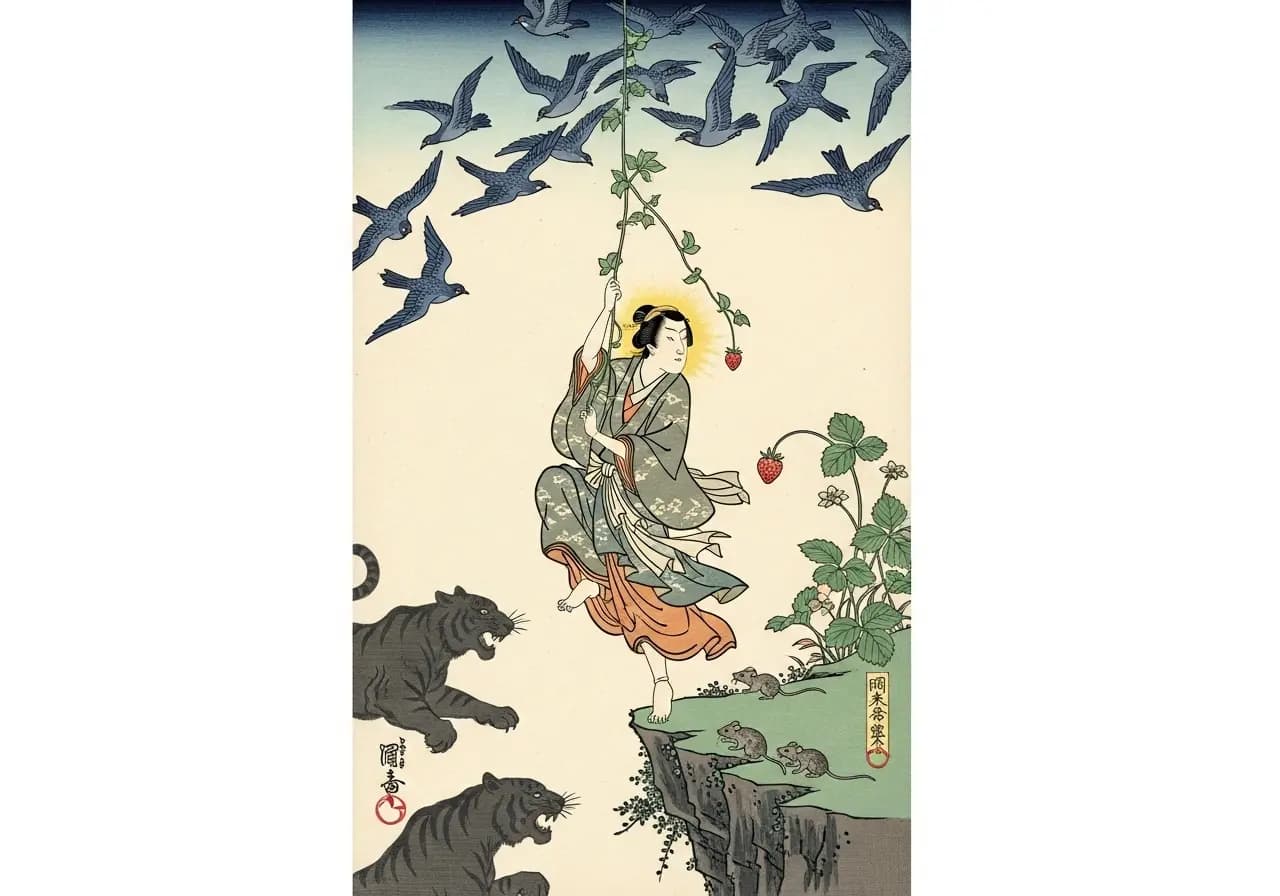
A Zen master was out walking one day and was confronted by a ferocious tiger. He slowly backed away from the tiger, only to find himself trapped by the edge of a high cliff. The tiger snarled with hunger and went after him. His only hope of escape was to suspend himself over the abyss, holding onto a vine growing out of the edge of the cliff.
As he climbed down the vine and dangled there, he noticed danger at the bottom as well—there was another tiger down there. He looked up but couldn't climb up because the tiger was there. He couldn't go down because there was a tiger down there. He was stuck. And then, as if that wasn't bad enough, two mice showed up and started gnawing at the vine. Now he knew it was just a matter of time before the vine broke and he would fall.
So there he was, dangling by the vine with death seeming imminent. Just then, he looked over and noticed a ripe wild strawberry growing along the cliff's edge. He plucked the strawberry, put it in his mouth, and supposedly said, "What a lovely strawberry this is," or spoke about it being the sweetest strawberry he'd ever tasted. And in that moment, he was enlightened.
The Deeper Meaning
It's a simple story—I've heard it many times. And it's so simple it's almost silly. But as I thought about this story more deeply, something stood out to me that I don't think I had really noticed before. And it's this: experiencing the strawberry isn't what made him enlightened. It's the fact that in the midst of being between the rock and the hard place—in his case, the literal experience of being between a tiger and a tiger with death imminent because the mice were gnawing on the vine—he was capable of doing something that most people are not capable of. He was capable of noticing something.
To me, this is a parable about awareness more than anything else. The average person would look and not even notice there's a strawberry there. Because we're focused on the situation at hand, right? The fact that there's a tiger, there's another tiger, there are mice, the vine is being chewed on. The last thing that would cross through my mind is, "What should I be aware of here? What am I not noticing?"
In Buddhism, we talk about awareness all the time. And specifically, we're trying to be aware of the fact that there are things we don't know that we don't know. It's not even an awareness of "I need to be looking for strawberries," in this case. Because you can't know in advance what you're going to encounter. But what the Zen master was capable of was being in a moment like that and noticing something. Having that sense of awareness.
Applying the Story to My Meeting
So I was thinking about this story in the days leading up to my appointment with the factory owners. And like I said, what this story means has shifted over time for me. I feel it's become a more meaningful and in-depth story for me as I realize that the whole point is about awareness. It's not about the conclusion. We don't know what happens. Did he climb up? Did he climb down? Did the vine break? You can draw all these metaphors, but that's not the point. The point is that in that moment, he experienced something because of his awareness.
On Thursday, the day of the meeting, I had been thinking about this. And I was trying to tell myself there's no need to be too stressed. Worst-case scenario is that this business deal doesn't happen the way I thought it would. Best-case scenario is that it does happen the way I thought. And in a way, both of them seemed like being stuck between a rock and a hard place. If it does work the way I wanted, then I'm bound by these new terms we're committing to. If it doesn't work, then none of it's going to work, and I'm free to start doing something else. But that also brings its own bag of new things to worry about.
As I was walking to the meeting, I was thinking of the story of the strawberry. I thought, okay, for me this is completely metaphorical because there's really no tiger. But it can feel like that. Life can feel like that at times. And I thought, if I were the person hanging on the vine right now and I'm nervous about what's going to happen—am I going to climb up, am I going to climb down, is the tiger going to get me, are the mice going to gnaw through the vine—when you're in that situation, what could I look around and see that I didn't notice that I wasn't noticing?
I was in Germany experiencing a really cool vacation tied in with work in a new place I'd never been. As we were walking to where we were going to have the meeting, I paused. And I thought, "What have I not noticed here?" And I just looked around. A flock of birds flew right over my head—probably thirty or forty birds. And it was just a really powerful moment to pause for a second and to realize: here are all these birds just flying. They're completely oblivious to my stresses, to the things going on in my life, to the fact that I'm walking to a meeting that's stressing me out. They just do what they do. They've been doing this for hundreds and thousands of years in this same little city. Where people are walking to and from the town square probably with stresses, moments of failure, moments of success, with all kinds of things. But to them, it doesn't matter. They're going about doing their thing.
The Birds and the Awareness
For some reason, that experience really clicked with the story of the strawberry for me. I took out my phone and started filming. On the iPhone, you can do slow motion video. I was filming them fly in slow motion. And I sat down and watched the birds flying with their wings flapping, all in slow motion. And it hit me with such a strong sense of awareness in that moment.
To realize there's so much that I'm not aware of in a moment like that. When I can feel stress or anxiety, that feeling of being stuck between a rock and a hard place can limit my ability to be aware of all the amazing beauty that's happening all around me. And in that moment, it happened to be birds. But I know that there are other things I'm not aware of. Maybe there were also ants crawling around. Or aside from the animals, just the other people in that same space. Somebody was probably walking with excitement in their step because they had just gotten engaged or gotten a new job or bought a new car. At the same time, someone else was walking through that plaza, disappointed because they just lost a job, or just crashed their car, or were going through marital problems. I don't know.
And I think that's kind of the point of the Zen story. It's not about the conclusion because we don't know the conclusion. We don't know what happened. But it was never about what happened. It's about what can we notice in the process of just being.
Why the Birds Mattered
This was really powerful for me because from that moment on, I kind of felt like it doesn't matter what's going to happen. What's going to happen is what's going to happen. But what can I notice in this one moment? What can be my strawberry?
My strawberry was seeing those birds and watching them fly. And I think a part of the reason that stood out to me so much is because I have a fascination with flying. Flying is a big part of what I enjoy in life. And flying, ironically, was also a big part of why I was there in that moment having that meeting. Because at one point in my life, I thought I was going to be a pilot—a helicopter pilot. I spent a considerable amount of time and money to pursue that career. And it just turned out that wasn't the career that worked out for me. Life events changed my plans.
Instead of graduating from the school I was going to and becoming a helicopter pilot, the school closed and went bankrupt and stole my student loans—the money I'd put toward my flight training. And that propelled me down this whole new path that was unplanned and unanticipated. And here I was in that present moment, the culmination of my desire to be a pilot, standing in a square in Germany watching birds in slow motion.
It was just kind of a cool experience. And to me, that's the essence of this story. The story of the Zen master who was capable, in the moment of being between a rock and a hard place, of noticing something and having a sense of awareness.
The Essence of the Teaching
So that's what I wanted to share with you this week: the topic of being stuck between a rock and a hard place. And I know you've all felt that. I've felt that. And if you haven't or you're not right now, you will at some point again. It's part of the experience of being alive.
When that happens, I would invite you to think of this story. Think of the Zen master dangling by a vine, looking and realizing, "Oh, there's a strawberry," and tasting it. Like I've said before, this sounds like such a simple, even silly, story. But it carries a very powerful message. The message of our ability to be aware. And I think it's this person's ability to be aware in a moment like that which makes that person enlightened. It's not the fact that he ate a strawberry and that made him enlightened. That would be silly.
So think about that. And if you're going through a situation like this in your life, pause for a moment. And just ask yourself continually, "What am I not aware of not being aware of?" Or "What am I not noticing that I'm not noticing?" Pause for a minute and look around. Try to capture something going on around you that can get you out of that sense of feeling stuck between a rock and a hard place. Because there's always something else.
I'd love to hear your story or your interpretation of this parable. What does it mean to you? You can share in the comments on the blog, on the Facebook page, or in the Facebook group "Secular Buddhism." You can find all of these at SecularBuddhism.com or Secular Buddhism on Facebook.
Why Awareness Matters
Awareness is one of the key teachings in Buddhism, and there's a big reason why. Because wisdom is what we're after. And the only way to obtain wisdom—in the spiritual sense—is by learning about or becoming aware of the things that we're not aware of. It's with awareness that we can have acceptance. And with awareness and acceptance that we can enact change in our lives.
That's why awareness is a key part of Buddhist practice. That's why this story is such a powerful story when you think about it and relate it to a teaching about awareness.
So ask yourself: What am I not noticing?
Closing
Again, I want to thank you for listening and being a part of this podcast. The podcast is growing at a rate that is quite incredible to me, and it's still hard to believe. I want to thank you all for that. Because it's because of you that the podcast gets shared and continues to grow.
If any of you are interested in doing humanitarian work, I'm going to remind you again of the humanitarian trip we're doing to Uganda, January 26 through February 4th of next year. You can learn all about that at MindfulHumanitarian.org.
That's all I have for this week. Thank you again for listening. If you have time, please write a review or give the podcast a rating on iTunes. That really helps. If you have any questions, feel free to reach out to me. I can be reached at SecularBuddhism.com or on the Facebook page.
Thanks again for your continued support. Until next time.
For more about the Secular Buddhism podcast and Noah Rasheta's work, visit SecularBuddhism.com