

Understanding Non-Attachment
Episode 27 of the Secular Buddhism Podcast
Hello. You are listening to the Secular Buddhism podcast, and this is episode number 27. I'm your host, Noah Rasheta, and today I'm talking about understanding non-attachment.
Welcome
Welcome back to the Secular Buddhism podcast. This is a weekly podcast that focuses on Buddhist concepts, topics, and teachings, presented for a secular-minded audience.
The Dalai Lama has said, "Do not try to use what you learn from Buddhism to be a Buddhist. Use it to be a better whatever you already are." I like to emphasize that at the beginning of every podcast episode, so please keep that in mind as you listen. And remember, if you enjoy the podcast, please share it with others, write a review, or give it a rating in iTunes. Or if you're in a position to help, I would really appreciate it if you could make a one-time donation or become a monthly contributor to the podcast by visiting SecularBuddhism.com.
Let's Jump In
Let's jump into this week's topic: understanding non-attachment. This is something I wanted to discuss because it's come up a few times in recent workshops that I've done. I think the understanding of non-attachment is a little bit misconstrued. Typically, people ask for clarification on whether it's okay to be attached—specifically to loved ones like a spouse, children, or parents. So I want to clarify this topic because non-attachment is a very important part of understanding Buddhist philosophical thought, but I want to be clear about what exactly it is. Or perhaps more specifically, what it's not.
When we think of the word "attached," and if I were to say I'm attached to my kids or to my wife, we don't necessarily view that as a negative connotation. And I don't think we should.
What Non-Attachment Actually Means
The type of non-attachment that's being talked about in Buddhist thought has less to do with what you own or what you hold on to, versus how that holds on to you. Let me say that again: it has more to do with how things hold on to you, rather than what you hold on to.
I heard a recent quote that said, "Non-attachment doesn't mean we don't own things. It means we don't allow things to own us." That, in a nutshell, is the type of non-attachment we're talking about.
A Zen master put it pretty simply: "Everything breaks. Attachment is our unwillingness to face that reality."
I think non-attachment really stems from a misunderstanding of things being impermanent. When we attach to something, we suffer, and others suffer, because we're holding onto things that are past their time. You remember the Parable of the Raft? The Buddha was with his monks and he asked if somebody were to build a raft and they used it to cross a river, at the time they finally made it to the other side, would it be wise or unwise to continue carrying that raft with them?
I think this lesson is really talking about the understanding of non-attachment. Letting go of the raft, whatever the raft may be, is a lesson of letting go of things that are past their time. That is essentially the understanding of non-attachment.
This can apply to relationships, friends, experiences—even our moment-to-moment experience of living. If we're attached to it, it can be the source of a lot of suffering for ourselves and others. By accepting the true nature of things as being impermanent, we ease our fears and we open our hearts. This understanding of impermanence will not only benefit ourselves but will benefit others as well.
So don't think of non-attachment as a form of indifference or self-denial. Think of non-attachment as a way of not allowing things in your life to own you. Giving up the attachment to the permanence of things—that's the key understanding here.
Why Non-Attachment Matters
Because we understand that all things are constantly changing, that all things are impermanent, when you hold onto something and attach to it, it's detrimental. That thing changes. It evolves and transforms over time. Like that quote: "Everything breaks." Attachment is our unwillingness to face that reality. You can apply that thinking to almost anything.
Non-Attachment in Relationships
In terms of relationships—because that one comes up quite often—what does non-attachment mean in how I love my spouse, my partner, my children, my parents, or my siblings?
Thích Nhất Hạnh has a really good quote that I like. He says, "You must love in such a way that the person you love feels free." I think this goes hand in hand with the understanding of non-attachment. Loving in a non-attached way is loving in a way that the person you love feels free. And to be loved in a way that you feel free—that's a way of being loved without attachment.
It's not that there isn't love, or that you don't want to be with someone. It's that you don't allow that person, or that thing, to own you. That's attachment. Letting go of attachment is the secret to really enjoying life and to loving others. It's a way of freedom.
Think about this with relationships like with your children. If you love your children in a way that they feel free, that's genuine non-attachment. You're allowing someone to be completely authentic and free as they are. I think this is very pertinent to relationships, but it applies to other things too.
Non-Attachment and Goals
I've been asked specifically about goals. "Is non-attachment meaning I go through life without milestones or goals that I'm going to work towards or aspire to?"
The goals or milestones themselves are not the problem. It's when we allow those things to own us that it becomes unhealthy. That same form of thinking applies here. I think it's completely appropriate to have goals and milestones that you set in life, in your career, in various phases of your life. There's nothing wrong with that. It's when we become trapped because those things own us that we run into trouble.
Jack Kornfield had a quote he posted on Twitter not too long ago that said, "Everything that has a beginning has an ending. Make your peace with that and all will be well." I think that's a wonderful understanding of the concept of impermanence. Apply that to something like a goal. Having goals can be fine when you understand that goals are impermanent. You work towards it and you either accomplish it and move on, or something changes and it doesn't work out. That's where the wisdom of adaptability comes into play. The moment life presents something new, you can adapt and create a new goal. Because that goal didn't own you—you used it as a tool, not as an anchor or something that makes it more difficult for you.
The Buddha taught that all conditioned phenomena are impermanent. That all meetings end in parting. In all these examples, what stands out to me is the understanding of non-attachment in terms of our understanding of impermanence. The mistake that we make is seeing life as permanent.
Life as a Comma, Not a Period
One of my teachers, Koyo Kubose, would say, "Don't put a period on it. Just keep going." Our tendency in life is to freeze things and make them permanent, like we do with sentences. When a sentence is over, there's the period. That thought is done. It's locked, and now we move onto the next one.
But what if life wasn't about putting periods on things? What if it was always a comma and then you keep going? Then you add another comma and you keep going, like one infinitely long run-on sentence. I know that's going to bother some of you who are into grammar, but think about that in terms of life.
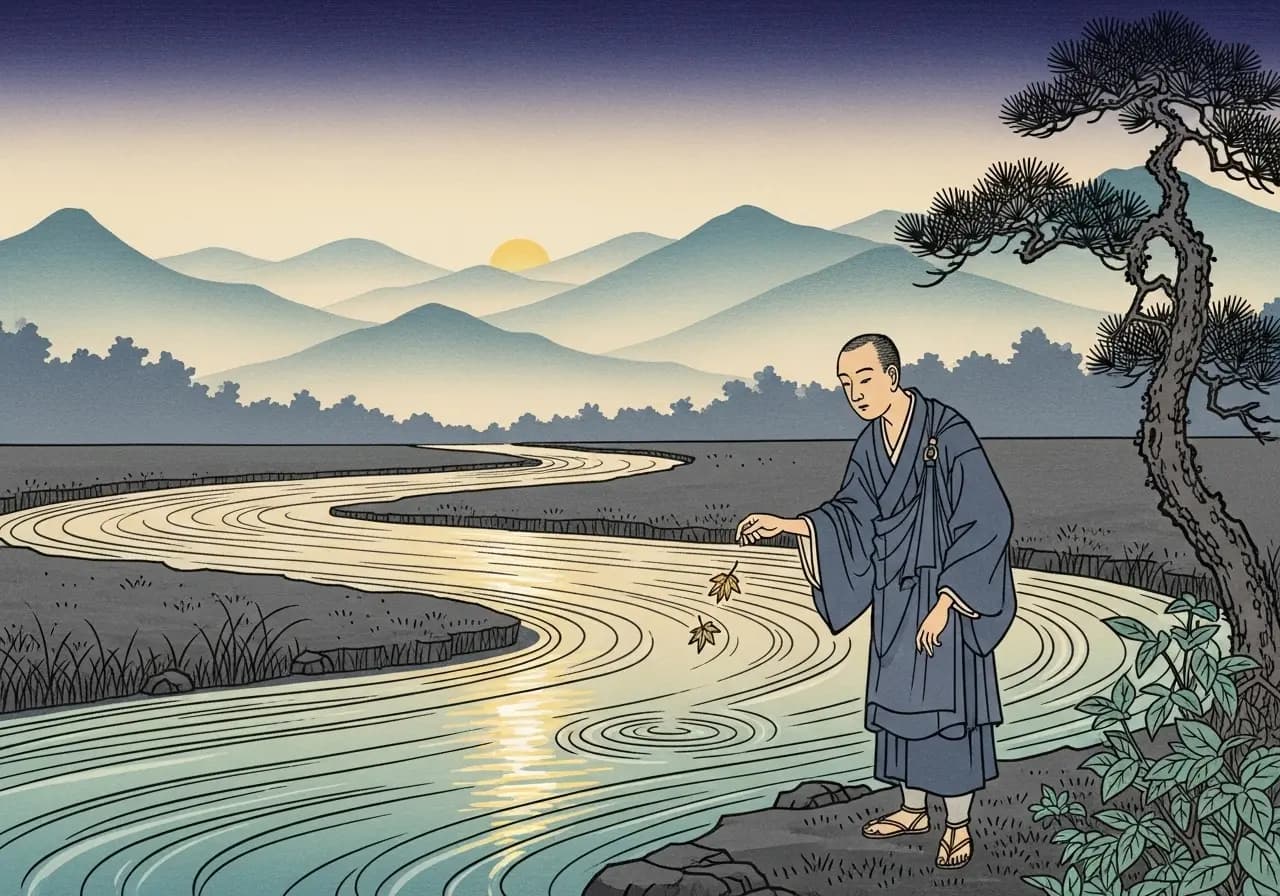
I've compared life to a river. There's no aspect of the river that's permanent. The water that's flowing is continually changing. The very edges and banks of the river are constantly eroding, and sand is being carried away. If a big storm comes and the water rises, the shape of the river can change. The water finds a new path, and that becomes the new path of the river.
There's not one aspect of a river that's permanent. Life is a lot like that. There's no aspect of life that's permanent. It's when we get caught up in those moments of making things in life seem permanent that we run the risk of becoming attached. When we attach to the permanence of things, those things start to own us.
Non-Attachment as Freedom from Comparison
Non-attachment could be said to be really about not comparing. When you think about this in terms of time, this could be really powerful. Think of the present moment. What if we allowed the present moment to be free as it is, without comparing the present moment to a previous moment or to a future moment we anticipate? What if we just allowed the present moment to be completely free to be what it is, right here and right now?
We're not very good at that. Our tendency is to compare the present moment to a past moment or to a future moment we anticipate. In doing that, we're not allowing the present moment to be free. And it's without that sense of freedom that we become slaves to these concepts.
That's the idea of attachment. Not that we're attaching, but the way we understand it—it attaches and binds us, almost like shackles or chains. So think of non-attachment as a form of freedom. Non-attachment could be synonymous with freedom. The opposite of non-attachment would be a form of being bound or chained to whatever it is—ideas, relationships, the present moment. There are several things in life that can come up, and non-attachment would be a much healthier way to approach it than the path of attachment, which I think in a lot of cases is more common.
The Practice: A 50-Mile Walk
The idea of non-attachment, and what one of my teachers always talks about—"just keep going"—became very real for me last weekend. I had the opportunity to get together with some friends and attempt a 50-mile walk. Fifty miles is about 80 kilometers for those of you who use the metric system. We walked that distance in one day. We started at five in the morning in Provo, Utah, and walked to Salt Lake City. It took me just over 19 hours. I started at 5:00 a.m. and arrived just after midnight, around 12:30 a.m.
It was a long day of non-stop walking, and the reason I did it was because I knew that at some point I would want to stop. I would want to quit. I had been studying this concept of "keep going" with my teacher, and the idea that sometimes we do things just to do them.
Our tendency—and I've mentioned this in earlier podcasts—is that our utilitarian view of the world is "What's in it for me? If I'm going to do this, there's got to be a reason why." Either I get a trophy, or at least I get to say that I did it. I thought, "What if I did it just to do it?" A walk that long is interesting because at some point, you just forget about measuring how long it will be. It's still so long that you're not really thinking about the distance anymore.
I thought it might be a fun exercise to get into the mindset of thinking, "I'm just taking one more step. And then one more step. I'm just going to keep going." Practicing this form of understanding impermanence: This moment, this step I'm taking, ends. It ends the moment I take the next step. Then that moment is also impermanent. It ends the moment I take the next step. Overall, that's how the entire walk turned out to be for me—this form of walking meditation, just taking one step at a time, with the attitude of "just keep going."
At times I thought about Dory from Finding Nemo. She's always singing that song: "Just Keep Swimming, Just Keep Swimming." I had that popping into my mind on multiple occasions during the walk. Just keep going. Just keep swimming.
This Too Shall Pass
I finally completed that walk, and for me it was a form of being unattached to the permanence of the situation. I think it's easy to think, "Okay, here's the start of the walk and then there's the end of the walk." I knew it was going to be about 20 hours. Sometimes there's this attitude—and I know that I was certainly thinking this—of enduring. I'm going to endure this. Enduring things in life is one way to view things, but I like to think of it as understanding that what I'm going through in the moment is not permanent. This too shall pass.
I've talked about that ring before—the king who was looking for a way to be cheered up when he was down, and he was given a ring with the inscription "This too shall pass." But that also reminded him that when things were good, this too shall pass. It kind of became his curse in a way.
While I was doing the 50-mile walk, I thought about that a lot. Especially towards the end when I was starting to feel really sore, my muscles were really tight, and I was starting to limp, I was thinking, "This too shall pass." At the first part of the walk, "this too shall pass" was my comfort level. I was feeling very comfortable, my legs were fine, and I was telling myself, "Well, this too shall pass"—knowing that at some point it was going to hurt.
Then when it was hurting, I was telling myself, "This too shall pass"—a reminder that once the walk was over, at some point my muscles wouldn't be sore again. That actually took a full week after the walk. The next day I could barely walk. It took almost a full week before I could walk without limping. But throughout this whole ordeal, it was fun to try to practice the mindset of not allowing any of it to feel permanent. Every day I was reminding myself, even after the walk, I'm still sore—"Well, this too shall pass."
That's essentially the attitude of non-attachment. It's recognizing that everything that I'm experiencing is impermanent. I'm trying to face the reality that everything ends. Every start has an ending.
The Parable of the Two Monks
I thought about the parable that I've shared before about the two monks who were crossing the river. I think that's a wonderful depiction of detachment. The two monks arrive at the edge of the river, and there's a young girl in a wedding gown. The senior monk picks her up without even thinking. They cross the river. He puts her down, and then at some point on their journey, the young monk is just going crazy trying to figure out what he had just seen. He finally tells the senior monk, "Hey, what are you doing? We've taken vows to not touch a female, and you just picked her up like nothing and carried her across the river."
The senior monk pauses and just tells him, "I put her down on the other side of the river. Why do you continue to carry her?"
That's another wonderful example of attachment. When something has gone beyond its time, when it's past its time, we have a hard time letting go because we're attached. Non-attachment is being able to do what you need to do in the moment—like the monk putting the girl on his back—and then when it was done, it was done, and he let her go.
Where Are You Attached?
I would invite you to think about this topic and ask yourself, "What are you attached to?" Maybe an even stronger way to word this to make it more clear is, "What are the things that currently own you? What are the things that control and currently own you?"
This could be emotions. If you're still angry at something that happened in the past, or at someone—take a look at your life and ask yourself, "What is it that currently owns me?" Because if you feel a sense of something that owns you, there's attachment there. That's a great place to start with practicing non-attachment. What can I try to detach from? Try to detach from the things that you feel own you.
This doesn't just have to be the negative things. It can be anything that you feel owns you. With relationships, this is incredibly powerful.
If you are able to have a non-attached loving relationship with your spouse, with your parents, with your children—what would that look like? To love someone in such a way that the person you love feels free? What would that look like? What would it look like if you felt like you were loved in a way that you felt free?
Start by offering that to someone else. Offer that sense of freedom to the person you love. That's a form of non-attachment.
Closing Thoughts
I hope that clarifies the topic a little bit about non-attachment. Rather than thinking of non-attachment as "I don't own anything" or "I'm not going to have anything in my life. I'm going to give everything up," consider that non-attachment has more to do with not allowing the things that you do have in your life to possess you or to own you. Think of it that way, and then look for what areas or things in your life right now feel like they have a sense of attachment for you.
I'd love to hear about this in the comments. As you explore this, think about what it looks like for you, and reach out and let me know what you discover.
I want to remind everyone that we're getting closer to the date of the humanitarian trip I'm doing next January—January 26th through February 4th. If you're interested in learning about that, please reach out to me. You can learn more at MindfulHumanitarian.org, or you can reach out to me on Facebook. My username is Noah Rasheta, so facebook.com/NoahRasheta. You can also find me on Twitter and Instagram—same username on all those platforms. Or you can always reach out by email. Many of you do, and I really appreciate communicating with you. My email address is [email protected]. You can find me on SecularBuddhism.com as well.
As always, thank you so much for taking the time to listen. I really believe that this podcast is making a difference. Many of you have reached out to tell me it's making a difference in your lives, and that's wonderful to hear. It really motivates me to continue recording new podcast episodes.
I do this because I enjoy it. I do this because I'm trying to make myself a better whatever I already am. I have no intent of converting or changing anyone. I'm just sharing these topics because they're meaningful to me and I enjoy them. In a way, they're written for me as I go through my journey. I'm trying to be more mindful, and I'm determined to continue producing content and creating tools to help myself and others to be more mindful.
You can play a part in that if you're in a position to help. Your donations allow me to continue producing weekly content and creating these tools for the workshops, retreats, seminars, and of course the podcast. If you're in a position to help, please visit SecularBuddhism.com to make a one-time donation or to sign up as a monthly supporter of the podcast.
Thanks again for taking the time to listen, and please feel free to share the podcast, write a review, or give it a rating in iTunes. Please reach out and let me know what you think of this podcast episode.
Good luck with trying to explore the areas of your life where you feel you could practice non-attachment. I'd love to hear what it does for you to think about it this way and to see if you can start to practice non-attachment in different areas of your life.
I wish you all the best. Have a great week. Until next time.
For more about the Secular Buddhism podcast and Noah Rasheta's work, visit SecularBuddhism.com