

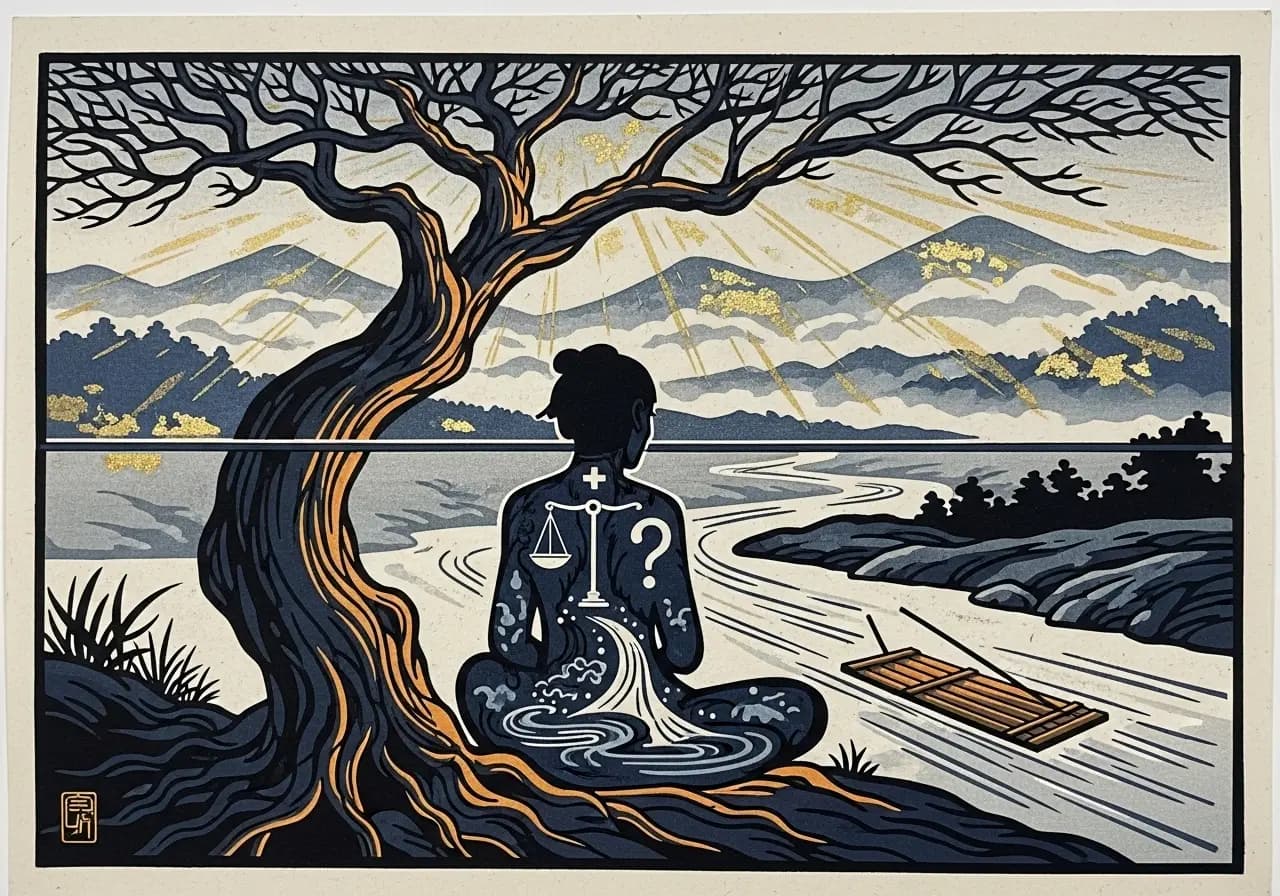
Is Buddhism a Religion?
Episode 25 of the Secular Buddhism Podcast
Hello. You are listening to the Secular Buddhism Podcast, and this is episode number 25. I'm your host, Noah Rasheta, and today I'm answering the question: Is Buddhism a religion?
Welcome
Welcome back to the Secular Buddhism Podcast. This is a weekly podcast that focuses on Buddhist concepts, topics, and teachings presented for a secular-minded audience. The Dalai Lama has said, "Do not try to use what you learn from Buddhism to be a Buddhist. Use it to be a better whatever you already are." Please keep that in mind as you listen to this episode.
If you enjoy the podcast, please share it with others, write a review, or give it a rating on iTunes. If you're in a position to help, I would encourage you to make a one-time donation or become a monthly contributor to the podcast by visiting SecularBuddhism.com.
Let's Jump In
Now, let's jump into this week's topic. As many of you may know, I travel around teaching workshops on how to develop more mindfulness, offering an introduction to Buddhism, and things along those lines. A question I get quite regularly is: Is Buddhism a religion? Because I'm asked this question so often, I thought I would dedicate a podcast episode to answering it, at least from my perspective.
This can be a tricky question. In the Western mindset, we typically ask questions and expect either a true or false answer, a yes or no, or a specific answer that works for everyone. With most things in life—especially regarding a spiritual path, or religion in general—I think part of our mistake is expecting things to be very clear: black or white, yes or no, right or wrong. We do that even with Buddhism. We're expecting the answer to be either yes or no with a reason behind it.
I think it's very fitting for the answer to this specific question to be: yes and no. It's yes, and it's no, and it's yes and no, and it's neither yes nor no. How's that for a Buddhist answer to the question "Is Buddhism a religion?"
Here's my thinking behind this answer. Of course, it's a religion. It's a religion practiced by over 300 million people in the world who consider themselves Buddhist and who practice Buddhism as a religion. But there are also many people—I don't know the exact numbers—who would say Buddhism is not a religion. I think this view is more prevalent in the West. We tend to see Buddhism more like a psychology.
The definition of psychology is the study of the mind and its functions, particularly those affecting behavior in a specific context. Buddhism fits very well—very nicely—with that definition of psychology.
Defining Religion
Now, the definition of religion depends on who's defining it. There are so many definitions, and every dictionary I've checked has a slightly different one. Let's look at a couple and see how Buddhism applies.
One definition is "the belief in and worship of a superhuman controlling power, especially a personal god or gods." This could be problematic in Buddhism because Buddhism is a non-theistic tradition. There isn't a deity at the head of everything, controlling it the way we would typically think in the West or in the Judeo-Christian mindset. We tend to picture a monotheistic god who is the creator, who has the power to control everything—an all-powerful, all-knowing deity.
Buddhism doesn't have that. There are some schools of Buddhism that incorporate cosmology with gods and realms and worlds, but these aren't part of the doctrine of Buddhism. Buddhism doesn't really have a doctrine or a set of esoteric facts that you need to believe in. In fact, it's the opposite. It's more like saying, "Let's study the way that you see and understand the world, because when you take a look at the way you see things, the way you see things changes." It's about studying the mind.
Rather than having something to believe in, it's saying that the things you believe in affect how you see the world. If we're comparing these two definitions, Buddhism is much more of a psychology than it is a religion.
If you look at the definition of religion as "a particular system of faith or worship," then you could start to say Buddhism could fit that. Buddhist rituals like meditation or, in some schools of Buddhism, chanting or reciting mantras, or lighting incense—practices like that—start to look like a system of faith and worship. It starts to look more like a religion.
I think part of the problem is that we typically observe Buddhist practices and rituals from a Western mindset. You see someone lighting incense and you think they must be worshiping the Buddha or something along those lines. We associate the ritual practices with what we understand as religious behavior, and that makes it seem more like a religion.
Again, I think from the Eastern mindset it's very different, and it's hard for us to know the Eastern mindset because we're not Eastern. We don't have an Eastern mindset. We grew up with a Western mindset that's much more conditioned by the Judeo-Christian understanding of religion.
Looking at Other Definitions
Another definition of religion includes "a set of beliefs concerning the cause, nature, and purpose of the universe, especially when considered as the creation of a superhuman agency or agencies, involving devotional and ritual observances and often containing a moral code governing the conduct of human affairs."
You can start to pick out parts of this definition where Buddhism might fit and other parts where it doesn't. For instance, take the purpose of the universe. In Western thinking—and I've mentioned this before—we tend to think that if something exists, there must be a reason for it, because if there wasn't a reason, it shouldn't exist. In Eastern thinking, it doesn't work that way. There doesn't need to be a reason for something to exist.
With a Buddhist mindset, it's not about the reason, it's about the cause. Buddhism teaches that all natural phenomena have causes and conditions. Everything that is exists because there are causes and conditions that allow it to exist.
From the Buddhist mindset, we're looking for the causes and conditions of things, and this applies to everything. A tree exists because the seed came from another tree. Internal experiences like anger exist because there are causes and conditions for that anger. You can explore and find the causes and conditions for all things. I think this mimics the scientific approach to life, where science is always looking for the causes of things. Buddhism does the same.
So here's another angle where it's like: in some ways, it's more like a science than a religion, or more like psychology than religion. So it gets kind of tricky.
The Yes and No Answer
That's why I think the most appropriate answer is yes and no. It is a religion, and it's not a religion, depending on who you're asking and how they practice it.
For me specifically, I practice Buddhism as a philosophical way of life. The advantage of this approach is that you can fuse it with religious ideas. I know people who practice Buddhism, meditation, and mindfulness while also holding Christian beliefs. Certain aspects of their life, they find meaning through their religious system, and other aspects—their contemplative practice—comes from an Eastern tradition like Buddhism. It can be a combination.
I like to think of Buddhism as a philosophical way of life.
Buddhism as a Medical Diagnosis
Here's the main reason why, for me personally, I tend to think Buddhism is much less of a religion than it is a psychological or philosophical practice. If you break down the core teachings of what the Buddha taught, you find that it mimics more of a medical diagnosis than any kind of religious or esoteric set of facts.
Typically, a religion presents an answer to the question: What is the meaning of all of this? You're then presented with some kind of story—whether that's the story of creation or the story of what happens after you die. There's some narrative that you can believe in, and you choose, based on your own observation, whether that be through reading scriptures or analyzing it and deciding if it resonates with you. Then it's up to you to decide whether to believe it.
Your belief in that story can evolve over time, but to be a Christian, you have to believe certain core stories. First, you have to believe you need to be saved, so you'd think, "Oh, I'm not saved, so I need to be saved." Then the parts of the story start to make sense. You need someone to come save you from your sins. And if you do that and are saved from your sins, then when you die, you don't have to go to hell. You get to go to heaven. All of it fits together, but it's all contingent on your belief in that set of esoteric facts and stories presented as facts. You have to believe those things. It can become problematic if you don't believe some of them, because the whole system starts to fall apart.
Buddhism, on the other hand, isn't presenting a set of facts. It's more like a medical process where you're trying to figure out: What is the problem? Here's the problem. It's a solvable problem. Here's what you need to do about it. Then once it's done and you're treated, it's over. Just like going to a doctor. The doctor diagnoses a problem, identifies the underlying causes or conditions, determines the prognosis, and issues a prescription. Then you leave, and presumably you don't have to come back because you've treated the problem.
To me, this is—and I don't want to be down on any religions because I think religion can be a beautiful thing when practiced the right way—but I think the biggest difference is that Buddhism says, "Here's what you need, and once you figure that out, you're done. You don't need Buddhism anymore in your life."
A religion won't do that. It tends to say the more you believe this, the more attached you become to it. Your whole hope of what to expect in the future—particularly in the afterlife—hinges on whether or not you believe the story you've been told.
Because Buddhism doesn't have that component, it's anchored in the present moment. It's not anchored in the reward or punishment you'll experience after this life. I think if Buddhism is a religion, it's very different from Judeo-Christian religions or Islam. That's one of the big differences.
The Four Noble Truths as Medical Framework
Let's look at that real quick. The Buddhist approach to the problem at hand—I want to show you how it parallels a medical framework. This is essentially what happens with Buddhism.
The problem that's diagnosed is that in life there is suffering. Life difficulties arise. It's not personal. It's universal. Everybody experiences it. Imagine you're going to see Dr. Buddha. This is essentially what you'd be told. You go to the doctor with this problem saying, "I'm not happy. Something's wrong in life. Life isn't the way I want it to be, and I'm suffering because of that." The very first thing the doctor's going to say is, "I need to diagnose the problem, and the problem is this: In life there is suffering." That's the First Noble Truth in Buddhism.
Now, the second part of the medical diagnosis is identifying the underlying causes. What the Buddha teaches is that attachment or clinging is the cause of suffering. It's wanting life to be other than it is, and because I want it to be other than it is, I'm going to experience suffering. That's the definition of suffering in Buddhism: wanting life to be other than it is.
If you look at this honestly, anytime you're experiencing suffering in your life, you'll find that it can be rooted in wanting it to be other than it is. This goes from big things like losing a loved one—the reason that's so painful is because you don't want to lose them; you want them to still be there—all the way down to smaller, more mundane things like being stuck at a red light. Why is that a problem? It's only a problem because you don't want to be stuck at the red light.
I always think about this scenario: You're driving somewhere, you just lost your job, and you have an interview for a new job. You're trying to get there early, and on the way, you get a flat tire. That's a problem. The only reason it's a problem is because you don't want the flat tire. You don't want to risk being late to your interview. Wanting life to be other than it is—that's suffering. The problem isn't the flat tire itself, because all you have to do is change the circumstances and the event doesn't matter.
Imagine a different scenario: You've been accused of something you didn't do, and now you're going to jail for it because they don't have evidence to prove your innocence. You're resisting. You do not want to go to jail. On your way there, the bus gets a flat tire. Now you're thinking, "I hope it takes them forever to fix this flat tire," because you don't want to go to jail. The event is the same. A tire went flat and has to be fixed. But suffering comes from wanting life to be other than it is.
Look at that in your own life anytime you're experiencing suffering and figure out: What is it that I want to be different? You'll find that's the root of your suffering.
Then the doctor needs to determine the prognosis. The prognosis is that this is a treatable condition. We can treat the cause of suffering. Here's the catch: We cannot eliminate suffering, because remember, the diagnosis of the problem—the First Noble Truth—is that in life there is suffering, and it's universal. The fact that you want to get rid of suffering is only going to create more suffering. Now you're suffering, you want life to be other than it is, and the way it is is that in life there is suffering.
What part of this is the treatable condition? We can treat the cause of suffering—the attachment or clinging. Remember, the underlying cause is what the Buddha taught: it's attachment or clinging that's causing suffering. That part is the treatable condition, and we treat it with non-attachment.
The prescription is that there needs to be a change in perspective. This sense of non-attachment comes through obtaining wisdom, and in Buddhism, this is the Fourth Noble Truth—the Noble Eightfold Path. There are eight areas in your life that you focus on, where you're shifting your perspective and gaining wisdom, and that helps to eliminate attachment.
Just discussing non-attachment by itself could be its own podcast with hundreds of episodes. I won't attempt to explain it fully here, but the key is non-attachment. I think that can be tricky for people to understand, because one misconception is that if you're going to be non-attached, then you're numb, you don't have any feelings, and you have to be okay with whatever is. That's not what non-attachment is.
The other thing that's dangerous about non-attachment is when you decide, "Okay, I'm done playing this game. I do not want to be attached anymore," you run the risk of becoming attached to non-attachment. Then you're back in the same spiral. The definition of suffering is wanting life to be other than it is, and you look at it and say, "Okay, then I don't want to experience attachment anymore. I don't want to have any kind of craving." Now you're wanting life to be other than it is, because in life you're going to crave things. It gets tricky, and that's essentially the entire situation Buddhism is trying to address.
The Buddhist Path vs. Religion
The key is non-attachment, but it's not just that easy. It's not dropping everything. At the same time, it is—it's letting go. If you want to learn all about that whole process, you study Buddhism. That's what Buddhism teaches you: that entire process summed up in four things.
We diagnose the problem: in life there is suffering. We identify the underlying causes: attachment and clinging, wanting life to be other than it is. We determine the prognosis: this is a treatable condition. We can treat the causes of suffering, but we cannot eliminate suffering. The key is non-attachment. That's the prescription—a change in perspective, wisdom, non-attachment, having a flexible attitude to adjust with life as it unfolds.
That's it. That's where it starts. It's very much like the process of going to visit a doctor.
Here's where I think it becomes very different from religion: If you take the prescription and you solve the problem, then you're done. You don't need Buddhism anymore. The Buddha taught this in his Parable of the Raft. He asks the monks, "If somebody's trying to cross the river and they build a raft, spending considerable time and effort to do so, they get on the raft and eventually cross. Now that they're on this side, is it appropriate for this person to continue the journey with the raft, or do they leave it behind?"
The monks deliberate and decide it's wise to leave it behind because you don't need it anymore. The Buddha tells them specifically, "This is how you are to view the teachings of the Dharma"—the teachings of Buddhism.
This is why my personal approach to Buddhism is to view it as a set of tools to develop mindfulness, to solve the problem. The problem is that in life there is suffering, and when you get past it, just as the Buddha taught, it's something you leave behind. You need to, because you don't want to become attached to non-attachment. You don't want to attach to Buddhism. You don't want to attach to anything. You can become attached to your religion in a way that becomes unhealthy. I'm sure everybody knows somebody who probably fits that picture.
With that information, I personally think Buddhism is more of a philosophical way of life. It provides me with a set of tools that determine how I live and how I see the world. Because of that, I don't view it as a religion, because I don't ascribe to a specific set of rituals or practices or anything that would even look like a religion in the way I teach and practice Buddhism.
The Answer
There you have it. That is my answer to the question: Is Buddhism a religion?
I would say yes it is, and no it's not, and yes and no it is, and it's neither yes nor no. That, my friends, is Buddhism for you. It's a very paradoxical approach to the situation at hand—the fact that in life there is suffering. You can practice it as a religion. You can adopt this as your religious practice, and at the same time, you don't have to. You can take these as tools and study the nature of the mind and how and why we think the way we think.
This concept of not knowing in Buddhism is very prevalent. It's in Zen Buddhism and every form of Buddhism I've explored. At its root is this concept of not knowing. Rather than trying to give you answers to the deep questions of life—like most religions—this is where it differs from religion. Religion is trying to answer the questions: Who am I? Why am I here? Where do I go when I die? These big existential questions are answered by religions.
Buddhism doesn't answer those questions. Buddhism isn't concerned with answering them. Buddhism is focused on exploring: Why do I feel I need to know these answers? That's what Buddhism is trying to get at. What is the root of the motivation behind asking these questions in the first place? If you can get at that, then the answers shouldn't matter. The answers won't matter.
If I understand myself, if I know why those questions even matter, it doesn't become about the answers. It becomes about the questions. Because Buddhism is about the questions and not about the answers, I don't think it really fits the traditional bill of a religion—especially religions that are just trying to answer the questions.
A Final Thought
That's a lot. Having said that, if you have more questions about this or you want to contribute to the conversation, I hope this doesn't ruffle anyone's feathers. The people who say the answer is yes get upset with the people who say the answer is no. The people who say no get upset with the people who say it's yes. Just to throw another mix in there, let's add the people who say yes and no, and let's add the people who say, "No, it's not even yes or no." Because let's just all be in there and talk about this together.
If you want to add to the conversation, find the post where I put this on SecularBuddhism.com and join in the conversation.
I hope my answer makes enough sense that you can feel you can choose the answer that makes the most sense to you. Because ultimately, it doesn't matter what I think. If you ask me "Is Buddhism a religion?" well, that's just my answer. The only answer that will ever really answer your question is your answer. You get to choose. You get to study this and decide: Is it a religion for you? Is it not? Is it yes and no? You get to choose.
Good luck on your journey finding the answer that makes the most sense to you. I know a lot of people who love practicing Buddhism as their preferred religious practice and practice it as a religion, and there's nothing wrong with that. Find the answer that works for you. What I've shared today is my view and my answer.
Announcements
Before we wrap up this episode, I want to remind you about the workshops I'm doing. I did one in Salt Lake City last weekend, and it was very well received. I have one coming up very soon in Seattle. If you're in the Seattle area, September 3rd is the date. There's one in London in the UK on September 18th—that's a Sunday. You can get all this information on SecularBuddhism.com.
I also want to remind you that next year, January 26th through February 4th, we're doing a humanitarian trip to Uganda. We'll be doing humanitarian work along with a mindfulness retreat. If you're in a position to do that and it sounds interesting to you, consider coming with me and a small group of people to Uganda to do humanitarian work and learn more about mindfulness. It'll be a lot of fun. You can learn more about that on MindfulHumanitarian.org.
Closing
Thank you for listening. I've mentioned this before, but I really believe that if we have the desire to contribute to making society or the world a better place—a more peaceful place—it starts by making our own lives more peaceful. We work on ourselves. We always have these grand desires to change the world, and yet the only thing we can ever change is ourselves. It's by changing ourselves that we do, ironically, change the world.
That's why I'm determined to produce podcast content, workshops, retreats, and tools that will help us to be more mindful. Mindful individuals are the key to mindful families and mindful societies. That's why I do what I do, because I enjoy it. There's nothing to convert to or convert away from. I'm just trying to present another perspective.
If you're in a position to contribute, your generous donations allow me to continue producing weekly content for the Secular Buddhism Podcast, along with workshops, content for retreats and seminars. If you're interested and in a position to help, please visit SecularBuddhism.com to make a one-time donation or sign up as a monthly supporter of the podcast.
Thank you again for listening, and thank you for your continued support. I look forward to another podcast episode next week. Have a good week, and until next time.
For more about the Secular Buddhism Podcast and Noah Rasheta's work, visit SecularBuddhism.com