

The Journey Is The Goal
Episode 24 of the Secular Buddhism Podcast
Hello, you are listening to the Secular Buddhism Podcast. This is episode number 24. I'm your host, Noah Rasheta, and today I'm talking about how the journey is the goal.
Welcome
Welcome back to the Secular Buddhism Podcast. This is a weekly podcast that focuses on Buddhist concepts, topics, and teachings presented for a secular-minded audience. The Dalai Lama has said, "Do not try to use what you learn from Buddhism to be a Buddhist. Use it to be a better whatever you already are." So please keep that in mind as you listen to this episode.
If you enjoy this podcast, please share it with others, write a review, or give it a rating on iTunes. And if you're in a position to be able to help, I would greatly appreciate you making a one-time donation or becoming a monthly contributor to the podcast. You can do that by visiting SecularBuddhism.com.
Now let's jump into this week's topic.
The Train Journey
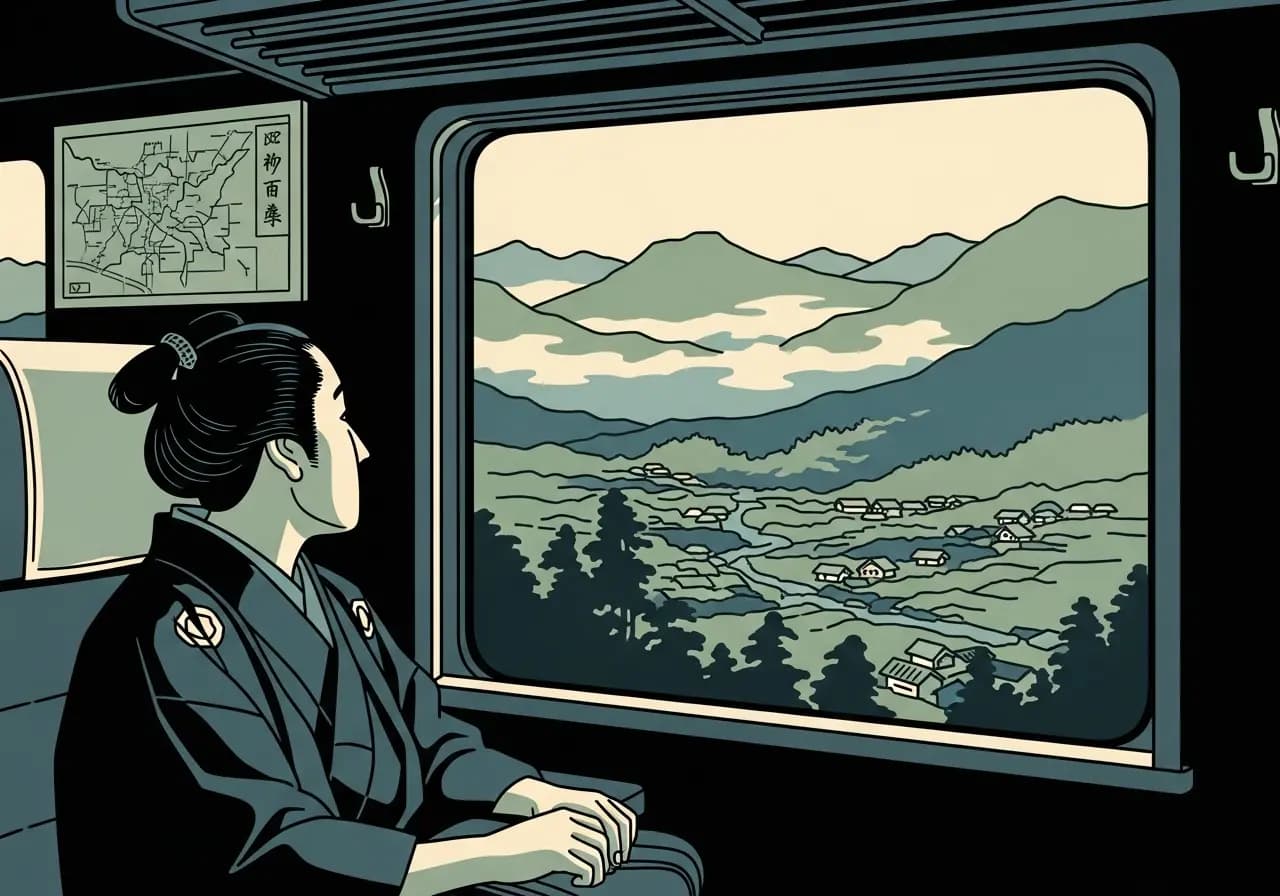
I want you to imagine for a minute your favorite destination—maybe somewhere you've wanted to visit but haven't yet. Perhaps it's Europe or Asia, or some exotic location. Picture it in your mind. Imagine you finally get to go there, you land at the airport, and the first thing you need to do is jump on a train to get to wherever you're going—maybe your hotel or something.
Imagine you're sitting on the train and it gets going. You're looking down at the map, or looking up at the map. Some trains have them posted on the wall. You're paying attention to the various stops along the way, focused on the stop where you need to get off. As you pay attention to each of these stops, with every stop you look out and see what's there—maybe it's snacks or souvenirs or different vendors at different stops. And if you've ever been on a train, sometimes they come up to the windows and try to sell you stuff. At least where I grew up in Mexico, that was common on the train.
But the point of this exercise is to imagine that you've been focused on each of these stops, and you finally arrive at your destination, and it occurs to you that you hadn't paid attention throughout the journey. You hadn't looked out the window and simply enjoyed the view. Imagine how sad it would be at that point to realize that you missed the journey because you were so focused on the various destinations and stops along the way.
And that's kind of what we end up doing in life. Life is a journey and it just goes and goes and goes. We divide it into milestones. You know—when I graduate from school, that's a milestone. When I get married. When I land the job I've wanted. When I start my own business. When I have kids. When I finally get divorced. Whatever these stops are that we create, these milestones on the journey of life.
Often times, by the time you reach the end, what you'll find is that you've missed enjoying the journey as it unfolded because we get so focused on the stops that we don't pay attention and simply enjoy the view all along the way.
That's kind of what I wanted to talk about in this week's podcast episode. The idea is that the journey is the goal.
The Problem with End Goals
In previous podcasts, I've talked about how our tendency is to take a very utilitarian approach to the things in life. I go to school because I'm trying to get a degree. I'm trying to get a degree because I want to have a better job. I want to have a better job because the job pays better money. If I have more money, I get to go on vacation and have better memories. And this process becomes a cycle and it goes on and on and on.
The problem with it is that we end up replacing the journey with the goal. Let me start with the first one. Imagine the idea of school. What if the goal was to simply learn? If my goal was to obtain knowledge and to learn something, I would go to school. That was the original intent of it. I go to school because I want to learn. The degree that you get at the end—what if that was treated as, well, that just happens? That just happens to be what I get at the end.
Some people do this, but I would say the vast majority of people have a tendency to get caught up in the stations of the train journey. We get caught up in the expression that "the ends justify the means." What if the goal was to obtain knowledge versus the goal is to get a degree? Because you can get a degree and maybe not really have learned anything in the process.
See, when the goal is the degree, what does it take to get the degree? Then all of the means can justify the ends. Whether that be—I'm going to cheat on my test, or I'm going to do the bare minimum and get C's. You can do all that and it's justified because the goal was the degree. The goal was not to obtain knowledge. Whereas if the goal was to obtain knowledge, you're going to pay attention in your classes. You're going to take better notes. You're going to try and read and study things because the goal was knowledge. And the result happens to be the degree.
Can you see the difference? That's just taking one concept—going to school with the goal of gaining knowledge. Well, imagine if we apply that to all of the areas in life and we do things to do them, rather than something else.
See, this is where it gets tricky. If you take a certain part of your life, look at it, and try to understand: Do I do this for the sake of doing it? Or is there an end goal that becomes the reward, so to speak?
What you'll find is, if you get caught up in the idea of always looking for that next station, looking for that next something, we're really not that different than the hamster stuck in the hamster wheel that's running. You can stay on the hamster wheel for as long as you want. And my goal isn't to tell you, "Hey, you need to get off the hamster wheel." No, you're free to stay on the hamster wheel. My goal isn't to change you or teach you or do anything like that. I'm simply trying to bring a new perspective into the way that we experience the journey of life.
A New Perspective
This is the perspective that Buddhist philosophical concepts bring to the table. It's saying, "Hey, you're running and it's hot and you're sweating and you're miserable. You can keep doing that if you want. There's no reason not to. Or you can realize, 'Hey, you're never going to get what you're after, so calm down.'"
And that's tricky because some people will hear that and think, "What do you mean I'll never get what I'm after? Of course I will. I'm going to keep working hard. You watch me."
They go and they finally land the job they wanted. "See, I got it!"
Well, yeah, you got what you thought you wanted. But are you done? Are you content?
No. Now I need to get my promotion. Or I need... There's always something that we're seeking. That's the concept of the hamster wheel. You're always seeking something. Just like on the train, you're always waiting for the next stop. You think, "When I finally get to that stop, then I'm going to be happy. Or then I'm going to..." And you get there and maybe you experience that contentment. Maybe it lasts a little bit. And then, guess what? You're waiting for the next stop. There's something else.
We all experience this. We all have stops coming up that we're looking forward to. Ask yourself, "What are those stops? I'm on the train ride. What are those stops I'm looking forward to that are coming up?" We all have them. Some we may reach and some we may not. But we have those stops.
Now imagine what some of yours are. And then ask yourself, "How would this journey be different—this experience—if I was doing things just for the sake of doing them? If I understood that the journey is the goal, not the destination? The destination isn't the goal. The journey is the goal."
The Reward Problem
Like I mentioned before, if the goal was to obtain knowledge, then the experience of going to school would be very different than if the goal was to obtain the degree. In our society, we've kind of been conditioned to have end goals that we aspire to. And I think a really common one, at least in our society, is the idea of reward. Maybe it's reward in the afterlife—the idea that if I do good now, I may be rewarded for it in the future.
Now compare that to what I talked about with going to school to obtain knowledge versus going to school to obtain a degree. If you believe in reward or punishment in the afterlife, imagine this: What if the purpose of being alive, my goal, is to be kind for the sake of being kind, without any attachment to aspiring for reward or out of fear for punishment?
Imagine the difference in those two scenarios. Doing something just to do it versus doing something for whatever we think the goal is at the end of it all. It's a very different thing. Just like going to school for knowledge versus going to school for a degree.
My Own Hamster Wheel
The reason I came up with this topic this week is that about 15 days passed since the last podcast episode. In the middle of these last 15 days, I had to move my office and my warehouse to a new location. I've had a lot going on that's kept me busy, and I've had three or four ideas for a podcast episode. But I just barely found myself—for the first time since I started the podcast—trying to plan it. "This is what I have to talk about. This is what I expect to happen when I talk about it. This is what I hope people get out of it."
And I realized, "Oh no, that's not the mindful approach."
It took me several days to realize this. I was on my own hamster wheel, trying to find what the milestone was I was trying to get at. And I realized: there is no milestone. The whole reason I started this podcast is because I enjoy talking about these topics. It's not because I'm trying to change people. I'm not trying to convert anyone to the Buddhist philosophical way of life.
There is no end goal. I am sharing this the same way you would hear a bird that happens to be singing. There is no goal. The bird isn't trying to entertain anyone. It just does what it does. If you happen to enjoy it, good. And that's the approach I want to take with this podcast.
Rather than trying to plan it and have expectations of what I think will come of it, I want to share the wisdom that I've learned through studying Buddhism because I honestly enjoy talking about it. And if you happen to enjoy it and get something out of it, that's great. But I hope it never comes across that I'm trying to convince anyone of anything, because I'm not.
Like the quote I mentioned in every podcast: "Do not try to use what you learn from Buddhism to be a Buddhist. Use it to be better whatever you already are," because everybody is already something.
So that's just a quick side note. Throughout the week, I've been thinking I'm caught up in this myself, trying to make something of this when the reality is I want to share what I enjoy talking about—Buddhist concepts. I'm fascinated by Eastern philosophy and Buddhism specifically. So I wanted to kind of share that with you.
Love as the Perfect Example
Taking this concept of understanding that the journey is the goal, imagine the idea of love. When you love someone, you love naturally. We don't love because we're compelled to love. If you love your parents or your siblings or your children, you love them because you love them. If you don't love them, it's not because you're supposed to love them. You don't love them because you're being commanded or compelled to love them. It just happens naturally.
So this is a perfect example of something that's done just for the sake of it being done. I've thought about this a lot, and I've wondered: What would it be like to feel compelled to love someone? You're commanded to love someone, okay? I would never be able to get at an authentic or genuine love in that relationship because it would always feel like, "Well, am I loving them because I'm supposed to love them? Or am I loving them because I'm compelled to love them? Or because it just happens naturally?" You would never know.
And that's why love is one of those things that cannot be compelled.
Enlightenment in Ordinary Action
In several Buddhist traditions, and in Zen especially, there are stories of encountering someone and realizing, "Oh, they're enlightened."
"Well, how did you know they were enlightened?"
Because whatever they were doing, they were just doing it. When they were sitting, they were just sitting. When they were walking, they were walking. When they were doing the dishes, they were doing the dishes. And it can be baffling because you're like, "Well, okay, everyone does that."
But the thing is, we don't. We don't do things just to do them.
I had this problem for a long time. I really despised washing dishes. When I would do the dishes, the goal was to get done as quickly as possible because I didn't want to do the dishes. And I think this is applicable in many areas of life. We do things with a utilitarian mindset. I'm doing the dishes so that they're clean so I can eat another bowl of cereal. Or I go to work because I'm trying to make more money, or whatever it is.
What would it be like to do it just because that's what you're doing? I practiced this, and I've developed a habit of doing the dishes just to do the dishes. Rather than rushing through it to hurry and be done—not that I'm slowing down either—I'm just doing the dishes. I'm trying to focus on the simple act of doing the dishes.
And I practice this with people too. If you're talking to someone, talk to someone. Don't talk to someone and be thinking, "Oh, I just heard my phone vibrate. I must have a Facebook notification or a text or whatever it is." That's really common, I'm sure you've experienced this, especially in our day and age. Trying to communicate with someone who isn't really communicating—they're multitasking. And it can be very frustrating. And yet our tendency is to do this with a lot of things.
When we drive, there's a utilitarian purpose. I'm in my car, but really I'm trying to get home. What if I drove just to drive? I mean, I have to drive to get home. There's no way around that. But what if while I'm driving, I enjoyed driving just for the sake of driving?
Sure, there's an end goal, but what if I could learn to enjoy the journey? When the red light shows up and I stop, rather than thinking, "This is slowing me down. This is a bad thing," I just pause and look around and think, "What can I notice here that I've never noticed here before?"
It's a really fun exercise. Because I have a new path—I told you I have a new warehouse—my new path home has made it easy the last couple of weeks to focus on this. At each red light, I'll pause and look around and say, "What have I never noticed here?"
And I'll see a little store on that corner. "Oh, I never saw that store."
Or I'll be looking for new things—new things that I may not have been aware of before. And I think it's a way to practice pausing. It's a way to try to practice getting away from the mindset of whatever the end goal is I'm trying to reach. What if I try to enjoy just the process? It's practicing the journey as the goal.
An Invitation to Practice
So I would invite you to practice that this week. Whatever it is that you're doing—if you're sitting, if you're walking, if you're talking, if you're doing the dishes, walking the dog, driving your car—whatever it is, try to catch yourself and recognize the difference in that experience when you're doing it for the sake of doing it versus when you're doing it to reach your goal.
Whatever your goal is, try to focus on that this week and see if you notice a difference.
The Hamster Wheels
The crazy thing about the hamster wheel—I call this the hamster wheel of materialism. We're always after something. I'm working hard to get a raise. I'm trying to get a raise so that I can buy a boat. I'm trying to get the boat so I can... whatever. It's a cycle and it goes on and on and on.
And if you can jump off the wheel of materialism, typically the mistake is that we jump onto the wheel of spirituality, thinking, "Okay, now that I'm not caught up in that materialism stuff, I'm going to be very spiritual."
And now you're on the hamster wheel of spirituality. "When I can finally learn to meditate, then I'll be happy. If I can finally..." And this goes on and on and on, and now you're on another hamster wheel. And I would say the hamster wheel of spirituality is more dangerous than the hamster wheel of materialism.
So don't make that mistake. The spiritual journey, like any other journey, is also to be enjoyed with the journey itself as the goal.
Meditation Without a Goal
When you sit to meditate, if you practice meditation, do it without an end goal. Instead of sitting and thinking, "My goal with meditation is so that I can finally be peaceful," what if the goal of meditation is to simply observe? I'm sitting here and I'm observing my thoughts. There is no goal. That's actually the objective of mindfulness meditation—to learn to observe. We're really bad at observing.
We tend to want to be analyzing and making meaning of things. So we practice sitting and observing, and there is no end goal. There's no, "If I do this right, this will happen." There's none of that. What you're doing is you're sitting there and you're watching. Just like you would sit on the porch of your house, at the front door, and watch cars go by. There's no goal. You don't sit there and think, "I'm gonna sit here and watch until this or that happens," because you're never going to know what happens. You sit there and watch with non-judgment.
And if you ever try this with your thoughts, it's an incredible experience. To sit and watch and to observe the thoughts in a non-judgmental, neutral way.
And in this process, you're going to get it. You're going to get the greatest thing you'll ever get: that there's nothing to get. And that happens by observing. And when you actually get that—that there's nothing to get—that's awakening. That's enlightenment, in my opinion. That's the concept of letting go because you're letting go.
What is it you're letting go of? Of thinking that there was something to reach. There's nothing to reach. And if you think there is something to reach, you're on the hamster wheel. But the moment you step off and understand there's nothing to get, now you just start to enjoy the journey. The journey becomes the goal.
It's the most beautiful experience because then every part of it is enjoyable because it's part of the journey. There is no goal.
The Treasure in Contentment
There's a Tibetan saying: "If we know how to be content, it's like holding a treasure in the palm of our hands." And this is ultimately what I'm alluding to in this topic—understanding that the journey is the goal. There's a significant amount of contentment that can be experienced when we let go of whatever our goal, our destination is, the stops on the train on the journey of life.
I'm not saying don't have goals. Don't have aspirations. Don't try to get a career. Don't want a raise. I'm not saying that. I think it's perfectly acceptable and natural and normal to have goals. In fact, if you don't have goals, it's very difficult to progress in career or to progress in other things.
All I'm saying is this: there's a quote that I think does a good job of explaining this. It says, "Detachment is not that you should own nothing, but that nothing should own you."
Taking that and applying it to this topic about the journey being the goal: I'm not saying to detach from the aspirations of these milestones that are coming up. It's that don't let those own you. Don't let those blind you from what's happening in the present moment because you're continually looking forward to what's happening in a future moment. That's what I'm trying to get at in this topic.
Final Thoughts
As I mentioned before, there's really no goal with this. It's just a thought experiment. Give this a try this week and try to do things for the sake of doing them. Try to focus and understand that the journey is the goal, and see how that works for you. I'd love to hear what you think about that and what it feels like to really practice that.
A good time to do that is when you're driving. We're always driving for a purpose—to get somewhere or to get away from somewhere. Driving is a very utilitarian experience. But what if we learn to experience the journey while we're driving? I mean, that's a literal journey. What if you could actually focus on enjoying the drive while you're driving? Take in everything that's happening around you and don't feel rushed to get to wherever you're trying to go.
Just enjoy the drive. So this week, try to enjoy the drive. Let me know how that goes.
Announcements
As a quick reminder, we have a study group on Facebook. If you go to Facebook, you can find a group called "Secular Buddhism." There's a Secular Buddhism Facebook page that has about 30,000 fans on there—that's how you know that's the page. And then there's a group that has about 500 members, and we post topics there. That's a good place for you to come on and comment about what you're listening to or trying or experimenting with on the podcast.
So go on there and find the Secular Buddhism Facebook group if you want to be a part of that.
As a quick reminder, I am hosting a Mindfulness Humanitarian Aid trip to Uganda, January 26th through February 4th. We have a few open spots for that still. You can get more information about that by visiting MindfulHumanitarian.org.
And then there are one-day developing mindfulness workshops. The purpose of these workshops is to give an introduction to Secular Buddhism and learn to develop mindfulness as a daily practice. I'm doing one in Salt Lake City on August 20th—that's coming up. One in Seattle on September 3rd, and one in London, in the UK on Sunday, September 18th. You can find information on all of this on SecularBuddhism.com under Events.
Gratitude and Closing
That's all I have for this week. Thank you for taking the time to listen to this podcast. I've received a lot of emails from people who listen to the podcast, thanking me for the topics that I talk about. And I do this because I enjoy it. I've asked for support from anyone who's in a position to be able to make a donation or become a recurring donor to the podcast.
And that is what allows me to do this more. If I had the support to do this full-time, I would. I just don't. And I believe that the key to making society or the world a better place is just by making ourselves better people. I'm not out to try and change the world. I'm out to try and change myself, and I'm the only person who can change me. Nobody else can change you. You're the only one who can change you.
And that's why I do this podcast. These are topics that I enjoy talking about, and I'm determined to continue producing content and creating tools that will help us to be more mindful. Because mindful individuals typically create mindful families, and mindful families make up mindful societies. The irony is that by focusing on changing just me, I'm contributing to changing the world. But my goal isn't to change the world—because the journey is the goal.
I just want to enjoy the journey. But your generous donations allow me to continue to produce weekly content for this podcast, along with content for the workshops, retreats, and seminars. And I do plan on eventually making this available as an online course.
So, if you have any questions, please feel free to reach out to me. You can go to SecularBuddhism.com and that's an easy way to contact me. Find me on Facebook. I've become Facebook friends with a lot of you who listen to the podcast.
And I really enjoy this, and I'm trying to figure out where all this goes and where we take this from here. So I support your feedback and your friendship. Thank you very much, and I look forward to recording another one next week.
So until next time.
For more about the Secular Buddhism Podcast and Noah Rasheta's work, visit SecularBuddhism.com