

Dealing With Difficult Emotions
Episode 22 of the Secular Buddhism Podcast
Hello. You are listening to the Secular Buddhism podcast, and this is episode number 22. I'm your host, Noah Rasheta, and today I'm talking about understanding difficult emotions. So let's get started.
Welcome
Welcome back to the Secular Buddhism podcast—a weekly podcast that focuses on Buddhist concepts, topics, and teachings presented for a secular-minded audience. The Dalai Lama has said, "Do not try to use what you learn from Buddhism to be a Buddhist. Use it to be a better whatever you already are." Please keep that in mind as you listen to this episode.
If you enjoy this podcast, please share it with others, write a review, or give it a rating on iTunes. And if you're in a position to help, I would encourage you to make a one-time donation or become a monthly contributor to the podcast by visiting SecularBuddhism.com.
Now let's jump into this week's topic.
The Beginning of the Conversation
A few weeks ago, I was attending a workshop in Phoenix, Arizona where I was one of the presenters. We were discussing several different topics, including the topic of going through transitions or changes in life. One of the individuals—a gentleman who was there in the audience—was visibly aggravated or angry about the circumstances he was going through in his life. He was attending this workshop looking for some solace or peace with reconciling the changes and transitions he was experiencing.
But what I found interesting is that at one point in the conversation, towards the end, he brought up the idea that he was angry. He said something to the effect of, "Look, I know that the point is that I need to get over being angry. And I need to be more mindful and have more peace in my life. That's kind of what secular Buddhism promotes—this idea of living a more peaceful or compassionate life. But I'm just angry. I'm upset. And I want to be angry. And I don't want to not be angry right now."
I thought it was an interesting segue in the discussion. Because one of the things I had been talking about in my presentation was the nature of learning to accept things, and I felt like he was misunderstanding the whole premise of what Buddhism teaches. It's not that you need to be peaceful and avoid being angry. It's that you need to be with what is. So I paused and said, "Wait a second. We're not talking about getting rid of your anger. The problem isn't that you're angry. The problem is that you think you're not supposed to be angry. So you're angry about being angry."
That was an interesting moment, because giving the freedom to allow this person to be exactly as he was—if you're experiencing anger, just experience anger. Be with the anger. We're not trying to eliminate it. We're trying to be with it. After explaining this concept, I noticed an almost instant reduction in his anger. Just because now he was free to be angry, and that alone was enough to start minimizing the anger he was experiencing.
This is kind of what I wanted to talk about in this podcast episode: How do we deal with difficult emotions? We all go through difficult emotions. And we add to the complexity of the emotion when we try to get rid of it. This is applicable with any emotion.
Understanding Emotions
The standard emotions we go through are emotions like anger, disgust, happiness, and sadness. There's a wonderful film that came out last year called Inside Out—an animated cartoon that does a wonderful job of presenting how emotions work in the mind.
The emotions that we go through are all natural. When the causes and conditions are right, happiness is there. And when the conditions are right for anger to appear, anger is there. They're just natural emotions. And one of the mistakes that we make, I think, is that we have the tendency to believe there are certain emotions we need to avoid or eliminate, and there are certain emotions that are more enjoyable—like happiness or joy—that we want to experience more of. So we become trapped.
This is called the happiness trap. We become trapped by the idea that there are certain things we can do that will guarantee we're always happy, and there are certain things we can avoid that will guarantee we'll never have to experience anger or sadness. And it's just not true. The reality is, these are emotions that we experience. They're completely natural. And they appear and then they disappear like all impermanent things. It's a natural state of being.
When the causes and conditions are right, emotions appear. When the causes and conditions are not right, they are not there. We're always experiencing one or another of these emotions—or multiples of them.
Think about times when you have experienced happiness. If you were able to pause, you would be able to look at what causes or conditions are allowing this happiness to exist. And it can be several factors. These are really complex emotions. It's hard to pin it on just one thing, although we often make the mistake of pinning it on one thing, thinking, "That is the reason I'm happy."
And you'll notice this in the overall happiness trap. We're always chasing after things like money or power or fame—things we think are the source of happiness. When in reality, they're not. But it's the same with difficult emotions like anger. Think about the last time you were angry. Were you able to pause and really pinpoint exactly what was causing your anger? Because I think we make the mistake of usually pinning it on one thing.
Beyond Simple Cause and Effect
Viktor Frankl talks about stimulus and reaction. When there's a stimulus, that leads to a reaction. Well, when we think about it this way, I think we make the mistake of thinking it's simple: Somebody cuts me off on the road. Reaction: I'm now angry. And it seems that simple. Somebody cut me off and now I'm angry. But the reality is, it's never that simple.
If you could pause in that very moment of being cut off and really look at it, what is it that you're really mad at? If you were to dig deep there, you'll find that for most of us, it gets really complex really quickly. It has to do with ultimately thinking, "I'm mad because I feel like someone's taking advantage of me," or "somebody is overstepping their bounds and imposing what they want on everyone else," or "this person is a jerk, and jerks shouldn't be able to get away with stuff."
The anger is attached to something—generally one step removed from whatever the actual action was. The action was just that you got cut off. But because there's a story attached to it, then the emotion can arise. And there can be anger.
You know, it would be funny if you were cut off by a person in a car versus if a tree fell in the road and you had to swerve to avoid it. It could be the exact same time delay or the exact amount of swerving in both instances. And yet one doesn't leave you angry, while the other scenario does. Because there's so much more attached to the scenario of the person driving than there is to just a tree falling.
But if you think about just the reality of what happened—the reality is really no different. I think that's kind of interesting, just to be able to observe that and to notice that.
A Personal Story
So where I'm trying to go with this topic on dealing with difficult emotions—this is something I was interested in this week because I'm experiencing and going through my own difficult emotions right now.
On Thursday of this week, I went camping with my family. Where we live, if you just go up into the mountains about thirty minutes, you're quite removed from civilization. There's no cell phone service or signal, and it becomes very remote very quickly up there.
We packed everything up into my truck, loaded the three kids and my wife and I, and headed up the mountain. We found a nice little camping spot that was next to the river. I really enjoy the sound of the river. I've always, since I started studying Buddhism, really come to appreciate rivers and the sound of rivers, and how the river is symbolic to life—it's just constantly flowing.
So I'm sitting at the river, starting to contemplate the sound of the river and thinking, "Is there a river? There is no river. There's just the continual flowing of water." And I'm starting to think really deep and just enjoying the moment. Meanwhile, my kids are running around, playing, laughing, and just enjoying the whole moment up there.
I thought, "How interesting to be up here, completely disconnected from my normal hyper-connected world—the internet, Facebook, and so many things. Whatever is happening in the world, I'm completely oblivious to it. I'm only here, enjoying this specific moment. Enjoying the sound of the river. Enjoying the sound of my kids laughing and playing."
I held that thought in my mind: whatever is happening out there, I just don't know. And it's not that I don't care. I just don't know. I have no way of knowing. That was Thursday night.
Friday morning, I woke up and had to go down and pick up my camera—I was filming a project up in the mountains, which is why we went camping in the first place. As soon as I was back down in the valley and had cell phone service, my phone connected. And all of a sudden, I got the news flash of what had happened Thursday night: the police shootings in Dallas.
It was incredible to come back from a disconnected world the very next morning into a world where suddenly I was flooded with emotion again. And dealing with difficult emotions. Because I was upset. I'm from Dallas. I have a twin brother who's a police officer. And it hits close to home when you hear a story like that. So I was sad, mostly. Thinking, "That's so unfortunate. The things that are happening in the world." And I was reflecting on how only a matter of hours prior to all this, I was completely oblivious. I had no idea what was going on.
Then I started to think, "What about all the things that I'm still oblivious to?" There may have been other instances similar to this where there were injustices or murders or any form of injustice taking place in the world. And I'm oblivious to them. Whatever's happening in a certain town in India, or what happened on the road in some town in China—whatever it is that happened there, I'm oblivious to it and have no idea what's happening. So I don't feel any difficult emotions around it. Yet the things I am aware of, I feel emotions.
The Business Crisis
To add to the complexity in my story, I had checked my email Friday morning. There was a pretty large and significant business deal in the works to sell off my company. But I had the email that the whole deal had just collapsed and fallen through. After months and months of negotiations, my partners—who were going to buy my part of the company—had backed out of the whole deal.
Beyond that, they weren't interested in continuing with the original financing agreement for the structure of the company. One email, within moments, put me in a very critical financial position with the survival of my own company. It was very stressful to suddenly be experiencing the difficult emotions of wondering whether or not my company is going to survive.
In the middle of all this, I had picked up the camera and headed back up to the campsite. As soon as I got out of my truck with all these thoughts about all the things I had just found out that morning, there's the sound of the river. And it's just there flowing. Once again, I'm disconnected from everything. But this time I know what's happened. And I'm dealing with the difficult emotions.
From my studies and my understanding of the nature of how emotions are impermanent, it was fascinating to be up there and to think, "I'm observing myself going through the emotion of feeling stressed, or feeling anxiety." Now suddenly I'm thinking, "I don't know if my company is going to survive. I don't know if I'm going to have a job in the next few weeks. I don't know..." All these unknowns. And all this uncertainty coupled with this horrible news of the tragedy, already building on the back of the news of the prior tragedies the week before. And suddenly you're just immersed in emotion.
And I was thinking, "What is the training for how we deal with difficult emotions?"
The Thinking Mind Versus the Observing Mind
Well, the first thing is understanding that "I am not my emotions." And this is a concept I like to describe as "the thinking mind versus the observing mind." Because it's one thing to think, "I am angry," and another thing to observe, "I am experiencing anger." In acceptance and commitment therapy, this concept is called diffusion.
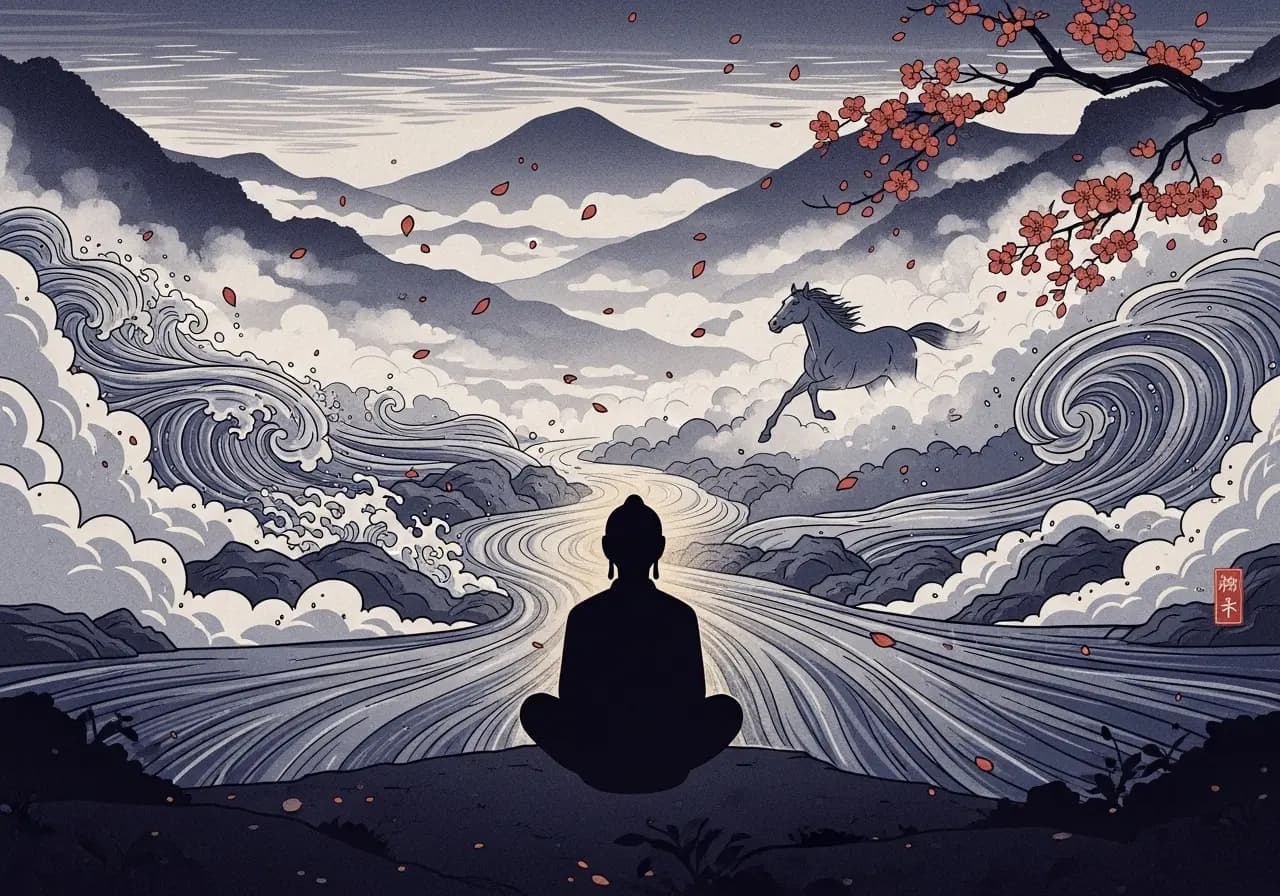
There's a story I've told before that illustrates this really well. There's a man standing in a field, and he sees another man on a horse, galloping at full speed toward him. As the horse gets closer, the man yells out, "Hey, where are you going?" And the guy on the horse just says, "I don't know. Ask the horse,"—as the horse sprints by and keeps on going.
I love this visual. I can imagine what that would be like, to be on the horse with no control of what it's doing. It's running, and you're on it, and you don't know where it's going. And yet this is exactly how many of us spend significant portions of our life—on the emotional horse. The horse of emotions just takes us. And no matter how analytical or capable we think we are, when we're on that horse and it's galloping, there's not much we can do.
That's the difference. The thinking mind is one with the horse, and it's just going. Then the observing mind can recognize, "Oh, I'm separate from this horse. I'm on the horse, so I can't separate from it completely, but we're not the same thing. The emotions or the horse is not the same thing as me, the rider." And you create this gap. It's the thinking mind versus the observing mind.
My twin brother—who I mentioned earlier—one day brought this up. We had been talking about this idea of the thinking mind and observing mind. He mentioned how he was in traffic and somebody cut him off. He noticed he was experiencing anger. For that moment, he paused and asked himself, "When I'm able to think about the observing part of me observing the fact that I'm angry, is the part of me that can observe that I'm angry also angry?" He said, "It wasn't. Because that part of me is neutral."
It's like the rider on the horse looking at the horse saying, "Wow, this horse is going crazy." And then suddenly realizing, "Oh, I'm not the horse. That's the horse that's angry." That's the difference between the thinking mind and the observing mind.
The Problem Is Not the Problem
The problem with emotions like anger isn't the emotion. It's never the emotion. Because, like I've mentioned before, the emotion is completely natural. So being angry isn't the problem. I like a quote from Captain Jack Sparrow. He says, "The problem isn't the problem. The problem is your attitude about the problem."
And this is exactly what I'm referring to in how we deal with our difficult emotions. The problem isn't the emotion. The problem is how we deal with the emotion.
Understanding Fusion and Non-Attachment
So imagine this concept of diffusion from acceptance and commitment therapy—it's really what we call non-attachment in Buddhism. The idea is this: when you take two things and fuse them together, usually through a tremendous amount of heat or pressure, something can take two objects and fuse them. Once those objects are fused, they seem like they're one. And that's what happens with ourselves. The sense of self that I have in relation to the things that make me who I am—including my emotions—I fuse with my emotions and then I think I am my emotion.
And what's interesting with this in English, for example, we say, "I am angry." And that's no different than saying, "I am Noah"—my name—or "I am..." whatever I am. In the language itself, it's already fused.
In other languages, like Spanish, you can't say, "I am angry," because that wouldn't make sense. In Spanish, we have two verbs: the verb "to be" (ser) and the verb that describes "how I am" (estar). So when you're talking about something like your emotions, you use the verb that describes the state in which you are, not who you are or what you are.
In English, it doesn't make sense because we only have one way to say that: "I am angry." But if you were speaking in Spanish, the closest translation would be something like, "Anger is how I am," or "Anger is what I'm experiencing."
And that's the idea of diffusion. It's understanding, "There's anger. And that's what I'm experiencing. But it's not me. I'm not angry because it's not something I can be. But it is something I can experience." Just understanding that difference in the language may be enough. So when I'm experiencing the emotion, I can pause and understand, "I am experiencing an emotion. Instead of getting fused with the emotion and saying, 'I am this emotion. I am happiness. I am sadness.'"
Because understanding that it's not what you are is non-attachment. You're not attaching to the emotion you're experiencing. You're understanding that it's just a separate thing.
Furthermore, if you understand interdependence, then you really understand, "I'm experiencing this, and there are reasons why. There are causes and conditions. And as long as those causes and conditions remain, I will experience this emotion. But the moment those causes and conditions change, then I no longer experience that emotion."
And that allows you to diffuse from the emotion. Because now you're not so attached to it. You understand that the emotion is not you. You never were the emotion. The emotion was never you. It's something that you experience, very much in the same way as saying, "I'm hungry." You experience hunger because the causes and conditions arise that allow you to experience hunger. And as soon as you satisfy that need and the causes and conditions change, you're no longer experiencing hunger.
And emotions are no different. They're impermanent and interdependent. They're interdependent with the causes and conditions that allow those emotions to exist. So when we're dealing with difficult emotions—anger, for example—you're not trying to get rid of anger. We can't get rid of anger. And that's okay. In fact, I think it's really powerful to understand: you can't get rid of your emotions. Your emotions are impermanent.
And the point isn't to get rid of them. It's to observe them. And maybe pause and say, "Hmm, why am I experiencing this emotion?" Because if you can pinpoint the causes and conditions of the emotion, then you can work around solving the causes and conditions or changing them so that you no longer experience it.
But I think our tendency is to get stuck at that first level—where there's whatever happens, and there's the emotion that corresponds to it. And I get stuck at that level. Now I'm just angry. And then I'm angry because I don't want to be angry. So I'm angry that I'm angry. And it becomes this vicious cycle. We become fused with the emotion. We become one with the emotion.
And this idea of non-attachment is that we're not attaching ourselves to our emotions. We're understanding that we're observing the emotion and thinking, "Huh, okay, I'm experiencing anger. Why am I experiencing anger?" And then you can just be with it.
Think about that for a minute. What would it be like if you could just be with your emotions? And when you are experiencing an emotion—especially a difficult emotion—what if you could just accept it and be with it and say, "Okay, I'm experiencing anger or I'm experiencing sadness"? And then be with it.
Instead of thinking, "Uh oh, I'm experiencing sadness. I need to get rid of this. I need to be happy again." That's not the point. Because that's a way of fusing with it. Thinking that there's how you are and then there's how you're supposed to be. That's dualistic thinking. Because there is no "how you're supposed to be." There's just how you are. So when you experience how you are during a difficult emotion, you can just be with it and say, "This is what I'm experiencing right now," and be with it.
Compassion Within Difficulty
And what's really beautiful is that you can have compassion for the emotions that you're experiencing as you're experiencing them. When I was at the campsite and I was starting to feel anxious—starting to get caught up in the difficult emotion of anger and sadness about what I was perceiving as the impending doom of my company—I was able to pause. And suddenly there was room for compassion in that experience.
I was thinking, "Wow, I'm observing that I'm starting to get really stressed. And I have compassion for the emotion that I'm feeling. I have compassion that I'm feeling so stressed and anxious now."
And because I allowed there to be room there, I was able to diffuse quickly from the emotion. Never with the intent of, "I don't want to feel this. I need to get rid of it." That's not what I'm saying. What I'm saying is, I allowed it to be what it was. And in that space of mindfulness, it took me back to a memory of my own parents.
When we moved to Mexico when I was a teenager, my dad was going through a very difficult financial crisis with his company. And that's part of the reason why we ended up moving out of the country. And suddenly I was able to relate to what he must have been experiencing during those stressful periods of his life. Up until this moment, quite honestly, I'd never thought about it. I never thought, "What kind of stress was Dad going through when we moved? Why did we move?"
And suddenly I was able to think for a minute, "I'm feeling, and to some degree what my dad was probably feeling during a stressful period of his life." And it made me feel more closely bonded to him. Just through a moment of mindfulness.
I felt gratitude and appreciation for growing up and never really knowing exactly what he was going through. Because it wasn't communicated to me. That stress wasn't necessarily carried on to us. And it did manifest in certain things at times. That looking back, I can say, "Oh, okay, no wonder he lost his temper that day when this or that happened." I can look back and see all that now. But I was oblivious to it at the time.
But this moment of mindfulness up at the campsite with dealing with my own difficult emotions and stress was a very powerful experience.
A Meditation Practice for Difficult Emotions
There's a form of meditation that you can do when dealing with difficult emotions, and I want to talk about that a little bit.
The meditation practice is a way to have a little bit of insight into your emotion and into your difficult emotion—whether it be anger, sadness, or any difficult emotion you're experiencing. The first thing you can do is try to bring your mind to understanding the specific event as it's unfolding. So look at what it is that you find irritating you. Or what is it that's unpleasant about the experience that you're having?
In my case, I was thinking about the email I got and how it was making me feel, understanding that there was a very real possibility that my company might not survive this. As you think about it, just think about how you feel about the emotion that you're experiencing. Typically this would be things like: "This isn't fair" or "Why am I experiencing this?" or something along those lines. And then be with it.
Instead of getting caught up in the story that we create in our minds about what's going to happen now, just hold the image in your mind that conveys the nature of what you're experiencing. So if it's anger, just picture anger. Picture an angry troll or something that would say, "This is the picture of anger." Try to picture that in your mind. Or picture sadness. And just hold it there for a moment.
And try to notice how you're feeling while you're thinking about that emotion. So notice: are your arms tense? Are your legs tense? My jaw usually gets tense up and my cheeks start to hurt. Pay attention to your various muscles and try to stay completely relaxed while you think about the difficult emotion.
Once you become aware of how you're feeling physically while you're being with this, then try to feel what's going on in your mind in terms of the thoughts that are coming and entering your mind. And as thoughts enter your mind, create space for them. Don't try to resist anything. Don't try to fight anything. Allow whatever you're experiencing or feeling to just be there. To be what it is.
Remember: resisting only aggravates the problem. Because if I'm angry and I don't want to be angry, now I've added to the complexity of anger. Because now I'm angry about being angry. So if you're angry, just be angry. If you're sad, just be sad. Just be with it. And allow any thoughts associated with that to just linger in your mind without trying to resist them.
Just try to switch from the thinking mind to the observing mind. So imagine you're the rider on the horse that's running at a full gallop because you're experiencing the emotion. And now take a minute and try to switch to where you're not the horse—you're the rider. You're just the rider observing that you're on the horse. That's kind of the mental exercise you're going to do as you just sit there with the difficult emotions that you're experiencing.
And then anytime your mind starts to jump into the story behind the emotion—you know, "This happened because so-and-so is a whatever"—as soon as you start going there with whatever the story is, pause for a minute. And just think back to, "How am I feeling in my body at this very moment?"
And try to rescan and analyze from top to bottom or bottom to top: How are your legs? Are they relaxed? How are my arms? Am I feeling tension in my chest? Does it seem like my heartbeat is elevated? Pay attention to the sensations that you're experiencing physically while you're allowing the thoughts to just race. Because thoughts come and go. They're not there, then they're there. They linger and then they're gone. They're completely impermanent—very much like the clouds in the sky.
So allow the thoughts to just come and go. Don't resist them. And pay close attention to how you're feeling in your body. And you can talk to yourself in this process and say, "Okay, it's okay to experience what I am experiencing. It's okay to feel what I'm feeling."
You can think, "Well, I'm really angry. And this is stupid that I'm even doing this meditation thing." And it's okay. It's okay to think, "This is dumb. And I should be doing something else." Just be with it. Just be with it and experience. Let it be what it is.
Connect with your anger the way you would talk to a little kid who's angry. And just say, "Be with your anger. Allow it to be what it is." And that calming awareness of how you're feeling will allow the emotion to start to dissipate.
Because emotions, as I've mentioned before, are impermanent. They don't last forever. The only way they'll last forever is if you let them linger and you try to get rid of them. Then you can hang on to them for quite a bit longer. But allow it to be what it is. Just observe it. And try—really try—to get into that observing state of mind where you can just see it for what it is and allow it to be what it is.
And remember: ultimately there is no goal with this meditation. The meditation technique isn't, "Okay, I'm going to do this meditation technique so I can quit being angry." No, that's not going to work. In fact, that's going to make it worse. So start it by saying, "I'm going to just be with my emotion. There's no goal here. I'm not trying to get rid of it. I'm not trying to tame it. I'm not trying anything. I'm just trying to observe my emotions."
So do that in your meditation. Just be with your difficult emotions and see what happens if you're just with them and you're not trying to do anything.
The First Noble Truth and Universal Suffering
Something else I like to think about as a form of meditation when I'm experiencing difficult emotions is the first noble truth—the understanding that in life, there is suffering. The universality of suffering is very powerful. Not because I can compare my suffering to someone else's and say, "Oh, well, you're way worse than me." It's not that.
It's being able to understand that I'm not alone in my suffering. Others are experiencing suffering, or have experienced, or will experience suffering. And just knowing that it's universal can do a lot for how attached I feel to my own difficult emotions when they arise.
For example, this week when I was experiencing my difficult emotions and trying to decide what to do, it was helpful to pause and say, "Okay, this is universal. Everyone has experienced something difficult. What are some other difficulties that others experience?" And while I was sitting there thinking, I was thinking about a close friend of mine who lost her husband to cancer. And another friend of mine who lost his wife to cancer. And I was thinking about my business partner who recently lost his son in an automobile accident.
And as I started to think about the other difficulties that other people encounter, what I found in my own difficulty—it doesn't minimize it. Because like I said, the point isn't to compare and then say, "Well, I shouldn't feel sorry for myself." That can happen, but that's not the point. The point is there's a moment of mindful compassion.
As I was able to remind myself, "How I'm feeling now, others are feeling that somewhere in the world now. Some more than me. Some less than me." And it's not a competition, so it's not about the comparison. It's just about understanding the universality of suffering. And that allows there to be a lot of space for compassion.
Because I was able to quickly realize, "Wow, it's not fun to feel difficult emotions. And when others are feeling these emotions, I would want to be a supportive and compassionate ear that can listen and just be with them. Not to fix it."
You know, when I approach someone who's experiencing something difficult, the point isn't to say, "Well, here's what you need to do. Let me fix this for you." It's just to say, "I'm here with you. I'm not here for you—because that implies that I can take this away from you. And we can't. We all experience our difficulties. But I can be here with you. While you're going through this, I am with you. I'm here with you."
And we can do that with ourselves. We can understand what the observing mind can say: "Okay, I see what's going on here. I see what I'm experiencing. And hey, I'm here with you. I'm here until however long this emotion lasts. And then it will go away."
Bringing It Together
So in dealing with difficult emotions, remember the object isn't to change our emotions. It's much more powerful to just be with our emotions. To allow them to be what they are. And naturally, they'll go away.
When causes and conditions are right, emotions are there. And when they're not, they're not. And because all things are impermanent—things are continually changing—nothing is going to last forever. So you can be with something and then allow it to pass. And the quickest way to allow it to pass is to be with it.
I hope that topic makes sense. Again, I share this mostly because it's what I'm going through this week. And it was very interesting to observe my own difficult emotions and to put into practice the observation of just being with the emotions and allowing them to be. And by not resisting them or thinking that it's wrong to feel the stress or the anxiety that I'm feeling in my own circumstances, it was enough to alleviate the power of the emotion I was experiencing.
Very much like my friend that I was telling you about at the beginning of the podcast—when he realized, "Hey, the point isn't that you're not supposed to be angry." We just don't want you to be angry about being angry. It's okay to be angry. Just be angry. That's just how you are. That's what you're experiencing right now. Thinking that you have to get rid of it is only going to make it worse.
That simple understanding, ironically or paradoxically, was the catalyst to start letting go of the anger. Because now there's a diffusion. There's non-attachment to it: "I'm not attached to the idea that I shouldn't be angry. I'm just allowing anger to be the emotion that is with me." And this is what I saw in this person—already a significant amount of letting go of the anger. Because now it was okay to be angry. And just being okay with being angry was enough to start to minimize that.
Announcements
So that's all I have for the topic this week. Just a reminder of some news items: we still have some open spots if you're interested in joining my friend Suzy and me on a humanitarian expedition. We're going to Uganda in January of next year, and we're going to be doing a mindfulness retreat plus humanitarian work. So you'll be able to change your life while changing the lives of others. You can visit MindfulHumanitarian.org for more information on that.
And workshops: I'm doing a workshop in Salt Lake City on August 20th, and a weekend workshop in Seattle, Washington, on September 3rd. And another all-day workshop in London in the UK on September 18th. All of these workshops are going to be listed on the SecularBuddhism.com website. For now, you can go to SecularBuddhism.com/events if you want to fill out your email with a notification for which city you're interested in. Then I can send you the actual link to the registration to attend the workshop.
The workshops are really cool. The topic of the workshop is developing mindfulness. In the workshop, we take one whole day to explore the concept of how to develop mindfulness as a day-to-day practice.
Closing Thoughts
Thank you for listening. I've mentioned this before, but I truly believe that if we want to contribute to making society or the world a more peaceful place, we must start by making our own lives more peaceful. And we do that through developing mindfulness.
This is why I do this podcast. I'm determined to produce content and tools that will help us to be more mindful. And mindful individuals are the key to creating mindful families and mindful societies. My work with the Foundation for Mindful Living is what allows me to produce the weekly content for the Secular Buddhism podcast—the content for the workshops, retreats, and seminars.
So if you're interested and you're in a position to help, please visit SecularBuddhism.com to make a one-time donation or to sign up as a monthly supporter. I have six monthly supporters at this point in episode 22, and that makes a difference. Right now that's just barely enough to cover the cost of hosting for the website.
But with more monthly contributors, I'll be able to put an entire program online—the developing mindfulness workshop that I'm doing. I want to turn that into an online course that will be available. And then of course, continuing with the weekly podcast episodes discussing different topics based around secular Buddhism and mindfulness.
So I hope this podcast episode was worthwhile to listen to: how to deal with difficult emotions. Remember the big takeaway with this is that in dealing with our difficult emotions, we don't want to get rid of them. You can't get rid of anger. That's okay. You can't get rid of sadness. You can't get rid of the difficult emotions you experience in life. They're just a part of how we experience life.
So when we're experiencing these difficult emotions, like I am this week, just be with them. Allow the difficult emotion to be what it is. And have room to be mindful and have compassion in the midst of dealing with difficult emotions.
That's all I have this week. So thank you for listening. Thank you for your continued support. And until next time.
For more about the Secular Buddhism podcast and Noah Rasheta's work, visit SecularBuddhism.com