

Right Action
Dharma Talk
Hello, and welcome. The last several weeks, we've been talking about different aspects of the Eightfold Path—right view, right intent, right speech. Today, I want to talk about right action, which is the fourth step on the Eightfold Path.
Moving Into the Realm of Action
So moving into the realm of action itself, this is a big one. This involves how we engage with the world around us through our actions.
Last week, as you know, I was on this paragliding trip. And one of the days that we were flying, the wind conditions were pretty strong. Someone came to the hill—to the launch site, as we call it, where we normally fly—and started asking questions that made me realize right away this person wasn't a local. This was someone who had probably never been to this site before.
I could tell that his confidence might have been a little bit greater than his situational awareness. And based on the questions he was asking about where we normally take off, and because the conditions were strong that day, I knew that he might not fully understand what he was about to get himself into.
So I warned him about a couple of things from that particular launch site. I said, "If you launch from here, make sure you take off and go to the left, gain altitude, then cross to the right. Because if you go to the right right away, there's a little gully that acts as a Venturi. It'll suck you back into the hill. And then, you know, you're not going to have a great day if that's how you started out."
He just acknowledged, said okay, okay, and then went down and started to set up his wing and proceeded to try to take off in the exact spot that I warned him about.
I kept eyes on him, and I could see he was really struggling with handling the wing because of the strong conditions. I just kept an eye out on him and saw exactly what I expected to happen. He started to be dragged across the sand and slowly sucked back into that gully, where at that point, you're just fighting against the wind while connected to a giant kite that's just dragging you like a rag doll.
He was never in danger in the sense of life-threatening danger, but it was very much a situation of you're not having fun anymore. You're struggling and having a really hard time. As he was being dragged around for, I don't know, thirty minutes or so, we were all flying and playing and enjoying the conditions. And I saw when he decided to finally pack up his wing and call it a day. He was never able to take off.
The Difficult Times We Create
The whole scene as it unfolded reminded me of a quote that I often think about that comes from Pema Chödrön, where she says: "The most difficult times for us are often the ones we give ourselves."
I love that quote because it points to something that I think is so true about the human experience. We know life is difficult. Life entails difficulty and suffering, challenges, unexpected Tetris pieces. But sometimes we're the ones that make it so much worse for ourselves. And really, we have no one else to blame. We're the ones who make it more difficult than it needs to be.
That particular paraglider pilot that day at that site—nobody forced him to try to launch in those conditions. Nobody forced him to ignore the advice he was getting. His difficult experience was largely self-created through a series of unskillful actions. And I think that's how it goes for all of us from time to time.
How often do we create our own unnecessary suffering through our choices and through our actions?
Skillful, Not Correct
Now, when we talk about this notion of right action in Buddhism, it's important to understand that right doesn't mean correct in a moral or absolute sense. It's a word that's better translated as "skillful" or "appropriate" or "wise." I like to use "skillful."
So it's less about following some rigid moral code, and it's much more about developing the wisdom to act in ways that reduce suffering, both for ourselves and others.
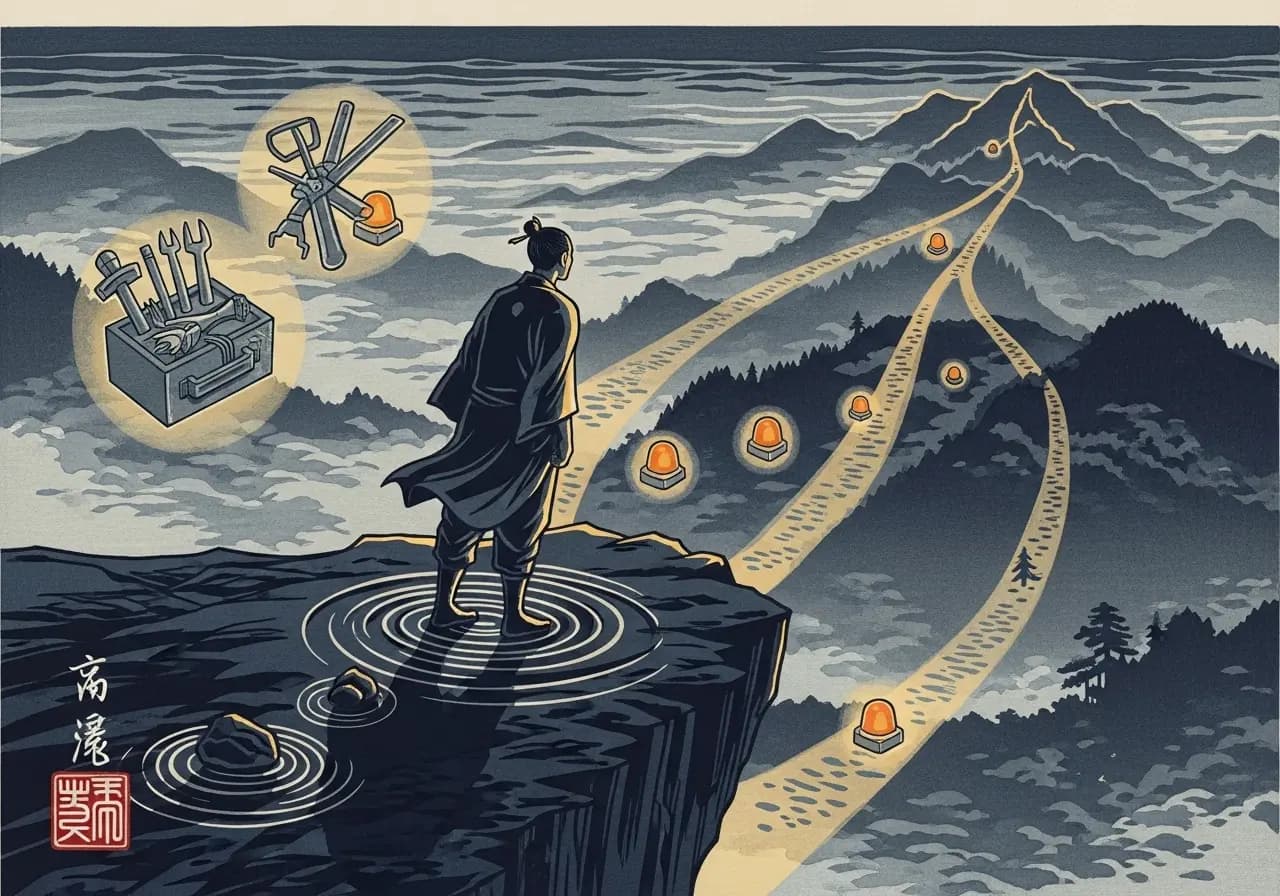
One way I like to think of it: if you think of a craftsman or a carpenter, they have a whole toolbox at their disposal. Sometimes it makes sense to use a hammer, sometimes it makes sense to use a screwdriver or a saw or whatever the tool may be. A hammer might be the perfect tool if you're trying to put nails in wood, but if you use that same hammer when you're trying to install screws in a deck, you're going to have a bad time. The screws might go in crooked. If you can get them in at all, it might split the wood. It could compromise the whole structure that you're trying to put together.
In that sense, it's not that the hammer is wrong as opposed to right. It's just not the skillful tool to use for that particular job. And I like to think of our actions through this same lens. In any given situation, we have a whole range of tools—of possible responses. Some might be skillful and accomplish what needs to be done with minimal harm and maximum benefit. Others might be unskillful and they might seem to work in the short term, but they create problems that we didn't anticipate down the road. Or it could just be that the tool you're using is making everything harder than it needs to be.
And I think that's what I noticed with the paraglider pilot visiting our site. His fundamental error wasn't that he was doing the wrong thing, or that he was bad in any way. His error was just not being able to read the situation skillfully. He had several opportunities to act more skillfully.
He could have paused and observed all the local pilots and seen how they were doing it, where they were taking off. He could have taken the advice that he received a little bit more seriously. He could have recognized, "Hey, these conditions are maybe stronger or beyond my skill level." He could have decided to wait and see if the conditions change or improve.
Any of these things would have been a more skillful action than the action that he took. And it's not that these are morally superior actions. It's just that they are actions that would have led to less struggle, less suffering, and probably more joy.
The Three Poisons as Warning Lights
Now, in Buddhism and Buddhist psychology, we talk about the three poisons: greed or craving, hatred or aversion, and delusion. And these, I like to think of them in this context as warning lights on our dashboard that might be indicating, "Hey, maybe your actions aren't as skillful as they could be."
In this case, when this particular gentleman was dismissing the advice that he was given, what was driving that action? Maybe it was craving—the craving to get in the air as quick as possible. It's fun to be out there, right? So he didn't take consideration into the conditions. Maybe it was aversion. Maybe he didn't want to appear inexperienced in front of all these other pilots that were there. Maybe it was delusion or ignorance—genuinely not understanding the way the conditions work at that particular launch site or that particular style of flying.
Maybe it was a combination of the three. Whatever the motivation, the result was that unskillful action was taken that led to unnecessary suffering.
The Power of Small Choices
So most of us, we're not making these decisions centered around paragliding and strong winds, but all of us are constantly making decisions, making choices about how to act, how to go about doing whatever we're doing. And these choices shape our experience in the same way that the paraglider pilot's choices shaped the outcome of his experience.
You can think about your morning routine, for example. How do you wake up? Do you set your alarm in a way that you'll end up having to hit snooze four times and then suddenly feel rushed? Then there you're starting your day out with a little bit of unnecessary stress. Or do you set the alarm for the actual time that you need to get up? How do you interact with your loved ones before you leave the house to head off to work or to school?
Are you building in enough time to have connection and to be present? These all seem like little small things, but they're not. These are the building blocks of the start of our day and the building blocks of how we go about experiencing our day-to-day life. And every action either increases or decreases the suffering that we will experience in our lives and also for those around us.
One example with this morning routine for me: I used to have the habit of waking up and right away checking my phone. I would look at what emails were there. And it was inevitable that it would start my day out with either a problem to solve or something to now be worrying about—something that would get my mind right into that form of thinking before my feet ever even hit the floor. I was already in problem-solving mode.
It's not that checking your phone is wrong, but you could ask, "Is it skillful?" In my case, I feel like it was definitely not skillful. It was not the tool that I needed in that particular moment of the day. So I changed the action. Now I refrain from opening email or doing anything communications-related with my phone until I've gotten up and I've gone out and brushed my teeth and gotten ready for the day.
That's an example of skillful action. And again, when we think of it as trying to live more skillfully rather than unskillfully, I think that's the right framework. And then we realize that this has ripple effects throughout the rest of the day. Every action—and I'll add that includes not action, because sometimes not doing something is the form of action that might be most skillful.
The Importance of Context
And something to consider in all of this is context. I think that's one of the beautiful things about framing this in skillful versus unskillful—it acknowledges context. The same action that could be skillful in one situation might be unskillful in another, given a change in the context.
Speaking up is an example of this. Sometimes speaking up is the skillful action to take because you have something important that would maybe benefit others to hear it, or it might help solve the problem that we're trying to address or whatever it is. But in other circumstances, maybe staying silent is the most skillful thing to do. Maybe tensions are high. The comment that you're about to share is only going to make things worse.
So that's an example of context. And the right thing to do might be different given the circumstances. The skill in that case is learning to read the situation, learning to understand what is needed, and then choosing the most skillful action accordingly.
So again, it's not about following a rigid rule that says always speak up or always be quiet. It's not that. It's about the wisdom of knowing I have a toolkit here, and I want to become better at knowing which tool to use and when. And part of that learning process is trying the tool and thinking, "Okay, that didn't work. All right. Mental note: don't use that tool next time."
Understanding Karma
Now, another concept that fits well here that we encounter in Buddhism is the notion of karma, which I think is often misunderstood. Remember, it's not a cosmic justice system or a cosmic scoreboard where good deeds give you points and bad deeds take away your points.
Think of karma as simply action and consequence. Every action has a consequence. Every action creates ripples—very much like throwing a stone in a pond.
When I warned that paraglider pilot about the Venturi effect that was happening just off to the right, that was an action. It created a certain ripple. It gave him information. It showed that I cared for him and I didn't want to see him have a bad time. We were all there having a good time.
But when he dismissed it, it contributed another ripple. It contributed now—I didn't take off for a while because I was keeping an eye out to see if he was going to need help. So it delayed my launch. Not that that's a bad thing. It certainly created frustration for him. It was a stressful experience that now he probably left that site and he'll have a poor association with that site. He'll say, "Oh yeah, that place in Monterey, California? Yeah. Don't go fly there. That's not fun."
Where he could have walked away saying, "Hey, that was one of the most fun places I've ever flown." That's definitely my view of it.
So it's important to remember that skillful action or right action asks us to become aware of the relationship between what we do and the outcome of what we do. It's the practical application of right view and right intention. It's where the rubber meets the road, so to speak.
The Three Pillars of Right Action
Now, in traditional teachings, when we talk about right action, it's always presented as three guidelines of things to abstain from. They are: abstain from taking life, abstain from taking what is not given, and abstain from sexual misconduct. That's the way that these teachings are typically presented.
And if you look at these through the example that we were just discussing, where you have someone who has tools in their toolkit, you could think of abstaining from taking life as the practice of non-harming. This is the foundational ethic of causing no harm.
In this case, that pilot, by acting unskillfully, killed his chance for a good time, a good flight. His actions created what you could say was a harmful experience. In our daily lives, this principle invites us to examine the consequences of our actions. It could be a harsh word that didn't need to be said has now killed someone's enthusiasm. A thoughtless expression has now killed someone's self-esteem. An unskillful purchase has now contributed to a system that's harming the environment.
Whatever it is, you can see it through that lens: skillful action is about choosing the path that nurtures and protects life more than it diminishes it. That's how I like to think of that first one—abstaining from taking life.
Then you have abstaining from taking what is not given. This is the practice of respecting what is. I think at its core, you could think of this as don't steal, but there's more to it. It's also about not taking things that aren't freely offered.
Again, that pilot was offered advice, the gift of experience, and he didn't take it. And in doing so, he stole from his own potential to have an enjoyable flight. He also stole from the potential of someone else's time and maybe someone else's trust or someone else's peace of mind because, you know, people were watching and people were worried.
So again, skillful action is to act with respect for boundaries and for property and for the offerings that others give us. That's how I like to think of the second one.
And then with the third one—abstaining from sexual misconduct—I like to think of this as the practice of honoring others. This is fundamentally about respect in our most intimate relationships. It's about recognizing other people as human beings, not as objects or as a means to an end.
Unskillful action here in this context is really anything that is coercive or manipulative or that ends up exploiting the other person, anything that causes harm. Someone who's trying to be skillful is trying to build their relationships with honesty and with consent and with genuine care for the other person as another fellow human being. So that's how I understand those three pillars within right action.
How Do We Practice Right Action?
So then we can talk about: how do we actually practice right action? How do we develop more skillful action?
It's kind of echoed in what I mentioned in the podcast: "How do we become a better whatever we already are?" That's the framework I like to think about when it comes to this.
First, we need to develop awareness before we can choose skillful actions. We need to see clearly what is happening, or at least see more clearly what is happening. This is where mindfulness practice comes in. When we are present and aware, we can see the situation more clearly, including our own mental and emotional states.
Second, we need to be better at pausing. We've talked about how between that stimulus and response, there is a space, and it's in that space that we have the freedom to choose how to act. And even just one simple breath can be enough to shift our perspective from one of reactivity to one of more intentional response—from something that's more unskillful to something that will be skillful.
Third, we need to try to consider the consequences, not in a deep, heavy analytical way, because as we go about our day-to-day lives, we kind of don't have time for that all the time. But at least with the light touch—the simple question of: "If I do this, what might happen? Is this going to increase or decrease my suffering or the suffering of someone else?"
And then we need to learn from our experience. When we do act unskillfully, which we will—we all do—we can treat that as a teaching moment. It's data, right? It's something that I can learn from.
And if you do realize after doing something that, "Hey, that wasn't skillful," instead of beating up on yourself, just say, "Hey, that's awesome. I just became aware that that was not skillful," and celebrate the fact that you noticed it. That's a form of growth.
Because again, ultimately right action is not about following specific rules. It's about learning to dance with the way of life, learning to go with the flow with what life is throwing our way. With these Tetris pieces, it's learning to place each piece with as much presence, care, and wisdom as you can. Because then guess what? Here comes the next piece. And that's the beautiful thing of the practice: each new moment is a new chance to practice.
The Paradox of Skillfulness
Now, there is a paradox that comes up with this as a practice, and it's something that I've noticed in my paragliding life, but I think in general life as well. With time and with practice, sometimes the most skillful actions start to feel effortless. When you've developed enough skill, you can fly in harmony with the conditions that you're in rather than fighting them. It's like you and the wing become one rather than you fighting the wind.
And it starts to look effortless. And when that happens, you're not fighting against reality. You're working with reality. You're using the right tool for the job. And then you are in a position to act from a place of clarity rather than continually being in a place of reactivity.
And that's that struggling paraglider. He was working so hard and expending so much energy, creating so much unnecessary stress. Meanwhile, there were other people there who were having the time of their lives, flying around and enjoying the exact same conditions—the same wind, the same hill—but completely different experiences unfolding, all based on skillful action versus unskillful action.
So I mean, this doesn't mean that skillful action is always easy. I think sometimes skillful action is actually the hard thing. It's having the hard conversation that you don't want to have. It's setting the boundary that you didn't want to have to set. It's admitting the mistake that you don't want to admit to.
But even then, there's a different quality to it when that is coming from a place of wisdom rather than a place of reactivity.
The Middle Way
And we know the Buddha talked about the middle way and avoiding the extremes, and I think this teaching applies very well to right action. We're not trying to live perfectly. We're not trying to set up an impossible standard so that now we're just feeling more guilt and more self-judgment. It's not about that.
And we're also not trying to just throw up our hands and say, "Okay, well, I guess I give up on how to do anything right." Instead, I think we're just trying to cultivate wisdom, develop our skills, learn to use the right tool for the right job.
Again, as I say all the time, we're just trying to be a better whatever we already are—even if that means I'm just this much better than I was last time or yesterday or whatever measurement you're using there.
An Invitation for the Week
So the invitation for the week is to try to start noticing your actions through this lens of skillful versus unskillful rather than right, wrong, good, bad. Make it about skillful versus unskillful.
And when you notice you're about to take action, whether that's saying something or doing something, see if you can pause just for a moment and ask: "What is the motivation behind this action that's about to take place?"
See if you can notice: Is there craving, aversion, or delusion attached to what I'm about to say or do? Or is this coming from a place of clarity and wisdom?
And maybe you can ask yourself: "Is this the right tool for this particular job? The word I'm about to say or the action I'm about to take?"
And then, of course: "Is this going to increase or decrease suffering for myself and others?"
Try to notice this in different aspects of your day. The start and end of the day are great times to evaluate this before you get into the autopilot mode of the day. Another time is when you feel frustration or when you realize, "Hey, I've just come up against an obstacle." That's a moment to reflect on skillful action. When you're dealing with someone who's difficult, that's a great time to pause for a second. And then when you feel, "Oh, I've made a mistake," that's the time to evaluate: "Okay, what just took place? Why did I say or do what I did?"
And remember, we're not aiming for perfection. There's not a right way to be. We're all fumbling through life, figuring it out as we go. We're just aiming for more awareness and gradual improvement—trying to be better at using the tools that we have, gathering tools along the way to keep adding to your toolkit, and just trying to live life as skillfully as possible.
Remember, every moment is a chance to pick up and maybe try a different tool, to learn to respond rather than react, and to try to create less suffering rather than more.
Closing Thoughts
So this path of right action—it's not about trying to become a different person. It's not about trying to follow a specific moral code. Remember, it's about becoming more skillful at being who you are, navigating your own unique life with greater wisdom and with less unnecessary suffering.
And then remember, Pema Chödrön reminds us that life is already difficult. We don't need to create these extra difficulties for ourselves if we can help it. Will it happen? Yeah, it's going to happen from time to time because we're all learning as we go.
But through skillful action, I think we can learn to work with life's challenges rather than only fighting against them. Learning to use the right tool for the right job and creating a life that's just a little bit more easy and more enjoyable as we try to become a better whatever we already are.
So that's the topic I wanted to share today on the topic of right action. I'd like to open this up to group discussion now and just get your thoughts on the topic. If you have anything to share, anything that came up for you during this talk, please feel free to share.