

Right Speech
Episode 208 of the Secular Buddhism Podcast
Today, we're going to continue our journey through the Eightfold Path. I'm excited to continue exploring each aspect with you, one by one.
As you recall, over the past few weeks we've been unpacking these together. We started with right view—how we see the world, recognizing that we're all wearing different tinted glasses, experiencing reality from our own unique vantage points. Then we talked about right intention and how we choose to relate to what we see, understanding that our intentions are like seeds that determine what grows in our lives.
We also talked about wisdom in general, recognizing that true wisdom isn't about having all the answers. It's about learning to trust our own inner voice, our own inner teacher, while at the same time remaining open to guidance from others on the path. And together, right view and right intention form what we could consider the wings of wisdom of the Eightfold Path.
Today I want to start talking about the aspects that fall within the second category: ethical conduct or integrity. The first aspect here on the Eightfold Path is right speech.
Understanding Right Speech
As a reminder, these aren't commandments. They're not rules carved in stone. They don't start with "thou shalt not." They're invitations to live more skillfully, to reduce unnecessary suffering and harm for ourselves and for others. Really, it's about becoming more aware of the ripple effects of our actions—and in this case, our words.
When we think about right speech, the first thing we need to clarify is that word right. It's not in the context of right versus wrong or right in a moralistic sense. It's more appropriate to think of it as skillful speech, or appropriate speech—speech that's aligned with our values, speech that reduces suffering.
It's also not about being nice all the time or speaking in some artificial way. It's about being mindful of the impact of our words and how they affect ourselves, others, and the situations we find ourselves in.
The Four Types of Unskillful Speech
In Buddhist teachings, we encounter four types of speech that tend to be unskillful.
False Speech
The first one is false speech—flat-out lying or intentional deception. Now, this one can get interesting because there are examples where we shouldn't view this as black and white. There could be scenarios where lying or intentional deception would actually be skillful.
I've used this example before, but imagine you're living during the Holocaust and you're hiding people in your home. When the Nazis come knocking and ask if you're hiding anyone, lying wouldn't just be skillful in that moment—it's actually the compassionate, protective thing to do. It's probably the most ethical thing to do.
So when we're exploring false speech in the context of Buddhist teachings, we really have to look at intention and context. What reduces harm? What protects life? We have to recognize that sometimes the most truthful thing isn't the most skillful thing.
Harsh Speech
The second form of unskillful speech is harsh speech. These are words that are abusive, hurtful, or cruel. We sometimes refer to it as having a sharp tongue—cutting remarks, words used as weapons.
Divisive Speech
The third form of unskillful speech is divisive speech. This includes gossiping, backbiting, any form of speech that splits people apart rather than bringing them together. It's when we talk about someone who's not in the room, often in ways we probably wouldn't if they were there.
Idle Chatter
And the fourth form is idle chatter—pointless talk that distracts or numbs us from what's really happening.
Now, here it's important to clarify: this isn't saying there's anything wrong with small talk. I think sometimes talking about the weather is exactly what's needed to connect with someone. But when we use idle chatter or endless chatter to avoid what needs to be said, to avoid being present, or when we're filling the moment with noise because we're uncomfortable with silence—that's when we have to evaluate whether it's become unskillful.
I know in my case, as someone who tends to avoid conflict, I used idle chatter as a technique to perhaps avoid having the deeper discussions that needed to take place. Early on in my marriage, that was something I struggled with. There's this thing we probably should be talking about, but for me it's much easier to go into full distraction mode. "Oh, look, did you notice? Let's go into a different topic." That could be an example of unskillful speech.
But here's the key: right speech is not a rulebook or even a set of guidelines for what not to say. It's a mindfulness practice. It's a practice that engages with why we speak, how we speak, and tries to make us aware of what effect our speech has on ourselves and others.
Why Does This Matter?
Well, if you think about it, words shape our experience. The stories we tell ourselves and others literally become our reality.
For example, if I'm always thinking to myself, I'm not good enough, that becomes the lens through which I see myself. If I'm continually describing my neighbor as that jerk who lives next door, I'm creating a reality where that's all they are, because that's how I see them.
When we understand that words can heal or harm, that sometimes a single careless comment can linger for years—and I'm sure we all have examples of this. Something that someone said to us decades ago still stings. Or the reverse: something someone said to us a long time ago still makes us feel good or it lifts us up.
I know when I think of moments in my own life, especially with the people close to me—my family, my kids, my siblings—there have been times when communication didn't go as planned. Maybe we snapped at each other. Not because we really meant any harm, but because sometimes we operate on autopilot. Sometimes we're stressed from work or we're just not really present in the moment. And it's in those moments that we end up reacting rather than intentionally responding.
That's where awareness of speech becomes a practice.
Speech as Action
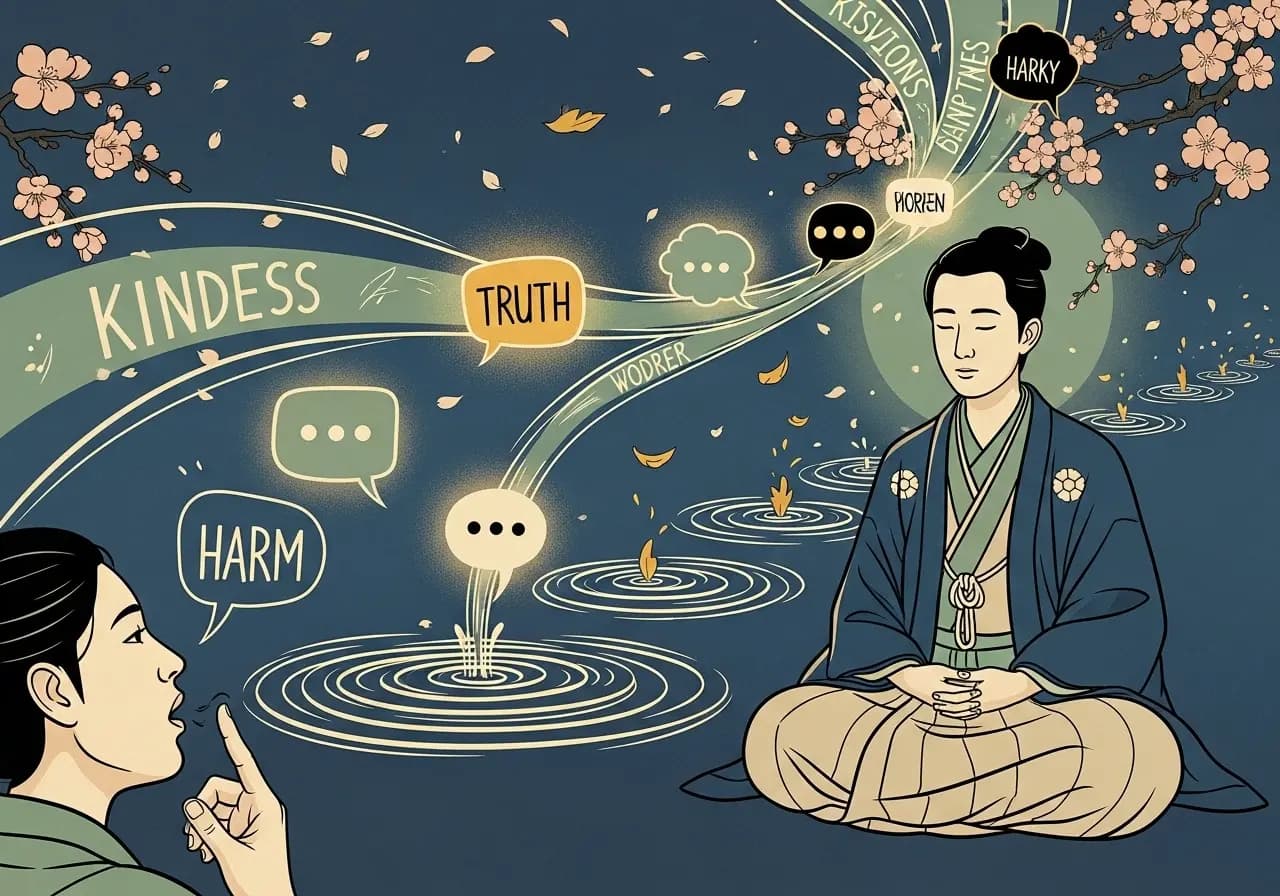
Here's where we can connect this to what we've talked about with intention. Speech is a form of action. Every word we speak is, in a way, like planting a seed. The question isn't just what we're saying, but why are we saying this? What seed is being planted in the process? Is it a seed of connection or division? Are we moving closer to understanding or closer to judgment? Are we healing or are we harming?
The Three Filters
One traditional way to approach this teaching on speech is to use three filters before we speak. Ask yourself:
First, is it true?
Second, is it kind?
And third, is it necessary or helpful?
Again, this can be nuanced because not all things that are true need to be said. Truth without compassion can feel like a form of aggression, even violence. If someone asks, "Do I look terrible in this outfit?" right before they're going to give a presentation on stage, that might not be the moment for brutal honesty. In that moment, the question becomes: what is most helpful to say? What is going to reduce anxiety or suffering?
Sometimes, and I think this is important, sometimes the most skillful response is silence. Silence is also a form of communication. It's not because we're trying to avoid or be passive, but because sometimes silence is the kindest form of speech or communication. Sometimes people need space to figure things out themselves. Sometimes our words, even with the best intentions, would only be adding to the noise.
That requires a little bit of discernment and understanding that maybe I don't need to say anything.
Right Speech in Our Lives
If we think about this in the context of real examples—examples we all face in our ordinary lives—relationships are a big one. How often do we find ourselves in the middle of an argument and realize, mid-argument, that we're not trying to understand this person anymore? We're trying to win the argument. We're gathering ammunition, waiting for our turn to speak, not truly listening anymore. We're just waiting for our opportunity to give the right response.
Right speech in relationships might mean catching yourself in those moments and saying, "Hold on, I'm not sure I'm understanding this correctly. Help me understand what you're feeling. Let's go back to the goal of mutual understanding."
This can also happen at work. When we give feedback to someone, we can ask ourselves: Are we really trying to build them up? Or is there a part of me that's actually trying to tear them down?
You can deliver the exact same constructive feedback or critique in two completely different ways. One leaves the person feeling more motivated. The other leaves them feeling demoralized. The information might be the same, but the impact of how we deliver that information is completely different.
That's another example of skillful speech.
Right Speech Online
And then there's the one we're all very familiar with in our day and age: online communication. Social media, texting, email. These platforms seem to make it very easy—almost as if they were designed to amplify harsh and divisive speech.
Maybe it's because of the distance or the feeling of anonymity. Maybe it's the lack of being able to express tone or read facial expressions. Whatever the reason, online communication seems to bring out especially cruel behavior in us.
Practicing right speech online might mean really looking at what you're about to say, and then deleting it before you hit enter. Asking ourselves: What am I really trying to accomplish here? Am I trying to understand, or am I trying to dominate this conversation?
I think the most powerful communication online is sometimes not saying anything at all. Just silence.
I often think about this because it feels like we've reached a point where it doesn't matter what is shared. If you go through the comments on anything, it's disheartening. We can't talk about anything without it turning into nasty exchanges. And I often wonder: why can't you just not comment? If you see something you don't agree with, you don't have to say anything at all. Why is there this almost compelling need to make sure everyone knows what you think?
The answer is: you don't have to. You can just let it be.
Right Speech Includes Self-Talk
There's an aspect of right speech that we often overlook, and that's how we talk to ourselves. Many of us, as we've talked about before, are our own worst critics. The voice in our head can be brutal. It can say things you'd probably never in a million years say to a friend.
So it's important to take a moment to reflect and ask yourself honestly: How do I talk to myself? Especially after I've made a mistake. What is that voice like? When I'm looking in the mirror, what is that voice like? When I'm struggling with something I can't figure out, what is that voice like?
Because if you wouldn't speak like that to someone you care about, then you probably shouldn't be speaking like that to yourself. And if you are, you should ask: Why? Where's that coming from? Why would I think it's okay to talk to myself like that?
The internal dialogue matters. It shapes our reality just as much as our external dialogue does.
So right speech includes practicing inner speech that's compassionate and supportive. Instead of repeatedly thinking, I'm such an idiot, maybe you could rephrase that and say, I'm always learning. Or instead of, You're never going to get this, maybe think, This is challenging and I'm doing my best. Maybe at some point this will get easier.
Just rephrasing the way we talk to ourselves can change everything.
Common Misconceptions
Some misconceptions arise around the topic of right speech. One is: "Okay, well, then does that mean I can't ever be honest?"
No, absolutely not. Honesty is important. But truth without mindfulness of impact isn't skillful. It's the difference between honesty that's in service of clarity and understanding versus honesty that's being used as a weapon to cause harm.
The question is always: What is my intention here? Am I trying to help or am I trying to hurt?
Then there's another common misconception: "What about staying silent or quiet to keep the peace?"
This one's tricky too, because skillful silence can be right speech, but silence can also be a form of harm if it's being used to avoid, manipulate, or withhold connection.
If the silence is enabling harm to continue, or if it's leaving important things unsaid, if it's building resentment, then silence is not skillful either. The key is awareness of why you're choosing to be silent.
Like I mentioned before, I had to come to terms with realizing that my silence in communication was often not skillful. It was a way of avoiding discomfort. Some people have the opposite problem. They probably need more silence in their communication. Some of us are the opposite and we need less silence.
Again, it's the middle way, as we always talk about, and being honest with ourselves about what we need.
Right Speech as Practice
Right speech is a practice. There's never a moment where it's like, "I did it. I mastered right speech. I can communicate perfectly now." No, we're all going to mess up. We're all going to occasionally say things we regret, because that's part of the human experience.
The beauty is that every moment gives us a new opportunity to try to be better than we were, to speak more skillfully, to communicate more skillfully.
Think of it like learning to play an instrument. At first, the sound might not be great. My son learned to play cello, and the first few sounds out of a string instrument when you're learning? They're not the most pleasant. But with time, it gets better. You become more conscious, more aware, more skillful. And with speech, it's the same.
It can feel awkward if you're not very good at it. But with practice, it starts to feel more natural. You develop a feel for it. The more we practice pausing, reflecting, being more deliberate and choosing our words with care, the more natural it becomes to communicate that way.
An Invitation
So my invitation for this week, as we think about the topic of right speech: Can you pause before speaking? Even if it's just for one breath. Just a moment of space. Where you're experiencing harsh self-talk, can you pause there too? And then maybe try to be a little kinder. Say, "Hold on, let's rephrase that. Hey brain, I know what you're doing here, but can you please rephrase that for me?"
And remember, we're not aiming for an impossible standard where we never say the wrong thing anymore. That's not realistic. We're just practicing being more aware, more intentional, and more skillful with this incredibly powerful tool we use every single day: our communication.
Why? Because words matter. They create the world we live in, and they happen one word at a time, one conversation at a time.
Reflection and Discussion
I'd like to open this up to discussion now around the topic of right speech. Maybe you can think of a time when someone's words helped you feel truly seen or understood. Or maybe you could reflect on how your inner voice speaks to you. What tone does it take? Or just consider the difference between being honest and being skillful in how you speak.
So let's open this up to the overall topic of skillful speech.
For more about the Secular Buddhism Podcast and Noah Rasheta's work, visit SecularBuddhism.com