

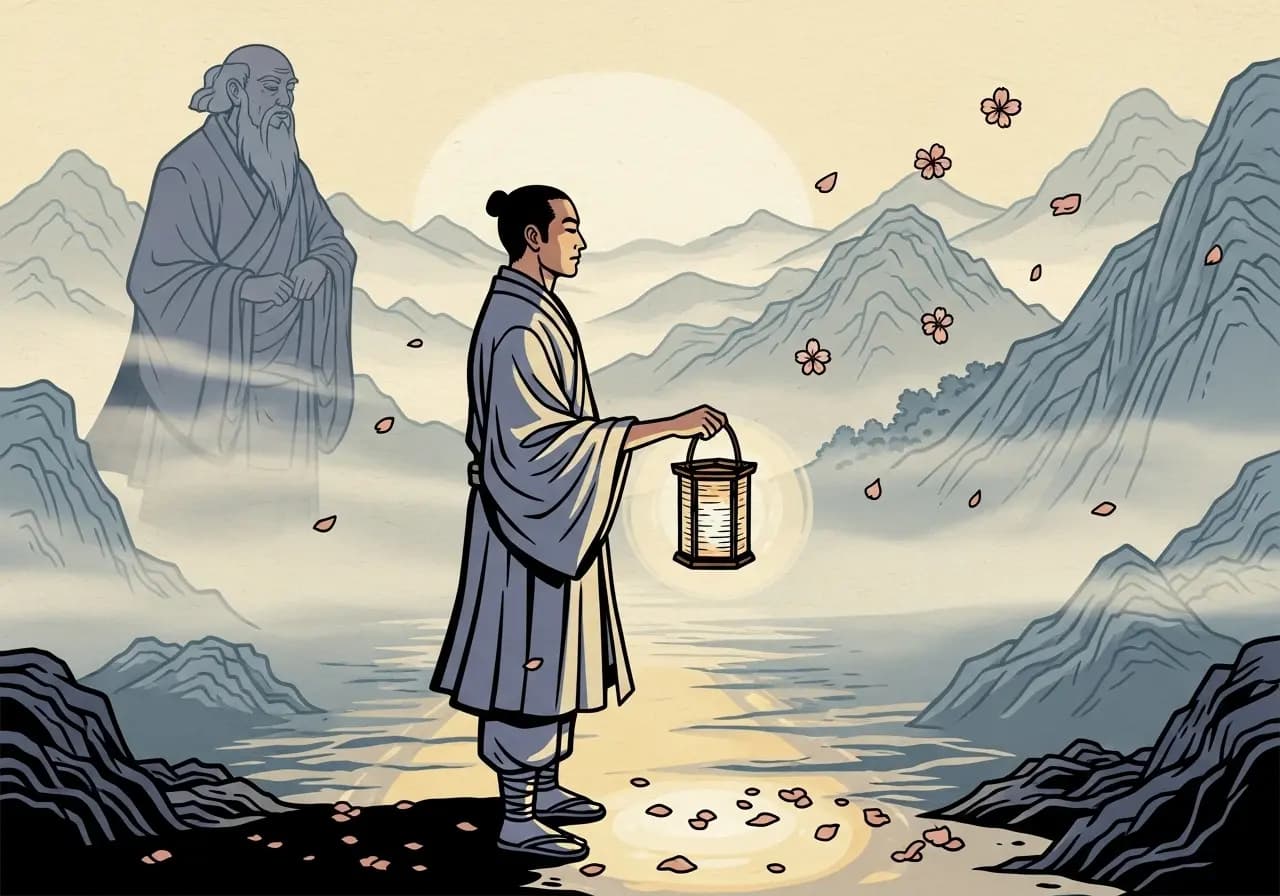
Be a Lamp Unto Yourself
Episode 207 of the Secular Buddhism Podcast
Hello. You are listening to the Secular Buddhism podcast, and this is episode number 207. I'm your host, Noah Rasheta.
Introduction: Moving Beyond the Teacher
The last two discussions were centered around the Eightfold Path—specifically the first two parts: right view and right intention. I mentioned how those two fall under the category of wisdom. You kind of have these split into three categories: wisdom, ethical conduct, and mental discipline. Since we've talked about two of them, I thought we might as well explore some of the others.
But before moving on to the next one, I wanted to pause and just talk about wisdom for a second. As I was thinking about these three categories—wisdom, ethical conduct, and discipline—it got me thinking about wisdom in general, and I wanted to share some thoughts around the notion of wisdom from my perspective.
The Guru Within
This was prompted by a passage I came across in a book called Turning Confusion into Clarity by Mingyur Rinpoche. In the passage, he says: "Many people come to the Dharma because they are in some emotional crisis or experience chronic mental suffering." That makes sense, but then he points out something important. These people may want their guru to solve all their psychological issues. Somehow they have mistaken the idea that solving their problems is the guru's job, rather than taking their problems to the path of meditation and study.
He continues by saying that in Tibet, the great masters would go to their teachers or their gurus to receive teachings or to clarify instructions. But then they would leave. They didn't hang around waiting for the teacher to fix anything. They took what they learned and they went off to do the actual work.
That really got me thinking about our natural tendency—myself included—to want to look outside of ourselves for answers. I think especially when we're in the midst of suffering, when life gets hard and we get confused or we're experiencing pain, it feels so natural to want to look externally to find someone who can just tell us: "What do I need to do? What do I need to think? How do I need to be? Just solve this for me."
I get it. I have felt that pull many times myself—that longing for someone wiser, someone more enlightened, or someone more put together to just fix it. And then that's what will make everything okay.
And I thought about this in the context of an area where I have experienced it firsthand many times over, and that's with teaching people how to fly.
Learning to Fly: A Metaphor for Inner Development
During the years that I ran my flight school, I taught hundreds of students how to paraglide. Through that experience, I feel like I've gained an understanding of the dynamic between teacher and student.
When I first started my journey trying to learn to fly, I was completely dependent on my flight instructor. And rightfully so, because you don't know what you don't know. I remember that for the first year or maybe even two years, even though I had reached the point where I could fly on my own, I would still rely on going to fly when my instructor was going to fly. Because I knew that if he was there, that meant the conditions were going to be good to fly. I wasn't quite trusting my own judgment yet. That's how it was for the first couple of years.
And then it took time to start getting more comfortable with that process. Like I said, I think that dependence on him was appropriate. It was really important. When you don't know what you don't know, you can make decisions that are risky or dangerous without realizing it.
I saw this in the years that I taught where I had students who thought nothing of going to fly before checking the forecast, for example. All it takes is one day where you miscalculate the forecast or the conditions, where the wind is too strong or the weather suddenly turns dangerous. And it can be a huge wake-up call. If you're lucky, it's just a wake-up call, but it could even be life-threatening.
So in the beginning, yes, we need teachers. We need guides. We need someone with experience to keep us safe while we're learning the basics.
The Students Who Excelled
But what I've noticed in the years of teaching is that there was a difference between students in how they approached the learning process. Some students excelled and became really quickly skilled and safe pilots. What they all had in common is that they took responsibility for their own learning from day one.
These were students who showed up to class having already read the books. They had already been watching all the videos. They had read articles. There are plenty of videos on YouTube that will teach you how to study weather patterns, and they took advantage of those resources. I think these students understood something really important.
They realized they could come to a flight school where they could learn the fundamentals, where they could learn from the experience of someone who had been doing it longer than them. They could be guided through those early stages. But at the end of the day, they were the only ones who were going to be up in the sky. They were the only ones capable of reading the conditions and trusting their own judgment.
In a way, these students became their own gurus. They knew that they could trust their ability to learn and their ability to integrate the guidance they had received, whether that was from me as their teacher or from other pilots they flew with. And they also knew that the responsibility for their ongoing development was theirs. No one else could do that for them.
The Dependent Student
On the other hand, I had students who only relied on me and what I told them in class. They'd show up, they'd listen, they'd do all the right things, but then they'd go home and they wouldn't do anything. They'd come back for the next class and wait for all the instructions and be told what to do.
While that worked in those early stages of learning, it's just not sustainable to be that way. Because ultimately, you have to be capable of flying safely on your own. You have to develop your own skills, your own judgment, and your own ability to assess and respond to the changing conditions.
When to Trust Yourself
This brings up an important question when we're talking about wisdom: When does that transition happen? When are you actually ready to start trusting your own judgment? When is it safe to start calling your own shots?
In paragliding, it's a gradual process. You start by relying completely on a guide or an instructor, but then you start to notice things on your own. I remember paying attention to things like: What is the wind speed? What is the wind direction? What did it feel like that day with those particular conditions?
And then the next time I'd go fly, I would check the forecast and think, "Okay, I remember last time the forecast was similar to this. I think it might be good." And then you show up and it turns out it was good. And so then you start to trust your judgment little by little. You're making these decisions and assessments and verifying if they're correct.
Eventually, you're running it by your instructor. Like, "Hey, here's what I'm seeing. Is that what you're seeing?" I would do that with my students too. When they would come do a ten-day course, they knew by day two that I wanted them to tell me: "What are you seeing? What are you seeing in the forecast? Do you think there's a chance we're going to try to fly this evening or are we going to wait till tomorrow morning?"
I wanted to encourage that process to begin early, because eventually you are making your own decisions. You're the only one who's responsible for your safety. And that's where that transition happens—slowly, little by little.
The Paradox of Wisdom
Here's the paradox, though: the more confident you become and the better you get at something, the more natural it is to become reckless. Because now you've had a lot of successful flights. You've developed a lot of experience. You think maybe you can cut a few corners. Maybe I don't need to check the forecast quite as rigorously. Maybe I can fly in conditions that are a little bit questionable.
And that's where I think the wisdom comes in—understanding that even as you develop confidence and skill, you still need to remember: where did that skill come from? It came from paying attention to the basic fundamentals. It came from respecting the process. It came from not taking unnecessary risks.
And so I think there was a natural progression. You start completely reliant on your teacher. And over time, if you're paying attention, if you're taking responsibility for your own learning, you start to notice things and you start to develop your own judgment. And that judgment becomes more and more trustworthy as you continue to pay attention and learn and verify and stay humble.
And I think that's where wisdom comes in—that balance between confidence and humility. Between trusting yourself and staying open to learning. Between being your own teacher and still respecting the process and the guidance that you've received.
Being Your Own Teacher
I remember the feeling of the first time one of my students called to tell me, "I went out and I flew this morning and I was going to call you, but then I thought no, I'm just going to trust my instinct." And they had a great flight. It's a really exciting feeling.
But a good teacher is like a good therapist. They're not there to create dependence. They're there to help you develop your own capacity to learn, to trust your own judgment, and essentially to give you your own wings.
So that's what we're trying to do. But how do we do that when we're trying to be our own teacher while at the same time staying safe?
I think there are a few ways we can do this process, at least on the spiritual path.
Pay Attention to Your Inner Voice
The first is learning to pay attention to that inner voice. Pay attention to it, but also verify it against reality. Just like I learned to read weather conditions by making my own assessments and then checking them against the actual forecast or even verifying with someone like my instructor, you can start to notice what your gut feeling was telling you and whether or not it was right or wrong. Then you can start weaning yourself off from needing that advice every time.
Practice Sitting with Discomfort
The second one is practicing sitting with discomfort when difficult emotions arise, when confusion comes, or when you're not sure what to do. Instead of immediately reaching for your phone to call a friend or someone, just try sitting with that discomfort.
This is kind of like learning to handle turbulence in flight. There's a concept we talked about in paragliding called bump tolerance. The idea is that when you go out and fly, there are times when the air is just turbulent and bumpy and you feel that. Well, the more time you have flying, the more tolerant you become to those bumps.
But I remember my bump tolerance on the radio with my instructor, or if he was flying with me, was one level. But then when I was all alone and nobody was there with me, my bump tolerance went down quite a bit. It was like, "Oh, this is too bumpy," when I probably would have been okay had he been there with me.
So just learning to sit with that discomfort and increasing the bump tolerance is an important part of developing wisdom.
Journal and Document Your Journey
Along with that, I think journaling falls in here—documenting your journey, writing down what you're learning, what you're experiencing. I remember with paragliding, I did this a lot. I would pay attention to what was the wind speed, what was the wind direction, what was the temperature, and I would log it. And then over time I started to get more and more confident in my forecasting because I had a lot of data I could look at.
It was like, "Oh, well, last time it was five miles an hour coming from the North. That was a good flight." And over time I became more and more confident in my ability to judge, but that was because I was logging stuff, keeping a record.
Keep the Beginner's Mind
And then don't forget to keep the beginner's mind. Even as you start to develop your own confidence and your own judgment, always stay curious. I think the best paragliding pilots I know are always asking questions, always open to new perspectives, always willing to learn. They trust themselves and they stay humble.
Lean Into Community
And then we have the community. Just like pilots who learn to fly start to go fly with others, they have a community where they share experiences and learn from each other. And that's where the beauty of the Sangha comes in with spiritual practice.
That's the goal, right? To have a community where we can share, where we talk, people who can keep us honest—not in a disciplined sense, but people who know we're all just trying to be better, whatever we already are.
Redefining the Teacher-Student Relationship
So wrapping this up, I want to say: being your own teacher doesn't mean that teachers are useless, that we should just go it alone. Like I said, I think we need teachers. We need community. We need the wisdom of those who have walked the path before us.
But the relationship changes when we start to recognize ourselves as our own primary teacher. And instead of looking for external sources to save us or to fix us, we can approach them as consultants or guides, as friends, as fellow travelers who might have some useful tips from the territory that they've been navigating that we're also exploring.
And then it's less of a dependency and more of a dance. We can receive teachings from others with gratitude while maintaining our own center, our own balance. We can be students without giving away our power. We can honor the wisdom of others while most importantly, trusting our own wisdom.
Buddha Nature: Your Inner Light
So I think that's the ultimate teaching. Recognizing that being your own teacher is about recognizing that you already have Buddha nature, right? We talk about that concept in Buddhism. You already have access to the same wisdom, compassion, and clarity that any other teacher has. It's not something you need to acquire. It's something you need to uncover from within.
I think that's important. It makes you exactly where you are and how you are. We're all human beings with the capacity to wake up, to see more clearly, to live with wisdom and compassion. The same capacity that the Buddha had or that any other great teacher has had.
And the question isn't whether or not you have that capacity. The question is whether or not you're willing to trust it. Will you trust that inner capacity of wisdom?
An Invitation to Reflect
So hopefully you'll carry this concept with you throughout the week and see if you can notice if and where you're giving away that spiritual authority to some external teacher. In what areas of life do you tend to look outside yourself for answers that maybe the answers are already within?
And then just gently, with compassion, remind yourself and see if you can shift that balance back to bringing it internally.
And again, this isn't about becoming closed off to external learning. It's about recognizing that the ultimate authority in your life is you. The ultimate expert on your experience is you, because your path is the unique path that only you are walking.
Gather teachings. Gather good teachers. Learn from others. But remember, at the end of it all, it's just fingers pointing at the moon. But the moon itself—that capacity for awakening—that's something you experience within you. It's already there.
Closing
So that's what I wanted to share on the topic of wisdom. And then with that, moving forward into next week or the coming weeks, I'll share my thoughts on some of the other aspects of the path. But I just wanted to kind of tie up the discussion of wisdom—right view, right intention—with this reminder: you are the ultimate teacher you're looking for.
Anyone else can be a guide. Anyone else can be a finger pointing at the moon, but they're not the moon.
So let's end it on that and open this up to discussion. If you have any thoughts you'd like to share around this, we can go from there.
For more about the Secular Buddhism podcast and Noah Rasheta's work, visit SecularBuddhism.com