

Right Intention
A Dharma Talk from the Secular Buddhism Podcast
Hello. Last week, we talked about the topic of right view. Today, I want to continue that discussion and move on to the next part of the eightfold path that fits really well with right view—right intention.
For those who might not be familiar, some of the most basic teachings of Buddhism include the Four Noble Truths, which explore the understanding of suffering and its causes, and the path to the cessation of suffering. Part of that path is the eightfold path, which can be broken into eight different topics. These are usually organized into three general categories, the first of which is wisdom. The aspects of the path that pertain to cultivating wisdom are having right view, which we talked about last week, and having right intention. So this is almost like part two of the overall topic of trying to develop wisdom.
Last week, in the discussion around view, we talked about different types of truths: objective truths, subjective truths, and intersubjective truths. These ideas came from the book Nexus by Yuval Noah Harari, which isn't a Buddhist text, but I connected those concepts with right view and how understanding different types of truth can help us navigate life more skillfully. Now I want to shift the focus to right intention—the second component of wisdom on the eightfold path.
The Two Wings of Wisdom
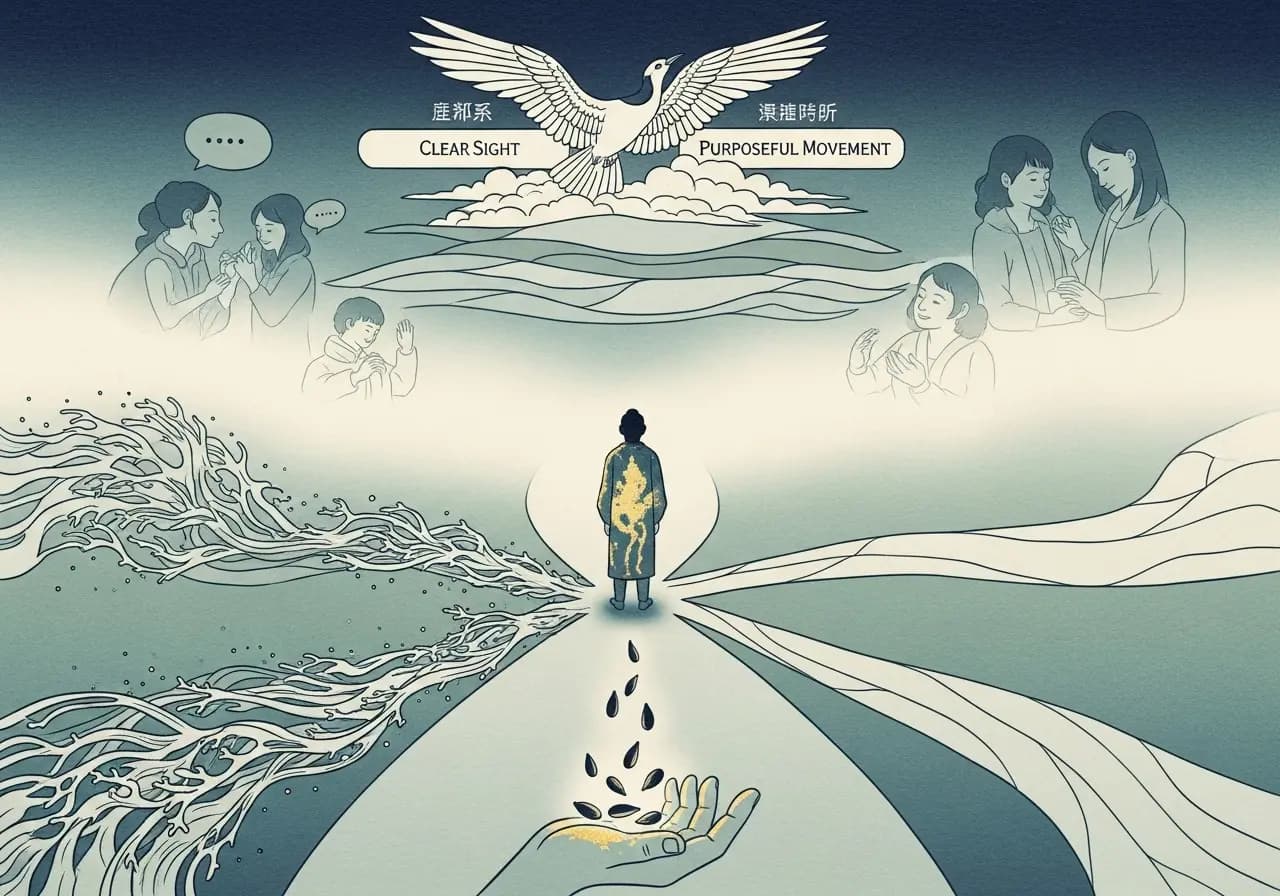
I like to think of right view and right intention like a bird that needs two wings to fly. One wing is right view, and the other is right intention. Right view is what helps us see where we are at any given moment—to see more clearly. Right intention is what helps us move forward more skillfully in flight.
Without right intention, right view remains theoretical. It's like having a perfect map for an incredible journey but never actually taking a step. You have this really good understanding of the map, but you don't use it. The wisdom we're trying to cultivate on this path isn't measured by what we know. It's more about what emerges—or perhaps what's revealed—in how we show up on the journey. It's the experiences we have along the path.
Reacting Versus Responding
I want to start with a simple observation: at any given moment, we are either reacting or responding to life as it unfolds. I think intention is the difference between simply reacting and actually responding.
The other day, my work schedule and my family's school schedule overlapped. My wife teaches, so they all get home around the same time, usually before I'm done with work. It's common that they'll come home and immediately want to tell me about their day or ask for help with something. One afternoon, one of my kids came in and said, "Hey, I need your help"—very immediate and focused on their need.
For a moment, I could sense how I wanted to respond. I wanted to say, "Hold on, I'm still at work. My camera is literally still on. I'm still on a work call." But I paused for a second and thought, "Well, wait. What is my intention here?" There's what I want to say, and then there's the intention behind what I want to say. That brief little pause between stimulus and response—that's where our intention lives.
In that space, I was able to think: What is the intent behind what I'm trying to express here? That brief pause was just enough to allow me to express it differently. Instead of conveying the urgency of my work in a way that might make my kids feel like they're in trouble for interrupting, or worse, that they're being rejected, I said, "Hey, I need two more minutes to finish what I'm doing right here. Then I'm all yours, and I'll help you with whatever you need."
What they sensed was: "Okay, my needs were heard, and they're going to be met. I can wait." And then they let me finish my work.
Of course, that's not always how it goes. There have been times when they push and push, and then I snap and say something like, "Leave me alone. Just go and close the door." And then they leave, and I feel terrible, thinking, "Oh man, they're going to feel like I was angry at them or rejecting them when that's not the case at all."
We often have the best of intentions, but we might not communicate them. I think right intention is more about trying to live purposefully—bringing awareness to what it is that I'm trying to move toward, not just what I'm trying to avoid. What am I trying to go toward? What type of person am I trying to be? In this case, what kind of parent am I trying to be?
Something that's really helped me along these lines is to do occasional check-ins throughout the day. I ask myself not just, "What am I doing?" but deeper: "Why am I doing what I'm doing?" Understanding the reason behind our actions and sometimes our words is important because of a Buddhist metaphor that comes up often—the metaphor of planting seeds.
The Seeds We Plant
Every word, every action, every habit that we try to cultivate is like growing from a seed. And that seed is intention. This is directly connected to the understanding of karma, where we can think of karma not as some cosmic justice system, but as the simple understanding of cause and effect—everything that we do and don't do has effects. It creates ripples.
Our intentions are the seeds that determine what grows. Even good actions can cause harm if they're driven by unskillful intentions. Here's an example: if a friend is moving and needs help, the surface-level action is offering to help. But what's the intention behind that action?
Maybe you're helping because you want them to owe you one when it's your turn to move. Or maybe you're doing it because you want them to think you're a helpful, good friend. Or perhaps you're afraid that if you don't help, they won't help you when you need it. Whatever that intention is, it matters because you can have the same action with different intentions behind it. And that's like a different seed. It could result in different fruits.
So right intention is a way of refining or calibrating that inner compass. It's not about doing things for the right reason, because we don't always know what that is. It's not about being perfect. It's simply about being more aware of what's actually driving us. Why do we do the things we do? Why do we say the things we say? Having more understanding of that is where wisdom can emerge.
Three Aspects of Right Intention
In Buddhist teachings, three different types of intentions are often brought up. You can think of these like three components of wisdom, or three orientations or directions of the type of intention we're trying to understand.
Renunciation: Letting Go
The first is renunciation. The word carries its own connotations and meanings, so let me be clear: it's not about giving away all your possessions and going to live in a cave. I'm talking about something more practical.
Renunciation is about recognizing when our attachments and our clinging are causing unnecessary suffering for ourselves and others. Then asking: am I willing to let go of that attachment? I had a friend going through a very difficult separation in a relationship. This friend realized that what she was holding onto was the image of what she thought the relationship should be—not the reality of what it actually was. That renunciation, letting go of the fantasy of what I think this should be and instead accepting what it actually is—that was real-life renunciation. It was letting go of the clinging.
This can happen in relationships, in our possessions, in our identities, in the need for things to be a certain way. You can evaluate this in yourself at any time by asking: What is it that I'm holding onto that's weighing me down? What's causing this unnecessary suffering? It could be a grudge. It could be an outdated self-image. It could be the need to control how others see us. It can happen in many areas.
But what happens when we let go? The invitation is to loosen the grip. Not because holding on is bad, but because it's exhausting—especially when you're holding on really tight to something that doesn't serve you anymore. What would happen if you loosened that grip?
Goodwill: Loving Kindness
The second form of wise intention is goodwill, sometimes understood through the lens of loving-kindness. What's important here is recognizing that having the right intention isn't about being right—maybe it's more about being kind. And this doesn't just apply to others. I think it especially applies to ourselves.
Many of us are our own harshest critics. We say things to ourselves, think things about ourselves that we'd probably never say to a friend or someone we care about. Goodwill and loving-kindness come in here as a powerful counter to the resentment or blame or shame we might feel, especially when aimed at ourselves.
Goodwill is the intention to simply wish well for ourselves and others, especially when it's difficult to do that. You can practice this by thinking of someone you don't get along with all that well—someone who annoys or frustrates you. Maybe it's that one family member, that one coworker, someone with different political views than yours, whoever. Just think about them for a moment and ask yourself: Can I wish them well, even just a little bit? Can I imagine them being happy, at peace, content, and free from whatever causes difficulty for them in their lives?
Here's the key: you don't have to like them. You don't have to agree with them. It's just this very simple question: Can I wish them well? Am I capable of wishing well for this person? That one little shift in intention—"I have the intention to wish them well"—is separate from liking them or befriending them. It's just: can I wish them well? That's a really powerful exercise. It helps align your values with your intention.
Harmlessness: Doing No Harm
The third kind of right intention is harmlessness, or to do no harm. This extends to bigger things like nonviolence or non-harming, but it's not just that. It's about being mindful of the ripple effects of our words, the tone of our words, and even just our simple presence when we're with someone.
A question you can ask yourself here is: What impact will what I say have? Not so much "What do I want to say?" but "What will this have as an impact?" That brief moment of introspection will maybe change how you say what you're going to say.
We've all experienced examples of this. I know it happens with me, especially with people in my inner circle. It feels like the closer people are to you, the easier it gets to sometimes be a little snippy with them. I've had examples in my own relationship with my wife where we're having a conversation that's going down a path where it feels like we're arguing about something specific. And in my mind, I'm coming up with the perfect way to counter what's being said. If she's talking, I'm already thinking, "Okay, if I answer it like this, that might be the perfect way to win this argument."
But then I can pause and realize: What is my actual end goal here? What am I actually trying to achieve? What impact will this have? What will the ripple effect be? In that moment, I realize I don't need to say what I was going to say—or at least not in the way I was going to say it, not with that tone.
That can make a big difference. I think that's an example of harmlessness, or non-violence—trying to make sure this doesn't escalate. I'd call it a form of de-escalation. And it's not a form of passivity or being a doormat, because that's not helpful either. I think it takes courage to be willing to say: "What I say and how I say it matters. So let me be careful with what I'm going to say or how I'm going to say it." We're being mindful of how our actions and words affect others and ourselves.
Intentions Versus Outcomes
There's another way to frame this whole thing that I find really interesting: thinking about goals versus outcomes. Many of us are goal-oriented. We have outcomes we want to achieve. You can think of intention as the compass. Imagine you're on a journey. Intention is the compass that orients the direction you're trying to go. Everything else that happens on that journey—those are outcomes. Some of which we control, some we don't. The weather on the journey, that's what happens. How you react to it—that's a whole different thing.
A common trap is setting the intention and then judging our success based on the results. But Buddhist practice invites us to recognize something different: plant the seed and water it. That's the practice. What am I planting? How am I tending to it? But it's not to control the harvest—where and how it grows, the speed at which it grows, whether it grows at all. Maybe the weather comes along and ruins the harvest. That's separate.
The point of the practice is: what am I planting and how am I tending to what I'm planting? That's where you focus. Not on fixating about outcomes, not on the result of what you've been planting or tending to.
So remember: we can't control the outcome. All we can do is understand our intention, check the intention, be honest with ourselves about it, and then try to approach all that we do from a place of genuine care. Then you don't have to get bent out of shape when the outcome doesn't turn out the way you wanted. You can think: "But was my intention in the right place? Yeah, I feel that it was. And if I feel that it was, then I don't have to worry about it after that. I was doing what I felt was the best thing to do."
This has been helpful for me—to try to have genuine, sincere intention in what I do and to think of my intention as the compass. That orients the overall direction of the journey I'm on. But I understand that there are many other factors that might change the specific moment-to-moment experience of the journey.
Making It Practical
So those are the main thoughts I wanted to share around this topic. One way to make this more practical in our day-to-day lives is to schedule specific pauses throughout the day to check on intention. Before you respond to that text message or send off that email. Before you walk into a meeting. Before you respond to your kids if they're being needy. Before you respond to your spouse. You can just pause for a moment and ask: What is my intention here? What am I hoping to create? Make that a habit—occasionally checking in on your intentions.
Second, once you start to notice when you're being driven by what we call the three poisons in Buddhism—whether that's greed (wanting more), aversion (pushing away), or ignorance (not seeing clearly)—when these are hijacking your intentions without you realizing it, see if you can detect that.
And then, remind yourself that the practice of setting intentions is different from setting goals. I'm not saying goals are bad, but a goal is focused on the outcome. Setting an intention is focused more on the system or the process that you're putting in place.
Bringing It Together
Right view is one of the wings of wisdom. It helps us see clearly. Right intention helps us travel more skillfully—whether that's walking or flying or however you want to visualize it. Together, these two give rise to a sense of wisdom.
And wisdom isn't knowing what's going to happen. It's knowing how you want to show up for whatever happens, no matter what it is. It's being able to ask yourself: What am I actually aiming for? Are my actions aligned with how I want to live and who I want to be? Where can I focus or practice letting go? Wishing well for myself and others? Doing less harm? Those three aspects of intention—letting go, wishing well, and doing less harm.
That's the thought I wanted to leave you with.
Hopefully, throughout the week, you can recognize that every moment offers us that choice between simply reacting and skillfully responding. Every action is like planting a seed. Ask yourself: What seeds am I planting? What are the intentions guiding the decisions and actions in my life?
And here's the beautiful thing about intention: it's always available. Even if you've been on autopilot—whether for many years or just for the last few minutes while you were in an argument with someone—there's always that next moment that offers a fresh start. You can say, "Hold on, I've identified my intention. Here's my intention moving forward. As of this moment, there's always that ability in every moment to make it a fresh start."
For more about the Secular Buddhism Podcast, visit SecularBuddhism.com