

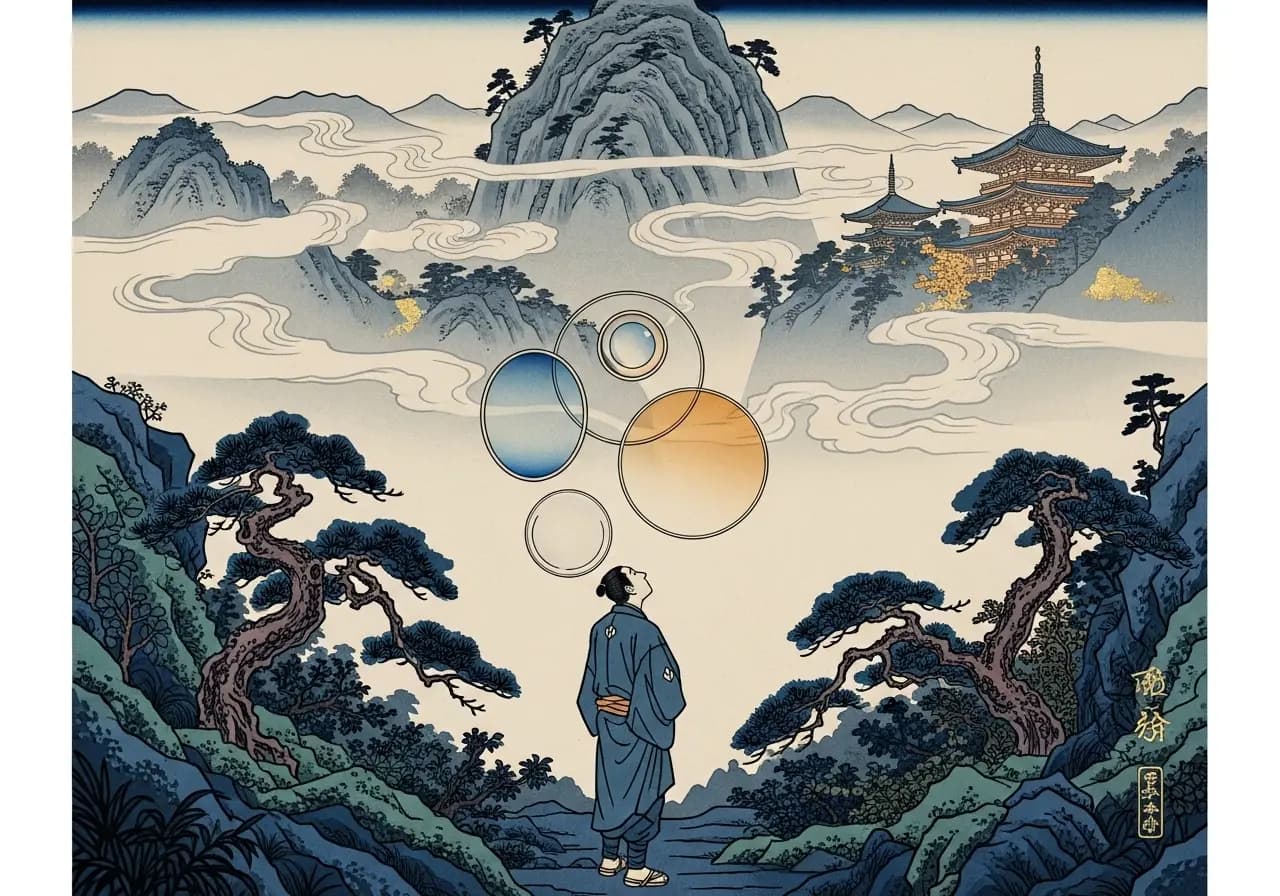
Right View
Episode 205 of the Secular Buddhism Podcast
Hello, and welcome to another episode of the Secular Buddhism Podcast. This is episode number 205. I'm your host, Noah Rasheta. I want to remind you, as always, that you don't need to use what you learn from Buddhism to be a Buddhist. You can use what you learn to simply be a better whatever you already are.
Today's episode is the audio of a Dharma talk that I gave during one of our Sunday Zoom calls. These are weekly calls that I do with podcast listeners and supporters, with members of the Secular Buddhism Podcast online community. And the audio is on the topic of right view. So without further ado, let's jump right into the topic for this podcast episode.
Finding Inspiration in Unexpected Places
This week, I wanted to talk about the topic of right view, which is the first step in the Noble Eightfold Path. But what inspired this is actually a book that I just started reading. I'm only on the first chapter, but this is the book Nexus by Yuval Noah Harari. He wrote Sapiens, which was one of the first books of his that I read. That was a very impactful book that talks about stories—about what got humanity from where we were to where we are, our ability to have shared stories. Then he wrote another book that I didn't get too far into. And now this one, which I've started and so far, I'm really enjoying.
This book goes more into the topic of information and where we're headed with our information systems, AI, and things like that. But it got me thinking about right view and what it means to see clearly. I think when we encounter this topic of right view being the first step on the Eightfold Path, sometimes we interpret it through the lens of having the correct view or the correct opinion about something. We ask, "What is the right view?" But I think it's important to recognize that maybe we're approaching that incorrectly if we're thinking in terms of right and wrong, because what if it's much more nuanced than that?
And that's one of the things that gets talked about in this book: how information is conveyed and how we often think of information as a means to discover truth. But that's not necessarily its primary function. Information that we share and consume serves to connect. So thinking about information as a tool or a means for better connection, more trust, and shared meaning—rather than as a source for arriving at some form of mutual truth—that's a different way of looking at it.
So that's where this thought process came along. What if right view isn't about seeing what's subjectively true? What if it's more about seeing reality in a way that reduces suffering both for ourselves and others? What if it's more about how we relate to what we consider to be truth?
Understanding Different Types of Truth
So the first thing we'd have to explore is: what even is truth? In that first chapter of the book, Harari goes into this, and I know I've talked about this in the past, though I don't recall these specific definitions the way it's described in this book. But I wanted to share them with you because I find them to be very useful.
When talking about the notion of truth in our daily lives, it's important to understand that there are different types of truths. I think this is a more skillful way of trying to see reality.
Objective Truths
First, there are objective truths. These are truths that exist regardless of what we believe about them. Gravity is an objective truth. The fact that water boils at 100 degrees Celsius if you're at sea level is an objective truth. It doesn't matter what your opinion is about that—it's still an objective truth. The sun rises in the morning, whether we're feeling optimistic or pessimistic about that. These are the types of truths that science deals with very well. They're measurable. They're testable. They don't care about our feelings and our beliefs.
And Buddhism has very little interest in these objective truths. The Buddha wasn't trying to understand the world through the lens of these objective truths. Buddhist teachings are focused more on what we could call experiential truths. The truth of suffering, the possibility of the end of suffering, what path leads to that end—things of that nature. These are truths that have to be experienced in order to be understood.
Subjective Truths
So that leads to the second type of truth: subjective truths. Subjective truths are true for one person but not necessarily for another. When someone says, "I love jazz music," that might be a subjective truth. It may be absolutely true for that person, but it doesn't mean that it has to be true for someone else in order for that to be a valid truth.
Pain is subjective. Joy is subjective. Fear is subjective. The experience of suffering is subjective, even though the causes of suffering might be more universal.
These subjective truths are much more central to what Buddhist practice is trying to deal with. Because the whole point is to understand and work with our individual experience of suffering. What causes me to suffer might be different than what causes you to suffer. And that's okay, because it's not a problem to be solved. It's just the nature of subjective experience.
Intersubjective Truths
And then we have the third type of truth, which I think is much more interesting to think about: intersubjective truths. These are truths that exist because a group of people get together and agree on them.
Money is an intersubjective truth. The value of gold or silver—that's an intersubjective truth. The identity of nations is an intersubjective truth. The idea of being a citizen of a country exists because enough people have come together to agree that this is something that exists and we're going to participate in the shared story of this reality. But it's an intersubjective truth.
Language is intersubjective. Grammar, the rules of grammar, laws, customs, traditions, social norms—they all fall into this category. And I think most of the conflicts and misunderstandings that we encounter in our lives happen around intersubjective truths. We treat them as if they were objective truth, fixed and unchangeable, when really they're more like collective agreements that can evolve. They do evolve, and they can change.
Think about how many arguments you've had in your life where you were essentially arguing about an intersubjective truth that you wanted someone else to accept. Political discussions often fall in this category. Religious debates fall in this category. Even family arguments about the right way to do something, the right way to raise your child, how to discipline, or how to celebrate Thanksgiving—whatever it is—these are all about intersubjective truths.
A Simple Analogy
You can think of it like this as an analogy. Imagine that we're all standing at the intersection looking at a traffic light. One person sees the lights—red, yellow, green—and says, "Hey, that light is red." The fact that that red light is different from the other two—that's an objective truth. That color is distinct.
But another person says, "When I see red lights, it makes me anxious because I feel nervous around red lights." That would be a subjective truth.
And the person who says, "Well, red light means stop"—that is an intersubjective truth. It's true because we've collectively agreed that red means stop, but there's nothing inherent in that color that objectively means stop.
So that's a quick way to see the difference between the three types of truth.
Right View in Practice
So how does this relate to right view and Buddhism? Well, I think that right view, like I said before, is less about having the correct opinion about something and much more about developing a skillful way of viewing or seeing reality. It's about understanding at any given moment which type of truth we're dealing with, and how do we respond more appropriately or more skillfully?
Right view involves a kind of humility—knowing which truths are solid, which are fluid, which are constructed. And it allows us to hold our views, our beliefs, or our opinions a little bit more lightly, especially when it comes to those intersubjective truths that most people mistake or treat as if they were absolute.
The Blind Men and the Elephant
The perfect story that we have in Buddhist teachings about this is the story of the blind men describing the elephant, which we've talked about before. But just to frame this again, you've got six different interpretations of what an elephant is like. One person standing there saying, "This feels a lot like a wall," while another is feeling the trunk and says, "No, this feels a lot like a snake." A third one says, "No, I think you're both wrong, because this," touching the leg, "feels a lot like the trunk of a tree." The fourth one, feeling the ear of the elephant, says, "No, it feels kind of like a floppy piece of fabric." And the one touching the tail says, "No, this is a lot like a rope."
You get the idea, right? They're all describing something, and each one feels quite certain that their experience represents a complete truth about what an elephant is. And the thing is, they're all right, but they're also all wrong. They're right about their particular experience, but they're wrong about the totality of the experience because they can't experience it from another vantage point. They can only interpret it from the vantage point that they have.
And this is how we often approach life. We have our limited perspective. We have one particular vantage point, and then we mistake that for the complete picture. Right view is like stepping back and recognizing that we're all touching different parts of the elephant here. We're all experiencing reality from a unique vantage point.
And that doesn't mean that we just throw up our hands and say, "Okay, well then I give up. Everything is relative. So nothing matters." That's not it. That would not be skillful either.
Right view means that we can learn to hold our perspectives and our experiences with an appropriate amount of confidence while remaining open to the fact that there are other viewpoints. If I'm the person experiencing the elephant from the vantage point of standing next to its leg, I can say with confidence, "This definitely feels like a tree," because that's the experience I'm having and that's accurate. But where I get into trouble is when I insist, "Therefore the entire elephant has to be exactly like this. So anyone who's saying otherwise has to be wrong." That's where I would get into trouble.
Right View in Relationships
So how do we apply this understanding of right view in our ordinary day-to-day lives? Well, think about relationships for a moment—the conflicts that we get into in relationships. Often you have two people operating from their own vantage point of their subjective truths. But the relationship also depends on a shared intersubjective truth as well. Agreements about how do we treat each other? What is acceptable behavior? What does the relationship mean to us? Those are truths that emerge in an intersubjective manner.
In my own relationship, when we have different perspectives on something, right view is the idea that reminds me to ask in these moments: "What are we dealing with here? Are these objective facts? Are these subjective experiences? Or are we just having difficulty negotiating the intersubjective agreements?"
This can flare up in the tiniest things. Whose turn is it to do the dishes, right? Well, there could be objective facts—who did it last time. That would be on the objective level. But then you can get lost in the intersubjective agreements of: "Well, whose role is it? What does fair mean when we're trying to divvy up chores?"
So it's just important to recognize that right view in this context is really about holding space for the different subjective experiences we're having and trying to recognize that we're consciously negotiating a reality that is unique to each of us.
Right View in Difficult Conversations
I think keeping this idea in mind with right view is really powerful when we're dealing with more difficult topics with people—whether that's social views or political differences. So much of our political discourse involves people treating intersubjective truths as if they were objective truths. When someone says, "This is just obviously the right way to do something. This is the way you should run society," they're often presenting an intersubjective truth as if it were an objective truth.
Right view in that moment helps us to recognize this—to recognize what's happening—and then respond with curiosity rather than defensiveness. Instead of thinking, "Well, this person here is clearly wrong about the facts," we could say, "This person has a different vision of how society should be organized. I wonder what experiences have led to that vision."
And it doesn't mean that we have to treat all viewpoints as if they're equally valid, or that we shouldn't have strong conviction about our own viewpoint. But it does mean we can be more skillful in how we engage with our differences. That, I think, is the key.
Right View and Our Stories About Ourselves
And then we have how right view applies to ourselves. This might be the most important aspect of it. So many of the stories that we have about ourselves are either subjective truths that we're treating as if they were objective, or they're intersubjective truths that we've internalized and never thought to question them.
Thoughts like, "I'm not good enough." Is that really an objective truth, or is that a subjective experience that's been influenced by intersubjective cultural messaging about worth and success?
Or the thought, "I should be further along in life than I am now." Well, compared to what objective standard are we measuring ourselves? Or what are we measuring ourselves against? Are these intersubjective cultural expectations?
Right view invites us to investigate these beliefs with kindness and with curiosity. Not to just dismiss them, but to understand: What type of truth am I dealing with here? And is this really serving me to hold this view?
The Tinted Glasses Analogy
An analogy that I think is helpful—and I've talked about this before—is coming to the realization that "I am wearing glasses that are tinted." My tinted glasses—I either forgot that they were on, or more realistically, as humans we didn't realize that we were born with these glasses. We didn't realize that they've been almost implanted from the moment that we're born. That's what conditioning is. So now everything that I see looks blue, well, that's because the tint of the lenses that I wear are blue.
Right view is like having that moment of realization where you remember: "Oh, that's right. I'm wearing blue glasses. That's why the world looks blue to me."
Does that mean I can take them off? I don't know. I don't know that it's that easy. I think it's just about recognizing: "Hey, I have my own unique tint that makes the world look a certain way to me. And just recognizing that that's what's happening is already a significant step."
The glasses in this case—they're conditioning. It's our cultural beliefs, our personal history, our lived experience, the habitual ways of thinking. All of that. And right view doesn't mean that now I'm going to take these glasses off and just throw them away. Like I said, I don't know that we can do that. But it does mean we can remember: "Hey, I'm wearing glasses that make me see the world this way. And you're wearing glasses that make you see the world your way. And I can't just expect to take those off of you either. We're both viewing reality in a way that we almost can't help but view it."
Right View and the Tetris Game
I think this ties in well with the other analogy we talk about often—that life is like playing a game of Tetris. And I think where it applies here, when it comes to truth, is that we don't control what objective truths we encounter. Gravity is what it is. Water boils at the temperature it boils at. We don't control that. It doesn't care about our opinions or beliefs about it.
We also don't fully control our subjective experiences. Emotions arise. Sensations happen. Thoughts appear. But we do have some influence over this, especially over the intersubjective truths that we participate in. We can choose which collective stories we buy into, which social agreements we're going to support, which cultural narratives we want to perpetuate and which ones we might want to challenge. We do have some say-so there.
So right view in this sense is like becoming a more skillful Tetris player who can recognize: "What kind of piece am I dealing with? Is it a piece that I can work with or is it something I can change? Or am I dealing with something that I can't change, that I can't really do anything with?"
An objective truth would be like a piece that you just can't change. There's really nothing you can do with it. It's the shape that you're working with, whether you like it or not.
A subjective truth, on the other hand, is more like understanding: "Hey, I have my own unique playing style. This is the piece that I'm dealing with right now, but I can choose how I'm going to react to that piece." That would fall more in the subjective truth area.
And then the intersubjective truths that we deal with—these are like the rules of the game that society has placed on us. They're real, and yet they're not real. But we have to deal with them. You can't just be like, "I'm going to run all the red lights now because red light means nothing." That's not going to be very skillful. And at the same time, I don't have to live my life in a way where I think, "Red light means stop, and if anyone questions that, it really ruffles my feathers." I could be like, "Yeah, I'm going to have to do it, but it doesn't have to mean anything either."
Where I think an unskillful Tetris player comes along and tries to force every piece to be exactly what they want it to be—well, you're going to live a very miserable life, because that's not how reality works. That's not how the game works. Where the skillful player might work with each piece, trying to maintain awareness of the bigger picture of what's really happening.
Right View and Harmful Perspectives
Now, something that does happen from time to time—because all of this sounds nice in theory, right? But what happens when we encounter views from others that seem harmful or seem dangerous?
Right view doesn't mean that we just accept everything or that we have to remain passive in the face of what we might perceive as injustice. This is where the skillful aspect of right view comes into question. The question isn't: "Is this view correct?" Maybe the better question is: "Does this way of seeing reduce suffering or increase suffering, both for myself and for others?"
Sometimes we have to stand up for the values that we hold. Sometimes even forcefully, because it's the most compassionate response. And right view, I think, can help us to do this more skillfully. Instead of thinking, "I have to convince this person that they're wrong," maybe we could think, "How can I respond in a way that reduces harm and perhaps opens up possibilities for greater understanding?" It might just be how we approach the conversation. So that's one way to think of it.
The Practice of Zooming Out
Another way that I like to think of this—and Kalias usually brings this up in a way that I really like—is the idea of zooming out. Imagine that we find ourselves in the middle of a really complex, vast landscape, but we're right there standing at the base of the mountain. From that vantage point, we can see certain things very clearly because we're up close, looking at the trees or the rocks or whatever the thing is we're looking at. But there are also things we can't see because they're hidden behind the trees or behind the next hill.
Where if you could maybe climb up a little higher—climb to the top of a tree, or even to the top of the mountain—you're now standing at a different vantage point. Now you can start to see things that were much more impossible to see up close. Now you can see the bigger picture. And it doesn't mean that view is the correct view, because now that you're standing way up there with the wide picture of the zoomed-out landscape—well, guess what? Now you can't see the insect on the rock or the pattern of the leaves in the tree, because you're zoomed out now.
So again, it's not about saying one of those is more important than the other—zoomed in versus zoomed out. It's saying there are different ways of viewing. Sometimes you've got to look zoomed in. Sometimes you've got to zoom out. Don't just stay fixed on one view, saying, "This is the one view. This is the correct view." It's about recognizing there are many angles, many distances, many truths if we want to call it that.
But I will always be limited by my perspective of where I stand right here and right now. That's, to me, what this is all about. The difference is I'm aware of my limitation. I'm aware that from where I'm standing, this is what I see. But I'm also aware that there isn't a final, comprehensive, complete view of reality that says, "This is it. This is truth here."
So our best bet is to try to be more skillful at understanding each other—not over who's right and who's wrong, but to help me understand the way you view the world, and I'll help you understand the way I view the world. But I'm already starting off from the vantage point that I think we're both wrong, rather than thinking one of us is right.
Cultivating Right View in Daily Life
So I think this is where the practical aspect of right view comes along. How do we cultivate this as a practice in our daily lives?
First and foremost, I think it's just looking and recognizing that there are different types of truths. When we're dealing with something—and a disagreement is a great time to do this—we can just ask ourselves: "Are we arguing about objective facts or subjective experiences or intersubjective agreements?"
The person you're disagreeing with might not be aware of these concepts, but just you knowing that there are three different types here can make a real difference. Let me see what's really happening. Where are we getting caught up here?
Then the second part of the practice, once you can identify what kind of truth you're dealing with, I think it would be to ask yourself: "Maybe I can hold my view or my opinion a little bit more lightly." That doesn't mean that we have to become wishy-washy or lose our conviction or our views. No, it just means I'm going to make a little mental note that says, "This is just how it looks from where I'm standing." That's it. I can stay confident while also staying humble—yeah, this is how I see it, but it's because I'm not standing where you are.
And this is where the third part of the practice comes in, which I think is really powerful: curiosity. When you encounter another person's viewpoint that seems off, or wrong, or just crazy to you—you're like, "I don't get what you're seeing"—rather than immediately assuming they're wrong, just ask: "What would it take for someone to arrive at the conclusion that they have? What did it take for you to arrive at the place where you're experiencing reality from that vantage point?"
This isn't saying that you're going to agree with their views, especially if they're harmful views. It's just about trying to understand more skillfully.
And then I think perhaps the most powerful part of the practice is to question our own certainties. What are some of the beliefs that you hold that you've never really examined? That you've never really questioned? These are truths that you've inherited from culture, from family, from your upbringing—that maybe you've never even thought to question.
And again, right view doesn't say you have to abandon all your views or get rid of them. That's not what it's saying. It invites us to hold them consciously rather than unconsciously. Unconsciously, you don't question them. They're just there and there's no question about it. Consciously, you say, "Yeah, this is what it seems like, but maybe I'm at least willing to entertain that a little bit and look at it."
The Essence of Right View
So for me, the essence of the teaching of right view is really about seeing more clearly in a world of many truths. It's about recognizing that there are different types of truths. There are objective, subjective, and intersubjective truths. They all have their place and their function. It's not that one is right and one is wrong or one is good and one is bad. No, it's about responding to each type of truth appropriately and not mistaking or confusing one type of truth for another.
And I think maybe most importantly, right view is not about asking, "What is true?" I think it's about asking, "What is the most skillful way for me to see this current situation, this current reality that I'm looking at? What way of seeing is going to reduce or minimize suffering and perhaps increase freedom, peace, and liberation?"
Right View in Our Information Age
In a world where we're constantly bombarded with competing claims about truth, with social media algorithms that feed us information designed to trigger specific emotions and responses—rather than promoting understanding—I think cultivating right view becomes an act of wisdom and compassion on our part.
The Invitation
So that's the invitation for this week. I invite you to experiment with this lens. Notice when you're dealing with different types of truths. Practice seeing from different perspectives—whether that's zoomed out, like climbing to the top of the mountain for a moment, versus walking down and zooming in at the base. Just remember you can't become an expert about reality because you can't ever see the full picture. You're either zoomed in or zoomed out, or you've got something blocking your view. You can't see what's on the other side of that mountain. None of us have the full picture.
So the goal isn't to become neutral about everything. No, it's to become more skillful in how we engage with the complex, beautiful, and challenging landscape that is human truth and human reality.
That's all I have for today's podcast episode. I hope you enjoyed this topic. Remember, you can learn more about the podcast, the community, and the work that I'm doing by visiting SecularBuddhism.com. I look forward to another episode soon.
Until next time.