

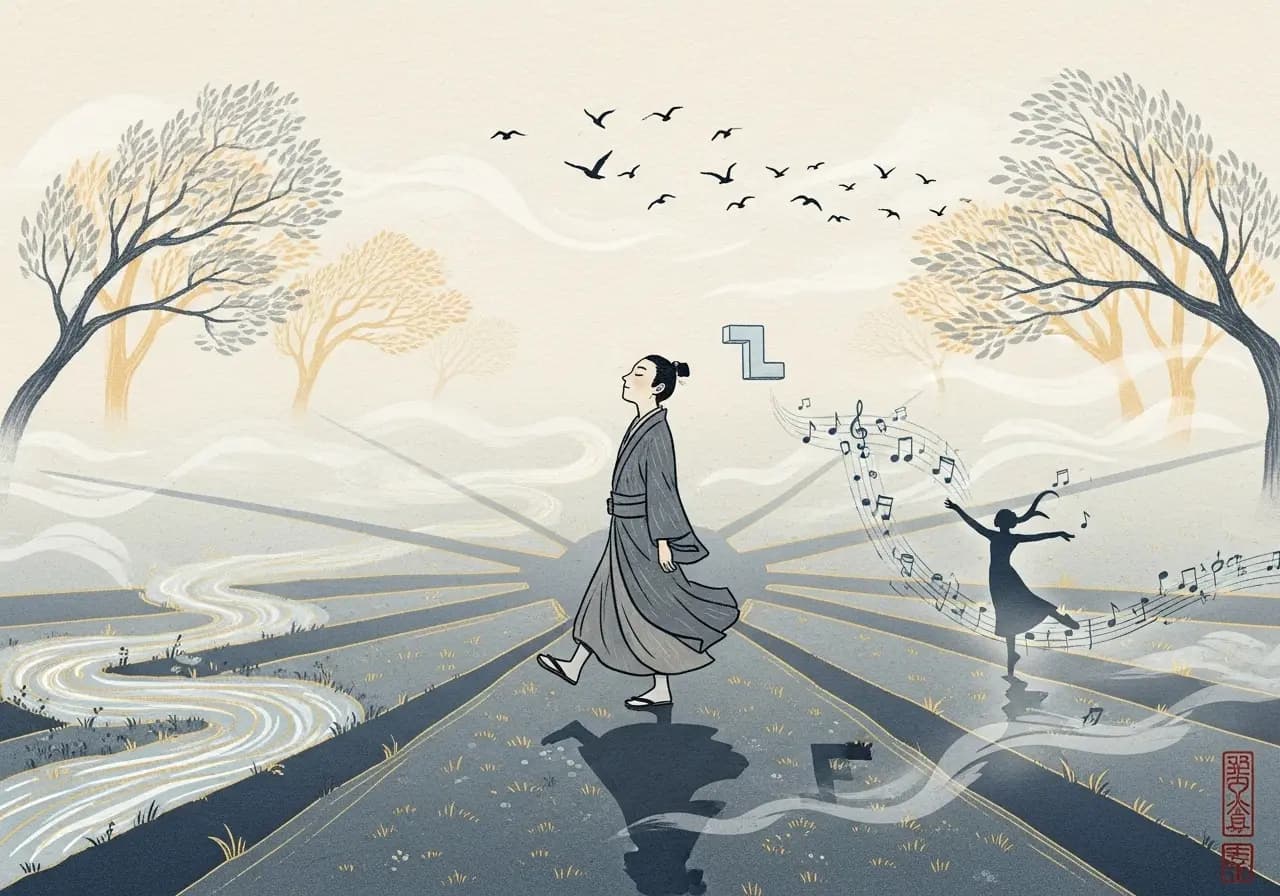
The Art of Purposelessness
Episode 203 of the Secular Buddhism Podcast
Welcome to another episode of the Secular Buddhism Podcast. This is episode number 203. I'm your host, Noah Rasheta. Today I'm talking about purpose, purposelessness, and the Buddhist teaching of aimlessness—one of the three doors of liberation.
This topic has been on my mind lately as my son, Riko, who is now 16 years old, has started thinking about college and what he wants to be when he grows up. That's a milestone that many parents can relate to—watching our children begin to confront these big life questions about purpose, meaning, and career.
An Invitation to Think Differently
As always, keep in mind: you don't need to use what you learn from Buddhism to be a Buddhist. You can use what you learn to simply be a better whatever you already are.
Buddhist teachings and concepts challenge us to think differently about life. They invite us to question the stories that we've come to believe about ourselves and about reality. This teaching of aimlessness does a good job of this for me.
Most of us grew up being asked from time to time that question: "What do you want to be when you grow up?" It's a question that seems innocent enough, but embedded in it is the assumption that we need to be something specific—that we need to have a clear sense of purpose, a direction, a goal.
As adults, we often continue this line of questioning with ourselves and with others. You've probably heard or been asked: "What's your five-year plan?" or "Where do you see yourself in 10 years?" or the bigger existential questions like "What is your purpose in life?"
These questions aren't inherently bad. There's nothing wrong with them. They can be useful. They can help clarify our values and priorities, but they can also end up creating an underlying anxiety that says, "Well, if I don't have a clear answer, maybe I'm lost or maybe I'm failing at life."
My Son's Journey, My Questions
I've been thinking about this a lot lately with my son because he's starting to wrestle with these questions about his future. He has a couple more years left in high school, and he's thinking about which college to attend, what degree program to pick, and what career path to follow.
He recently started asking me questions about aviation—which, of course, made me really excited. I love aviation. He's considering, as of now, the path of learning to fly and becoming a pilot for fixed-wing aircraft.
I've been thinking about this as he's starting to ask these questions, and I find myself wanting to tell him something balanced. I want to be counterintuitive in a way, especially in our highly goal-oriented society, to let him know: "Hey, maybe the most beautiful thing about life is that it doesn't have to have a fixed purpose. You don't have to have that answer."
Here I am at 45, getting ready to turn 46 next week, and I still wrestle with the question, "What do I want to be when I grow up?" I don't know that I've ever fully answered that.
Life as Tetris
I've talked about in many episodes the idea of life being like a game of Tetris—we never know what piece is going to show up next, so we learn to adapt to whatever comes our way. Looking back on my own life, I've experienced many unexpected Tetris pieces that completely changed my course, not only my career, but also my relationships, my living situations in new houses or new cities or new states, even new countries.
Each of these pieces required me to adapt, to reorganize my life, and to completely reimagine what I thought was supposed to be or what the purpose was. And I know that this isn't over, right? More Tetris pieces are on the way. That's the nature of life. There's constant change, constant transition.
So what does this mean in light of these questions or ideas about having a sense of fixed purpose?
Well, when I was younger, I thought my purpose was defined by what I do—by my career, by my beliefs, by my particular faith tradition, or by my roles. I am a brother, a son, a husband, a father. And I kind of had this whole story mapped out about who I was, where I was going, and where I should be going. But as you all know, life has other plans.
Every time one of those unexpected Tetris pieces would show up—whether it was a sudden loss of a job, a shift in my beliefs, a dramatic change in worldview, or a catastrophic relationship issue—these major life changes would suddenly come along. And I found myself at these various junctions having to reconsider my sense of purpose, because the purpose that I had been so sure of up until that moment no longer fit the new reality that I was in or the new reality I was experiencing.
The Three Doors of Liberation
In Buddhism, there's a teaching about the three doors of liberation, and these are described as emptiness, signlessness, and aimlessness. I've talked about these before in previous podcast episodes.
Emptiness teaches us that nothing has a fixed, independent existence. Everything is interconnected, interdependent, and things are constantly changing.
Then we have signlessness, which reminds us not to get caught up in labels or the concepts and ideas. Reality transcends the mental categories and labels and descriptions that we give it. The map is not the territory, right?
Then we have aimlessness, and aimlessness invites us to let go of our attachment to specific goals or outcomes. It's often translated as wishlessness, desirelessness, or purposelessness. And this doesn't mean that we shouldn't have intentions or that we shouldn't take action in our lives. It means we practice not being driven by that constant feeling that we need to be somewhere other than where we are right now.
Thích Nhất Hạnh described aimlessness as "there is nothing to do, nowhere to go, nothing to attain." And at first glance, this might sound like an invitation to be lazy, lethargic, or indifferent about life, but that's not it at all.
I think it's an invitation to fully inhabit this present moment—to pause and stop racing towards some imagined future state where we think we'll finally be complete. It's an invitation to recognize that we can be complete and whole in this present moment just as we are, with no aim of being any different than how we are.
The Art of Purposelessness
Alan Watts talks about this, and he referenced what he called the art of purposelessness. He observed how in nature, you can see what looks like beautiful purposelessness. Birds singing for the sake of singing. Plants growing just for the sake of growing. Things doing the things that they do just because that's what they do.
Waves don't have to have some sense of purpose or meaning to crash against the shore. They just do. And we can look at it and say, "Wow, what a beautiful thing," or hearing the bird, "Wow, what a beautiful song." It doesn't have to have a sense of purpose. It can be beautiful just because of what it is.
In our productivity-obsessed culture, purposelessness or aimlessness sounds like a negative thing. If something doesn't have purpose, then it's wasteful or it's meaningless. But what if purposelessness is actually one of the keys to liberation? That's what's taught in this teaching of the three doors of liberation—that purposelessness or aimlessness is indeed one of the doors to liberation. It's one of the keys to being able to experience life fully.
Music and Dance as Metaphors
I like to think about this in the context of music. Is the purpose of music to get to the end of the song as quickly as possible? No. Otherwise, we'd have the greatest songs out there—they'd be the shortest songs. But of course, that's not how it is. The purpose of music is to be experienced, to be enjoyed in each moment as it unfolds. There's no rush to get to the end.
Or think about dancing. When you dance, you're not trying to arrive at a particular spot on the dance floor. The whole purpose of dance is the dance itself. It's the experience of doing it.
And if we take these two ideas of music and dance and apply them to life, what if life is more like music or dancing than it is a race to a specific destination or to achieve a specific milestone?
When you're on the dance floor, your focus is on the movement itself. You're not thinking about where you need to be. You're present for each step, each turn, each moment. That's where the joy comes from. That's where the aliveness comes from. When we're so focused on where we're trying to get, we miss the beauty and richness of where we are. That's the issue here.
Three Practical Approaches
Learning to embrace aimlessness has a few practical components, and let me share them with you.
First, it means learning to appreciate the journey rather than being fixated only on the destination. When I'm paragliding, I try to remember that the real joy isn't reaching a particular altitude or a particular spot. It's the experience of the flight itself. It's the feeling of the wind, the view as I'm ascending, the present-moment awareness of being in the air. It's easy to fall into the trap of having a singular focus on the destination, but when we do that, we miss out on so much of what's available to us right now.
Second, it means learning to appreciate the value of what we would think of as useless activities—things that we do simply for their own sake, not because they serve some special productive purpose.
In traditional Chinese and Japanese arts, there's a concept of uselessness that's actually highly valued. For example, a twisted old tree might be considered more beautiful precisely because it can't be cut down and made into straight lumber like all the other trees. So its value lies in its uselessness.
I like that idea. And similarly, I think we might cultivate activities in our lives that have no purpose beyond the joy or presence that they bring us. Maybe it's sitting by a stream and watching the water flow, or maybe it's playing music. People who just get their guitar out and start playing it don't need an audience. They're doing it for the sake of doing it. For me, it's paragliding, or taking a walk somewhere with no particular destination—just to go out and take a walk.
We can all find things like that. It could be as simple as the routine of preparing your tea or coffee or sitting down for a snack. Whatever it is, these activities matter because they are inherently valuable.
Third, it means embracing the reality of uncertainty and change. Rather than trying to nail down a fixed purpose that will give our life meaning once and for all, we can recognize that meaning emerges from how we engage with whatever is present right now.
Aimlessness isn't about giving up. It's about giving in—giving in to life just as it is. It's a form of radical acceptance. It's about letting go of the story that says, "Hey, you're not enough until you get somewhere or do something or become someone."
I think there's a powerful sense of peace that arises in realizing that the journey is the destination. The dance is the point. Listening to the music is the goal of the experience. There doesn't have to be something beyond that.
The Beautiful Paradox
And that's the beautiful paradox in this teaching: when we let go of our attachment to having a specific purpose, that's when we often discover a deeper sense of meaning and direction. It's like the difference between clutching tightly to something and holding it gently in an open palm. When we clutch at something tightly like purpose, we strangle it. But when we hold it lightly, it can breathe, it can evolve, it can change.
Again, I'm not suggesting that we abandon our plans and our goals. No, I still set intentions. I make plans. I'm always working towards certain outcomes. But I try to hold these things lightly, recognizing that life has a way of surprising us and those Tetris pieces will keep coming in unexpected ways and shapes.
It's kind of like this idea of having a plan with no plan. We move forward with intention, but we remain open to the unexpected turns in the road. And it's in that space of openness where we might discover what Dōgen called the suchness of things—the joy of a wave simply being a wave and crashing onto the shore, the beauty of a tree simply being a tree, regardless of its size or shape or color.
And imagine the joy of you simply being you, not having to be anyone else any different than how you are. That, to me, is the essence of this idea of aimlessness.
Speaking to My Son
So now, going back to talking to my son, as I talk to him about his future and his plans, I'm not discouraging him from thinking and planning about things like college or career paths. What I'm trying to do is invite him to hold these questions with a light touch.
I tell him that while it's natural to wonder about purpose, it's also okay to not have all the answers right now. His purpose might change many times throughout his life, just as mine has.
My original dream and goal for a career was to be a pilot. As some of you might recall from early podcast episodes, I dreamt of being a helicopter pilot and pursued it—but then life threw out the Tetris pieces and it just didn't work out. And I'm on a whole different path. And then that path led to a different path. We've all had these forks in the road in our path where we think, "Okay, now this is the new path I'm on."
And that's what I'm trying to tell him: whatever path he chooses, the real art of living isn't about arriving at some final destination where everything finally makes sense. No, it's about being present for the journey itself, about learning to dance with whatever Tetris piece life is going to send his way.
And most importantly, I tell him that he doesn't need to justify his existence through achievement or productivity. His worth isn't tied to having a grand purpose or to making a big impact or to achieving a specific goal. No, his worth is inherent in his being, in his presence, in the way he shows up for his life and for others, regardless of what that life looks like.
The Radical Alternative
The Buddhist teaching of aimlessness offers a radical alternative to the purpose-driven culture that we live in. It suggests that perhaps the most meaningful life isn't about striving towards some future state of achievement or enlightenment. Maybe it's about being fully present for the life that's already here—the life that we're already living, the experience that we're already experiencing.
As Thích Nhất Hạnh says: "The raft is not the shore. The practices, the goals, the purposes, the meaning that we create—these are the rafts that carry us across the river of suffering, but they're not the destination itself."
For me, this perspective has been incredibly liberating. It's allowed me to hold my plans and purposes more lightly, to adapt more gracefully when those unexpected Tetris pieces show up, and to find meaning in the simple act of being present for my life exactly as it is right now.
Because life is indeed an experience to be had, and the art of purposelessness is about showing up fully for that experience. Not because it's going to lead somewhere grand or important, but simply because this is the moment we have, and this moment is enough.
An Experiment for You
So this week, I invite you to experiment with this idea of aimlessness or purposelessness. Notice when you're fixating on outcomes or connecting your sense of worth to some future achievement. And then try doing something simply for its own sake, with no goal beyond the experience itself.
Just go take a walk with no destination in mind, or sit somewhere without a purpose. That's part of what meditation is. Or listen to music, not with the goal of getting to the end of the song, but just to enjoy each note as it comes along—to be in the music.
And see if you can approach your life a couple of times this week with that mindset of the dancer rather than the runner. The runner's racing towards a finish line with a goal and a purpose, but the dancer's just out there enjoying the movement of the dance. That's why we have expressions like dancing in the rain.
Give it a try and just see. And think of the middle way, right? We don't want to be in the extremes. I think there are times to have purpose and be driven. And there are times when we can let go of purpose and just enjoy. So find the middle way for you. Everyone's middle way is different, but find your middle way and see how it goes.
Closing
That's all I have to share. Thank you for listening and joining me on this episode of the Secular Buddhism podcast. If you enjoyed the episode, feel free to share it. If you'd like to support the work I'm doing with the podcast, you can visit secularbuddhism.com or consider joining our online community.
That's all I have for this episode. Thank you for listening. Until next time.