

Who Is Driving the Car?
Episode 202 of the Secular Buddhism Podcast
Hello and welcome to another episode of the Secular Buddhism podcast. This is episode number 202. I'm your host, Noah Rasheta. Today I want to talk about a concept that's been on my mind lately: the idea of who's really in control of our thoughts, words, and actions, and how this relates to the Buddhist concept or teaching of no-self.
As always, keep in mind that you don't need to use what you learn from Buddhism to be a Buddhist. You can use what you learn to be a better whatever you already are.
Buddhist teachings and concepts challenge us to think differently about life. They challenge us to question the stories that we've come to believe about ourselves and about reality. And today's topic does that for me.
The Car Full of Passengers
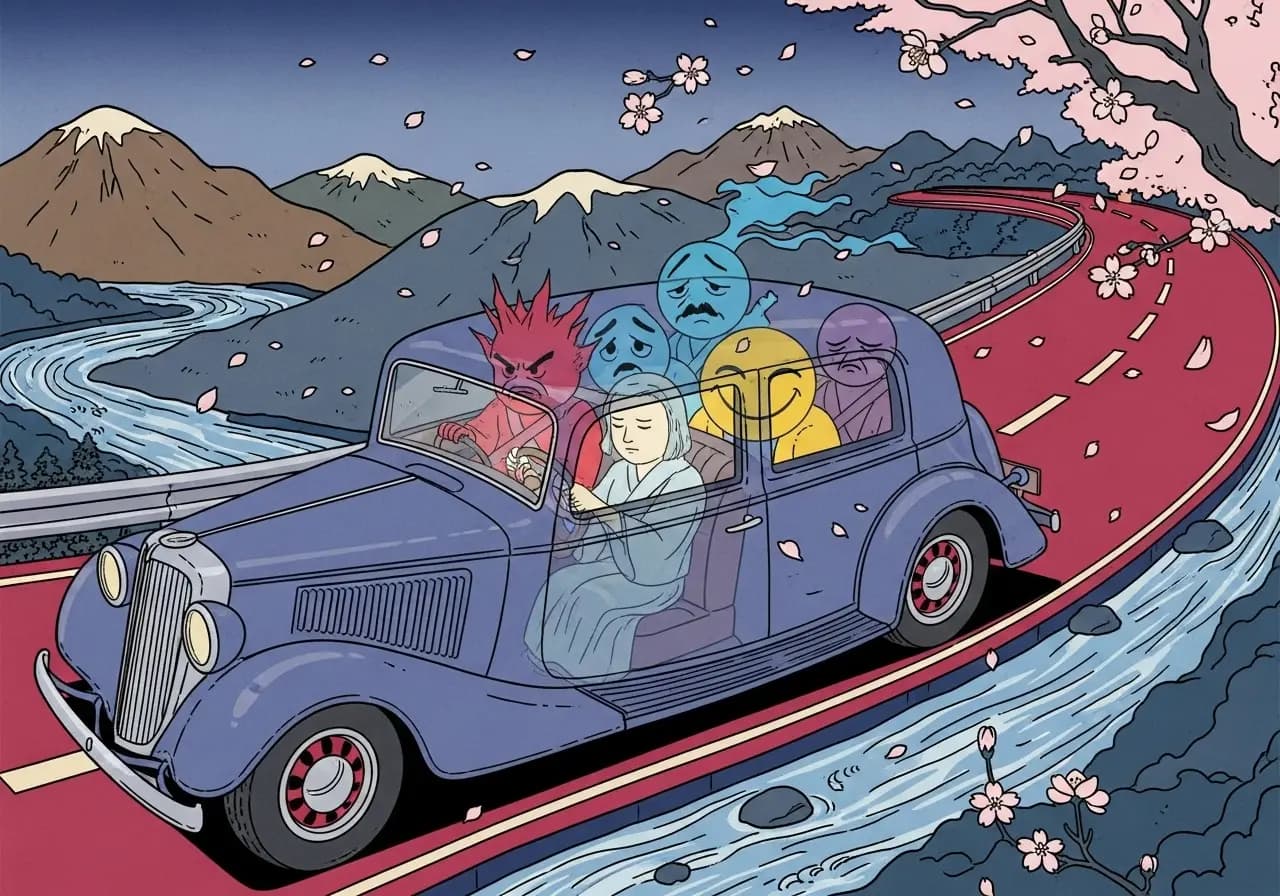
Imagine your mind as a car. Picture yourself as if you were driving, but you're not alone in this car. The car is full of passengers—all of your emotions, reactions, habitual patterns. There's anger in the back seat. There's joy riding shotgun. There's shame crammed back into the back left corner. And there's hesitation, occasionally leaning over to mess with the steering wheel, not sure how tightly to grip it.
Sometimes, without even realizing it, one of these passengers actually jumps into the driver's seat and starts to take control. Suddenly anger's driving the car, speeding down the highway, honking at everyone in sight. Or maybe fear grabs the wheel, slams on the brakes, and immediately swerves to the shoulder, refusing to move forward.
This isn't just a metaphor. I think this is a powerful way to understand what's actually happening inside us. And it relates directly to one of Buddhism's most profound teachings: anatta, or no-self.
The Buddha's Teaching of No-Self
The Buddha taught that what we call our "self" isn't a fixed, permanent entity. Instead, it's a collection of constantly changing processes. He broke this down into what are called the five aggregates, or the skandhas:
- Form - our physical body and the material world that we interact with
- Feelings - pleasant, unpleasant, or neutral sensations; how we recognize and interpret our experiences
- Perception - our mental formations consist of our thoughts, emotions, intentions, habits, and propensities
- Mental Formations - the patterns and tendencies that shape how we respond
- Consciousness - our awareness of all the rest
None of these aggregates on their own are you. And even taken together, they don't constitute a permanent, unchanging self, because they are constantly in flux—emerging and fading in response to conditions, just like the passengers stepping in and out of the driver's seat of your car.
Sometimes what was the backseat passenger is now riding shotgun. The character who was in the trunk of the car is now sitting in the backseat. There's just constant change happening.
In the car as a metaphor, Buddhism would say there isn't actually a real "you" that's separate from all these characters or passengers. There's no CEO of the self, no permanent driver who's the real you. Instead, you are the ever-changing collection of processes and patterns, emotions and thoughts, all working together—or sometimes even against each other—to create the experience of being you, the experience of the car on the journey.
The Practical Implications
This teaching can sound a little abstract, but it has very practical implications for our lives.
When we realize there's no fixed self behind our experiences, we can relate to our thoughts and emotions in a completely different way. And here's where I think it gets really interesting.
In meditation practice, we often cultivate what's sometimes called the observer—the capacity to witness our thoughts, emotions, and sensations without immediately identifying with them. In our car metaphor, this would be like recognizing that even though anger has grabbed the wheel, you can still observe what's happening. You can notice, "Oh, anger is driving now," rather than identifying with that experience as "I am angry."
This shift in perspective—from "I am angry" to "Oh, I notice anger is present," or "I notice anger has put its hands on the steering wheel right now"—it's subtle, but it's profoundly transformative. It creates a little bit of space, a pause between the emotion and your response to the emotion.
The Buddha called this kind of awareness mindfulness—the clear seeing of what's happening in our experience moment by moment. And it's through this mindfulness that we start to loosen our identification with these passing states.
A Personal Example
Let me give you a personal example. Many years ago, I went through a difficult breach of trust with a loved one. In the aftermath, there were times when anger had completely taken over the driver's seat of my car. When anger was driving, everything looked like a threat. Every conversation became a potential battlefield. It felt like I wasn't making decisions—anger was making them for me.
If I had remained identified completely with that emotion of anger, if I had said, "I am angry" rather than recognizing "anger is present right now and anger is trying to do the driving," I probably would have stayed stuck in that state much longer.
But what gradually happened was I began to notice moments when anger had taken the wheel. I could observe it happening, which meant I wasn't completely identified with it. Because if I can see it taking place, is it something that I'm doing or something that's happening to me?
Over time, anger moved to the backseat. It didn't have to be in the driver's seat anymore, but other passengers took turns. Hesitation, for example, would grab that wheel whenever I started to feel emotional intimacy again. Hesitation would grab the wheel, veering the car off course to protect us from getting hurt again. Fear would slam on the brakes at the first sign of vulnerability.
Certain emotions have been at the wheel over the years, but they rotate through. Some of them have moved to the backseat now, but some of them are still there in the backseat. They're hypervigilant, determined to ensure that we never go through that experience again.
This relates directly to the Buddhist understanding of no-self: these emotions aren't me. They're processes arising due to conditions, due to things that actually happened. They're passengers in the overall car, but none of them alone is my identity.
Clearing Up Misconceptions
One common misunderstanding about the teaching of no-self is that it means we don't exist at all. "There is no-self," as though nothing's there. I don't think that's necessarily what the Buddha taught. It's not that there's nothing there—it's that what's there isn't a fixed, permanent entity. It's a flowing process of causes and conditions.
I like to think of it this way: you are the car experiencing the journey of the drive. So who's controlling the car? Well, that depends. Different parts of you.
Another way you could think about this is to imagine a river. We give a river a name, right? There's the Mississippi, the Ganges, the Amazon. But the water in it is never the same from one moment to the next. You never step into the same river twice, as the expression goes. Yet still, we refer to this river by name, and that's helpful. It's useful for navigating our world, even though if you look at it closely, you realize, "Yeah, what even is the river?"
Similarly, I think it's useful to have a sense of self for how we navigate life. Of course, it's going to naturally feel like, "Well, this is me. I'm the one going through life experiencing all of this. I'm the one who has to show up for work, remember my responsibilities. I'm the one maintaining relationships." The problem comes when we mistake this conventional sense of self as if it were something solid and unchanging.
The teaching of no-self isn't asking us to give up that functional part of an identity. It's inviting us to hold it more lightly and to recognize the fluid nature of the sense of self.
Working with Your Passengers
When I started to see these emotions and characters not as evidence that something's wrong with me, but as passengers in my car—each one with their own perspective, their own history, their own reasons for being there—I could work with them more skillfully.
In Buddhist terms, this is similar to what we might call skillful means: finding ways to respond to our experience that reduce suffering rather than amplifying it.
All of these characters are in the car, and they're all doing what they think is best to protect the car, to protect the journey. And it doesn't help to fight or argue. In fact, fighting might make it more chaotic inside the vehicle. It might make these characters even more aggressive and more assertive in their attempt to fully take control of the car.
The Emptiness of Self
Now, something I've talked about in a previous episode: the idea of emptiness and how we can use a car as an example of this. You can't point to any single part of a car and identify "the car." You can see the wheels, the engine, the seats. You can say, "This is the car," but the car only exists in dependence of its parts and conditions.
The same is true for what we call our self—the sense of self, the "me" that is going through this lived experience. It exists in dependence of the five aggregates and countless other conditions, but it's empty of any fixed, inherent existence. And yet it still functions, just like the car. You can still get in a car and that's how you're likely to travel around these days. And yet, there's really no car there, right? There are all these car parts that have come together to give the illusion of a car.
The Benefits of Seeing This Way
So what is the benefit of seeing ourselves this way? What does recognizing the various drivers in our car do for us?
For one thing, I think it gives us more freedom. When we're not identifying so strongly with any particular state or part, we have more choice in how we respond. We don't have to let anger drive us off a cliff or let fear keep us parked with the emergency brake applied in the garage forever.
It helps us to be more compassionate with ourselves. If you say something in anger that you later regret, it's easier to forgive yourself when you recognize, "Oh, that was anger driving," rather than, "Yep, that's just how terrible I am."
And I think perhaps most importantly, it helps us to be more present for the whole journey. If we're constantly fighting with or trying to suppress certain parts of ourselves, we miss out on the full experience of being alive. When we can welcome all of our emotions and aspects of ourselves—the pleasant and the unpleasant, the easy and the difficult—we can be more fully here for this wild, beautiful ride we call life. This incredible journey in the car that we call being alive.
Working with Awareness
When I notice anger driving my car, I don't try to throw anger out of the vehicle. Instead I acknowledge its presence. "I see you, anger. I understand you're trying to protect us."
And this isn't about a separate me that's trying to control anger. It's about awareness of the whole system—all the aggregates that make me me—working together and finding a more balanced expression. It's the wisdom that emerges when we're not identified with any single part of our experience. We're allowing the whole experience to be there.
Sometimes this might mean letting a particular emotion stay in the driver's seat for a while, but do it with awareness accompanying it, keeping eyes on that particular character that's driving the vehicle right now. Other times it might mean gently guiding the car in a different direction than the emotion wants it to go.
For me, for example, when I notice shame has taken the wheel—because shame's thinking, "Oh, crap. We're lost. I don't want to stop and ask for directions. That's embarrassing. Maybe I just won't say anything"—then the part of me that's observing that can say, "You know what? I'm not going to say anything because I see what's happening here. But I'll just plug my phone into the GPS system on the radio and turn on the GPS guidance."
And once that map pops up and it's giving us turn-by-turn directions, shame is like, "Oh, okay. Maybe we're not lost anymore. I'll let go of the wheel." It moves back to the backseat again.
That's an example of not having to fight it, but just working skillfully with taking inventory of what's happening in my car. What can I do to make this chaotic orchestra of characters—all trying to influence the journey of the car—more cohesive and more skillful? That's where the practice comes in.
Putting This Into Practice
How do we put this into practice? Well, I think a simple exercise that you could try right away—try it this week.
First, next time you notice a strong emotion arising, just pause and try to label it or name it. Like, "Ah, there's anger," or, "Oh, I notice fear is kicking in," or, "Fear has put his hands on the wheel."
Then try to shift from identifying with the emotion—that natural tendency where you say, "I am angry"—to observing it. Say instead, "Oh, anger is present," or, "I'm experiencing anger," or, "I'm experiencing fear."
Then get curious about what this particular emotion is trying to do for you. Because remember, even difficult emotions are trying to help us or protect us in some way. So you can acknowledge that, almost like saying, "Thank you." Even though you're recognizing, "Hey, this method isn't the most skillful. Anger, buddy, you're not really helping us." But you can acknowledge, "Oh, you're trying. I know what you're trying to do. Thank you for at least watching out for us."
And then see if you can gently suggest an alternative way forward—not by suppressing that emotion, but by bringing in other parts of yourself that might have different perspectives. So there's anger, right? And you could say, "Yeah, but what does knowledge say about this? Hey, joy, what are you thinking here? Gratitude, chime in."
Get the other aspects of you to communicate in those moments, and then anger might naturally loosen that grip. It'll say, "Okay, all right. I'm sitting here just in case," and let go of the wheel.
Harmony, Not Elimination
To me, this practice isn't about eliminating any emotions or any parts. They're all doing their part, but it's about creating more harmony and more skillfulness in how the aggregates work together as they produce this sense of self—the self that is experiencing the journey of the ride, the car going through life.
The Buddhist teaching of no-self isn't about getting rid of your experience or denying your identity. It's about relating to your experience with more wisdom and more flexibility.
When we use this visual metaphor of the car and ask ourselves, "Who's driving this car?" I think we can make this teaching a little bit more practical and accessible in our everyday lives. We can learn to recognize when anger, fear, joy, or any other emotion or passenger has taken hold of the wheel. And we can develop the awareness that allows us to choose more skillfully what we do next—how we will engage with the circumstances that we find ourselves in.
Remember, none of these passengers is actually you in the sense of a fixed or permanent you. They're all just part of that flowing process that makes up your experience. And by relating to them with mindful awareness, you can navigate life—navigate this journey in the car—with a little bit more ease, wisdom, and compassion.
An Invitation
So this week, I invite you to notice who's driving your car and what happens when you bring awareness to that question. The simple act of noticing might just be enough to change the course of the journey that you're on.
That's all I have for today. I hope you enjoyed this episode. Feel free to share it with others, write a review, or support the podcast by visiting secularbuddhism.com.
Thank you for listening. Until next time.