

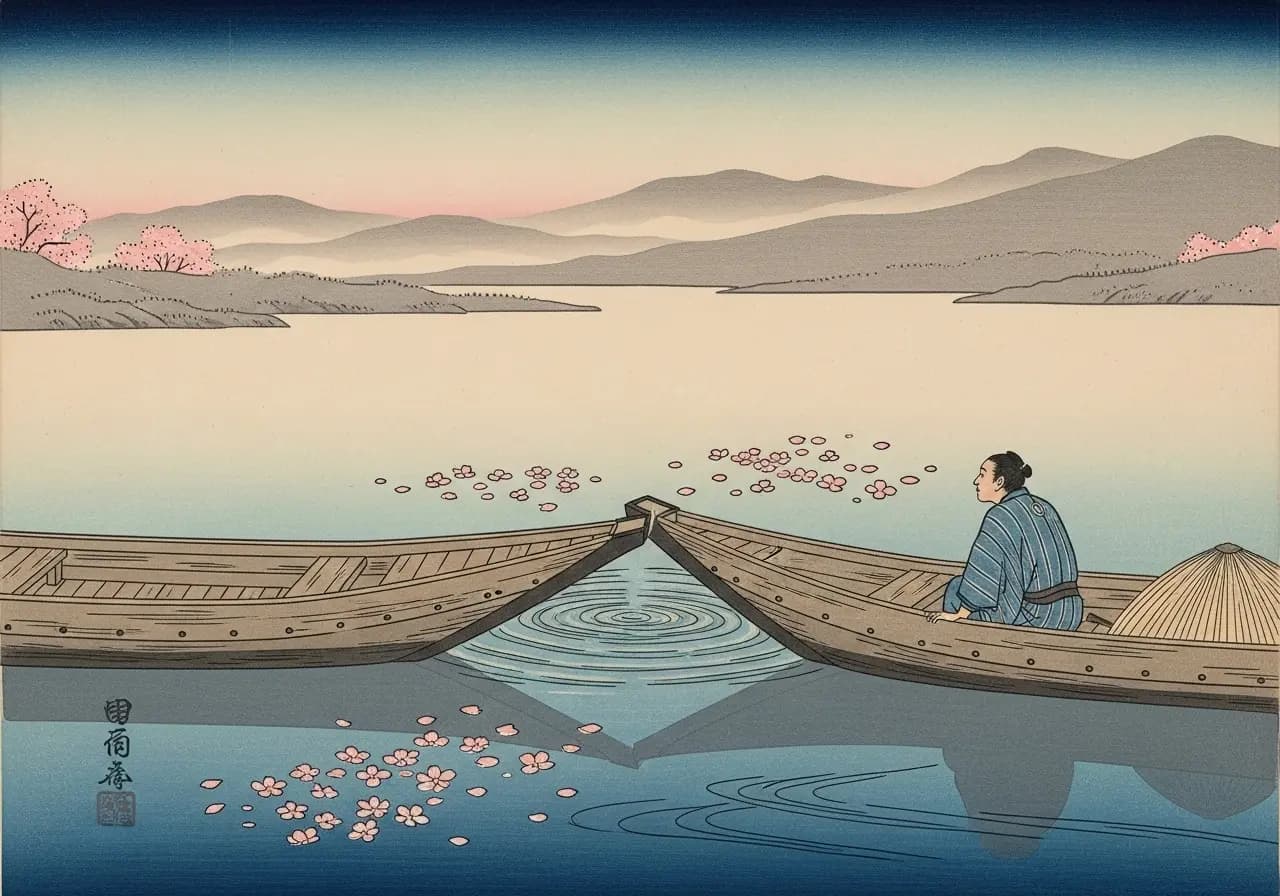
The Empty Boat
Episode 201 of the Secular Buddhism Podcast
Hello. You're listening to the Secular Buddhism Podcast, and this is episode number 201. I'm your host, Noah Rasheta, and today I'm talking about The Empty Boat—a story or parable that offers insights into how we respond when we get bumped or jostled along life's journey.
As always, keep in mind: you don't need to use what you learn from Buddhism to be a Buddhist. You can use what you learn to be a better whatever you already are.
An Invitation to Think Differently
Buddhist teachings and concepts often challenge us to think differently about life. They invite us to question the stories that we've come to believe about ourselves and about reality. The parable of The Empty Boat certainly does this for me, and I hope by the end of this episode, it might do the same for you.
The Origins of The Empty Boat
This parable originally comes from Taoist writings, but it has made its way into Zen Buddhism with various iterations. The Taoist version tells of a fisherman out on the water at dusk where visibility is low. He sees a boat coming toward him and starts panicking, yelling at the other boat to veer off or turn away. The other boat keeps coming until it bumps into his boat.
At this point, the fisherman becomes extremely upset and starts yelling at the other person—only to realize there's no one in the other boat. The boat was empty.
In the Zen tradition, another version involves a monk who takes a boat out to the middle of a pond to meditate. After hours of peaceful meditation, eyes closed, he feels the jarring blow of another boat bumping into his. Immediately, anger arises, but when he opens his eyes, he realizes there's no one in the other boat. Perhaps it had become untied and was simply drifting.
In that moment, the monk achieves a new level of understanding: realizing that anger is found within. It sometimes just needs an external object to be provoked.
The Heart of the Teaching
For me, the essence of this teaching is to imagine yourself floating peacefully down a river. The water is somewhat still, the sky is clear, everything seems calm and easy. Then out of the blue, bam—you get struck by another boat.
Immediately, you feel frustration and anger arising. Who could be so careless? Why wasn't this person paying attention?
Then you look up and realize the other boat is empty. No one is in it. It was just drifting along the current, just like you.
What happens to your anger in that moment?
For me, typically it would subside or perhaps even disappear entirely if I realize there's no one in the other boat. And that's what I find powerful about this story: nothing about the physical details of the encounter changes. The boat's there. The boat got struck by another boat. Those facts remain the same, but the story about what happened and why it happened can shift dramatically.
That shift in perception can soften our experience completely.
The Deeper Truth
I think the deeper truth this parable points to is that much of our suffering doesn't come from what happens. It comes from the meaning we attach to what happens. And this aligns perfectly with core Buddhist teachings about how our perceptions and stories create our suffering—not the external events themselves.
Real Life Complications
Now, in the past when I've shared this story, people have said, "Well, that's a nice story, but in real life, there are actually people in those boats. Sometimes people are careless, and it's their careless decisions that led their boat to crash into mine. The person who cut me off in traffic—they're in their boat. They're a real person making choices that affected me."
And I would say, well, certainly that's true. So let's explore some variations of this story that might feel more relevant to our daily experiences.
Variations on the Theme
Imagine that you're floating along the river, everything's calm, everything seems nice. You relax, maybe even drift off a bit while you're enjoying the sun. And then bam—there's the other boat. You wake up angry, but you realize the person in the other boat was also napping or relaxed or just not paying attention, just as you weren't. They were just as surprised by the unexpected contact as you were. That's one way to look at this story.
Another is to consider the version where it's the monk. But what if that bump happened, the boat gets bumped, and when the monk opens his eyes, he sees another monk who had also been meditating for hours in their own boat? Here you have two people both engaged in something meaningful, accidentally bumping into each other. Is anger the appropriate response?
Or you could imagine a scenario where it's not another boat at all. What if it was a log or a tree that fell into the river—something completely natural and without any intention whatsoever?
The idea is that with these alternate variations, you can realize that a key insight remains: maybe this isn't all so personal. Maybe I don't need to make this all about me. Maybe the collision, whatever form it takes, isn't about me at all.
Life as a River
I like to think of the river or the body of water as symbolic to life itself. We're all being carried by the flow of life. We're carried along by things that happen, by stress, by our conditioning, the emotions that we carry, by everything we've learned since childhood and by our day-to-day lived experiences.
The stresses from yesterday that are still weighing on our minds, the fears about tomorrow, the things that are happening right now—all of this carries us along like a current.
Sometimes we're awake and paying attention. Sometimes we're not. Sometimes we're napping. Sometimes we're distracted. Sometimes we're focused on something specific like fishing, where we're so focused on what's at the end of our line that we don't see other boats headed our way.
The truth is, sometimes our boats knock against each other. We bump into each other, and that doesn't make these collisions okay. It just makes them part of the human experience—which is, for me, the essence of the teaching of the first noble truth: that life entails suffering and discomfort. It's uncomfortable when another boat bumps into ours.
But the heart of this teaching is that maybe I don't have to take it personally. Maybe the impact that occurred wasn't about me. Maybe it has nothing to do with my sense of self-worth or any perceived attack on who I am.
A Shift in Perspective
And when we start seeing things this way, we can open up to not taking things so personally. We don't have to ask questions like, "Why did this happen to me?" or "How dare you hit my boat? What did I do to deserve this?"
Instead, we can simply recognize: the boat has been impacted. That's what's happened. And maybe they were asleep. Maybe they were not. Maybe they were unaware. Maybe they were aware but being inconsiderate, or maybe they just have poor judgment. But perhaps it's not a case of intentional malice.
This shift in perspective doesn't mean that we go around excusing bad behavior. It means we don't have to get stuck in these moments of impact. We don't need to carry them any longer than necessary.
We can deal with what happened, figure out what needs to be done now, and then consider how to prevent it from happening again—all while realizing that something else will inevitably happen. That's the nature of life. It's like a game of Tetris where there's always another piece coming. There's always going to be another boat that's going to come along and bump you.
Turning the Mirror Inward
What I also appreciate about this teaching is how it invites me to turn the mirror toward myself. When have I been that person in the other boat who unintentionally hit someone else's boat?
And again, let's be honest. Sometimes we're the ones who are napping. We're the ones who unintentionally cause discomfort to others. We snap at someone without realizing why. We forget to respond to a message. We show up late. These are ways that we bump into each other emotionally—not because we want to hurt each other, but because we're not always fully present.
Sometimes it happens with the very best of intentions. We're doing what we thought was the most beneficial thing or the correct thing to do, and yet we still hurt someone. Or we still create an awkward situation.
So this teaching extends both directions. It's not just about how I respond when someone bumps into me. It's also about recognizing the times when I've been the one doing the bumping, the times when I've hurt people even though I didn't intend to.
Working with Our Initial Reactions
Here's something important to understand about how our brains work: when another boat bumps into us, whether that's literal or metaphorical, our initial reaction is often instant. It's the product of a lifetime of conditioning. We don't really choose that first response. It just happens.
The person cuts me off in traffic, and my brain immediately thinks, "What a jerk." I didn't decide to think that. It just happened. That's my conditioning. That's my learned pattern of response.
But here's the thing: just because I think it doesn't mean it's true, and just because I think it doesn't mean I have to attach to it as if it were absolute truth.
So when someone says, "Well, you just need to be more compassionate," or "You shouldn't judge people," I want to be realistic here. Your initial reaction might very well be judgment. That's okay. You don't have to feel guilty about having that initial reaction. That's just how your brain has been conditioned to respond.
The practice, then, isn't to never have that judgment. The practice is to notice it and not get stuck in it.
The Power of Curiosity
Once you notice the judgment, you can introduce curiosity. "Well, they're probably a jerk" becomes "Maybe they are, or maybe they're not." Maybe they had an emergency. Maybe they didn't see me. Maybe they're dealing with something that's making them less attentive than usual.
This is where the practice of non-attachment comes in. We don't attach to our judgment as if it were the final truth.
And here's what I've found: when I introduce curiosity instead of certainty, when I ask "What if I'm wrong about this?" instead of insisting "I know this person is a jerk," the anger actually softens. It's not that I'm forcing myself to be nice or to suppress anger. It's that by introducing curiosity, by staying open to the possibility that I might be wrong, the anger naturally diminishes.
Working Through the Emotions
Now, this doesn't mean that all anger immediately goes away. Sometimes there's still anger there, and that's okay. We can allow it to be there without being dominated by it.
One thing that really helps with this is to complete the emotional cycle. If I'm angry, I need to actually feel the anger, let it move through my body, rather than try to suppress it or pretend it's not there.
And there are different ways to do that. Sometimes I'll go for a walk. Sometimes I'll exercise. Sometimes I'll talk to someone about it or journal about it. Or honestly, sometimes I'll just vent it all out loud in my car when no one's around. I'll express exactly what I'm feeling, all the frustration, all the anger, just to let it move through me and out of me.
You could even try to imagine that you're having the conversation that you wish you were having or that you wish you could have had. When I'm driving in my car, I'll just vent it all out loud. And it's not with the intent of anyone hearing it. It's so that I can feel like I said it. And it's very therapeutic. It's a way of completing that emotional cycle.
But remember: the goal isn't to change how our brain initially reacts. That's often the product of a lifetime of conditioning. The goal is not to get stuck there.
Recognize: okay, this is how I'm feeling right now, and that's okay. Then move through it rather than getting stuck in it.
So don't approach this whole concept thinking, "Okay, when a car cuts me off, I'm not supposed to think, 'What a jerk.'" There's a reason why you think that. The idea here is don't get stuck in attaching to your thought.
Just because you believe this person might be a jerk doesn't mean they actually are. Just because I think it doesn't mean it's true. Therefore, I don't have to attach to my thoughts. You can still allow the thought to be there. If that was your original thought—"What a jerk"—then fine. That's the original thought. There's nothing wrong with that.
The problem is believing that it's true or not being willing to question whether or not it's true.
The Real Teaching
The teaching of the empty boat isn't about trying to minimize the collisions that might happen in life. It's about recognizing that the meaning we attach to those moments—in other words, how we react and what meaning we assign—that's what will keep us either stuck or set us free.
And it's just a matter of perspective.
Practical Application
So the next time someone bumps into you, whether that's mentally, emotionally, or verbally, just pause for a moment. Recognize: okay, here's what's happening. My boat just got struck.
Then ask yourself a few questions:
First, is this boat that struck me empty? Is there another person in it? And if so, is that person unaware? Were they asleep? Were they doing the best that they could and they just fell short? Was this other person perhaps engaged in something that they thought was right, trying to do the best that they can?
Then flip the questions and ask: Am I the boat that struck someone else? Am I the one that struck them? Am I being unintentional or unaware?
Just give it a little thought before you decide how to proceed next, knowing that this is not about right or wrong. It's about what's the most skillful thing that I can do next as this story unfolds.
The boat has already been hit. That part's over. There's nothing I can do to change that now. All I can do is see what happens next, and what happens next is up to me.
I don't need to be caught in the cycle of thinking, "Why is this happening to me? What did I do to deserve this?" None of that. I just simply address what is happening as it is.
Okay, this is what is. Now, how do I want to respond?
Collisions with the People We Love
Interestingly, it seems that some of the hardest boat bumps come from the people that we know and love best. And this makes sense. If we think about the river as a metaphor, those closest to us are the ones whose boats are right next to ours. We're navigating or trying to navigate together, which means we're much more likely to bump into each other.
And sometimes these collisions happen because we're trying to make each other's boats go the same way or do the same thing, or we're trying to sit in each other's boats. We're different people with different wants and needs and different ways of being in the world.
We don't need to have the same boat to sail on the same sea.
When we recognize and respect these differences, we can navigate alongside each other with a little more grace, knowing these bumps are still going to happen from time to time. But they don't have to be major disruptions. They can become minor nudges that we laugh off, or we can address them briefly before continuing our journey together.
Practice and Non-Attachment
One powerful insight from Buddhist practice is learning not to attach to our initial judgments. As I mentioned before, when someone cuts us off in traffic and our first thought is, "What a jerk"—the practice isn't to never have that thought. The practice is to not attach to it as if it were absolute truth.
We can think the person is a jerk and then immediately introduce curiosity and say, "But are they? Maybe they're not."
We can introduce curiosity and open-mindedness here as a practice. We don't have to attach to our judgment that they're a jerk. Maybe they are, but maybe they're not. I don't have to cling to my certainty that I know or that what I think is actually true.
Through this process of exploration and curiosity, we might find that we conclude, "Well, maybe they're not." And just entertaining that possibility might allow the anger to diminish or even to dissolve.
Again, we're not trying to radically change how our brain works or how our brain reacts. That would just lead to frustration with ourselves and frustration that we're frustrated. Instead, we're practicing non-attachment to our reactions, not feeling certain in those moments when the collision happens, and instead cultivating curiosity.
So maintain a level of curiosity and non-attachment.
Taking Care of Ourselves
It's also worth considering here that sometimes the issue isn't with the other boats at all. It's with our own captaining.
When we're tired or we're hungry or we're stressed or just depleted, we're not at our best. Our perception becomes skewed, and suddenly it seems like everyone's trying to crash into us when maybe they're just trying to go about their day.
It's in these moments that we can recognize: the problem isn't the boats or the river. It might just be that right now I'm not a very good captain today. I'm tired or I'm hungry or whatever it may be.
And this awareness itself can help us relax and let go of some of that tension. We can take better care of ourselves and maybe say, "You know what? I'm going to rest or I'm going to eat or I'm going to take a step back." Whatever it is that we need to do so that we can once again navigate more skillfully.
Remembering the Teaching
When these little bumps happen, try to remember: this isn't personal. It happens. It's just life. That's the experience of being human.
We are boats on a river. They get struck by other boats. And sometimes we're the ones that strike other boats.
And the real question is: now what? What do we do next?
I hope as you go through your week that you will carry this teaching with you. See if you can notice when your boat gets bumped—whether it's a minor nudge or a jarring collision. Notice what stories immediately arise and what meanings do you attach?
Then pause, take a breath, and consider the story of the empty boat. Ask yourself: What if this isn't personal? What if it's just part of the river's flow?
This simple shift in perspective might not change what happened, but it could completely transform how you're experiencing what happened. And that transformation—from reactivity to intentional responsiveness, from being rigid to being more flexible—that is at the heart of what mindfulness practice offers us.
Closing
That's all I have for today. Thank you for listening to this episode of the Secular Buddhism Podcast.
If you found this topic valuable, feel free to share it with others, write a review, or consider supporting the podcast through a donation at secularbuddhism.com.
And remember, if you're looking for an online community to practice with, click on the community link on our website where you'll learn more about our community and join us for our weekly live Dharma talks and discussions. They take place every Sunday at noon, mountain time, and we discuss topics just like this.
That's all I have for now, but I look forward to recording another podcast episode soon.
Thank you for listening. Until next time.
For more about the Secular Buddhism Podcast and Noah Rasheta's work, visit SecularBuddhism.com