

The Music of Connection
Episode 200 of the Secular Buddhism Podcast
Hello and welcome to another episode of the Secular Buddhism Podcast. This is episode number 200, and today I wanted to share an experience that led me to reflect deeply on connection, perception, and the way we assign meaning to our experiences. As always, keep in mind you don't need to use what you learn from Buddhism to be a Buddhist. You can use what you learn to be a better whatever you already are.
A Dance Competition
This experience took place at a dance competition. I actually just got home from the dance competition today. My wife runs this dance competition, and I help manage the technical equipment that the judges use to score each performance. This allows me to watch every routine, and over the past couple of days, I've seen well over 100 dances and listened to approximately seven hours of music. I had this profound experience, and I came home wanting to share my thoughts on it.
Dancers, their parents, coaches, and choreographers put a lot of thought into selecting the perfect song for their performance. I always enjoy the wide variety of music that comes through at these events. While I was watching and listening, I began to pay close attention to the lyrics of certain songs. There was one song in particular that caught my attention. A dancer moved gracefully across the stage to a song with lyrics that spoke of heartbreak, loss, and eventual healing. As I sat there watching, I found myself deeply moved—not just by the dance, but by how familiar those emotions felt to me.
The songwriter's words, written perhaps years ago about maybe their own personal experience, somehow perfectly captured feelings that I've had in my own life. It was very moving. From that moment on, I found myself listening a little bit more intently, trying to take in each word, noticing the emotions that certain songs evoked in me, and reflecting on why certain lyrics resonated so deeply. Some of the songs carried emotions that felt really familiar, even though they were written by someone else—someone else's words, someone else's story. And yet, in many of those lyrics, I recognized pieces of my own lived experiences.
The Question of Connection
It made me wonder: What is it that allows us to deeply connect with someone else's words, with emotions and experiences even if we've never met them? We might know nothing about them. How can a song written by a stranger make us feel understood in our most personal moments of joy and sorrow? Why do certain songs, words, poems, or even other works of art move us so profoundly?
I think these questions tie into a key Buddhist teaching: the concept of interdependence and impermanence, and even the nature of perception.
Throughout history, people have loved and lost and grieved and hoped. Someone from centuries ago could have written words of heartbreak or longing, and today those same words would still resonate with us. This is because our emotional experiences, while uniquely our own, are also universally human. In Buddhism, there's this beautiful understanding that none of us are alone in our suffering. And also, we're not alone in our joy.
The Buddha taught this concept called dukkha, often translated as suffering, but perhaps more accurately understood as the unsatisfactory nature of life. And this teaching isn't meant to depress us. It's meant to connect us, to help us realize and to remind us that the challenges we face are shared by others.
That's what I experienced while listening to some of these songs—realizing that this profound feeling I'm having has been experienced and felt by someone else, clearly, in a way that they're expressing it in words that felt as though I couldn't have said it better myself. If we've experienced loss, when we hear a song about loss, we don't just empathize intellectually—we feel it. The lyrics echo something inside us. We're not alone in our joy or in our sorrow. Our experiences, though deeply personal, are shared across space and time. It's part of the human experience.
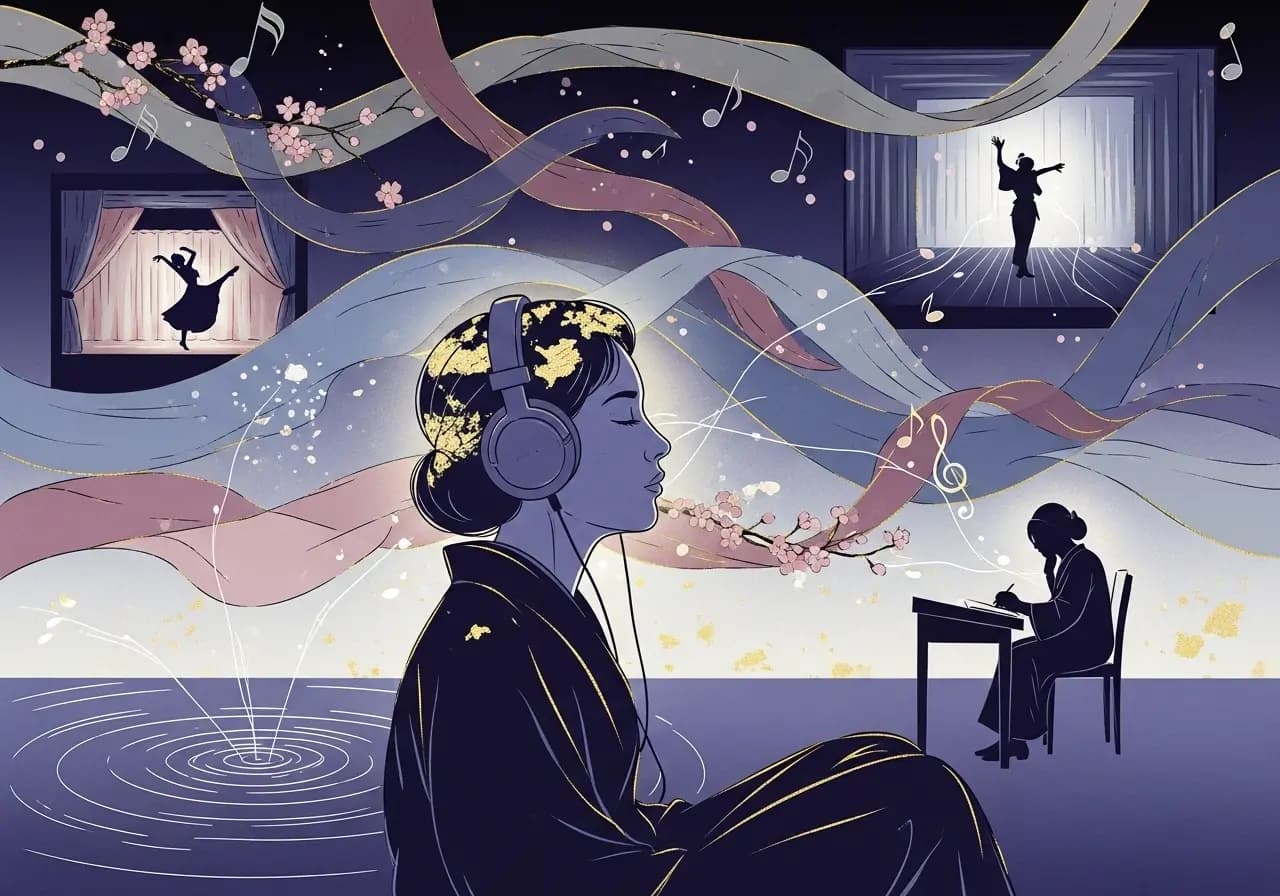
The dance performance I watched was a perfect example of this connection. The songwriter poured their experience into lyrics. A singer got hold of those lyrics and interpreted those words through their voice. The dancer came across that song and expressed through movement their interpretation. And I sat there as an observer, receiving all of this and bringing in my own connection of feelings and emotions to it. Each of us had our own unique experience while participating in a shared emotional journey. I think that's a really neat experience.
The Teaching of Vedana
This leads us to the concept of vedana in Buddhism. This is the teaching that every experience carries a feeling tone—it's either pleasant, unpleasant, or neutral. But the key is recognizing that we are the ones who assign meaning to these experiences as they unfold. The same song that might make one person cry could make another person feel uplifted and joyful. The lyrics don't change, the melody doesn't change, but the way we perceive them does.
At the dance competition, I was moved by the sorrow I heard in the lyrics. But what was interesting is recognizing that the dancer performing to this very same song was probably feeling joy and excitement because of the way they were expressing their movement to these songs, to these lyrics. So experiencing something entirely different because of where they stand in space and time versus where I do and my past experiences. This is a powerful reminder that the world is not as it is; it's as we perceive it to be. This is a concept that echoes over and over in Buddhist teachings.
Our perceptions are shaped by our past experiences, our current mood, whether we're hungry or not, the beliefs we grew up with, and countless other factors. All of these things color everything that we encounter. And what fascinates me most about this realization is that none of these experiences exist in isolation.
Think about that chain of events that occurred. The songwriter goes through some kind of personal experience and translates that into lyrics. The singer ends up performing the song. The dancer interprets it through movement. An audience watches, feels something, and perhaps goes home changed—even if changed just in a small way. That's what happened to me over the last few days. That's how I felt watching as a spectator, deeply moved by words that were written by someone I've never met, someone I know nothing about.
And then I saw it. That's interdependence in action. Recognizing that our experiences are not self-contained. They ripple outward in ways that we may never realize. I wonder if the person writing the lyrics to that song would have ever thought that somebody listening years from now, far away from where they sat when they wrote it, would feel with such depth the emotion of what was being written, and would cause that person to embark on their own series of actions. Here I am sharing teachings that come from the experience of listening to those words. That is the ripple effect.
Buddhism teaches that all things arise because of causes and conditions. Everything is interconnected. The emotions we feel, the art that we create, the lyrics that we write, the experiences we share—all of this becomes part of the greater web of interconnection where, as the Buddha said, "this is because that is." I love thinking about that. This present moment is the result of every single thing that's happened in the past. It's taken all of that for this to be this.
The Teaching of Impermanence
Another thing that struck me as I was reflecting on all of this was how emotions, like music, like the very song I was listening to, arise and pass away. I would listen to one song, and before I knew it, that song was over and another song was playing, one that had a different set of lyrics that would take me on an entirely different journey into my memories and thoughts.
I even came across one song that I thought, "You know, I remember that song used to make me really sad." And that's just how it is, right? A song that maybe once made us sad or made us cry at a different stage of life could bring us peace or joy because our relationship to those emotions changes. And this is the teaching of impermanence—that nothing stays the same, including our emotions, our perspectives, our identities.
Just as each note in a song doesn't last forever and has to give way to the next one, I think our experiences are like that. They flow one right into another. When we understand this, we stop clinging so tightly to experiences in the same way that we wouldn't cling to one note. We let the song flow.
We learn to move through life the way we move through music—just letting each note arise and then pass away, appreciating the beauty of the composition without needing to hold on to a single note and hold that note forever. That wouldn't be beautiful. That's not the experience of listening to music.
So perhaps instead of clinging to emotions as we experience them, or trying to accumulate the right emotions and the right experiences—more of this and less of that, you know, trying to avoid the wrong ones—what if instead of all that we could just see life as an ongoing, unfolding composition, very much like a work of art or a song, a sheet of music? Sometimes, yeah, it's melancholy and sad. But you know what? At other times it's joyful and happy. But it's always moving. It's always changing. One note ends, another note begins.
Life as Music and Tetris
This is what I try to convey with the idea I've brought up many times in the podcast: life is like a game of Tetris. And the pieces just keep showing up. You could say life is a lot like a song. One note ends and another note's coming. We don't always know what note is coming in the future. We don't even know the tune, right? The tune could suddenly turn into a sorrowful tune that evokes sadness, or it could evolve. At some point we're listening to a song that's very upbeat and happy. That's kind of what the experience of life feels like to me.
And just as in music, we don't need to get stuck on the note. We can allow ourselves to feel whatever arises, recognize whatever feeling tone we have with that experience as it unfolds. We could say, "Oh, this feels pleasant right now," or "This is unpleasant," or anything in between. But knowing that each moment is connected to countless other moments and none of them are going to last forever.
I love thinking about that—that you and I are part of this great symphony of existence, connected to every other person, every other being in ways that we don't see, that we don't know. I hope that you'll let yourself feel and let yourself experience while remembering that, hey, this is all just music. It's a song that's playing. It comes and it goes and it changes, but through it all, we all remain connected in this shared human experience.
I think that might be what I felt the most as I sat there listening to lyrics that made me feel—really, really feel things deeply. I felt the shared human experience. How many others have felt this? What did the person writing these lyrics feel? And how connected I felt to that person knowing that, hey, I know what that feels like. It's a beautiful feeling. And here we are in this shared human experience.
A Final Reflection
I'll leave you with this final thought to consider: What is the song like right now? The song that you're listening to in your life right now. What does it sound like? What does it feel like? What meaning are you giving to it? And can you hear beneath that melody that you're listening to perhaps the deeper music of how that connects you to everyone else, to me, to others?
And if you do find yourself caught in a difficult moment of your life's music, your life's symphony, remember you're not alone in that experience. We all will experience loss, heartbreak, heartache, sorrow. But we're all also going to experience joy and happiness, contentment, elation, and hopefulness. And if you are experiencing that—if you are in a joyful moment of your song—remember your joy ripples out and it touches others. Everything that we do affects everything else.
And this awareness isn't meant to try to make life's challenges feel less meaningful or to make them disappear. I think the goal is just to try to put things in a larger context—a context where we recognize we're all creating the song and the music of our life. We're all performing to it, and we're all experiencing this grand composition of life that is a lot like music together.
Those were the thoughts I wanted to share with you. If you enjoyed this podcast episode, feel free to share it with others. And if you'd like to join our online community or support the work I'm doing with the podcast, you can always visit SecularBuddhism.com to learn more.
That's all I have for now, but I look forward to recording another podcast episode soon. Remember, life is like music. It's always changing, always flowing. I hope you'll learn to listen to it deeply.
Thanks for listening. Until next time.