

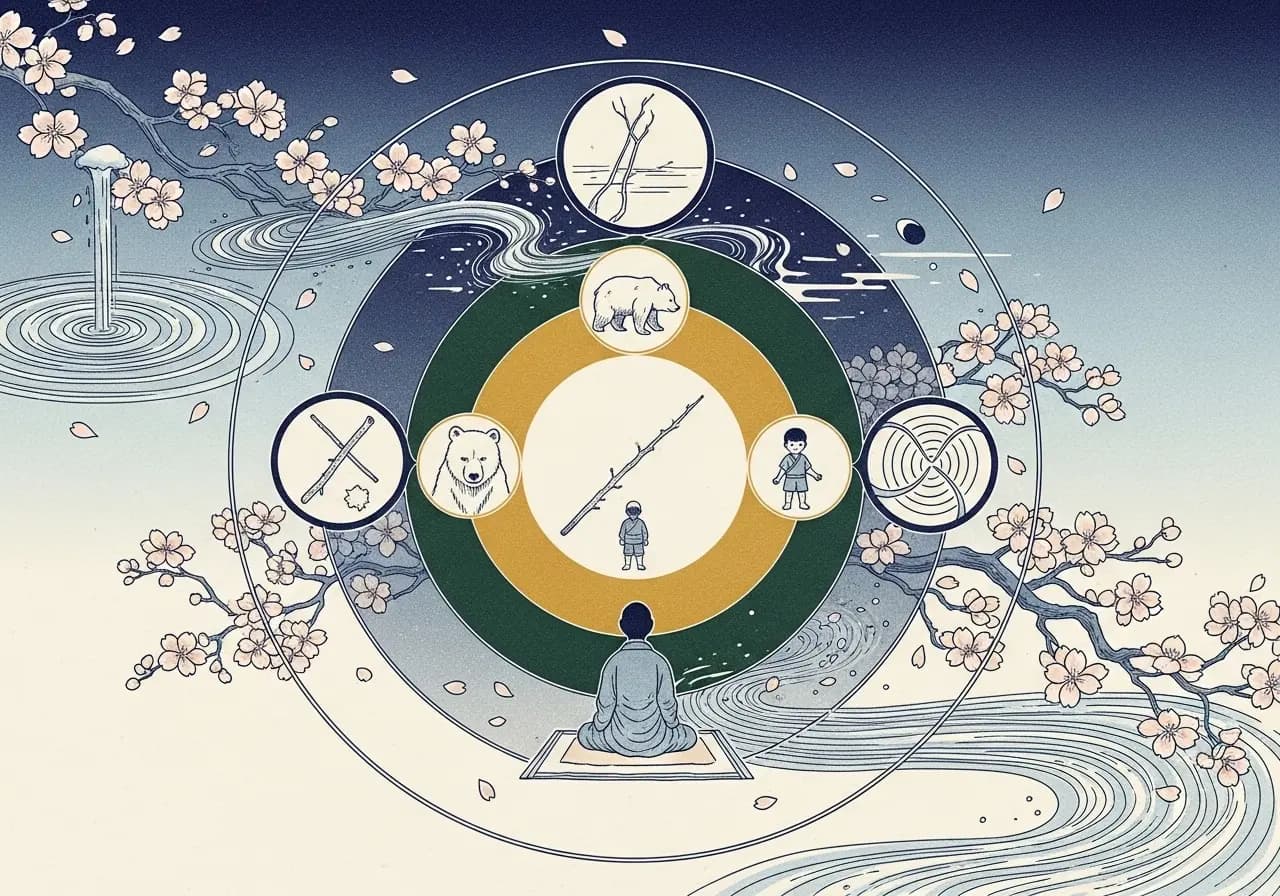
The Question of Good and Evil
Episode 20 of the Secular Buddhism Podcast
Hello. You are listening to the Secular Buddhism podcast, and this is episode number 20. I'm your host, Noah Rasheta, and today I'm talking about the question of good and evil. So let's get started.
Welcome
Welcome back to the Secular Buddhism podcast, a weekly podcast that focuses on Buddhist concepts, topics, and teachings presented for a secular-minded audience. The 14th Dalai Lama has said, "Do not try to use what you learn from Buddhism to be a Buddhist. Use it to be a better whatever you already are." Please keep that in mind as you listen to this episode.
If you enjoy the podcast, please share it with others, write a review, or give it a rating on iTunes. And if you're in a position to help, I would encourage you to make a one-time donation or become a monthly contributor to the podcast by visiting SecularBuddhism.com.
Now let's jump into this week's topic.
The Reality of Atrocities
On the topic of good and evil, I wanted to start out by saying "in light of recent events," but the more I thought about this, the more I realized it's not just recent events. For years and years now, if you look at the news, you'll see we've had catastrophes and attacks—all sorts of man-made problems. Terrorist attacks happen almost on a daily basis in countries like Iraq and Syria. And then of course we had the shooting here in Orlando a couple weeks ago. There are always, it seems, things in the news that remind us of the evils of the world.
I wanted to talk about the topic of good and evil in the Buddhist sense, specifically how we are to view or cope with the fact that atrocious things are committed almost on a daily basis all around the world. What is the Buddhist view of that?
The Western Understanding of Good and Evil
To understand this, we need to first discuss the dichotomy of good and evil as it's understood in our Western culture—the Judeo-Christian background and our way of thinking about good and evil. In this worldview, evil is usually perceived as the dualistic, antagonistic opposite of good, in which good should prevail and evil should be defeated.
It's like an ongoing war of good versus evil, and I think we're all familiar with that concept. That's very much the way of thinking we've inherited culturally. If you look it up on Wikipedia, you can get an idea of the origins of good and evil. It's pretty fascinating to see where it starts and how it spread throughout history.
The Buddhist Non-Dualistic View
In the Buddhist non-dualistic worldview, both good and evil are part of an interconnected reality that encompasses all things. Everything is interdependent with everything else. And if you'll recall from past podcast episodes, I've talked about the analogy of a car and the understanding that there is no such thing as "the car" in isolation. You can take apart all the pieces of a car, but which piece would you pick out and say, "This right here, this is the car"? The car was always all of those parts working together.
The same applies to a cake. You can look at a cake, and it's there, but there are components that make it what it is. There is no cake, per se, that exists independent of the parts that make a cake: the flour, the sugar, the heat of the oven, the container holding the ingredients, and on and on. All things are interdependent with all the things that allow that thing to exist.
There's a Zen expression that says, "For every mile you walk east, you are walking a mile west." This acknowledges the very idea that east requires the idea of west for east to even exist. You can also apply this to the sense of self that we have. Self only exists because we have the sense of "other"—self and other. When in reality, all there is is just what is.
Applying Interdependence to Good and Evil
Applying this to the thinking of good and evil, from the Buddhist worldview, is very similar. The only reason there's good is because we reference it in terms of what we consider to be evil. So good and evil cannot exist without each other. What would be evil unless it was the opposite of what we consider to be good?
In Buddhism, there's just oneness. "All things are one." So this concept can be a little tricky when we're thinking about specific events—the atrocities that we see on the news. Examples include the Holocaust or mass shootings, so many forms of atrocities that are committed. It's hard to look at something like that and not want to just label it as pure evil, or think that the only way this could have happened is to be inspired by some source of intrinsic evil because it's so atrocious and so not what we would do.
I want to explore this concept in relation to interdependence. If all things are interdependent, where or how does good and evil fit into this equation?
The Story of the Stick
To illustrate this, I want you to imagine the following story. Imagine a kid comes home from school and he's upset because he was called a name or something happened at school that made him upset. So he comes home and talks to his dad and tells him what happened at school. His dad says, "Okay, I understand that this makes you upset. Of course it would feel bad to be called a name at school, but let me teach you a lesson about this."
To teach the concept of interdependence, the dad picks up a stick and starts tapping the kid on the head, harder and harder. The kid is saying, "Why are you doing this? Stop whacking me with the stick!"
Finally the dad puts the stick down and asks, "Well, are you mad?" The kid says, "Yeah, I'm mad. Quit hitting me with that stick. I was trying to tell you what happened at school."
The dad says, "Well, why are you mad at me? I'm not the one that hit you. The stick is the one that hit you."
The kid replies, "Well, that's stupid. I'm not mad at the stick. You were the one holding the stick."
The dad says, "Ah, okay. Well, let me teach you a lesson here. In this example, how easy was it for you to understand that it would be pointless to be mad at the stick, because the stick was being controlled by something else?"
Then he goes on to explain the concept of interdependence: the things that happen to us are interdependent with the things that cause those things to happen.
Finding the Root of Harm
The idea here is that when something happens, we can be offended at the stick, mad at the stick, or we can understand that the stick is being controlled by something else. If you understand that and understand the nature of interdependence, it makes it very difficult to pinpoint the one thing that you should really be mad at.
For example, am I mad at the actual word that I was called? Am I mad at the mouth that spoke the word? Am I mad at the person who was controlling the mouth? But even there, am I mad at him for saying that to me, or am I mad at maybe his parents for teaching him that was a normal way of treating others? Maybe he was called those names growing up.
And this goes on and on, right? There are always causes and conditions to all natural phenomena, which means all things that happen happen because of the things that make those things happen. So it becomes this intricate web of interdependence. When we isolate an event, it can be easy to want to pin it on something that we think is inherently there—for example, evil, or the concept of maybe the devil. To think, "Okay, well there's this source of evil, or the devil made this person do it," makes it really easy to stop feeling any sense of responsibility.
Understanding interdependence makes that very different, because then we can just pin it on one thing and be mad at that, whatever that is. But when we understand interdependence, it makes it a lot more difficult to feel hatred.
The Distinction Between Anger and Hatred
We can certainly feel anger and frustration. Being mad at what happened is very different than hating the person who committed something. If we understand interdependence, we understand that this person is also a victim—a victim of their own ideology, a victim of their own upbringing, their societal views, their concepts, ideas, or beliefs that allowed them to commit such an atrocious thing.
But from the Buddhist worldview, there isn't a source of inherent evil. This means we can't pin the atrocities committed to just label it as, "Well, that's an evil person." You can say the things that are being done could be considered evil, or what was done is horrible or heinous, but it changes the way that you view events and things that happen. It allows there to be room for compassion at every step.
For example, if I take a stick and I hit you with it, and you lash out at the stick and break the stick, there can be compassion for the stick, thinking, "Oh, that poor stick. It wasn't even the stick; it was my hand that was controlling the stick." And yet your anger took out the stick but didn't ever understand or realize that it was me controlling the stick.
This is kind of what we do all the time when we interact with events happening in the world. It makes it very easy to want to retaliate at one level without understanding that there is a complex layer behind every step that has led to that specific event happening.
Recognizing Harm Without Hatred
I don't say this to try to minimize in any way the atrocity or the horribleness of what happened. It's perfectly fine to recognize that what's being done is horrible. But it's different to immediately experience hatred toward this person because we consider them evil.
That's the ultimate thing I'm trying to answer in this podcast: the question of good and evil.
Another way to think about this is to imagine you're in a campsite and a bear comes into the campsite. You don't just say, "Oh well, it's a bear. None of us should do anything." You would say, "Okay, well it's dangerous to be in camp with a bear. Maybe that requires tranquilizing the bear and moving it to another part of the forest, or putting it in a cage if required."
There can be action around the events that are happening, and that action can be driven still by compassion. You don't take that bear and put it in a cage and say, "I hate you, stupid bear." It would be silly. There's no anger or hatred there because, in this case, we understand a bear is just being a bear.
And yet when a human commits an atrocity, it's very easy to want to immediately retaliate with hatred. Hatred is just not useful. It's not a natural emotion. Anger is a natural emotion. Sadness is a natural emotion. But hatred is not. Hatred is a way of responding to anger or a way of responding to sadness.
What I'm trying to get across is that there are always things that are happening, and then there are complex layers of causes and conditions behind those things. That's the nature of interdependence.
Breaking Free from Duality
Too often, I think we get caught up in the duality of good and evil, making it very easy to think, "If I must be good, they must be bad." Then we're always stuck in this dichotomy of duality. There's always a duality. There's me and you, us and them—whoever "them" is. "Them" is always anyone who is not us, who doesn't think like us, who doesn't believe like us. We're always stuck in this world of duality, and it makes it very easy and natural for good and evil to fit in that paradigm of duality.
There's good and there's evil, but even that becomes very subjective. What might be completely evil for one person would be completely normal for someone else. The idea of walking around the street without any clothes on, to some, would be considered evil. While walking around without any clothes on in the Amazon jungle in a tribe of people who don't wear clothes wouldn't be evil at all.
So how do you pinpoint what is evil and what is good as inherent things? Well, we don't. The Buddhist understanding, which I think is similar to almost every major world religion, is the concept of the Golden Rule: don't do to others as you would have them do unto you. The Buddhist view of that is, "Don't do to someone else what you wouldn't want done to you," but it's the same concept, the same idea.
Understanding Harm as Ignorance
Causing harm is not intrinsically evil. It's just very unwise. Nobody wants to be harmed. You don't want to experience harm. Everyone wants to feel loved and respected, and that's our natural way of being.
From the moment we're born, we've evolved to survive one hundred percent exclusively on the time, attention, and love of another. Think of every human being who is alive now as an adult—you're only alive because you were cared for for a considerable amount of time by someone else. We just can't do it alone. It's not in our human nature. We're not born and then boom—we're independent. It takes years and years before we can be independent.
So it's our natural tendency to be caring and to want to be cared for, because it's how we evolved. It's a survival mechanism. When we understand that and we view everybody with the same natural tendency, then we can understand what must be going on. In Buddhism, we call this ignorance or delusion.
You can grow up and have ideas that are put in your head through your society, through your religion, through so many sources, through family. And they can be delusional ideas or concepts that make us ignorant to seeing reality. And inside this delusion, we can commit atrocities.
So take this and apply it to someone like Hitler. Rather than saying, "Wow, he was just an evil man, and evil is what caused all this," you can say, "Somewhere in this process, there's compassion for the fact that he was so delusional and so ignorant of reality that he was deluded by his idea that he needed to exterminate an entire group of human beings."
It's not that there was an inherent evil driving that. It's that there was an inherent ignorance or delusion that was driving it. But that's very different from recognizing there's an inherent source of good and an inherent source of evil.
The Non-Dualistic Perspective
That's the non-duality of the Buddhist worldview. It's not about good and bad, about righteous and evil. All things are encompassed in everything. Everything is interdependent with everything else.
So when we talk about the concept of good and evil, there can be good things. And I think it's more appropriate to say pleasant and unpleasant. What might be pleasant or unpleasant for everyone depends on their own scale. So we want to foster the things that are pleasant and try to eradicate or eliminate the things that are unpleasant—the things that are causing harm in the world.
And we do that by starting with ourselves. Everything starts with ourselves. We can't make the world a better place unless we're focusing on making ourselves better individually. We want to strive to be mindful and to practice compassion because it's individual compassion that creates compassionate families, compassionate societies, and it's compassionate societies that are going to make a compassionate world.
Values, Goals, and Action
So it requires action on our part. It's not just a matter of wanting things to be better; it requires action. This is kind of the idea of goals versus values. You can go through life with goals—you can have whatever kind of goals—but even more important than goals are values.
If I know what my values are, then I can use my goals that are driven by my values. So an example of this is a popular Buddhist prayer. People often ask me, "What does the term 'prayer' refer to in Buddhism? Who do Buddhists pray to, or what do they pray for?" The answer is that in Buddhism, you don't pray to anyone, and you don't necessarily pray for anything. It's just an expression that you do.
So here's an example of a popular Buddhist prayer: "May all beings be filled with loving-kindness. May all beings be free from suffering. May all beings be happy and at peace."
It's like a declaration of the values that I stand for. If that's my value statement, then my goals—my life goals—are going to revolve around my values and around my value statement.
That's the idea of goals and values. The reason I bring this up is that in light of the events that happen around the world, no amount of prayer is going to fix these things. These are man-made problems that need man-made solutions. It requires action on our part.
If I have my expression of prayer—"May all beings be filled with loving-kindness. May all beings be free from suffering. May all beings be happy and at peace"—that can be my value statement that is going to generate goals now to enact those wishes. Those goals may be what drives me to do humanitarian work or whatever action I'm taking. It can be driven by the value.
Because the prayer alone, the sentiment alone, isn't enough. I can wish for all beings to be happy and at peace all day long, but if I'm not doing anything about it, I'm not contributing to the goal that I want to see in the world.
Action and Collective Change
I think that's something appropriate to bring up because when we have these events taking place in society, we need to be mindful of the ways in which we can take action and contribute to hopefully minimizing or eliminating these acts from our society. And it starts with working on ourselves individually—mindfulness individually—and then from there it spreads until we're making a change in society.
That's the topic I wanted to share today. I would love to hear your thoughts and opinions on this. You can interact with me on SecularBuddhism.com or on the Secular Buddhism Facebook page. We also have a Secular Buddhism study group with three or four hundred members. Instead of a page on Facebook, it's a group, so everyone can interact with the posts. I usually post the podcast on there, and then we have a discussion.
And of course, another option is emailing me directly or contacting me on SecularBuddhism.com.
Closing Announcement
Before I wrap this up, I do want to quickly remind you of an exciting opportunity. We're going to Uganda from January 26th through February 4th next year, 2017. I'm partnering with Africa Promise Expeditions and with my friend Susie, who's the founder of the Africa Promise Foundation. We're putting together a fun trip that blends mindfulness with humanitarian work and adventure.
Susie invited me to be a part of these expeditions where they do humanitarian work. When she approached me, I said I've been wanting to go do humanitarian work, so I'm going to go do that. But I said, "Why don't we spend time every evening on the trip teaching mindfulness?"
So we'll essentially do a two-week workshop. Every day of the trip, we'll be doing mindfulness work in the evenings—learning meditation, learning mindfulness, all the foundations of Secular Buddhism. So it'll be like attending a Secular Buddhism workshop plus doing humanitarian work during the days. We'll be building schools, digging wells, and doing several other things.
And then there's the adventure component. Because if we're in Africa, it would be silly to miss out on some of the fun adventurous part of being in Africa. So we're going to end the trip with a safari and see all the wildlife that you would expect to see in Africa.
Again, this is January 26th through February 4th. You can get more information by going to mindfulhumanitarian.org. Feel free to contact us through that site or me directly if you have any questions. I'd be happy to answer any questions about this trip.
Final Thoughts
Thank you for listening. I truly believe that if we want to contribute to making society or the world a more peaceful place, we must start by making our own lives more peaceful. This is why I do the podcast. I'm determined to produce content and tools that will help us to be more mindful. Mindful individuals can make mindful families and mindful societies.
Your generous donations allow me to continue producing weekly content for the Secular Buddhism podcast, along with content for workshops, retreats, and seminars. So if you're interested and in a position to be able to do so, please visit SecularBuddhism.com and make a one-time donation or sign up to be a monthly supporter of the podcast.
Thank you for your continued support, and I look forward to talking to you next time.
For more about the Secular Buddhism podcast and Noah Rasheta's work, visit SecularBuddhism.com