

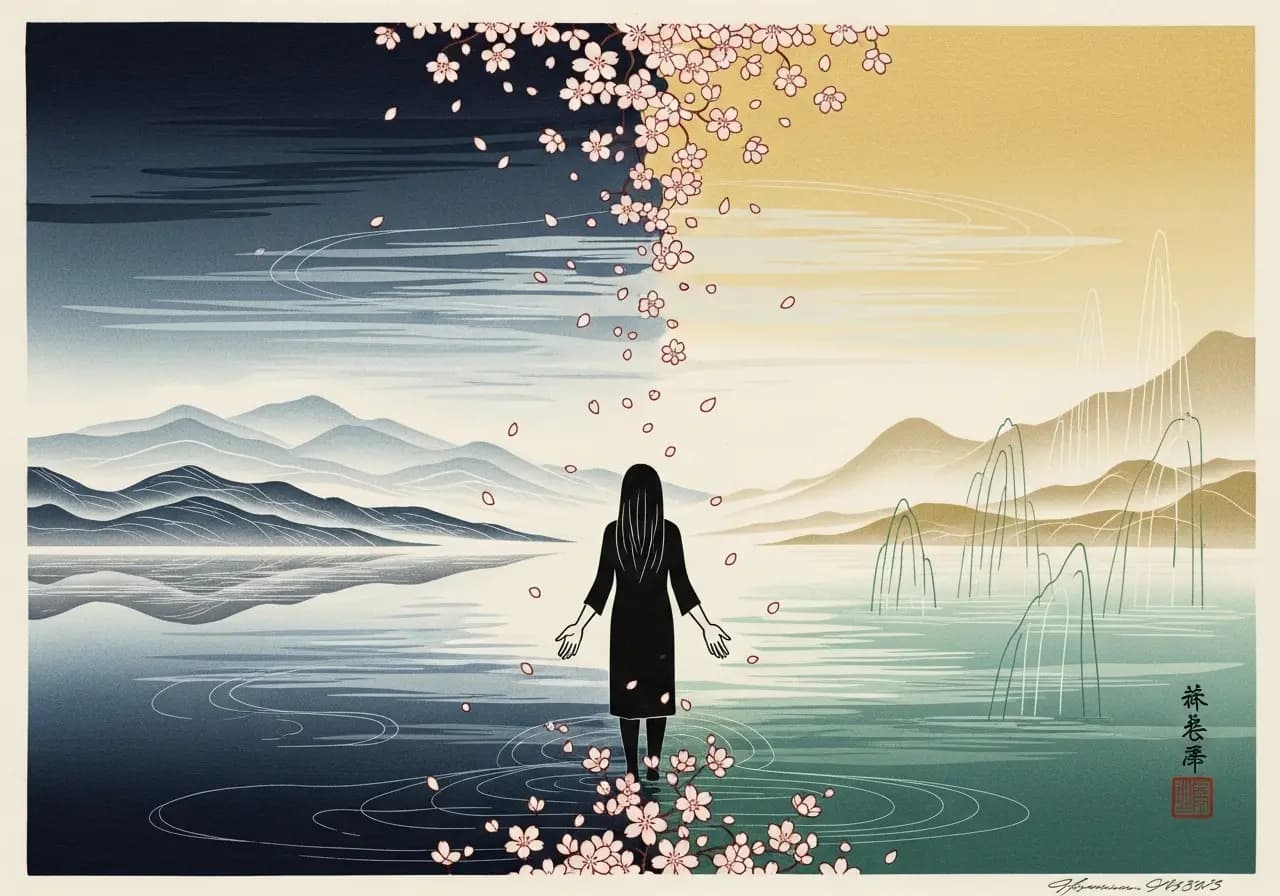
Between What Was and What Will Be
Episode 198 of the Secular Buddhism Podcast
Hello, and welcome to another episode of the Secular Buddhism Podcast. This is episode number 198. I'm your host, Noah Rasheta. Today, I want to talk about a concept that comes from Tibetan Buddhism—the teaching of the bardos—and how we can apply this idea to help us live more mindfully through all of life's transitions.
As always, keep in mind that you don't need to use what you learn from Buddhism to be a Buddhist. You can use what you learn to simply be better at whatever you already are. Buddhist teachings and concepts often invite us to think differently about life. They challenge us to question the stories that we've come to believe about ourselves and about reality. The teaching of the bardos certainly does that for me.
What Are the Bardos?
The word bardo comes from Tibetan Buddhism and literally means "intermediate state" or "transitional state." You might have heard of the book The Tibetan Book of the Dead. If you haven't, I'd recommend it—it's a really good read and was impactful for me. It's a traditional text meant to discuss the process of guiding people through the bardos of death and rebirth.
In traditional Tibetan Buddhism, there are six bardos that encompass the entirety of existence:
- The bardo of this life
- The bardo of dreaming
- The bardo of meditation
- The bardo of dying
- The bardo of the moment of death
- The bardo of becoming
Now, if you're like me, when you approach Buddhism from a more secular perspective, you might be wondering: what do these teachings have to do with ordinary everyday life? I want to explore a more secular interpretation of the teaching of the bardos—not just as something that happens when we die, but as something that's actually happening right now. This is where I think we can extract something really valuable.
The Bardo as Present Moment
What if we look at the bardos as a framework for understanding all the transitions we experience in our ordinary lives? Every moment of our lives is a bardo. We are always in transition.
Think of a bardo as the present moment—the space, the bridge between what was and what will be. Every single moment can be seen as a bardo. Each moment is a transitional space between what just ended and what's about to begin.
Think about it: right now, as you're listening to this podcast, you're in a transitional state between the moment that just passed when you weren't listening, and the moment that's happening now, and the moment that's about to arrive. This might seem obvious, but how often do we actually live with this awareness of being ever present in a transitional state between what was and what will be?
A Real-World Example
Recently I was working on an important project at work with a deadline, and I'm sure this has happened to some of you. I didn't save my work as I was going along, and my computer suddenly crashed, losing about an hour of unsaved work. In that moment, I felt a wave of panic and frustration—maybe even anger—wash over me. My mind immediately went to all the stories about how this is ruining my timeline, how now I'm going to have to stay up late to redo everything, how this is a bad thing that's happening to me.
But as I sat there staring at my screen, I remembered the notion of the bardos. I realized I'm experiencing a bardo in this moment—a transition moment. The result of my work as I had imagined it to be was gone. And now a new reality was emerging. I was in that space between what was lost and what was going to come next.
I took a deep breath and asked myself: all right, what qualities of mind do I want to bring into this new moment, this new situation? Do I want to carry forward the frustration and the anger that I'm feeling? Or maybe I can approach this with a different mindset. Just that awareness of being in a transitional state shifted my experience.
Instead of simply dwelling on what was lost, I decided to stand up, take a short break, and clear my mind. I went for a quick walk, got a drink and a snack, and then I came back. I sat down at my computer with fresh eyes and started to work again. I discovered as I was reconstructing my work that I actually found a few better ways to express certain ideas that hadn't occurred to me the first time I was working on it.
What could have been simply an experience dominated by frustration became an unexpected opportunity to improve what I had been working on. This transition—this bardo—became a space of possibility rather than just a loss. I do want to emphasize that it can be both. It was a loss. It was a loss of what was. But it was also the space of possibility for what was going to be—a possibility that wouldn't have existed if it hadn't happened.
The Six Bardos in Everyday Life
Let's look at the six bardos and apply them to everyday life. I think we can reinterpret the traditional view of these six bardos to make them feel very applicable to ordinary people like us.
The Bardo of This Life
Traditionally, this refers to the state from the moment of birth to the moment of death. But I like to think of this as our ongoing experience of being alive, growing, evolving, changing. The bardo of this life reminds us that life itself is a transition. We're always becoming, never fixed, never static.
Think about how many different versions of you there have been in your life. The you that was a child in elementary school compared to the you that was a teenager with big dreams. The you as a young adult finding your way through life and discovering who you are. The you that you are now. These are all phase transitions. Each of these phases transitions into the next, often with no clear boundaries between them.
A good reflection with this particular bardo is to ask yourself: what transitions are you currently experiencing? How are you approaching them?
The Bardo of Dreaming
Traditionally, this bardo is about the dream state experienced during sleep. I like to think of this as the space for imagination, creativity, and self-reflection. I like to think of the bardo of dreaming as the realm of possibility where we envision what could be before it actually manifests. It's not just dreaming that happens when we sleep. We all daydream from time to time.
I had a friend who spent years at a job that made him miserable. He would daydream about starting his own business, but he never really took action. It wasn't until he recognized that these daydreams were important signals—an invitation for what could be. It was a transitional space showing him a potential future. And he finally started to make the change and put in the time and effort to live his dream. He started small, working on his business idea on the weekends or after work. But over time, eventually he was able to transition fully into running his own business.
So the bardo of dreaming reminds us that our imagination is a powerful transitional space where we can explore potential futures. Every single one of us has probably had a dream at some point about what we would be when we grow up or what kind of job we might have. And those dreams—that transitional state where it's just a dream—sometimes is what it takes to set in motion the steps that do lead us to achieving the things we've thought of or dreamed of.
A good reflection for this particular bardo is to ask yourself: are you mindful of the stories that you tell yourself? Do your thoughts and your dreams serve you, or do they limit you?
The Bardo of Meditation
This traditionally refers to deep meditative states, but we can think of it as any moment when we pause, reflect, and gain clarity. It's the space we create when we step back from our automatic or habitual reactions and we start to consider how do we respond. This could happen during formal sitting meditation, but it also happens the moment that you take a deep breath and pause before reacting to something that someone said.
I remember one time in a conversation with someone I was close to, things were getting a little heated. And in that moment, I just paused. I took a breath. And instead of reacting to what they had said, I just for a moment, stepped back and said, "Let me think about what you just said." That pause—that bardo of meditation—allowed me to respond in a way that was actually serving the situation better than if I had just reacted in the heat of the moment.
The bardo of meditation is available to us at any moment when we need it. It's a transitional state that allows us to gain clarity before we move forward into the next moment. This is why meditation practice is so valuable, because it trains us to recognize and access that space of pause in the midst of our everyday lives.
A good reflection with this bardo is to ask yourself: am I mindful of the space between stimulus and response? Can I recognize that space and step into it?
The Bardo of Dying
Traditionally, this bardo refers to the process of dying, which can be a long process of letting go. But in a more secular sense, we can think of the bardo of dying as any time we're consciously letting go of something. Maybe it's letting go of a relationship that's ended or a job that we've left or a identity that no longer serves us.
I remember when I was going through a bit of a challenging time where I had been holding on to an identity that I thought I needed to maintain. But I realized it was no longer working for me, and I had to let it go. That process of consciously releasing that identity and being willing to experience the rawness of that transition—that was the bardo of dying for me.
This bardo teaches us that change often requires loss. And if we can approach that loss with awareness and acceptance, it becomes a powerful opportunity for transformation. So the bardo of dying is not about being morbid. It's about recognizing that as we live, we're constantly letting go of what was to make space for what's becoming.
A good reflection for this bardo is: what are you holding onto that you need to let go of? What are you in the process of releasing?
The Bardo of the Moment of Death
Traditionally, this is considered the moment of transition from life to death. But we can think of this as the most poignant transition between one state and another. If we apply this secularly, we might think of it as the moment we truly recognize impermanence and let go of the illusion of permanence.
This bardo is really about that moment of clarity when you're standing on the edge of transition. The old is gone. The new hasn't fully emerged yet. You're in that gap. And in that gap, there's a profound opportunity for awakening or understanding something about the nature of life itself.
I think about moments in my life where everything changed. Maybe it was the day I graduated from high school or the day I got married or the day my child was born. These are moments when I felt the old version of my life ending and a new one beginning. In that gap, in that bardo of the moment of death—death of the old, birth of the new—there was clarity about who I was and who I was becoming.
A good reflection for this bardo is: can you identify the pivotal moments where one chapter of your life truly ended and another began? What did that feel like?
The Bardo of Becoming
Finally, the bardo of becoming is traditionally the period between death and rebirth in traditional Tibetan Buddhism. But secularly, we can think of this as the period where we're actively creating the new. It's when we're integrating the lessons of what was and consciously building what's next. It's the energy and intention we bring into creating our new reality.
This is where we get to be creative. This is where we get to imagine and explore new possibilities. After we've let go of what was, after we've experienced the bardo of dying, the bardo of becoming is where we actively step into the life we're creating for ourselves.
A good reflection for this bardo is: what are you actively creating right now? What new possibilities are you exploring?
How to Work with the Bardos in Everyday Life
So we can look at all six of these bardos, and we can ask ourselves: do we actually work with this concept in our everyday lives? Again, I think the key is to recognize the transitions as they're happening. Notice: "Oh, this is a bardo. This is a transitional period that's taking place." Something is ending, something is beginning. What do I want to carry forward? What do I want to leave behind?
Buddhist practice is about learning to inhabit that space—the space between—to be fully present in that moment, to be fully aware, knowing that everything is always changing and we're always in the space between what was and what will be.
Practicing with the Bardos
Here are some simple things you can do to try to practice this or apply it to your practice throughout this coming week:
Step One: Transition Awareness
Several times each day, try to notice the transitions that you're experiencing. The transition from being asleep to waking up—that's usually the first one, right? You wake up, then there's the transition from being at home to leaving home, maybe headed to work. There's the transition from leaving the home to getting into the car. There's the transition from one road to the next road. There's the transition that starts from the moment you start work till you finish work. There's the transition that's happening from the start of a task to the end of a task, and then eventually returning home and going to bed.
These are all transitional periods. You can think of them as transitions and then try to notice them. Where does one stop and another end? Think of these all as bardos.
Step Two: Pause
After transition awareness and you're noticing the transitions, just take a pause at some of these transitions. Just take a pause and say: "I'm going to take three deep breaths—three conscious breaths where I'm very deliberate about being aware of what I'm feeling in this moment." That's really it. You notice that a transition is happening. You pause.
So you start to practice that pause.
Step Three: Reflect
Then you can incorporate reflection. With reflection, you ask yourself: "Okay, what am I carrying from that previous moment into this new one?" And we all carry things with us—whether that's propensities or mental states. Sometimes we're unaware. The song I was listening to on the radio in the car is now the song that I'm humming as I'm walking into the building at work, right? That's carrying something with you from the previous moment into the new one.
When you reflect, you ask yourself: "Is this serving me? What do I want to let go of? Or what do I want to bring with me into this new moment?" Because sometimes it's good. The mood you were in in one transition might be the mood that you want to carry into the next transition period. So just being aware, pausing, and then reflecting leads us to the fourth step.
Step Four: Choose
You make a conscious choice about how you want to enter the next moment. You might need to put in a new buffer if you need to—like the example I brought in earlier, where my computer froze and I lost my work. I knew if I just went right into it again, I might bring that frustration with me. So I said: let me put in a new bardo, let me put in a new space. And in that space, I'm going to deliberately do something different. In my case, I stood up, I walked around, I went and got a drink and a snack, and then I said, okay, I'm returning to this.
You might try this practice with simple daily transitions at first—like the transition from home to work, from one task to another. But as it becomes more familiar and the notion of transitions becomes a very common mindset that you carry with you throughout the day, you'll start to notice how you can apply this to the bigger life transitions—the transitions that carry stronger emotions from one job to the next, or big changes.
The Morning Transition
I've found that for me, the morning transition from sleep to wakefulness is a really powerful one. That moment when I first wake up, I have a choice. I can get up and brush my teeth, or I can choose to grab my phone and look at it first. Whichever decision I make shapes how I'm going to feel in the next moment.
I'm sure you've experienced this: if you go right to the phone and let's say you go right into social media or the news, you might see something that now sets the tone for what you're carrying into the next moment. Now I'm brushing my teeth and I'm also frustrated because I saw this email and all this stuff I have to do, or I saw the news and I didn't like what I saw. You understand what I'm saying there.
Making that choice of how I want to enter the next moment starts to happen with these little choices. When I wake up, what do I want to do first? Do I want to brush my teeth and maybe do some stretching? Whatever the thing is, you start to realize you can shape what you carry with you from one moment to the next. And that starts to make it so that certain choices are more important than others, especially when you first get going for the day. At least that's how I view it.
The Beauty of the Bardos
What I find most beautiful, perhaps, about this teaching of the bardos is how it can truly transform our relationship with moments—particularly with ordinary moments. When we recognize that each moment is a transition, a space of potential, even the ordinary, boring moments and experiences take on a new significance.
The Monday morning commute, the Wednesday afternoon slump, doing the dishes, waiting in line at the grocery store—all of these can be seen as bardos, as transitional states and opportunities to practice mindfulness and make conscious choices. You ask yourself: "Am I noticing? What do I want to carry forward into the next moment?"
And as I said before, this starts to apply to the bigger transitions too: changing jobs, moving homes, beginning or ending relationships, the way we carry our propensities into a new phase of life as we grow older—whatever it is. When we approach these transitions with the awareness that they are bardos, spaces of both ending and potential, we can navigate them with more grace and with more intention.
Closing
The bardos remind us that impermanence isn't just a philosophical concept. It's the reality of every moment. Everything is always in transition. And rather than being something to fear, this awareness of constant change offers us endless opportunities for renewal and growth.
So this week, I invite you to try to notice the transitions in your life—the big ones and the small ones. See if you can recognize them as bardos, as transitional states where you do have the freedom to choose what you will carry forward, what decision you will make for how you will enter that next moment. See what you're taking with you and what do you want to leave behind.
And as I always mention at the beginning of the podcast, I'll remind you again here: you don't need to use what you learn from Buddhism with the goal to be a Buddhist. You can just use these ideas to be a better parent, a better friend, a better partner, a better coworker or colleague, or simply a more mindful human being navigating life's ongoing transitions and bardos.
Thank You
Thank you for joining me on this episode of the Secular Buddhism Podcast. If you found this topic helpful, please consider sharing, leaving a review, or supporting the work that I'm doing with the podcast.
Remember, we have an online community too, where we have a weekly Dharma talk and group discussion. It takes place every Sunday at noon on Zoom, Mountain Standard Time. If that's something of interest to you, you can learn more at SecularBuddhism.com.
As always, thank you for listening. May you be present, be mindful, and embrace that space between.
Until next time.
For more about the Secular Buddhism Podcast and Noah Rasheta's work, visit SecularBuddhism.com