

A Meditator's Guide to Buddhism
Episode 197 of the Secular Buddhism Podcast
Guest: Cortland Dahl Host: Noah Rasheta
Welcome
Noah Rasheta: Well, Cortland, welcome to the Secular Buddhism Podcast. I'm grateful that you're willing to take time out of your day to discuss your new book, A Meditator's Guide to Buddhism. I've selected a few themes from the book that I thought were really interesting and that might be appealing to the audience for my podcast, and I thought it would be fun to discuss these. But first, why don't you just tell me a little bit about you? What do you do? What led you to where you are now, and to writing this book?
Cortland Dahl: Yeah, well, first, it's an honor to be on. Thank you for having me. I'm excited to connect. I have a very eclectic background, and it's always a long answer when people ask what I do because I actually have a very complicated professional career. One part of what I'm actively involved with these days is scientific research on meditation and the science of human flourishing. I work at the Center for Healthy Minds at the University of Wisconsin, here in Madison. I'm also the chief contemplative officer at Healthy Minds Innovations, which is a nonprofit affiliated with the center.
In essence, what we're doing is exploring how practices like meditation affect the body, the mind, and the brain. I think we're especially well known for our neuroscience and neuroscientific research, and then creating programs based on that science. We've created this Healthy Minds Program app, which has now been downloaded more than a million times, and we've done a lot of really rigorous scientific research on it.
I'm also very involved in much more geeky Buddhist stuff. I co-founded a community called Tergar with Mingyur Rinpoche, who's the guiding teacher of the Tergar community. This is based in the Tibetan lineage, but we have a lot of secular meditation training as well. Within Tergar, I'm the executive director of Tergar International, which is the organization that oversees the community, especially in the West. I teach meditation, lead retreats, and do all sorts of things within the Tergar community. So I have a foot in two different worlds, though there's some overlap between them.
My road to get there was pretty winding and complex, but it actually started back when I was nineteen, as a college student—more than thirty years ago now—when I started meditating.
Noah Rasheta: That's cool. It seems like you've got a lot of things that you're working on. I'll be sure to include links to all of these in the show notes and description so anyone listening can research and learn more about Cortland and what he's doing.
On the Accessibility of Buddhist Practices
Noah Rasheta: The first theme I thought would be interesting to explore is the accessibility of Buddhist practices. I usually start the podcast with an expression: "Don't try to use what you learn from Buddhism to be a Buddhist. You can use it to be a better whatever you already are." So I'm always interested in talking to someone like you who can present the scientific perspective and just the practical benefits of these concepts, ideas, and practices.
Many of the listeners of the podcast want to approach these ideas that way—not feeling like, "Oh, this is another something I need to do or be." How do you see these practices being relevant for people who are comfortable with their current worldview and may not be interested in anything about Buddhism other than some of the beneficial aspects of the practice?
Cortland Dahl: Yeah, it's a great question. That question has been at the center of many things I've done in my life. The work I mentioned from the Center for Healthy Minds is really about translating ideas and practices from the Buddhist tradition into a scientific framing so people from all walks of life can benefit from them. And it's actually not very hard because the Buddhist tradition was, from the beginning, a very human tradition. It's always been rooted in the human experience. It's not a theistic tradition in the sense of being oriented toward a God or a pantheon of gods.
There's all sorts of debates about whether Buddhism is a religion, a philosophy, or a way of life. But my take on it is that at its core, Buddhism has always been a process of exploring and transforming the human mind, really centered on some very human questions: Why do we get stuck in patterns that create and perpetuate suffering for ourselves and for others? Why do we find ourselves stuck in these patterns and unable to find our way out?
That was the question that got the Buddha started on his own path of discovery. A lot of the Buddhist tradition is still centered on that very human question: Why do we suffer, and how can we change those patterns so we suffer less and hopefully flourish more?
From that point of view, there are all sorts of practical ideas and actual practices like meditation—many forms of meditation—and because they're very centered on that human experience, I don't think the translation is that hard. It's fundamentally a very pragmatic, practical tradition.
Noah Rasheta: Yeah, I totally agree with you. I usually tell people that I view it somewhat like yoga as a practice—it's more something that you do. Or like the scientific method. It's a method, right? It's not a set of beliefs.
Within my own household here, I'm in a mixed faith marriage. My wife is LDS, and we navigate the complexities of multiple worldviews in our home. When people ask how we make that work, I always say that Buddhism works really well with almost any other ideology because it's not giving you a set of competing answers. It's giving you tools to explore the relevance of the questions, so you can be more skillful with how you deal with life's big existential questions—or even just how you deal with your own thoughts, actions, and words.
Cortland Dahl: Yeah, I couldn't agree more.
On Initial Resistance and Evolving Perspective
Noah Rasheta: You wrote about your initial resistance to certain aspects of Buddhism—like rituals and the guru concept. For me, it was very similar. I was learning about these concepts that were truly fascinating, and I wanted to go down this rabbit hole, but I was a little hesitant. How has your perspective evolved or shifted throughout your journey, from where you started to where you are now, learning more and more about Buddhism?
Cortland Dahl: At the beginning, there were certain things that I very much resonated with, particularly the practice of meditation. But some of the things that felt a little more esoteric, I didn't at all resonate with, and in some cases, I had an active allergy to certain elements of the Buddhist tradition.
Over time, almost all those things that I originally had an allergic reaction to, I've come to deeply appreciate. The big shift for me was seeing that some things can be quite profound and quite helpful, and sometimes it just takes a while to grapple with an idea, to see what's really underneath it, to have a healthy skepticism. And having healthy skepticism has always been part of the Buddhist tradition.
That's what really drew me to the Buddhist approach—it wasn't just that it was permitted to ask questions, but asking questions is actually a central part of the tradition. There's a real emphasis on putting ideas, concepts, and principles to the test of your own experience.
For me, it's that balance between being open to looking at things from a new perspective, trying ideas on in terms of my own personal experience, but also being skeptical—not just accepting things because a teacher said it, I read it in a book, or somebody I respect happens to believe it to be true.
That process of being open yet skeptical, but really open to exploring, has allowed me to gradually understand and ultimately really benefit from some of the things I originally wasn't so open to.
Noah Rasheta: That makes a lot of sense.
On Practical Rituals and Daily Practices
Cortland Dahl: So let me share a few daily practices that have become really important to me. One of the most meaningful has to do with compassion. The ritual is to pause very briefly between activities—right when I'm about to start something new. In fact, I did this right before hopping on for this podcast, and I do it all the time before a meeting, before I sit down to answer emails, or before I pick up my phone.
It can just be a few moments, and all it is is bringing to mind a compassionate motivation: "May whatever I'm about to do be a benefit not only to me and the people I care about, but may it somehow ripple out and be a benefit to others. And may whatever happens through this activity be precisely what is going to do the most good for the most people." Then I kind of just let go from there—letting go of how it plays out.
I find that by simply orienting to compassion and letting that be the guiding force—almost like infusing whatever I'm about to do with a little bit of altruism and compassion—I've found it to be profoundly transformative, not only for my life overall but actually just changing how I experience all those activities.
I started doing that at the beginning of my meditation practice because it's a very traditional Tibetan practice—this idea of "benefiting all beings" is the traditional phrase.
Another thing has to do with wisdom and insight: making curiosity a practice. It can be the simplest thing. For example, we've done some work at the Center for Healthy Minds with some of the biggest tech companies in the world on this question: How can we make technology good for us rather than something that's corrosive to our mental health and even physical health?
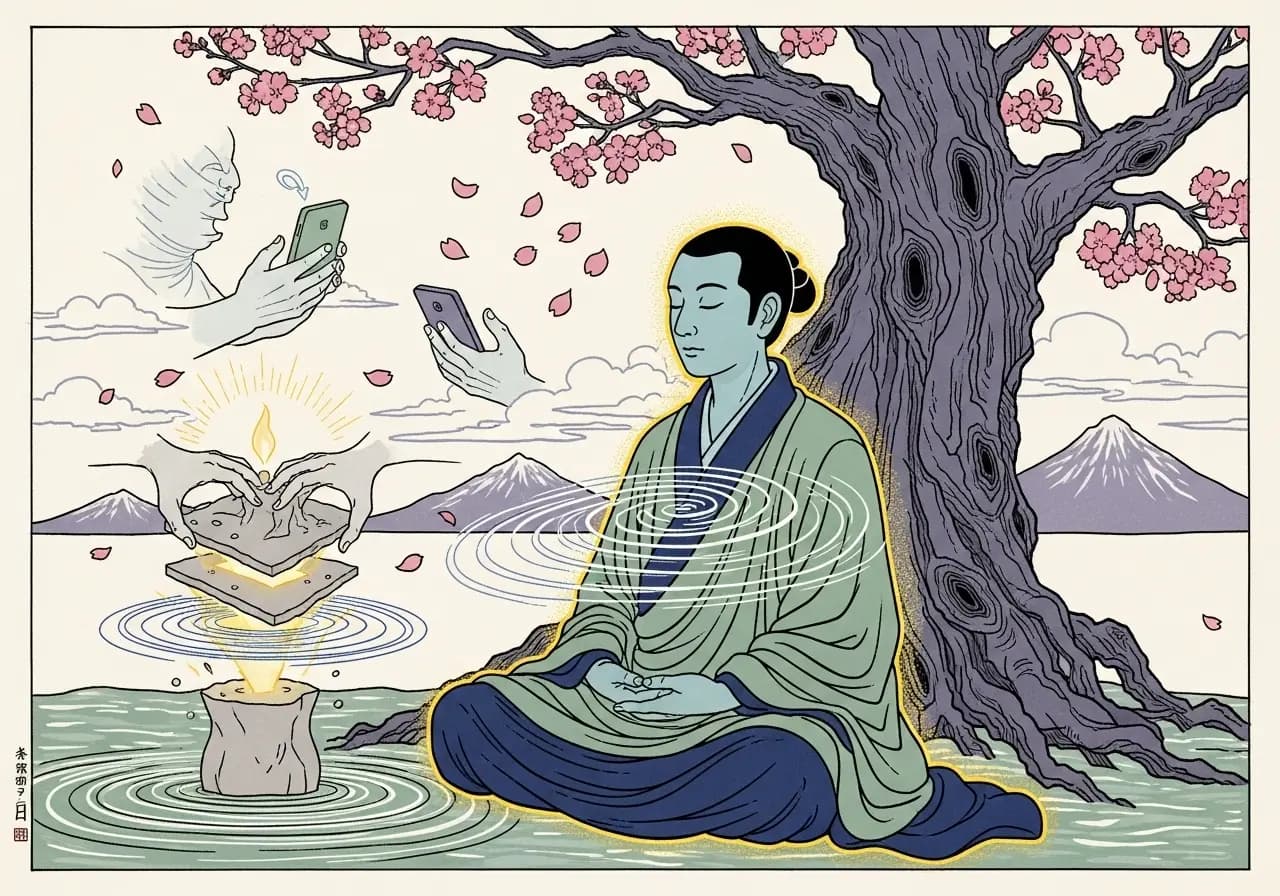
The data is kind of mind-boggling. The typical person picks up their phone 150 to 170 times per day, which just seems kind of insane, but it's pretty well documented at this point. Usually, that's pure habit energy—pure mindless habit. Your phone vibrates, you grab it, and you just go into habit mode of whatever you typically do.
But imagine that's 150 times every day. Multiply that by the days in a week, a month, a year, and it's just an incredible number of moments in our life. What if you were to infuse that with awareness, with curiosity, with kindness or compassion?
I really love using technology as an opportunity. When I pick up my phone, I first just notice that moment fully—feeling the weight of the phone, noticing the colors with a little bit more mindful awareness. And not even necessarily changing what I do, but getting curious about all of the habits that surround how I use technology.
It's fascinating to notice: Where do I go? What app do I open first? How quick is the pace? You're gaining insight into that conditioned behavior, the habit energy of the mind and brain in real time, seeing it play out as it happens. I find that just fascinating. So I'm just injecting curiosity and mindful awareness into routine activities, and then you learn so much about yourself and even about humanity and the human mind in general. It becomes a source of great wisdom.
Noah Rasheta: I love that one. That's a really good one, and I think it hits on another concept that resonates a lot for me—the reminder that meditation is not about feeling good. It's a tool to be good at noticing whatever it is that we're feeling. You echo this in the book as well.
I've been playing with this idea recently where I try to recognize that there are at least three layers of complexity to the present moment. One is the experience itself—whatever the experience is. The second layer is my awareness of the experience. And then, third, is the meaning that I ascribe to the experience.
What you were just talking about reminds me of what I'm trying to be better at: being aware of the experience as it's unfolding. So here's what's happening, but what am I noticing about what's happening? And I think when people who are relatively new to all of these ideas encounter this as a way of framing meditation as a practice, it suddenly seems like, "Oh, okay, I can see how that would be a very valuable tool to add to my toolkit."
Because, like you said, if most of us check our phone 150 times a day, we're probably not even aware of what that number is. I'm pretty sure I would be just as surprised if the answer was 200 as if it was 400. But what if you could be really aware and notice that? I think meditation is useful for that.
Cortland Dahl: Yeah, absolutely.
On Innate Qualities
Noah Rasheta: You mentioned a few times what I want to talk about next: the idea of innate qualities. You mention three qualities that are present in everyone: awareness, compassion, and wisdom. You talk about these as fundamental parts of our fundamental nature rather than something we need to achieve—something we can notice is already there.
For a lot of us, including myself, when I first approached Buddhism, this seemed very counterintuitive. In our upbringing, and I think in a lot of Western culture through Christianity, there's this notion that the natural human is an enemy to God. That's an expression in Mormonism, but I think in other forms of Christianity it's about original sin, the sinful nature of humanity, our need for salvation or redemption. So our default state is not good. But by doing all these things, then you can reach a state where things will be good.
What you're talking about seems like the opposite. It's like, "Hey, maybe our innate qualities are already these good ones, and what gets covered up through years of conditioning, concepts, ideas, and beliefs becomes more obscured. But maybe we can peel back these layers—imagine like clay hardened over a golden statue—and see what's actually underneath."
I want to talk about that a little bit. Can you explain what this means to you? This notion of innate qualities?
Cortland Dahl: You're absolutely right. I mean, the starting point—not only for Western religions, which is certainly the case, but really the way we're wired biologically—goes back to our evolutionary past. We're often wired to focus on the negative. You could say that we're wired to focus on the negative to some degree, precisely because it's helped us survive as a species. We didn't evolve to be happy. We evolved to survive.
The ancestors who survived and were able to pass on their genes—the ones who continued to evolve—were those who could stay alive. During the time of hunter-gatherers and for most of our evolutionary past, it was the ability to notice threats in the environment and then to dwell on those threats. We think about rumination and getting stuck in our heads on difficult things, and it feels very toxic, and it is toxic. But there was an evolutionary reason why our minds would just replay painful events over and over again.
Imagine you and I are out foraging in the forest, and we get attacked by a wild animal. Then we go home, hang out in the cave, and go to sleep. You sleep like a baby. You don't even give it a second thought. You've already moved on and forgotten about that difficult thing in the forest.
But I'm sitting there replaying it over and over again. I'm activating my nervous system. My brain is simulating the event, and I'm doing that over and over. Now, that's painful, right? That's not fun while I'm lying there. But guess what? A week later, if we're out in the forest and again we get attacked, which one of us survives? It's probably me. You're just enjoying your berries and hanging out, and I'm running off because I heard rustling.
So things like rumination, even PTSD and the hyperalertness that comes from that—there are very basic biological, evolutionary reasons why we respond the way we do. And so it's simply the most natural thing in the world to get focused on the negative and to see things that feel broken about ourselves or about the world.
At the same time, that predisposition to focus on the negative—what you could call a negativity bias—creates a blind spot. We oftentimes don't notice things that are so pervasive in our experience that they're like the air we breathe. We just don't even notice them because they're the normal thing, not the thing out of the ordinary that we need to worry about. It's the normal thing that's always there.
This is where things like awareness come in—which is simply put, the knowing quality of the mind. We always have that, right? It's always there for us. But we just don't notice it. We notice the stuff that comes and goes in awareness. Rarely do we take the time to attune ourselves to awareness itself.
However, when we do, we find that awareness can be a source of tremendous equanimity, energy, inspiration, a sense of groundedness and inner balance—all sorts of positive things that come from that.
You could say the same thing for the movement of kindness and compassion. Again, there are these elemental forces in our lives. And there's even interesting science behind that. Or something like insight. Again, thinking about this from a scientific point of view, we have by some estimate 80 to 100 billion neurons between our ears, every single one of us. Each of those neurons has sometimes thousands, even tens of thousands of connections.
The complexity of the wiring of our brain is incredibly powerful—just staggering in proportion. The complexity of our brains is on par with the complexity of the Milky Way Galaxy in terms of the number of stars, planets, and so on. We have that same level of complexity in our mind, and all of that complexity is a learning machine. We're constantly processing information, learning, adapting, changing. Principles like neuroplasticity show that the brain is constantly being shaped and learning in response to experience.
So the level of insight that is happening constantly in our experience—literally every single moment—is just staggering. But it's so pervasive that we don't even notice it. And most of it is actually unconscious. We're not even aware of it. So insight is just this innate capacity, and once we recognize it and see how it's playing out in every moment, then we can direct it.
Noah Rasheta: Yeah, I think my first time grasping the essence of this concept had to do with existential questions. For me, the collapse of my worldview is what led me down the path of exploring Buddhism. I approached it very much as a seeker looking for the truth. I thought I had the truth in my life, that kind of went away, and I thought I could recover it again. So I approached it with the mindset of needing to get the answers to life's big, burning questions.
But I distinctly remember the shift of realizing it's not the answer that's going to give me peace. It's not having the question. I can have the question and then I can have an answer, and if the answer feels good enough, I do have peace. But it's not a secure peace because if that question or if the answer is poked and prodded or scrutinized or called into question, my peace starts to go away because it's all anchored on the answer.
But when the need for an answer went away, the same peace was there. But now it's coming from not knowing—from uncertainty and curiosity. And that one can't be shaken because it's not centered on an answer. So I think that applies to what you're describing here.
For most people listening to this, you're probably analyzing where you are in your life and comparing that to where you think you should be or where you want to be. I think when we encounter these teachings and practices, we're still usually in that mindset of, "Okay, all of this is going to help me get from where I am to where I want to be. That's when things will be great."
But this process you're talking about—of looking inward and discovering these aren't things we need to develop but things we'll realize are already present—for me, that's the realization of, "I don't need to be any different than I am." The me that experiences uncomfortable thoughts or whatever it is—that's just fine. And then I can have this deep sense of peace with how I am, with no longing to be any other than how I am.
To me, that's simple when I think of big things like awareness or enlightenment or whatever. It's like, well, yeah, you can strive for it and think it'll be better when I achieve that. But you'll also feel the same peace when you realize I don't want to achieve that. I don't need that. Life is great just how I am now with whatever I'm experiencing.
I had a glimpse of this a few years ago when my dad passed away from cancer. In those final ten or eleven days that we had with him, going through the process of grieving and the sadness of the whole thing, there was this moment of realization that I wasn't resisting the experience. I could just go through the sorrow. I could just suddenly be crying. But it was all okay. There wasn't a part of me that felt aversion to that—like, "Sorry, I'm crying." It was like, "No, that's what you do when you lose someone you love."
And that's when it occurred to me: I don't need to be any other than how I am. This is what I'm going through right now, and fully embracing the experience. I think that's what you're hinting at here: things can be just fine how they are with whatever it is that you're experiencing. It doesn't need to be any other than how it is.
Cortland Dahl: Yeah, yeah, that's exactly it. If we think about the self-improvement paradigm—and usually we're not thinking of it that way, so the phrase "self-improvement" might sound a little odd—but it's really just the mindset of always thinking that we need to change something to get to a better experience in the future. Everything might be on a grand scale, or it might be on a little thing like, we're hungry and we need to get something to eat. But we're just always looking toward the future with the expectation that it'll be better than the present. And then the question is, what do we need to change right now so we can get to that idealized future?
This is just a whole different ball game. It's saying that the idea is not to try to swap out the experience we have now for a better one. Exactly what you just said. It could be grief. I, too, lost my father about two and a half years ago—a similar kind of thing. And it's like, "Okay, how can I get past this? How can I get beyond this? I don't like this suffering of this grief, and therefore, when I somehow move on from that, then I will be happy again."
This approach is actually saying something quite different. Rather than swapping out the experience, it's almost like we're expanding to see the fullness of who and what we are. And it's the discovery of that which brings the things we think are lacking. They come more from not seeing clearly who and what we are in the moment.
And seeing all this depth and richness to our experience, the grief can be there. But again, we're not consumed by it. We can feel the grief fully. We can honor it and let it move through our system. But it doesn't get stuck. Oftentimes our emotions get stuck in our system, and then we're carrying them around ten years later, and it's still shaping our perception because it got stuck somewhere.
So yeah, it's just a whole different way of relating to experience. It's quite different from what we're taught and what all our cultural and even biological programming inclines us toward.
On Working with Difficult Emotions
Noah Rasheta: This is a good segue into the final theme I wanted to discuss: practical application and working with difficult emotions. Could you walk us through a specific example of how someone might work with a difficult emotion using the approaches you talk about in your book?
Cortland Dahl: Yeah, so this is something I'm perhaps most geeky about: all of the different pathways through which we can learn, step by step, how to relate to experience. A lot of my work has been studying different frameworks—almost like instruction manuals for the mind—for dealing with different situations.
Actually, just last night I was leading a session in our local Tergar group. We just had this election, and it was a painful week—a really intense week. Regardless of where people are on the political spectrum, people are struggling, anxious, upset, or in some cases joyful. The whole range of human emotions.
And the beauty of it is that you can apply the same general approach really any time and anywhere. It's especially helpful when you're having a stressful reaction or struggling with an emotion. When I was young, emotion was the soup du jour in my experience, but it really could be anything.
It starts by simply noticing your own mental and emotional state in the moment. The key thing is that it's easy to immediately go into "fix it" mode. We want to change something. We want to alter something. We want to twiddle the knobs of experience. But here it's almost like we're dropping that impulse and letting curiosity drive it.
For example, when you find yourself getting stressed out or having an emotional reaction, just notice right now: What's your mental state? Is it calm? Is it scattered? Is it busy and filled with thoughts? Is it relatively peaceful and serene? Do you have any emotional response happening in the moment? If so, what is that actually like?
For me, when I was exploring anxiety back in my college days, I just brought awareness into my body and asked myself, "What actually is anxiety?" I use the term "anxiety," but what actually is it? What do I actually experience?
I noticed there would always be this buzzing energy in my solar plexus—a kind of amped-up, agitated energy throughout the body. There's usually a loop of negative thoughts thinking something bad was going to happen, playing out in my mind. It was really predictable, very repetitive. But when I was simply aware of it, it really diffused the emotional charge of it. It wasn't overwhelming anymore. It was almost kind of interesting. Eventually, it became almost like a fascinating process to observe—like somebody pressing an old recording and replaying it over and over again.
It's like, "Oh, there it goes again. It just got triggered." So you can just be aware of that. And that is a huge, hugely transformative starting point.
And then you can take that even deeper. For example, you can take the process of curiosity and inquiry deeper. You can say, "All right, I have this loop of thoughts. Whatever emotional response is happening—maybe you have a short fuse, you get angry easily, you get focused on other people and everything that's going wrong with the world, with other people, with yourself. It could be anything." And then you could just ask yourself, "Is this actually true?"
What emotional patterns and thought patterns tend to do is mask and screen out complexity. So by definition, it means we're not seeing something clearly. We're probably fixating on one thing and ignoring something else.
Once you have some awareness, you can look into that. You can say, "Oh, well, what am I not seeing here? What's being screened out? What is it?" And it's probably the positive qualities of the thing you don't like, whether it's yourself, another person, or a situation. And then you can try to bring more balance. Like, "Okay, there might actually be some negative things there. But there's probably all sorts of positive stuff that my mind, my emotional response, is just screening out. It's literally eliminating that from my conscious experience."
So again, it's not to change the response. It's simply to explore it fully and deeply and just to see how it's shaping and, in some cases, distorting the way you're perceiving things.
There are many ways to do it. What we do in the Tergar community—and I talk about this in the book—is explore the experience through the lens of awareness, the lens of kindness and compassion, and the lens of wisdom. You can explore the experience from any of those vantage points or even combining them.
There's a similar thing we do in the Healthy Minds Program app, adding in the element of purpose, which is kind of a subtext you find in these traditions. But I think the key thing is that right now, just bringing awareness to whatever your mental emotional state is and then getting curious about that and exploring it—you could do that your whole life, and you will never run out of insights and transformative new perspectives that come from that.
Noah Rasheta: Yeah, I love that. Thank you for sharing that. And I like that you mentioned it's not about changing the reaction. It's changing the relationship you have with the experience. Right?
Cortland Dahl: Exactly.
Noah Rasheta: Yeah, and I try to echo that over and over because it's a common misconception for people learning about these things. Just what we've talked about here, someone might be listening thinking, "Well, what does this say about having goals or aspirations for change? Should I just be in these circumstances forever—an unhappy relationship, an unhappy job?" And I always tell them no. Change is inevitable. Change is already going to be happening. It's about navigating that skillfully, because for some people that might be the realization, "Okay, I'm ready to do something about this." For others, it might be, "I don't need to overreact, and I don't need to change this thing right now." But there isn't an answer that's the one for everyone. It's like what you need is insight, wisdom, and then see what happens. But you'll do it more skillfully through these practices rather than just reactively.
Cortland Dahl: That's such an important point, because some of this language can sound like we're making things passive—like we're just becoming doormats for the world. But you can see from the people who are true masters of this, these traditions. These were intensely engaged people. In fact, some of the most enduring positive changes that have happened in the world have come out of this deep inner exploration.
If you look at Nelson Mandela, for example, if you read his biography, you'll see that all those decades he spent in prison, he talks about doing essentially deep meditation practice and deep self-reflection. He went into prison as kind of a revolutionary and came out as one of the world's greatest leaders—really, ever. Of course, there are all sorts of spiritual figures.
I think the key is that when we encounter difficulty in life—and it could be personal difficulty, it could be in our family, it could even be societal, like climate change, economic issues, or all the political stuff happening in our world these days—usually we try to engage that. We're all trying to suffer less, whether personally or collectively. But usually what's powering us is emotional energy.
It's like fossil fuels. It will give you some power, but it's a limited resource. It can get depleted. And it can also be toxic. So it will give you the energy, but it comes at a huge cost, and it's not there forever. You're going to run out of energy, and you're going to be depleted. It has all these negative side effects.
What you're doing, what we're doing here—and you said it perfectly—it's coming out of clear seeing, awareness, compassion. When you tap into these qualities, these innate capacities that we all have, it's like you're tapping into an inexhaustible resource. It's like you suddenly switched to solar. And the sun is not going anywhere—I guess eventually it will be depleted, but not in our lifetime, right? It's like an inexhaustible source of energy. And that's the same with these innate capacities.
When you power your engagement with the world and try to work on the challenges that we all face individually or as a species, it's just such a stronger, more sustainable way to power that process and to give ourselves the inner resources to deal with all of that.
So again, you can do it either way. It's just that one frankly creates a lot of suffering as a byproduct, and one kind of puts us in touch with an inexhaustible source of energy and inspiration.
Noah Rasheta: That's a great way to visualize this. I love that. I hadn't thought of it like that before. And for anyone listening, there are so many more nuggets of wisdom that come from this. You just need to check out the book. Cortland talks about bringing mindfulness into relationships, and there's a lot. It's a great book.
I read a lot of books, and I have these columns, you know? I put, "Oh, that was good," and then I can't quite remember what it was I liked about it. I just liked it. And then I have a column of books where I think, "Okay, these are great because they speak to people like me—people who make it practical, not esoteric. That's not going to require me to read a whole bunch of books before this one to understand these concepts."
Your book fell into that column where it's like, "This is one that's immediately on my list of, 'Hey, start here. This is a great book,' or among the first few books, because it's so easy to understand. It's very practical, easy to relate to." So I'm grateful that you wrote it. I can recommend it to people, and I can't recommend it enough to anyone listening now. You want to go check this out.
So that's the last question I want to end with. Where can people find your book? Where can people learn more about you and the work that you're doing? How can they follow along with your journey? Where can you point people to?
Where to Find Cortland Dahl
Cortland Dahl: Well, the easiest place is just my personal website, which is cortlanddahl.com. It has links to all the stuff we talked about today—the book and all of that. Of course, the book is available in any bookseller you know: Amazon, local bookstores, everywhere you buy your books.
Tergar—I mentioned it a number of times. A lot of the teachings and principles and practices in the book are very much based on what we do in the Tergar community, which is really this idea of connecting with these innate capacities. And then, if you're into the science, we didn't talk too much about it today, but the Healthy Minds Program app is completely free. There's no paywall. There's no ads. There's nothing. It's totally donation powered and freely available on any of the app stores. It's just called the Healthy Minds Program app.
But all of that—there's links to all of that on my website. So if people want to follow up, they can go to the website and sign up for the email list. There are lots of ways to stay connected.
Noah Rasheta: Great. Well, thanks again, Cortland, for taking the time. Thank you for all of the great content that you're putting out there in the world and for sharing it here on the podcast with me.
Cortland Dahl: Thank you so much.
Noah Rasheta: I really appreciate what you're doing, so thanks again.
Cortland Dahl: I love your podcast. It's an honor to be on, so I really appreciate you having me. And if you ever want to geek out about the science at some point, that might be another interesting conversation sometime. You can hear a lot of the same stuff we talked about on the Healthy Minds app, but much more from a scientific lens, and that's been really cool. So anyways, always happy to reconnect when we can.
Noah Rasheta: Yeah, I would love to. I'll check out the app, and then maybe at some point we can schedule another interview and we can go into the scientific side of things.
Cortland Dahl: Yeah, that'd be great.
Noah Rasheta: The audience would love that. That's the kind of stuff they're really into.
Cortland Dahl: Yeah, I'd love that. That'd be great.
Noah Rasheta: Cool. Well, I'll take all of this, and when I have something ready, I'll send it your way so you can see it. You're welcome to do whatever you want with it too.
Cortland Dahl: We'll put it out on our channels. We've got my social media, which are not huge, but through Tergar we have quite a huge following, so we'll put it out on our channels as well.
Noah Rasheta: Awesome. And I actually might take the video format too because why not? I do have a channel where I usually just put the audio of the podcast in, and there's no video. It's just like a little wave that's moving or whatever.
Cortland Dahl: Yeah, but that's totally fine with me. If you think it works, that's totally fine with me.
Noah Rasheta: Okay. Well, great. I won't take up more of your time, but I'll keep you posted, and hopefully we can connect again at some point.
Cortland Dahl: Great. Yeah, really nice to meet you. And yeah, again, I really appreciate you having me on.
Noah Rasheta: Yeah, you too. Thanks again for taking the time, and good luck with the rest of your day.
Cortland Dahl: Thank you. Thanks a lot. Take care.
Noah Rasheta: Take care. Bye.
Summary
In this episode, Noah Rasheta sits down with Cortland Dahl, author of A Meditator's Guide to Buddhism, to explore the practical applications of Buddhist meditation and contemplative practices. They discuss how Buddhist teachings can be relevant to people of all worldviews, how to work skillfully with difficult emotions, and the importance of recognizing our innate capacities for awareness, compassion, and wisdom. Cortland shares his personal journey from skepticism to deep engagement with Buddhist practice, the power of pausing between activities with compassionate intention, and how to transform our relationship with our experiences rather than trying to change the experiences themselves. They emphasize that true lasting change comes not from emotional reactivity but from tapping into an inexhaustible source of inner resources through clear seeing and wisdom.
Learn More:
- Visit Cortland Dahl's website: cortlanddahl.com
- Download the Healthy Minds Program app (free, no ads, donation powered)
- Learn more about Tergar at tergar.org
- Find Noah's podcast at SecularBuddhism.com