

Bodhi Day: Enlightenment Here and Now
Episode 196 of the Secular Buddhism Podcast
Hello, welcome back to the Secular Buddhism podcast. I'm your host, Noah Rasheta. This is a podcast where we explore Buddhist teachings, concepts, and ideas all through a practical secular lens.
And as I say at the start of every podcast episode: you don't need to use what you learn from Buddhism to be a Buddhist. You can use what you learn to be a better whatever you already are.
Today's podcast episode is a recording of the Dharma talk I gave earlier today in our regular Sunday Zoom calls. Members of the podcast community participate on these calls every Sunday at noon. I'll present a topic or concept as a Dharma talk, and then it opens up to discussion. Today was a beautiful discussion around the topic of Bodhi Day—December 8th—which is a Buddhist holiday. I wanted to share the audio from the recording because beyond being a Buddhist holiday, the particular topic presented in today's Dharma talk is enlightenment itself. What it is, what it means, and how perhaps we've been thinking about it wrong—as some distant thing rather than something we can experience in the here and now.
So I want to switch to the recording now and let you hear the Dharma talk. Hopefully you'll gain some insights, concepts, and ideas that might resonate with you and help you in your daily striving to simply be a better whatever you already are. So without further ado, here is the recording of today's episode.
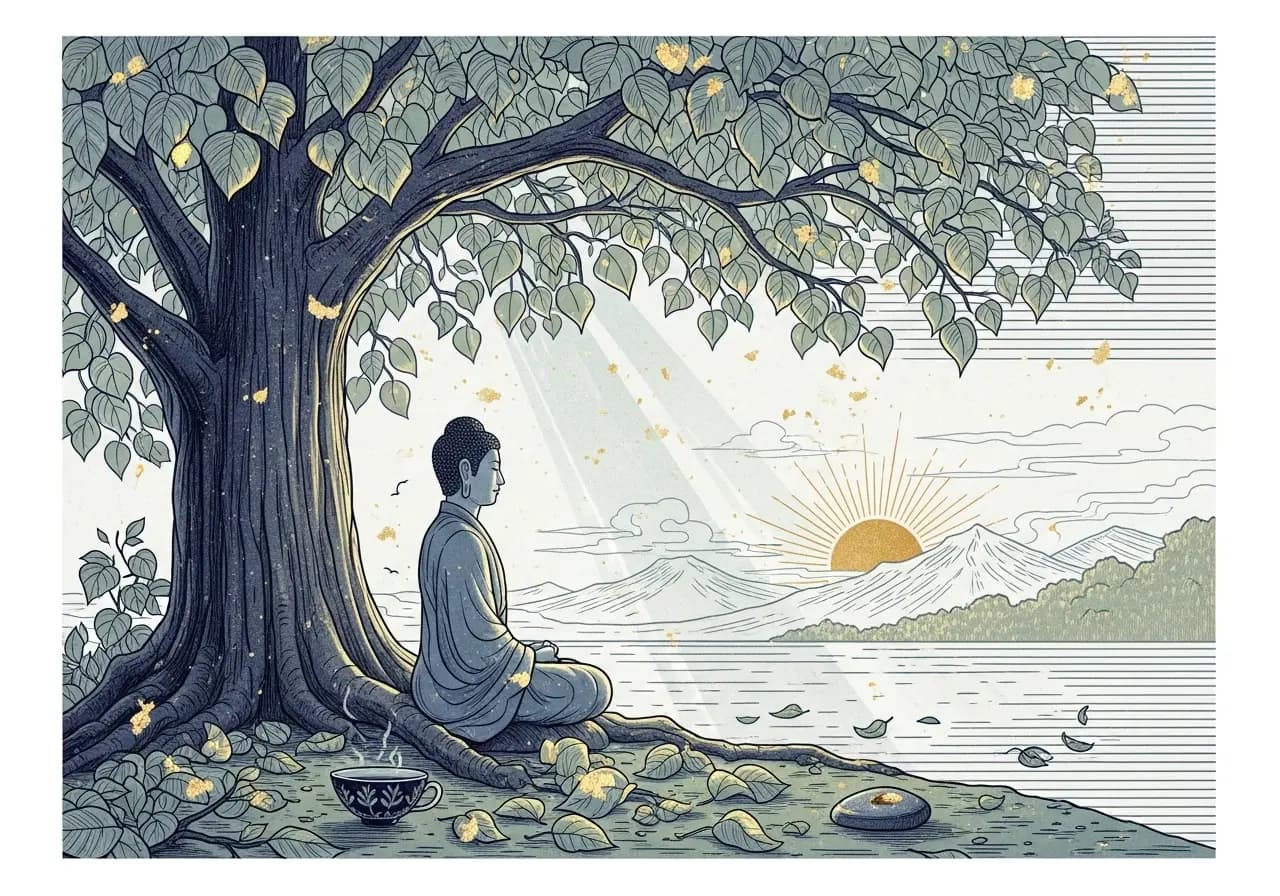
I have a topic in mind for today that I think coincides with the day itself. Some of you might know that today—December 8th—is celebrated as Bodhi Day. It's a Buddhist holiday in many traditions that commemorates the Buddha's enlightenment under the Bodhi tree. For many Buddhists, this holiday offers a moment to reflect on what it means to wake up, what it means to be enlightened—and not just for the Buddha 2,500 years ago, but for us here today in the here and now in our daily lives. I thought it would be a good topic to explore. So I'll just jump in.
The Historical Buddha's Awakening
Bodhi Day marks the day when Siddhartha Gautama, after years of searching, fasting, meditating, and working with different teachers, finally sat under the Bodhi tree. With his unwavering determination, he vowed not to rise until he discovered the truth that he had been seeking. As the story goes, after days of deep meditation, he awakened to the realities of life—the realities of suffering and liberation.
I believe this moment of awakening, of becoming the Buddha—a word or title that simply means the awakened one—wasn't so much a miraculous moment where he transcended humanity. I like to think of it as a profound moment of profound recognition of life as it truly is. A recognition of the interdependent and impermanent nature of things. A recognition of reality as it is.
Bodhi Day as Personal Reflection
Bodhi Day doesn't have to just be about celebrating the Buddha's enlightenment. I think it's a time to ask ourselves: What does the Buddha's awakening mean for me? What does the concept of enlightenment even mean? Where can I find awakening in my own life? What am I asleep to? And how might I wake up?
It's fun to think about the various ways this holiday is celebrated. Sometimes people light candles for each of the Buddha's insights—though I think that would be a lot of candles to light. Some people decorate Bodhi trees with strings of light, very similar to how we put up lights around Christmas on our Christmas trees. People spend time in meditation or simply spend time with family and friends.
But I think what's even more important is using this moment—whether in celebration or in quiet reflection—as an opportunity to consider what enlightenment really means for us individually. Is it a supernatural achievement? I don't think so. Is it something that's far away and unattainable? Personally, I don't think so. Is it something that perhaps is much closer to home?
So I would start out by asking you a question: What comes to mind when you think of enlightenment? What concept or idea arises in your head? And then at the end of this, we can open up to discussion.
I think most people think of enlightenment as a finish line. It's an ending point. It's where we finally conquer our struggles, where we finally stop making mistakes, where we finally achieve lasting peace.
But what if we thought about it differently? What if enlightenment isn't a prize waiting at the end of our spiritual marathon, but rather how we choose to move through the race itself? How we choose to move through life? What if it isn't a perfect, far-off state of being, but the way that we live our lives moment by moment?
Waking Up to Reality
I think the story of the Buddha teaches us that enlightenment begins with waking up. And waking up is about seeing the world as it is—not how we wish it to be, not how we fear it is, not how we want it to be, but just simply as it is.
In that moment, the Buddha saw that all things are interdependent. Things are always changing. He saw that suffering doesn't come from the world itself, but from how we grasp and cling and push away. And perhaps most importantly, he saw that the peace he sought wasn't something that anyone else could give him. He had to awaken to that for himself. The realization was simple: it was up to him.
You may have heard the expression that teachers can open the door, but you must walk through it yourself. The story of the Buddha echoes that. He went out and learned everything he could from various teachers, and then would move on to another, until eventually he realized: all right, it's me. If this is it, it's just me. And he sat there with that patience and determination, realizing that nobody was coming to save him. What am I going to do about this?
I think this story reminds us that while guidance and support are certainly essential, we must recognize that nobody can walk the path for you. It's your path. And perhaps that's the most empowering part of all of this: like the Buddha, we are it. You are it. You are the source of your happiness. You are the source of your freedom and your peace and the potential for awakening. Whatever that means to you in your life, it's already there, available within you.
So what does that mean for us as we navigate our normal, everyday, busy, often messy lives?
Enlightenment as Path, Not Destination
I think it's important to remember that enlightenment isn't some faraway destination. I like to think of it as the path itself. Every choice, every interaction, every moment is an opportunity to live an awakened life.
You don't have to sit and meditate under a Bodhi tree for seven days to touch enlightenment. I think it's in the way that you listen to a friend who's struggling. It's in how you respond when you're stuck in traffic or how you react to an angry coworker or to the craziness of a family member. It's in how you sit and breathe through moments of anxiety, or how you can show kindness to yourself and offer compassion to others when they need it.
I don't think that the Buddha's journey was about escaping life's challenges. I think it was about learning how to meet them fully, just as they are. And when we see that enlightenment is not something we need to be chasing, but rather something we can live, then in that moment, life itself becomes the practice. Whether we're washing the dishes, caring for our children, walking the dog, whatever it is, these everyday acts can be moments of awakening when they're done with awareness, with care, and with full presence.
A Personal Reminder
I was reminded of this just yesterday. In a previous call, I had mentioned that my wife's aunt has been battling with cancer. It was a very intense fight—about ten weeks from the day she found out she had cancer until she passed away this weekend. She passed away on Friday morning, and then everything moved really quickly. They did a celebration of life, and then yesterday was the burial and the funeral.
Leading up to that, during the celebration of life, my wife was tasked with making the slideshow. As she did that and we showed up for the services, her favorite music and artists were playing in the background. Then this slideshow appeared. As I watched it, I realized it was filled with the simplest, most ordinary moments. These were snippets of her teaching in her classroom, a clip of her dancing at her niece's wedding, a school celebration where she got up and ran and jumped into the pool.
And what struck me as I watched that slideshow was just how beautiful and how special these ordinary moments really are. And I think there's a lesson in that for all of us. We live so much of our lives waiting for the big moments, the extraordinary events. We think, "Well, I'll be happy when I get married. I'll be happy when I have kids. I'll be happy when I retire. I'll be happy when I travel the world." And meanwhile, the life that's happening right now—these are the moments that are making up our existence.
And as I sat there watching these clips of her life, all these little ordinary moments, it was like watching someone's awakening. It was like watching someone live. And I think that's what enlightenment really is. It's not some supernatural state where you're floating in the air or sitting in perfect peace. It's just being present for your life as it's happening, moment by moment by moment.
Taking Refuge
Now, from a Buddhist perspective, we talk about something called taking refuge. Refuge has traditionally meant seeking shelter or protection. In Buddhism, we speak of taking refuge in the Buddha, the Dharma, and the Sangha. These are known as the three jewels.
First, there's taking refuge in the Buddha. This doesn't mean worshipping a person or a deity. It means recognizing that the Buddha was someone who woke up. He was human. He struggled just like we struggle. And if he could wake up, if he could find enlightenment, then that suggests that we can too. There's nothing special about him that isn't also within us. So taking refuge in the Buddha is recognizing that awakening is possible for us as well.
Then there's taking refuge in the Dharma, or the teachings. In a sense, I think the Dharma is really just the wisdom of everyday life. It's the lessons that we learn from paying attention to what helps versus what hurts, what brings connection versus what fosters separation.
And then there's taking refuge in the Sangha, or the community. The Sangha originally meant just the community of monks or nuns that were practicing together. But I think today we see this in really any group of people who encourage each other while on the path. It can be your close friends. It can be the people you spend time with on Sunday at noon. It can be just the people that inspire you to be more kind and to be more understanding. We take refuge in community because we know that growth, healing, awakening, and comforting happen more readily when we support each other rather than going at it alone.
Which brings us back to tying all of this into our daily lives.
The Choice to Wake Up
I think perhaps the takeaway is this: enlightenment isn't waiting for us at the finish line. It's not about leaving your current life behind. It's not about going off to some mountain monastery. I think it's about recognizing that in each moment of your daily life, you have a choice. You can be aware or you can be asleep. You can recognize that what you do at any moment gives you the ability to be kind or to be harsh, to be curious or to be closed, to seek certainty or remain open to what might be. Whatever life's Tetris pieces might be right around the corner.
Over time, these choices and how we choose to live shape our experience and the experience of everyone around us. I believe enlightenment is about waking up to the truth that everything and everyone is interdependent. I believe that the Buddha realized that he himself was the cause of his suffering and also the source of the peace he was seeking. And that realization isn't exclusive to him. We too can wake up to the same understanding. It means that we can take responsibility for our own peace and our own joy and our own suffering.
This Bodhi Day
This Bodhi Day, however it is that you plan to celebrate, if you do celebrate, I hope that you could consider the possibility that your everyday experiences are opportunities to wake up. Whether that's just noticing your breath, noticing your body, noticing your emotions and your feelings, recognizing that how you react or respond to the people around you—those are the things that make a difference.
Understanding that your awareness, your understanding, and your compassion, those are the very manifestations of enlightenment. And they happen here and now, not in some far-off place.
And in this very moment, we are like the Buddha. We are the student and we are also the teacher. We are the seeker and the guide. I like to think of three key areas that stand out to me.
First, there's interdependence. Recognizing that everything that I do, everything that we do, the things that we do and don't do affects others. When we choose kindness, when we choose patience, when we choose to try to understand more clearly, that's not just affecting our own peace. It's also contributing to the wider circle of peace that happens to those around us and to the world as a whole.
Then there's change. With interdependence and change, we can embrace the fluid nature of life. Things change. People come and go. People are born. People die. Environments evolve, jobs come and go. But our practice allows us to adapt with grace and to not get stuck in resisting change or clinging.
And then the third key concept is self-responsibility. Like the Buddha, we are the gardeners of our own mind. We can sow seeds of understanding, of patience and love. Or we can plant the seeds of impatience, frustration, and anger. We cultivate through our actions and through our thoughts and our words. We cultivate these seeds, the plants that will grow. It's on us. We're the gardeners of our mind.
I would invite you to think about this day and carry this celebration with you throughout the rest of the day and the rest of the week—or actually, the rest of your life. Consider what waking up might look like to you.
Is there an area in your life—perhaps a relationship or a habit or a mindset—where you feel that you've been on autopilot? Sometimes the opposite of being awake isn't being asleep, but being on autopilot. Habitual reactivity, right? And what might happen if we approach these things with greater awareness and curiosity? In what ways can we wake up a little bit more today than we were yesterday? What activities can we see as opportunities to be more kind, to be more understanding, or to be more patient? And how does that change our lives and the lives of those around us?
So hopefully as you move through this week, you can consider how you might live the wisdom of the Buddha's awakening. See each moment as it unfolds and see if you can notice that for what it really is—a unique and precious moment. Honestly, it could be the moment that ends up on a slideshow at the end of your life that someone's going to be standing there watching, thinking, "Oh, what a tender thing." But we might not notice it as it's happening. But maybe we can. Maybe that's what it means to be awake.
Closing Thoughts
To close, I'll just leave you with this final thought: awakening isn't something you achieve. It's something that you practice. It's something that you live. Every smile you offer to a random stranger, every breath that you take where you're intentional and awake, every choice that you make if it's coming from a place of authenticity and integrity—perhaps this is enlightenment. Not a destination, but the path itself.
Wherever you are on your path and however that path is going for you, I hope that you'll cherish each moment that you spend while walking on this incredible path of being alive. Cherish it for what it really is—a unique moment that has never been and will never be again.
I hope you enjoyed today's podcast episode.
If you want to participate in the discussions that take place on our Sunday Zoom calls, check out secularbuddhism.com where you can learn about other podcast episodes and also learn about our online community. If you support the work that I'm doing with the podcast, we would love to have you join these discussions where we explore topics in greater detail. You can learn more about all of that on the website.
That's all I have for today. As always, thank you for listening. Until next time.