

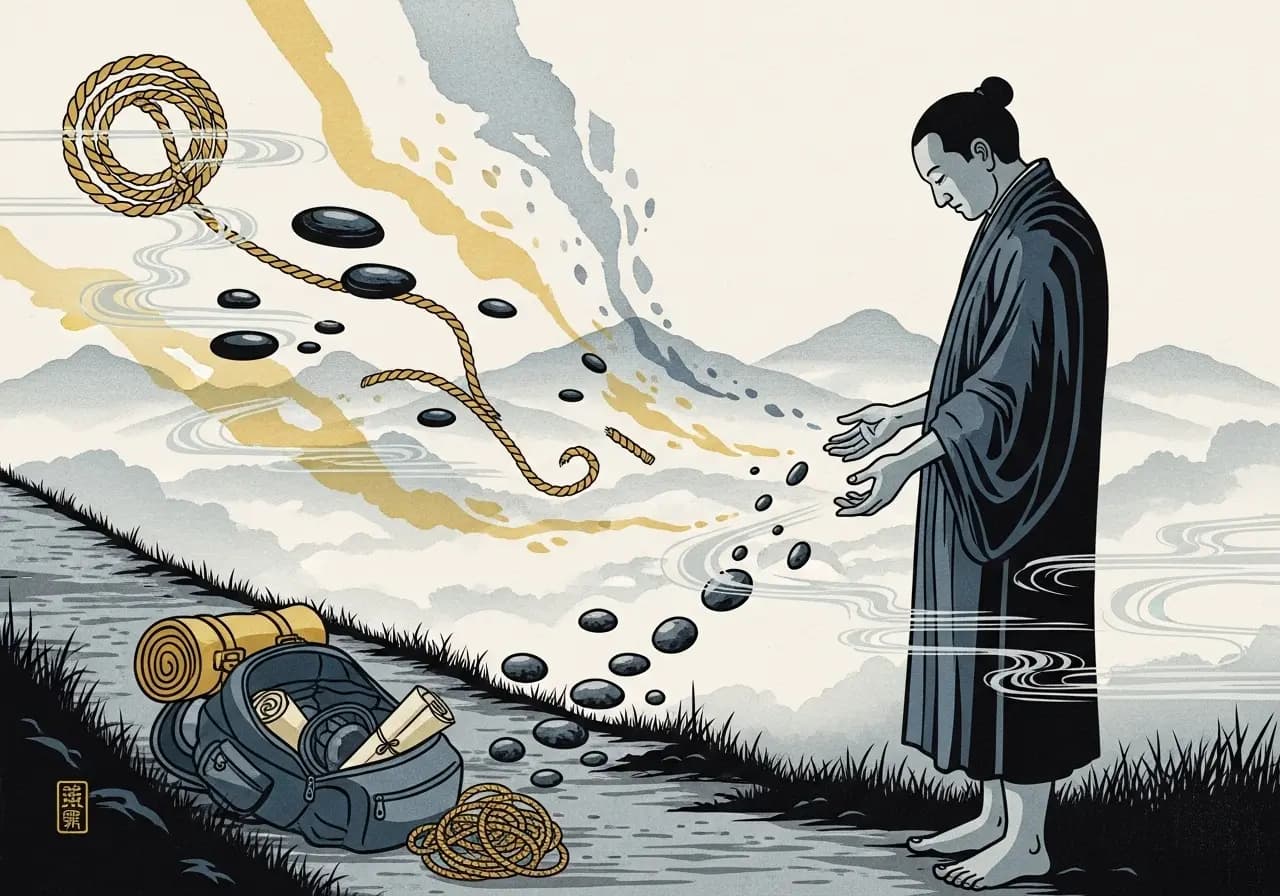
Letting Go
Episode 195 of the Secular Buddhism Podcast
Hello, and welcome. You're listening to the Secular Buddhism Podcast, episode 195. I'm your host, Noah Rasheta, and today I'm talking about the concept of letting go. So let's get started.
Opening
Picture this: you're holding onto a rope as tightly as you can.
As you hang there, your shoulders start to ache. Your hands are burning. Every second that passes feels heavier than the last. Yet you keep holding on, convinced that you can't let go.
Now imagine this—what if the pain isn't coming from what you're holding onto, but from the act of holding on itself? What if it's the grip that's causing the suffering?
What would happen if you loosened your grip? What would actually happen if you let go?
You might discover in that moment of releasing that the pain you were experiencing wasn't necessarily about the rope. It was the fact that you were gripping so tightly. It was the act of holding on.
That is the essence of today's discussion: the notion of letting go. Not as an action to force, but as a natural part of the path to freedom and liberation. I want to explore how letting go—whether of beliefs, roles, or habits—can ultimately lead to liberation. Not as a destination to reach, but as an experience to uncover.
A Quick Introduction
For those of you tuning in for the first time, hi. I'm Noah Rasheta, and this is the Secular Buddhism Podcast, where we explore Buddhist teachings, concepts, and ideas all through a practical, secular lens.
Remember: you don't need to use what you learn from Buddhism to be a Buddhist. You can use what you learn to simply be a better version of whatever you already are.
I also like to think of these concepts, ideas, and teachings—these practices that I present on the podcast—as tools. Tools for living more skillfully. Not every tool makes sense for every person in every set of circumstances. But just as if you had a giant toolkit, the more tools you have in there and the better you know how to use them, the more skillful you can be when you find yourself in a specific situation where you might say, "Oh, I have the right tool to help me with this."
That's what these are: tools for living more skillfully, no matter who you are or what path you're on.
Today's Three Takeaways
Today, I want to explore the Buddhist concept of letting go and the concept of freedom or liberation. By the end of this episode, you'll have three takeaways:
First, a clearer understanding of how attachment and clinging create unnecessary suffering.
Second, practical ways to identify and let go of the things that weigh you down.
And third, a new perspective on the concept of freedom and liberation—not as something that needs to be achieved, but as a process or a practice that you can embrace here and now.
So let's jump right in.
The Rope Analogy
Let's start with the analogy of that rope. When we cling to it, we convince ourselves that we need it—that we need it to stay safe. Yet the longer we hold on, the more pain we start to feel. And it's not because of the rope. It's because of the grip.
In our lives, these ropes can be our identities, our sense of self, the roles that we try to play, the shoulds in our lives, the way we think we should be. They can be beliefs, ideas, concepts, opinions. Think of the stories we tell ourselves: "I am a good parent. I'm a good dad. I'm a good mom. I'm a successful entrepreneur."
Or think of thoughts like "I'm not enough. I'm not smart enough. I'm not fit enough." Any form of these ideas or concepts that we might hold in our heads. These are ideas that define us.
When we hold an idea—whether that be an opinion or a deeply held belief—these things confine us. They keep us trapped.
For me, I've had several ropes throughout my life. One was the belief that I am a successful entrepreneur. I've talked about this plenty of times on the podcast, especially when discussing experiences I've had in the past and going through the collapse of my company when that happened many years ago.
Another rope might be the concept of being a good dad, a good spouse, a good husband. But what does that even mean? What does it mean to be a good dad? Instead of clinging to the concept, I've tried to learn to shift my focus to a different question: "What am I doing?"
Who Am I? Versus What Am I Doing?
This shift happens when we start continually updating the answer to the question "Who am I?"
If I were to ask you, "Who are you?" you might answer with something like, "I am..." and then fill in the blank. Whatever you use to describe yourself in response to that question, there's bound to be a concept, an idea, a belief attached to that label that forms your sense of identity.
But what if you could reframe the question? Instead of "Who am I?" what if you asked "What am I doing?"
This reframing helps me respond skillfully to whatever set of circumstances I might find myself in.
For example, if I believe "Who am I? I am a good dad," I have to define what that means. And then there's a lot that gets attached to it. "A good dad would never yell. A good dad would never lose his temper." But I'm not going to entertain that question. It's irrelevant.
What I will entertain at any given moment is "What am I doing?"
If I find myself on a particular day raising my voice to my kids, I ask, "What am I doing?" That form of inquiry with curiosity might lead to insight like, "Oh, I am really hungry, and I haven't eaten today."
I find myself asking, "What am I doing? I'm yelling at my kids right now because I'm actually just impatient and feeling hungry from not having eaten breakfast this morning. Okay, what am I doing? Okay, I'm going to go grab something to eat real quick because I don't want to feel what I'm feeling right now."
And then I find myself naturally being more patient.
By releasing the notion of good and bad, right and wrong, should and shouldn't, I focus on the one question that truly anchors me to the present moment: "What am I doing?"
The Backpack of Life
I have another analogy I like to introduce here: the backpack of life.
If you were to go on a hike—whether through the mountains, the desert, or along the beach—different paths would require different things in your backpack. Imagine carrying a backpack filled with all kinds of things. You can picture these like rocks. Each one represents something you cling to.
Some rocks are useful. Your sense of responsibility might be one of them. Other rocks might be outdated or unskillful beliefs, toxic comparisons, things that just weigh you down. And some of the things you carry are genuinely useful for specific situations. If you're hiking in the mountains, it's useful to carry a rope. If you're hiking along the beach, you might not need the ice pick or the axe you use when climbing ice. But if you're climbing a cliff of ice, you'll probably need that.
The idea here is that the backpack carries things, but not all things are useful all the time, depending on what path you're on.
I like to visualize that I have my backpack of life, and it's filled with all the things I've picked up along the way in the form of beliefs, ideas, concepts, views, and opinions. The practice for me isn't about emptying out my backpack and throwing everything out. It's not that at all.
It's about taking a moment from time to time to pause, unzip the bag, and ask: "Do I still need to carry this? Is this something that's still useful?"
I've experienced this firsthand. I've done the trek in Nepal three times now—two along the Annapurna Circuit and one to Everest Base Camp. What I packed with me on each trip was different. On one trip, I thought I'd need certain things that I realized I didn't need, so I didn't bring them on the second trip. On the second trip, there might have been one or two things I had on the first trip that I forgot on the second, but I didn't have a lot of unnecessary things. And then I refined it even more for the third trip.
I would presume that if I did this over and over and over, I would get better at knowing what to take with me. But I would never have it completely right because the circumstances of the trip might be different. On one trip, it may have rained, and I didn't have a poncho, so then I bring a poncho on the next trip. On the next trip after that, it doesn't rain, so it turns out I didn't need it, but I had it just in case.
We always have some things there just in case, but we might never need them. And I feel like that's kind of what life is like.
We're on a specific journey. For me right now, I am a parent. I am a spouse. You know, all the things that make life what it is right now all contribute to what things matter to me that I carry in my backpack.
But if I don't take the time from time to time to pause and unzip that bag and say, "What is this? Why am I carrying this? Is this something I still need?" then I run the risk of carrying a whole lot of unnecessary weight. I might find myself experiencing unnecessary difficulty on the trek of life because of the things that I carry—or don't carry.
Taking Mental Inventory
So for me, the practical exercise here is to take a mental inventory. What beliefs am I carrying? What roles am I attached to? What habits am I gripping too tightly?
Then I look at the inventory, take stock, and say, "What if I put this one down, even temporarily? I might not need this for the next several miles. And if I do, I'll pick up another one along the way or go to the store and grab another item. But I just might not need it."
I think this makes a lot of sense when we think about it with the visual analogy of the backpack of life.
The Problem of Identity
As I mentioned before, I like to think that I'm intentionally making the shift from asking "Who am I?" all the time and taking inventory in my answer to that question, and completely reframing it to "What am I doing?" That's really all that matters.
I think so much of our suffering comes from trying to have a satisfactory answer to the question "Who am I?" And in doing so, we cling to labels. "I am a parent. I am a teacher. I am a crappy partner." Or "I am a great husband. I am a successful entrepreneur. I am a failed this or that."
The problem is, every single label we use is loaded with meaning. When I say "I am a good dad," what that means to me might be very different from what it means to some other dad listening. We run into problems because we cling to our views and beliefs. Now there I am, hanging on that rope saying, "This is who I am and this is how I have to be."
The problem itself isn't the belief. It's not the rope. It's the fact that I'm gripping it so tightly. Why do I have to hang on so tight? Maybe I could let go of that.
When I shift and start to focus instead on "What am I doing?" this is a question that lives in the present moment. "What am I doing right now?" "Right now, I'm raising kids." "Right now, I'm feeling hunger." "Okay, well, then I can do something about that."
Understanding the Buddhist Perspective on "I"
It's worth noting here as a sidetrack to this topic: the question of "I" from the Buddhist perspective.
Remember the teaching of the five aggregates. In Buddhism, there's an understanding that who I am is not a single solid entity that's independent of anything else. What makes me me is the aggregate of at least my physical form, my feelings, my perceptions, my mental fabrications, and my consciousness—the overall awareness of all of this.
These things all come together to give rise to the sense of "I."
So when I'm asking "What am I doing?" or "What am I doing right now?" I'm taking into account every aspect of the "I." What am I feeling? What am I thinking? What am I feeling in my skin, my arms, my body? What perceptions am I aware of? What am I perceiving? What am I thinking? These are the mental processes. What am I aware of in general? Am I aware that I'm hungry? Am I aware that I'm experiencing anger?
I just want to make sure that's clearly understood: the concept of "I" from the Buddhist perspective goes beyond just the sense of self into all of the aspects of what make me me.
So understanding that and entertaining the idea of transitioning the center of gravity from "Who am I?" being the pivotal question to "What am I doing?" does entail more than just "What am I thinking?" or "What am I saying?" or "What am I eating?" It goes into all of it. "What am I aware of?" "What am I perceiving?" and so forth.
Letting Go as a Dynamic Process
What we can start to experience is the understanding that letting go is a dynamic process. It's not an ultimate state of being or a destination.
Here I like to visualize climbing on the monkey bars. When you're hanging from them—and if it's been a while since you've done this, you know the last time I did it, I was unpleasantly surprised at how difficult it actually is. Hanging from them is hard enough.
But if you want to actually navigate the monkey bars, you have to know when to let go of one bar to reach out and grab the next one. There's a dynamic process taking place: letting go and re-gripping, letting go and re-gripping.
Or picture a rock climber climbing a cliff. What you see is the process of letting go and re-gripping. They find a new grip, and to reach that new grip, they have to let go of the one they have. There's an art to this. When do you move your feet? When do you move your hands? But to do it skillfully, what you see is a process unfolding—a dynamic process.
If somebody is clinging to the side of the rock and not moving out of fear or for whatever reason, what you see is stagnation. They're stuck. At that point, either you let go and reach the next one, or you let go and fall to where the rope is going to catch you—assuming you're tethered to a rope, which you should be if that's the sport you're doing.
I like to visualize this in my mind as a process for skillfully navigating the cliff of life. I don't want to get stuck in the mindset that letting go means I have to let go of everything all the time. No, I have to know when to let go and when to connect again, when to grab, when to grip, how tight to grip, and when to let go.
It's a very dynamic process.
The Kite and the Bird
Another way I like to visualize this—and I've talked about it before in the podcast—is the visual of a kite flying.
You can imagine a kite, and the way a kite works is that it's tethered to a string and it's either tied to something or someone's holding it. But the fact that it's tethered is what allows the kite to fly. That's how a kite works.
But you can also visualize a bird that's capable of flying by itself. It doesn't need to be tethered. If it were tethered with its wings stretched out, it could soar the same way a kite does. But now it's quite hindered. It can't go and do all the other things a bird can do.
I feel like at different times in our lives, we're both the kite and the bird. It's a really sad sight to see a kite flying along and somebody comes and lets go or, worse, cuts that string. What's going to happen? The kite isn't flying anymore. It'll come crashing down.
But it's also a very sad sight to visualize a poor bird tethered to a string, unable to go anywhere because it's tethered.
So what I'm trying to get at with this visual is: don't make the mistake of thinking everyone's a bird or everyone's a kite. We're all sometimes one or the other, or both. And we constantly need to be re-evaluating. In this particular moment, am I a kite tethered to a string—a belief that's just no longer useful to me because I'm actually a bird?
Curiosity Over Control
I also like to think about freedom as curiosity, curiosity as a tool.
Instead of asking "What must I let go of?" or "What should I be letting go of?" don't think of it from that perspective. Think instead: what would happen if I loosened my grip? What would happen if I let go?
Not "What should I let go of?" but "What would happen if I did let go?"
Allow that curiosity, going down that path of introspective thought, to lead you to a conclusion. It might be "Okay, this isn't something I want to let go of." Or it might be "Okay, this is something I do want to let go of."
The shift from control to curiosity, I think, changes the entire experience.
In our group discussion on this topic during our weekly Zoom call, someone put it this way: "Letting go happens naturally when we're ready. It can't be forced."
I love thinking about that. I don't want the topic of letting go to morph into a new belief you adopt that says "I need to let go." You can let go of the idea of letting go. Just entertain this, again, as a tool.
The concept of letting go could be a tool. And timing is everything.
Very much like the rock climber or the person on the monkey bars, it's not skillful to let go too early in the process of swinging from one bar to the other. It's also not skillful to let go too late. Once you start swinging and you have that momentum on the monkey bars, it's all about knowing the right time to let go.
This speaks to the Buddhist notion of the middle way: not too far to one extreme, not too far to the other.
A Practice of Noticing
One way to practice this is to notice your body. Where do you feel tension, for example? Do you feel it in your shoulders? Do you feel it in your jaw?
I happen to feel tension a lot in my jaw. And sometimes I'll notice, "Wow, I'm clenching my jaw. What if I loosen that a little bit?"
That's just one place where I feel it. But through this exploration, you can say, "What are you gripping emotionally or physically?"
Often the body will give us clues before the mind catches up and figures out what's going on. So this is where it can be a practice—just noticing and bringing curiosity. Then entertain through curiosity the scenario of letting go.
What would happen if I let go of this grip? What would happen if this belief I have—if I wasn't attached to it so tightly?
What if it's not what I think it is? What if I'm not a good parent? What if I'm not a bad parent? Whatever that belief is that you're holding on to, what if that's not even a concept that's worth investing your energy in?
I know that's happened for me. The notion of "I'm a good dad" seems so irrelevant to me now. My thought process is "What am I doing? What am I doing right now?"
I recognize that I have the responsibility of other humans living in my household, and I do what makes the most sense and what feels right. But I'm figuring it out as I go. I'm not wasting energy on the thought of what it means to be a good dad, for example, because that's just a concept.
And who gets to define that? What system am I going to adhere to that gave me that definition? I don't need to play that game. It's not relevant.
But what is relevant to me is "What am I doing?" And I'm asking that all the time. "What am I doing right now?"
That's how I approach this. And that's the general idea I'm trying to convey in this overall topic: letting go isn't about getting rid of everything. It's not about emptying the backpack of life. It's about making space for what matters.
Freedom as a Process, Not a Destination
I think this is where it's helpful to recognize that true freedom isn't in having more or doing more. I think it's in needing less, or realizing that I'm only going to carry the right amount of things. No more, no less.
It's the openness to allow life's experiences to flow in and out, like unpacking and repacking your bag at different intervals for whatever the journey has ahead.
When you do a trek, you have intervals. Day one, you arrive at this place. Day two, at another place. You might notice that at these intervals, you decide, "Okay, what am I packing for my day pack for tomorrow?" It might be different than what you packed for yesterday.
When I'm sick, you can guess that I have ibuprofen or Tylenol or something in there. But then when I'm not, I don't have to have that in there.
Rather than thinking you just need to hoard and carry everything possible for every possible scenario—and that's not helpful either because now you have a really heavy backpack and you're making the hike unnecessarily difficult—that's what I'm trying to get at.
In our backpack of life, I think we do that. We carry all of these concepts and ideas and beliefs, the "shoulds" if we want to call it that. And the shoulds get heavy, and they make the trek pretty uncomfortable at times.
But what if we could let go and audit the bag from time to time and say, "You know what? I'm not carrying this thing around anymore. I don't need this thing."
All with the understanding that at some future point, you might decide, "Maybe I do want that," and you can always put it back in.
Our journey of life is an ongoing thing. Just like on a road trip, you can always stop at the next gas station and get the things you need. You don't have to have everything from the gas station in your car just in case you're going to need it.
We don't do that. We know that we're going to go until it's time we might need something else, and then you just stop and you do that.
That's one way I like to look at this, and I think it's helpful.
Questions for Reflection
I would encourage you to reflect on these questions:
What am I gripping too tightly in my life? What unnecessary weight am I keeping in my backpack?
You can visualize this as the rope analogy. You're hanging from a rope. What am I hanging on to? Why am I gripping this so tight? What would happen if I let go?
The other perspective, again, is the backpack. What is this weight? Why am I carrying all these things? Let me look through the bag sometimes. What is this? Do I need to keep carrying this? What would happen if I took this out of my backpack?
That's one set of questions.
The next question is: What would it be like if I removed this item from my bag?
Sit with that. Try to visualize yourself in the next day or two with that thing no longer in your bag. What's the journey going to be like?
You might, through that process, realize "Oh, okay, I will keep this in my bag." Or you might realize "Okay, I guess I don't need that one in my bag."
What you're doing in this process is learning to adapt, learning to modify, and making this a dynamic process of continually taking inventory and stock of what's in your bag. You're always emptying it and putting new things in. It's not becoming a stagnant thing that's just always getting heavier and heavier with more and more stuff.
Think of it like the rock climber or the person on the monkey bars. It's a dynamic process where you're continually letting go of one bar, grabbing the next bar. That's what makes the journey doable.
You're not the person who keeps getting stuck because they won't let go of that bar they've been hanging on to. Well, you can't move forward if you don't let go of that bar.
To me, that's the essence of this mental shift: trying to continually decide "Who am I?" Let's just not even entertain that. Let's shift that to "What am I doing?" and perhaps even more specifically "What am I doing right now?"
If that's a question you can answer at any given time for any of the facets of your life—"What am I doing right now as a parent? What am I doing right now with my career? What am I doing right now in my relationship?"—I think that becomes a much more skillful way to navigate this journey of life.
And it allows you to take inventory and ask sometimes, "Am I causing unnecessary suffering for myself, for those around me?" You might be, and I might be, because of what I'm carrying in this bag.
The Path Forward
Remember: the path to freedom isn't about achieving a final result or arriving at an ultimate state of mind. I think it's about embracing the process—the process of letting go, the process of taking one step at a time.
Think about walking. You place your foot somewhere that feels like "This is where my foot should go," and then you position the next foot. Then you let go of where the foot was and move it to the next spot. That happens as an ongoing process that we don't even think about.
But if you're walking very carefully and deliberately on a rocky path, you are paying attention to where you place each foot as you step and climb along. That's what this can be like. Think about it in a very deliberate way. Be careful of where you step. Be careful of "What am I holding on to right now, and when does it make sense to let go?"
That's how I'll go through this journey, rather than hoarding all the things and holding on to everything in my bag until I suddenly find myself walking around with this extremely heavy bag that makes the trek quite unpleasant and unnecessarily difficult.
Freedom, in this sense, is a continual process.
Closing
Thank you for joining me today. I hope you'll stay curious. Keep exploring, taking inventory of what you keep in your backpack of life.
And may you find peace and contentment on whatever path you happen to be on.
Remember, if you enjoyed today's podcast episode, check out SecularBuddhism.com, where you can find other podcast episodes on various topics. If you're interested in supporting the work I'm doing or joining the online community where we explore these topics in greater detail, you can learn more about that on the website.
Thank you for listening. Until next time.
For more about the Secular Buddhism Podcast and Noah Rasheta's work, visit SecularBuddhism.com