

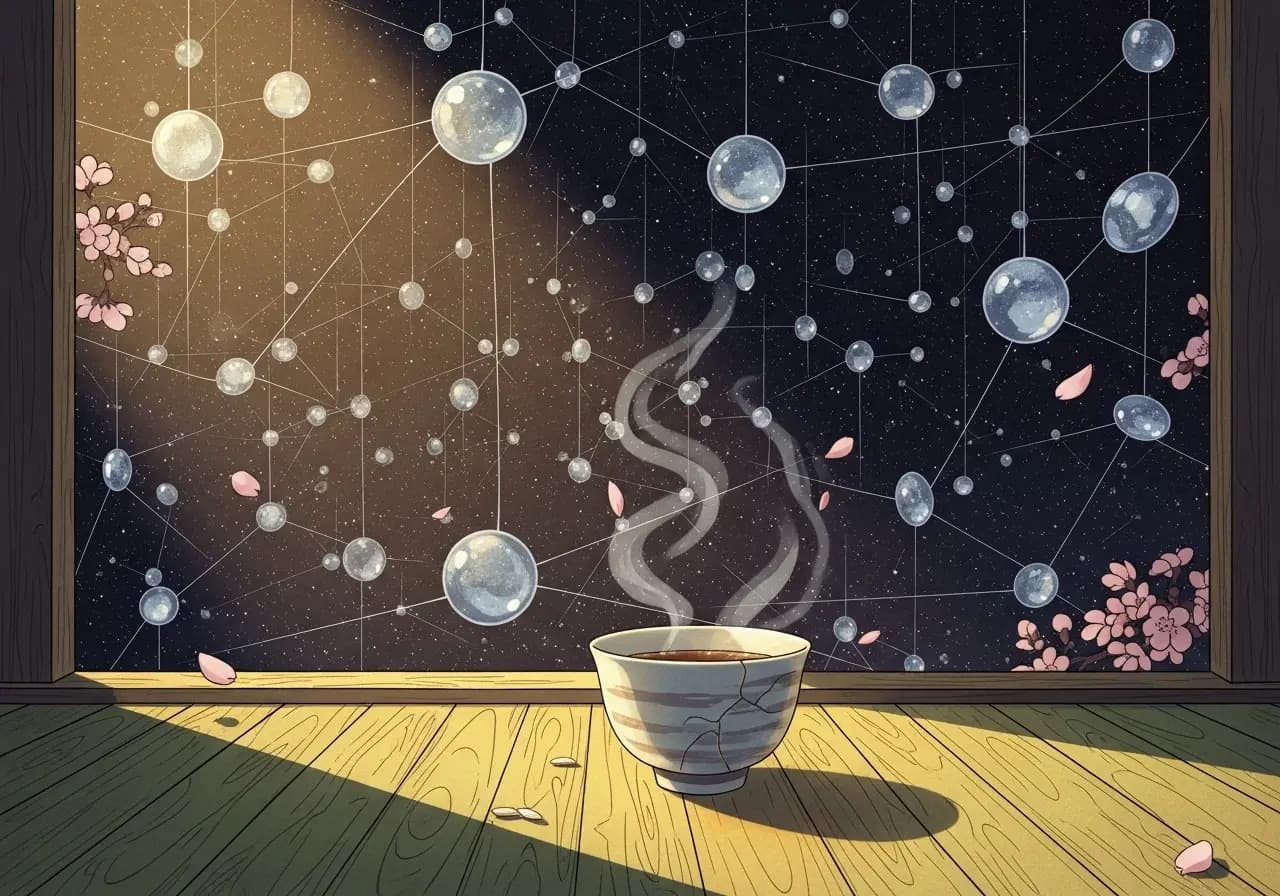
Gratitude
Episode 194 of the Secular Buddhism Podcast
Hello and welcome to the Secular Buddhism Podcast, a podcast that presents Buddhist teachings, concepts, and ideas from a secular perspective. You don't need to use what you learn from Buddhism to be a Buddhist. You can use what you learn to simply be a better whatever you already are. I'm your host, Noah Rasheta, and let's jump into today's topic.
For today's episode, I thought it would be fun to share some thoughts on gratitude, but specifically gratitude as a byproduct of awareness of interdependence. This is a time when culturally, a lot of us are thinking about gratitude with Thanksgiving right around the corner. Gratitude is a universal sentiment present across all cultures and traditions. In the United States this week, we celebrate gratitude with a specific holiday, Thanksgiving. That's part of why I wanted to share my thoughts around this topic, exploring gratitude through the lens of Buddhist teachings, a couple of Zen stories, and practices like nikyo practice.
But first, I want to emphasize something important: in Buddhism, gratitude is not a commandment. It's not something that is expected or that you're supposed to experience. It's a sentiment that arises naturally through mindfulness and awareness.
Interdependence and Gratitude
Let me start with the topic of interdependence—the teaching of dependent origination and recognizing that all things and all phenomena are interconnected. As the Buddha said, when we recognize this, gratitude flows naturally. When we see how deeply our lives depend on others, gratitude becomes almost inevitable.
Think about the farmers who contributed to planting and growing the food you're eating. Think about the workers and teachers whose education shaped you. Think about family members who helped raise you, whether that's parents, grandparents, aunts, uncles, or adopted family members. Even strangers we interact with have shaped this moment. When we look closely, we can see that everything in this present moment is the way it is because of other things.
Indra's Net
A metaphor I like to think about in the context of interdependence is Indra's Net. This metaphor comes from Hindu texts, but it's also discussed in the Flower Garland Sutra in some Mahayana schools of Buddhism. In this metaphor, every being is like a jewel reflecting all the others. It emphasizes that every phenomenon in the universe is not only interdependent but also contains within itself the entirety of the universe. Each part reflects the whole, just like each jewel in Indra's Net reflects every other jewel.
Imagine for a moment a vast net stretching infinitely in all directions. At each intersection of the net, there's a jewel—perfectly clear and reflective. Each jewel reflects every other jewel in the net, and the light of one shines in all the others. If even a single jewel is altered in any way, it will affect the reflection in all the other jewels. It affects the entire net. This is the teaching of Indra's Net, and it illustrates the interdependence of all things in the context of gratitude.
It reminds us that no one exists in isolation. Everything we have—our food, our clothing, our education, even our breath, the air we breathe—everything is possible because of countless people, actions, and forces working together to allow this moment to be just as it is. Recognizing this interconnectedness naturally gives rise to gratitude.
When we see how deeply others' efforts sustain our lives, we begin to appreciate not just the big things, but also the small, often unnoticed contributions. Think of the farmer who grows our food or the unseen person maintaining the roads when we travel. Where I live, we've had a lot of snow lately. People go out with snow plows and push the snow off the roads. They put salt on the roads to help the snow melt. Gratitude in this sense is an acknowledgment of the web of life in which we are held and supported every moment.
You can reflect on the jewels in your life—the people and conditions that shine and make your existence possible.
Impermanence and Gratitude
Through this lens, gratitude becomes not just a feeling but a profound awareness of how we're all interconnected. The teaching of impermanence also helps gratitude arise naturally. Awareness that things are constantly changing, that things end, helps us cherish the present moment and the people in our lives. And again, this gratitude isn't just for the big things. It's found in appreciating the small things—the little fleeting moments.
The Cup Is Already Broken
A Zen story that speaks to this, one I really enjoy, is "The Cup Is Already Broken." A Zen master once held up a beautiful, fragile teacup and said, "To me, this cup is already broken. When I understand that, every moment with it is precious."
I remember the first time I came across this Zen story. It really resonated with me. I came to understand that all the things in my life—whether they're people or physical possessions—are like that teacup. They're already broken. I know that at some point, this will no longer be what it is. But for now, it still is this. And then I can appreciate every moment I have with this teacup while I still have it. It's precious. I also won't be completely surprised the day I accidentally knock that teacup over, hit it with my elbow, or watch it fall apart and break. Whether that happens in my lifetime or at some other person's lifetime with the teacup, I know the end result will be that it will be broken.
This teaching reflects the essence of impermanence. Knowing that the cup will eventually crack, shatter, or even just get lost—that's the nature of the cup. By recognizing and accepting this truth, I don't have to cling so tightly to it, and I don't have to grieve so intensely when its inevitable end arrives. Instead, I can fully appreciate it while it's here, valuing each moment I get to use it and enjoy it.
I actually do have a favorite mug that I used for about a year or two. It was the mug I used every morning. One day it fell and it broke. My wife ordered a new mug for me. I have several mugs now, different sizes and all, but that particular mug was my favorite for a long time. When it broke, I thought about this teaching and remembered that this is the nature of the mug. Eventually, it will break.
When applied to life, this teaching encourages us to embrace the fleeting nature of all things—whether that's relationships, experiences, or even our own lives. When we recognize that everything and everyone is already broken, subject to change, gratitude is what naturally arises. And again, it's not forced or compelled. It's not because you're supposed to feel it. It's a natural feeling when you recognize that the nature of a thing is change.
I think we can become more present and cherish what we have right now when we know it's not going to last forever. So for me, the lesson is that gratitude is rooted in accepting impermanence and in cherishing the moment you have, knowing that the moment won't last.
The Single Grain of Rice
Another Zen story I enjoy in the context of gratitude is about a Zen monk who was sweeping the monastery grounds when he noticed a single grain of rice lying on the ground. He carefully picked it up, saying, "This grain of rice is as valuable as my own life." He cleaned it and placed it where it could be used.
A very simple story, yet it emphasizes mindfulness, respect, and gratitude for all things, no matter how small. It reflects an awareness of interdependence. The grain of rice exists because of the efforts of the farmers who planted it, the fertility of the earth, the processes involved, the rain, the storms, the sunshine—all of the things that went into creating this grain of rice. To not recognize that, to not see that, almost feels like a dishonor to the uniqueness and preciousness of that moment.
Nikyo Practice and Gratitude
Now, I want to talk about a practice called nikyo practice. This is a practice that comes from the Jodo Shinshu tradition of Buddhism, sometimes known as Shin Buddhism. Nikyo practice is the practice of reflecting on the grace or the blessings that have enabled our very existence. It's a practice of recollection or reflection.
In this practice, you can reflect on the causes and conditions that have allowed you to be where you are today. There are many people we may never meet who have contributed in ways big and small to our lives. There are teachers, there are benefactors, there are even strangers that we pass on the street. There are people in history, inventions, technologies—there are so many things that have contributed to this present moment that we're in.
For example, think about the technology you're using to listen to this podcast right now. What was it that took for that technology to arise and exist? That's how I like to think of gratitude. I'm not trying to be grateful. I'm trying to be aware. And when I'm aware, gratitude naturally follows.
A Gratitude Meditation
One way you can experience gratitude is to take a moment and do a quick gratitude meditation. Visualize someone in your mind who has supported you in one way or another. This might be a relative, a parent, a sibling, or someone who has supported you in some way. Just feel gratitude for their presence and for the efforts they put in to help you achieve whatever it is you achieved. It might be your education, ensuring food was on the table, or ensuring you have a roof over your head and a pillow to lay your head on.
Think about that person and feel the gratitude that arises naturally by simply thinking about them. Consider the causes and conditions that allowed them to be in a position to help you. What is the "this" you're thinking about, and what is the "that" that allowed this to be what it is?
Then try to extend that feeling outward and increase that circle of awareness.
Gratitude as Natural Arising
Closing on this reflection, I want to emphasize again that gratitude isn't something we need to force. There's no commandment compelling you to be more grateful—not from the Buddhist perspective. Gratitude is something that blooms naturally when we see the truth of our interconnectedness and the truth of our impermanence.
In much the same way that a flower will bloom naturally when it's planted in soil, when it receives sunlight, when it receives moisture—whether you're watering it or it's outside receiving water from rain—when all the ingredients and all the causes and conditions are right, a flower will bloom. In that same way, when the causes and conditions arise for gratitude to be a natural experience, that's what you will experience.
So instead of thinking "I need to be grateful," think: What are the causes and conditions that give rise to gratitude, and how can I be more aware of those causes and conditions? For me, that was an important distinction to make. I don't have to be grateful, but I want to be aware. By being aware, naturally I feel more grateful. There's no compelling, and there's no sense of guilt either, because it's not something I have to be. But by being more aware, I've noticed I tend to be infinitely more grateful than I was when I wasn't aware of the impermanent and interdependent nature of reality.
A Practice for Thanksgiving
If you're listening to this before Thanksgiving, try this over the holiday. Try this over Thanksgiving dinner. Remember this quote from Thích Nhất Hạnh: "Drink your tea slowly and reverently, as if it is the axis on which the earth revolves, slowly, evenly, without rushing toward the future."
That is something I know I will be thinking about this week—trying to appreciate every little thing. Not at every moment. That's not realistic. But take a moment to recognize something you probably wouldn't have recognized before. Realize that this particular thing, this particular moment, is what it is because of everything that led to this being what it is. And see if gratitude is what arises naturally through that awareness.
Try to carry that concept of gratitude and that awareness with you throughout the week and beyond the holiday into your daily lived experience—with the people you interact with, coworkers, people at school if you're in school, family members. Think about the interdependent nature of things. Think about Indra's Net and how you are one of those knots in the fabric. A net is a series of knots in the fabric, and at that junction, you're one of those. Every single one is reflected in all the others.
Everything affects everything else. What you do, what you don't do, what you say, what you don't say—you cannot escape the fact that you are a part of that net. And when you realize that, I think profound gratitude is something that can arise naturally. You might realize: "I am what I am thanks to everyone else and everything else that is a part of this net, because I am a part of the net."
I hope you'll carry that sentiment with you.
Closing
Those are the thoughts I wanted to share with you today on the topic of gratitude, and I look forward to recording another episode at some other time with a different topic. Thank you for listening.
Until next time, thank you for joining me today on the Secular Buddhism Podcast. If today's insights resonated with you, there's so much more in store. You can extend your journey exploring these concepts and ideas by joining our online community of podcast supporters. Together in our weekly video conferences, we dive deeper, share experiences, and discuss how to live these teachings in day-to-day life.
Discover all this and more at secularbuddhism.com. There you'll find insightful articles, my books, online courses, and information on how you can become part of our thriving community.
May you carry the wisdom from today's episode into your daily life. Thank you for listening. Until next time.