

30 Life Lessons Inspired by Buddhist Wisdom
Episode 193 of the Secular Buddhism Podcast
Hello and welcome to the Secular Buddhism Podcast. A podcast that presents Buddhist teachings, concepts, and ideas from a secular perspective. You don't need to use what you learn from Buddhism to be a Buddhist. You can use what you learn to simply be a better whatever you already are. I'm your host, Noah Rasheta, and let's jump into today's topic.
Today's podcast episode features 30 life lessons inspired by Buddhist wisdom. It's been nearly a decade of hosting the Secular Buddhism Podcast, and I've distilled out of all these hours of content 30 of my favorite life lessons inspired by Buddhist wisdom. These nuggets have profoundly shaped my daily life, and they represent the core teachings that I'm often talking about or presenting. When somebody asks me to summarize the key teachings from Buddhism, these are the 30 life lessons I would probably talk about.
It's worth repeating this notion once again: you don't need to use what you learn from Buddhism to be a Buddhist. You can use it to be a better whatever you already are. I think this is one of those places where that's extremely evident. As you listen to these 30 life lessons, you may find that some resonate with you. You may find that others don't. The only reason I'm sharing these with you is because some of them might be useful for you. Some of them might help you to truly be a better whatever you already are. There's no intent in the sharing of these to make you something other than what you already are. I just want to clarify that, as I do again at the beginning of every podcast episode.
I hope these resonate with you, and if one stands out more than another, I'd love to hear about it. So let's jump right in.
Lesson 1: Moments Have Layers
The first one is: moments have layers. There's the experience, there's your awareness of the experience, and the meaning that you give it—the story, the inner narrative. It's helpful to notice the difference between them.
I think a lot of times we go through our lived experience and we lump everything together in the moment as it's happening without realizing these distinct layers that are taking place within the moment.
When you start to recognize that the experience is different whether you're aware of it or not, then you realize your awareness of the experience is a different layer. And then of course there's that third one—the more complex one—the meaning that you give it. The meaning that you give to the experience colors the experience. So I think it's really helpful to remember that. In my own day-to-day life, I try to recognize that whatever is unfolding as it's unfolding, when I'm aware of the experience, that's already a separation from the experience. Then I try to notice what meaning or what story I'm giving to this experience as it's unfolding.
An example would be somebody calls you a name, or you're driving and somebody cuts you off. That's the experience—a car got in front of you. Then you're aware of what's happening. And because you're aware, we immediately jump into the meaning: that person's a jerk, I shouldn't be allowing this to happen, or whatever the story is that you create. And again, that colors the entire experience.
Lesson 2: Meditation Isn't About Feeling Good
The second one: meditation isn't about feeling good. It's about becoming better at increasing your awareness of whatever it is you're experiencing.
This one ties into that first one. When you realize that there's the experience and then there's your awareness of the experience, that's where meditation comes in as a powerful tool. I think one of the biggest misconceptions with meditation is that we're doing it to try to feel good. We're trying to change whatever experience we're having. We want it to be different than how it is. So we meditate, thinking this will change things.
An example would be: I want to be more peaceful. I don't like how I'm feeling right now. I'm going to sit and meditate. As if we could meditate away whatever it is we're experiencing. But the reality is that meditation is the tool to be better at increasing our awareness of whatever it is we're experiencing. So again, it's not about feeling good. It's about being good at feeling. And when we do that, it allows us to be open and honest about whatever it is we're experiencing.
If you're experiencing a strong emotion like anger, for example, you can really look at it through that open and honest lens of this is what is. I'm not going to pretend that this is something else. I'm just going to be really good at noticing whatever it is that I'm trying to notice.
Lesson 3: Discomfort Is Part of Life
The third one: discomfort is part of life. Growth comes from increasing your tolerance for it, not avoiding it. By leaning into discomfort, we discover deeper insights and inner strength.
Most, if not all, Buddhist teachings center around this overall notion that in life we encounter difficulties. Difficulties are a part of life. Discomfort is a part of life. And we spend an insane amount of time and energy in our lives trying to avoid discomfort. Almost everything in marketing points at this. It can identify our discomforts and it will try to sell us whatever they think will help us to get away from that discomfort. Now, I'm not saying that's a bad thing. I'm not saying that we should avoid buying products that make us feel good. I do it all the time. What I'm saying is there are aspects of life that are uncomfortable that are very much a normal, natural part of life, and we don't need to run away from or try to avoid those aspects of life. We can actually increase our tolerance for it rather than avoiding it.
Leaning into discomfort means recognizing that it's going to be uncomfortable when you lose your job, or when you're experiencing financial difficulties, or when your relationship is rocky and isn't going the way that you wanted, or when you have a strained relationship with a family member or loved one, or when you're late to work and you keep getting the red lights, or you get a flat tire when you're trying to get somewhere urgently. There are all these little moments in life where we will experience discomfort. And when we do, we can remember that first of all, there's no way to eliminate discomfort from life. We're going to experience it. So why not try to strengthen our ability to tolerate it?
Our ability to be with discomfort skillfully, because you can be with discomfort unskillfully. You can be so uncomfortable with whatever it is you're experiencing that you start making unskillful choices. The visual example I usually use here is being angry is not a problem. But being angry and being so uncomfortable with that anger that now we punch the wall—that's now added a new dimension to the problem that was unnecessary. And we didn't punch the wall and make a hole in the wall because we were angry. We did it because we were not comfortable with being angry.
If you increase your tolerance for discomfort, when you're really angry at something, you're totally comfortable with being uncomfortable, and you can recognize: hey, I'm really angry right now and I can just be with the anger. Then there's no need to go to that next step and do something more unskillful like punching the wall.
That's an example of what I'm trying to allude to with this notion that discomfort is part of life. We're going to experience discomfort. How can we start to lean into that discomfort and allow it to be part of our day-to-day lives and recognize: yeah, there will be days that I'm just not going to feel great. There will be days when everything kind of sucks. And that's okay.
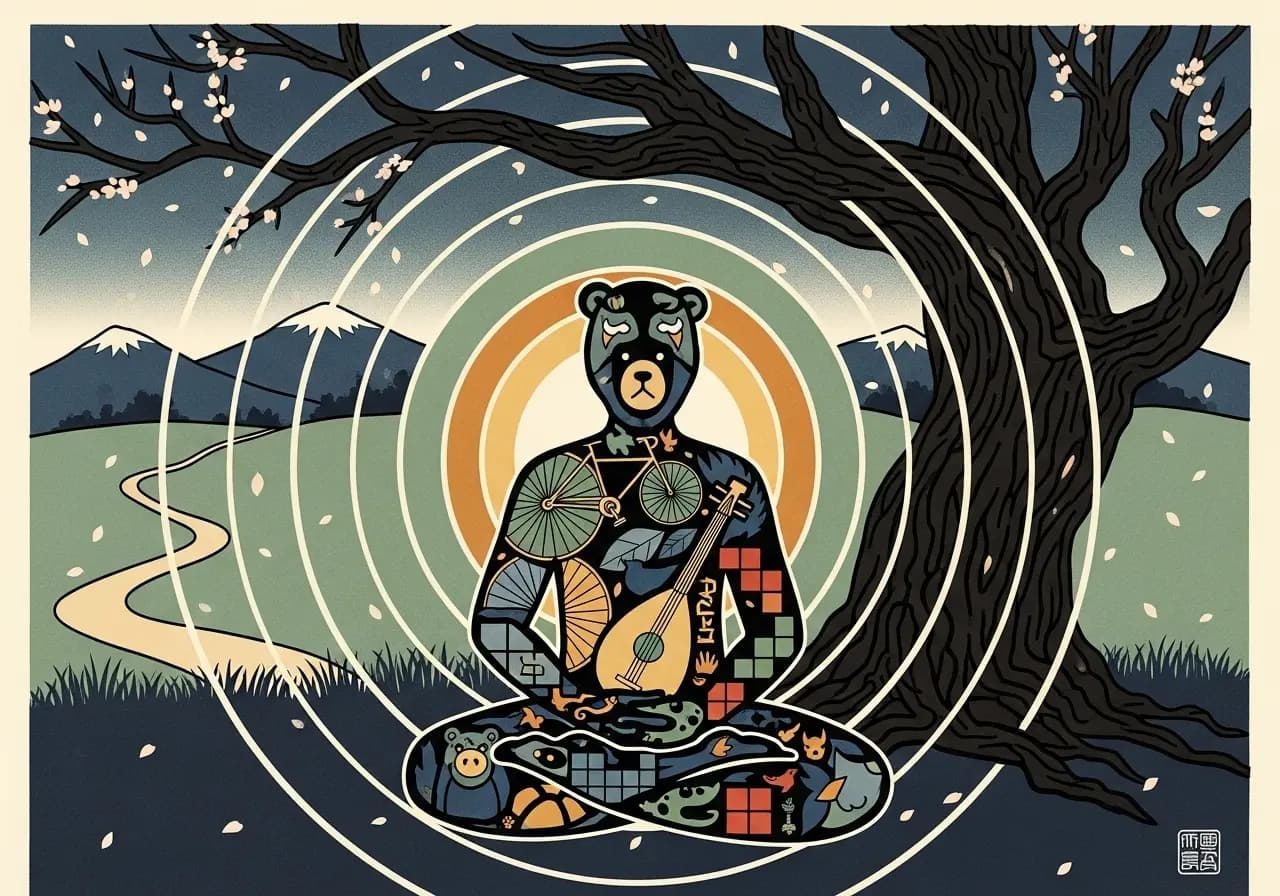
When we encounter those days or those moments, we can say: I knew that this was a part of everyday life. I'm going to allow myself to just sit with it. I actually referenced this early on in a podcast episode with the analogy of the bear costume. You imagine you're going for a walk in the woods, and right before you go, somebody warns you that there's someone out there dressed in a bear costume scaring people. Knowing that, you embark on this journey. And when the time comes that the person in the bear costume jumps out to scare you, you'll still be startled. But you'll remember and know: okay, I knew this was going to happen. I was warned. And you can recover from the spook a little bit easier.
So that's the essence of this teaching: life is about discomfort. Discomfort is part of life. You're going to experience it.
Lesson 4: Everything Is Impermanent
The fourth one: everything is impermanent. Whether it's your feelings, your relationships, your job situation, or your health, nothing stays the same. Recognizing this frees you from unnecessary suffering.
This is one of those foundational Buddhist teachings, and it's something I come back to again and again because it's so pivotal to understanding how to live a life with less suffering. Everything is impermanent. Your feelings are impermanent. Your relationships are impermanent. Your job situations are impermanent. Your health is impermanent. Your wealth is impermanent. Everything. And we spend so much time trying to make things permanent. We try to keep our relationships the way they are. We try to keep our job situations the way they are. We try to maintain our health the way it is. And the more we try to make things permanent, the more we suffer when they inevitably change.
When you recognize that everything is impermanent, you start to live with much more intention and presence because you recognize: this moment is fleeting. This opportunity is fleeting. This person I love is here now, and I don't know for how long. So you can live with much more appreciation and gratitude because you recognize the impermanent nature of life.
Lesson 5: The Present Moment Is All You Really Have
The fifth one: the present moment is all you really have. The past is gone. The future doesn't exist yet. The only moment you can actually live in is now.
This is tied to impermanence, but it's its own lesson. We spend so much time either dwelling on the past or worrying about the future that we miss the only moment we actually have, which is the present. And when you really sit with this idea, it becomes quite profound. You can't change the past. You can learn from it, but you can't change it. You can plan for the future, but the future isn't here yet. The only moment you can actually do something about, the only moment you can actually live in, is now.
When you start to remember this throughout your day, your quality of life changes dramatically. You're more present. You're more appreciative. You're more engaged. You're listening to people better. You're enjoying your food more. You're enjoying your surroundings more because you're actually there rather than lost in thoughts about what happened before or what might happen next.
Lesson 6: Don't Believe Everything Your Mind Tells You
The sixth one: don't believe everything your mind tells you. Your thoughts are not facts. They're suggestions. You get to choose which ones to follow.
This is huge. Our minds are like commentators that are constantly narrating our experience. They're constantly telling us stories about what's happening, what it means, what we should do about it. And most of the time, we just accept what our mind is telling us as truth. But our thoughts are not facts. They're suggestions based on our conditioning, our past experiences, our fears, our beliefs. And we get to choose which thoughts to follow and which thoughts to let pass.
An example: you send a text message to a friend and they don't respond right away. Your mind might tell you: they're mad at you. They don't like you anymore. You must have done something wrong. But that's just a thought. It's a suggestion. Maybe they didn't see your message. Maybe they're busy. Maybe their phone died. There are a hundred other possibilities. When you realize that your thoughts are suggestions and not facts, you gain so much freedom because you're not enslaved to every thought that comes through your mind.
Lesson 7: Gratitude Changes Everything
The seventh one: gratitude changes everything. The moment you shift from focusing on what you don't have to appreciating what you do have, your entire world shifts.
I come back to this one often because it's so powerful. Gratitude is not about denying that there are things you want or things you wish were different. It's about recognizing that even in the midst of difficulty, there are things to be grateful for. And when you practice gratitude consistently, your entire perspective shifts.
There's research that shows that gratitude is one of the most powerful practices for increasing happiness and well-being. And from a Buddhist perspective, gratitude is what frees us from the cycle of always wanting more. Because if you're grateful for what you have, you're already content. You already have what you need. And that doesn't mean you can't work toward your goals or improve your situation. It just means you're not coming from a place of scarcity and lack.
Lesson 8: You Can't Control Everything, and That's Okay
The eighth one: you can't control everything, and that's okay. You can control how you respond, but not what happens. There's freedom in accepting what you can't control.
This is a big one for a lot of people because we're taught from a very young age to be in control. We're taught that if we just work hard enough, if we just plan well enough, if we just stay organized enough, we can control our lives. But the reality is there's so much that's outside our control. Other people's behavior, the weather, economic situations, health situations, accidents—there's just so much that's outside our control.
But here's the thing: there's a lot that's inside your control. How you respond. What you choose to do. What you choose to think about. The effort you put in. Your attitude. And when you focus on what's inside your control and you let go of trying to control everything else, there's so much freedom in that. There's so much peace in that.
Lesson 9: Compassion Starts with Yourself
The ninth one: compassion starts with yourself. You can't give what you don't have. If you're being harsh and critical with yourself, that's going to bleed into how you treat others.
This is one that a lot of people miss. We think about compassion as something we extend to others, and it is. But it starts with ourselves. If you're constantly being harsh and critical with yourself, if you're beating yourself up for your mistakes, if you're judging yourself harshly, that's what you're going to extend to others.
When you start to practice self-compassion, when you start to treat yourself with kindness and understanding, that naturally extends to others. And your relationships improve. Your ability to be there for people improves. Your ability to forgive improves. Everything improves when you start with self-compassion.
Lesson 10: Life Is Like a Tetris Game
The tenth one: life is like a Tetris game. You can't control what piece shows up next. All you can do is work with what you have when it shows up, do your best with it, and then let go and wait for the next piece.
I've talked about this one quite a bit because it's such a powerful analogy. In Tetris, you don't know what piece is going to show up next. You could get a long line, you could get an L-shape, you could get a square. You don't control that. What you do control is what you do with the piece when it shows up. You rotate it, you position it, you figure out where it's going to fit best.
Life is exactly like that. We don't control what situations show up. We don't control what challenges we're presented with. We don't control what opportunities come our way. But we do control how we respond. We do control what we do with the piece we've been given. And when we accept that that's how life works, when we stop complaining about the piece we got and just start working with it, everything gets easier.
Lesson 11: The Middle Way Is the Path
The eleventh one: the middle way is the path. Too much effort and you burn out. Too little effort and nothing changes. The sweet spot is in the middle.
This is a core Buddhist teaching called the Middle Way. It's the idea that between two extremes, there's a balanced path that's most effective. Applied to effort, this means you're looking for that sweet spot where you're putting in enough energy to create change, but not so much that you're burning yourself out.
This applies to everything. Diet—too restrictive and you rebel, too indulgent and you get unhealthy. Work—too much and you burn out, too little and you're not progressing. Exercise—too intense and you get injured, too gentle and you don't see results. Relationships—too much time together and you lose yourself, too much independence and you lose connection.
Finding that middle way, that balanced approach, is what creates sustainable change in your life.
Lesson 12: Suffering Ends When You Stop Resisting
The twelfth one: suffering ends when you stop resisting. When you accept what is rather than fighting against it, the suffering diminishes significantly.
This is one of the deepest Buddhist teachings. We suffer not because of what's happening, but because we're resisting what's happening. We're saying: this shouldn't be happening. This is unfair. Why me? This isn't how I wanted it to be. And that resistance, that fighting against reality, that's what creates suffering.
The moment you say: okay, this is what's happening. This is the reality I'm in right now. How do I work with this? The suffering starts to diminish. Now you have energy to actually do something about it rather than wasting energy fighting against the fact that it's happening.
This doesn't mean you just accept everything and do nothing. It means you accept the present reality and then act accordingly. You stop wasting energy denying what is and you start channeling that energy into responding effectively.
Lesson 13: Your Story Is Not Your Identity
The thirteenth one: your story is not your identity. You are not the sum of your past experiences or your failures or your accomplishments. You are so much more than that.
We get really attached to our stories. I failed at business, so I'm a failure. I got betrayed by someone, so I can't trust people. I grew up poor, so I'm not worthy of wealth. I'm not good at relationships, so I'm going to be alone. And these stories become our identity. We carry them around and we let them dictate how we live our lives.
But your story is not your identity. Your past is not your future. You're constantly changing. You're constantly becoming. The you that failed at something in the past is not the you that's here now. And it's certainly not the you that's going to be in the future. When you recognize that your story is not your identity, you free yourself to write a new story. You free yourself to become whoever you want to become.
Lesson 14: Everything Is Interdependent
The fourteenth one: everything is interdependent. Nothing exists in isolation. Everything is connected to everything else.
This is another foundational Buddhist teaching. We tend to think of ourselves as separate, independent entities. But that's an illusion. Everything is connected to everything else. The food you eat connects you to farmers, to the earth, to the water, to the sun. Your clothing connects you to people in factories, to cotton fields, to designers. Your home connects you to construction workers, to architects, to raw materials.
When you really start to see this interconnectedness, it changes how you view the world. It creates a sense of responsibility. It creates a sense of belonging. It creates compassion because you realize you're not separate from others. You're all part of the same web of existence.
Lesson 15: Expectations Are the Root of Disappointment
The fifteenth one: expectations are the root of disappointment. When you can let go of how you think things should be and accept how they are, you suffer less.
We carry around all these expectations. Expectations about how people should behave, how situations should unfold, how our lives should look. And when reality doesn't match our expectations, we're disappointed. We're frustrated. We suffer.
But here's the thing: reality doesn't care about your expectations. Reality is just what is. The weather is what it is. Other people are who they are. Situations unfold how they unfold. When you can let go of how you think things should be and accept how they actually are, you suffer less. You can work with reality more effectively. You can make better decisions.
Lesson 16: You Don't Have to Fix Everyone
The sixteenth one: you don't have to fix everyone. You can be compassionate and supportive without taking responsibility for other people's journeys.
This one is huge, especially if you're someone who cares about people. We tend to want to help. We tend to want to fix things. We tend to want to save people from their own suffering. But you can't do that. You can't walk anyone else's path for them. You can support them. You can be there for them. You can offer guidance. But ultimately, everyone has to walk their own path and learn their own lessons.
When you release the burden of trying to fix everyone, when you recognize that's not your responsibility, you free yourself. And ironically, you often become more helpful because you're not attached to a particular outcome. You're just there, present, available, supportive.
Lesson 17: Anger Is Information
The seventeenth one: anger is information. When you feel angry, instead of acting on it, get curious. What is the anger telling you?
We're often taught that anger is bad, that we shouldn't feel angry. But anger is actually useful information. It's telling you that something is wrong. Something is out of alignment. Something is not being respected. Something needs attention.
When you feel angry, instead of just reacting or suppressing it, get curious. What is this anger telling me? What boundary is being crossed? What value is not being honored? What need is not being met? When you can answer those questions, you can address the actual issue. You can communicate more effectively. You can take action that actually resolves the situation rather than just reacting in anger.
Lesson 18: You Are Enough
The eighteenth one: you are enough. Right now. As you are. You don't need to be different. You don't need to achieve more. You don't need to be better. You are enough.
This is one that takes a lot of people a while to really believe because we're constantly getting messages that we're not enough. Not smart enough, not pretty enough, not successful enough, not thin enough, not rich enough. We're always chasing the next thing thinking that's what's going to make us enough.
But you're already enough. Your worth is not dependent on your accomplishments. Your worth is not dependent on how you look. Your worth is not dependent on what you have. Your worth is intrinsic. You have it just by existing.
When you really accept that you're enough, it changes everything. You stop chasing things from a place of desperation. You start creating things from a place of already being fulfilled. You start engaging with people from a place of confidence rather than need.
Lesson 19: Progress Is Not Always Linear
The nineteenth one: progress is not always linear. There will be steps forward and steps backward. What matters is that you keep showing up.
We have this idea that progress should be linear. We should just keep going up and up and up. But that's not how life works. There are periods of growth and periods of stagnation. Periods of clarity and periods of confusion. Periods of confidence and periods of doubt. And all of that is part of the journey.
The key is not to expect perfection. The key is not to expect that every single day is going to be a step forward. The key is to keep showing up. Keep practicing. Keep trying. Because over time, even with the steps backward, you're still moving forward. You're still growing.
Lesson 20: The Quality of Your Relationships Determines the Quality of Your Life
The twentieth one: the quality of your relationships determines the quality of your life. Invest in the relationships that matter. Be present with the people you care about.
This one is pretty straightforward but it's easy to forget. We get busy. We get caught up in work and projects and goals. And we neglect the relationships that matter most. But your relationships are really the thing that matters most. The people in your life are what bring meaning and connection and love.
When you invest in your relationships, when you're present with the people you care about, when you show up for them, your life becomes richer. You become happier. You feel more connected. So it's worth making that a priority.
Lesson 21: Your Thoughts Create Your Reality
The twenty-first one: your thoughts create your reality. Not in a magical way, but in a practical way. How you think about something determines how you experience it.
Your thoughts are powerful. How you think about a situation determines how you experience that situation. If you think a social gathering is going to be awkward, you'll probably be anxious and that anxiety will make the situation awkward. If you think it's going to be fun, you'll probably be relaxed and engaging and that will make it fun.
This is not about positive thinking in a naive way. It's about being aware of the stories your mind is creating and choosing stories that are actually helpful. If your mind is telling you: I can't do this, I'm not good enough, this is going to fail, you can recognize that's just a thought. You can choose a different thought. I'm going to try this. I might succeed. This is worth attempting.
Lesson 22: Forgiveness Is for You, Not Them
The twenty-second one: forgiveness is for you, not them. Holding onto resentment only hurts you. Forgiveness sets you free.
We often think of forgiveness as letting the other person off the hook. So we refuse to forgive because it feels like we're condoning what they did. But forgiveness is not about condoning. It's about releasing the resentment you're holding onto.
When you hold onto anger and resentment, it's like you're carrying around a heavy bag. You're the one who's tired. The other person probably isn't even thinking about it. But you're exhausted from carrying that weight around. When you forgive, when you release that resentment, you set yourself free. You lighten your load. You can move on.
Lesson 23: Suffering Is Often Optional
The twenty-third one: suffering is often optional. Pain is inevitable, but suffering is something we add on top of pain. We can have pain without suffering.
This is an important distinction in Buddhism. Pain is physical. Pain happens. You get sick. You get injured. People disappoint you. That's pain. That's part of life. But suffering is what we add on top of that pain. It's the stories we tell ourselves about the pain. It's the resistance we have to the pain. It's the way we amplify the pain by focusing on it and worrying about it.
You can experience pain without suffering. You can have a headache and just be with the headache without the suffering of thinking: why do I have this? This is so unfair. I don't deserve this. How long is this going to last? The suffering comes from the stories and the resistance, not from the pain itself.
Lesson 24: You Have More Power Than You Think
The twenty-fourth one: you have more power than you think. The power to choose your attitude, your effort, your response. That's enough to change your life.
We often think of power as something external. Money, status, influence. But real power is internal. It's your ability to choose how you respond to what happens. It's your ability to put effort into the things that matter. It's your ability to choose your attitude no matter what's happening around you.
Viktor Frankl, who survived the Nazi concentration camps, said that even in the worst circumstances, we have the power to choose our attitude. We can choose how we respond. And that power, that freedom to choose, that's what saves us. That's what allows us to create meaning even in suffering.
Lesson 25: Let Go of the Need to Be Right
The twenty-fifth one: let go of the need to be right. Being right is not worth the relationships you lose. Choose connection over being right.
We have this strong need to be right. We want people to see things the way we see them. We want to win the argument. We want to prove our point. But what we often lose in the process is the relationship. We win the argument but lose the person.
When you can let go of the need to be right, when you can prioritize connection over winning, everything changes. Your relationships improve. You become a better listener. You become more understanding. You become more compassionate.
Lesson 26: Your Body Is Wiser Than Your Mind
The twenty-sixth one: your body is wiser than your mind. Learn to listen to your body. It's often trying to tell you something your mind is not aware of.
We live so much in our heads. We think our way through life. But our bodies have a wisdom that our minds often don't have access to. Your body knows when something is wrong. Your body knows when something feels off. Your body has intuition.
When you start to pay attention to your body, when you start to notice what it's telling you, you gain access to a whole different kind of intelligence. You might notice you feel tense around a certain person. You might notice you feel energized in certain situations. Your body is constantly giving you information about what's true for you.
Lesson 27: The Meaning You Assign to Things Is Flexible
The twenty-seventh one: the meaning you assign to things is flexible. The same situation can mean something different depending on how you look at it. You have the power to change the meaning.
We assign meaning to things. We say: this is bad. This is good. This means I'm a failure. This means I'm successful. But that meaning is not fixed. It's not objective. It's something we assign. And we can change it.
The same situation can be a tragedy or an opportunity depending on how you look at it. The same failure can be a reason to give up or a reason to learn and try again. The same criticism can be a personal attack or valuable feedback. How you choose to interpret it determines how you experience it.
Lesson 28: Patience Is a Superpower
The twenty-eighth one: patience is a superpower. In a world that's always rushing, the ability to be patient, to wait, to trust the process, is incredibly powerful.
Everything in our culture is geared toward immediacy. We want results now. We want things fast. We're impatient. But patience is actually a superpower. When you can be patient, when you can trust the process, when you can wait for things to unfold, you gain access to a different kind of power.
Patience means you're not desperate. You're not grasping. You're not forcing things. You're trusting that if you do the work, if you show up, if you plant the seeds, things will grow in their own time. And that kind of trust, that kind of patience, is incredibly powerful.
Lesson 29: This Won't Go the Way You Think
The twenty-ninth one: this won't go the way you think. And that's often a gift. What seems bad becomes good. What seems good becomes bad. Life is a lot more complex than we can predict.
I learned this through my own experiences in business. I thought I knew what was going to happen and it rarely did. I remember thinking I had really made it big when I got my products into 2,000 Walmarts nationwide. I thought I had reached success. It turns out that was the moment that also turned into the downfall. Ramping up production to fuel manufacturing for that many products and that many stores—when they suddenly said never mind, take it all back, we don't want your products, and give us our money back—that was the moment my company died. I could not survive that.
So what seemed good at one moment turned out to be bad. And what seemed bad at another moment turned out to be good. But that's not where the story ends. It keeps going. It's still going. And I'm still vacillating between the moments where it seems like: oh, this seems good. Okay, but we'll see. Oh, this seems bad. Oh, but we'll see. And just stay open. Stay curious.
Lesson 30: Hold On, But Not Too Tightly
And the final lesson. Lesson 30: hold on, but not too tightly. Life is like riding a bicycle. Gripping too hard causes pain, while holding too loosely leads to losing control. The key is balance. Holding just enough to stay present, but letting go just enough to find freedom.
I want to end on that one. I think there are more lessons I could have made a longer list, but 30 seems like a good number.
The idea here comes from the Buddha's teaching about the strings on the lute, which is an instrument like a guitar. The strings have to be just the right amount of tension. You can think about any instrument that has strings—a guitar, a violin, a cello—it's the same principle. If it's too tight, it just sounds out of whack. If it's too loose, it also just sounds out of whack. But if you want it to sound amazing, the way it's supposed to sound, it has to be just the right amount of tension. Not too tight, not too loose.
Furthermore, it's not like you tune it once and you're done. The next time you play it, you have to tune it again. You're continually making this adjustment: am I trying too hard or am I not trying enough?
If you use the visual analogy of riding a bicycle, you'll know that if you grip it too tight and get too rigid, that's uncomfortable. It's unnecessarily uncomfortable. If you just let go, sometimes you can ride without holding the handlebars. But as soon as you're on a steep hill and you're trying to navigate terrain, well, you better be holding on. We're always playing the game of just how much. How tight is too tight and how loose is too loose?
And there isn't an exact answer because it'll always be: it depends. It depends on the terrain that you're riding. So you're always making the adjustment. Hold on a little tighter now. Okay, now you can ease up a little bit.
And I think life is the same way. We go through life sometimes just too tight and too rigid, trying too hard. And other times we're just not trying hard enough. And we forget that the process—the journey—is the goal. The process is that you're continually making the adjustments, continually adjusting your grip. Sometimes tightening it, sometimes loosening it. And that makes the experience much more enjoyable.
I think sometimes it's difficult, not because it's tight or loose, but because we're upset thinking: but I already had a tight grip. Why is it hard now? Because now you don't need the tight grip. You did 10 seconds ago, but you don't need it now. And we get all insensed about that because we forget that life—like the terrain on a mountain bike—is constantly changing for you.
So just go with the flow and recognize that: okay, life's always changing. Sometimes I'll grip tight, sometimes I'll let a little loose of that grip. Now that's the middle way. I'll be much more balanced in my approach.
Closing Thoughts
These 30 lessons have been very impactful for me. I actually designed a poster and printed it out that I hung in my office with the summarized version of these 30 life lessons. If you want that poster, you can go to my website. The file is there for free if you want to download it and print it or send it somewhere if you have a place.
I also have a link if you want to order a printed version from a website that prints them for you and they'll send it to you. I have it available in a couple of different sizes. If you do it that way, I get a couple dollars per poster on commission. But the file—like I said—is available if you just want the high-resolution file itself. I'll make those available for free. You can find those on SecularBuddhism.com/poster, or if you just go to the main page, I'll put a link there somewhere.
I hope you've enjoyed these 30 life lessons inspired by Buddhist wisdom, and I hope you will continue to enjoy your journey playing the game of Tetris, or life, for however long it gets to keep going on. I look forward to recording another podcast episode at some point in the future.
Thank you for listening, and until next time, thank you for joining me today on the Secular Buddhism Podcast. If today's insights resonated with you, then there's so much more in store. You can extend your journey exploring these concepts and ideas by joining our online community of podcast supporters. Together in our weekly video conferences, we dive deeper, share experiences, and discuss how to live these teachings in day-to-day life.
Discover all this and more at SecularBuddhism.com—from insightful articles to my books, online courses, and information on how you can become part of our thriving community. May you carry the wisdom from today's episode into your daily life.
Thank you for listening. Until next time.