

Embracing Uncertainty and Experiencing Groundlessness
Episode 192 of the Secular Buddhism Podcast
Hello and welcome to the Secular Buddhism Podcast, a podcast that presents Buddhist teachings, concepts, and ideas from a secular perspective. You don't need to use what you learn from Buddhism to be a Buddhist. You can use what you learn to simply be a better whatever you already are. I'm your host, Noah Rasheta, and let's jump into today's topic.
Welcome Back
Welcome back to the podcast. Today's episode is on the topic of embracing uncertainty and experiencing groundlessness. This is a topic that's been on my mind.
I know and acknowledge that there are collective and individual uncertainties that we all face in our lives, and sometimes they are major. I'm thinking about people who are dealing with the uncertainty of war and violence, people who are dealing with the uncertainty of the loss of a loved one, loss of a job, financial instability, the uncertainty of political and election outcomes. And then all the way down to minor frustrations—the uncertainty of where I placed my keys, what I'm going to do with my broken phone, little things like that.
Embracing uncertainty is a topic that's relevant to all of us, and I want to recognize the universal nature of uncertainty. While these circumstances may be unique—in other words, we each may be experiencing our own form of uncertainty—uncertainty itself is a shared human experience. None of us can control the future, and this state of perpetual groundlessness is a constant in our lives.
Life as Tetris, Not Chess
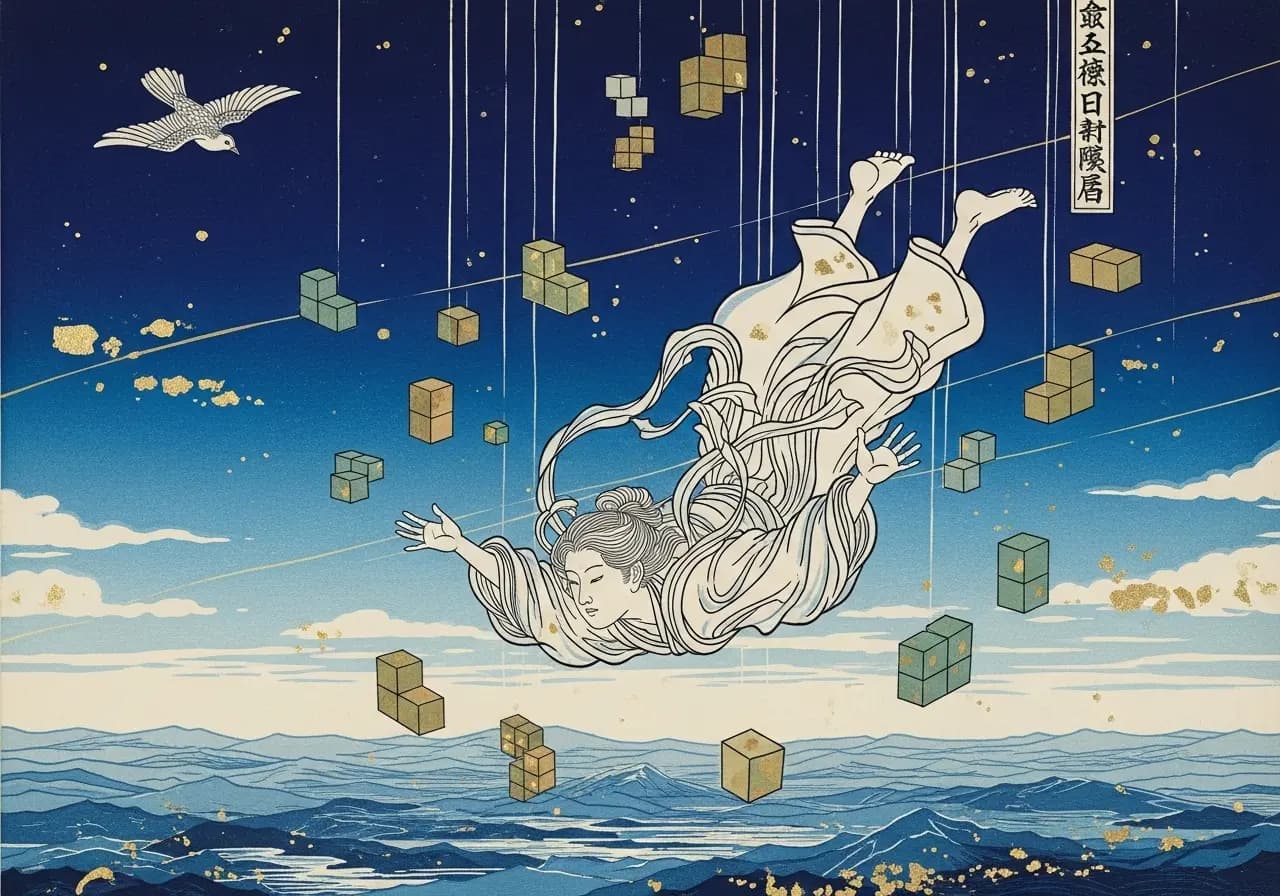
That's why I always reference the analogy of life being like a game of Tetris and not like a game of chess. We sometimes approach life as if it were a game of chess where we can make calculated moves and somehow win. But the truth is that life is more like a game of Tetris. Life throws pieces our way that no matter what we do to avoid, they may come our way or they may not. That's more true to the nature of reality.
Understanding Groundlessness
This concept of groundlessness refers to the realization that there is no fixed or solid ground on which we can base our sense of security. We have no solid ground to stand on.
I came across a story many years ago, I believe it was shared by Alan Watts, where he talked about this notion of falling off a cliff. The idea was to imagine or envision a scenario where you are standing at the edge of a cliff, and then suddenly you slip or fall or get pushed, and now you're in free fall. The point is that at the moment you fell, other things fell with you—a rock that was next to you is also falling. You can embrace the rock if it gives you any sense of security or certainty while you're falling, but it actually doesn't do anything to really help. It doesn't change the reality of the situation, which is the free fall.
I remember that story stuck with me visually. I started to see myself in this situation where life is the free fall, and here I am experiencing what it is to be alive, and there's really nothing to hang on to. No matter what I cling to, it doesn't change the fact that I don't know what Tetris piece is showing up in my life in the next day. I don't know how long this will last. I don't know when life ends.
I like using that as a visual representation of the situation of life. And when we think about groundlessness and relate it to the teaching of impermanence, we can understand that nothing lasts forever. We don't have to get caught up in these notions of good or bad. If you'll recall the other story I bring up often—the Chinese farmer and the horse—you just don't know what's going to happen next. That's what I love about that story. It highlights one scenario that seems bad, and then that evolves to another scenario that now seems good, which leads to another scenario that now seems bad. It goes back and forth that way.
I think that's so true to the experience of being alive.
Disorientation as Wisdom
When we are experiencing these moments as they unfold, it can feel disorienting because we realize that the nature of reality is uncertainty. We don't know what's coming. We don't know what's happening next. But it can also be what leads to a deeper sense of wisdom.
One of the ways I've thought about this overall journey is similar to the experience of learning to fly. I think I've referenced this several times throughout the podcast or in other places, but when you learn to fly a paraglider—a paragliding wing—which is something that I do and something that I've been teaching for many years, you first learn how to ground handle the wing. You learn how to maneuver and manipulate the wing, but you do it on the ground.
As you develop those skills, then you can do what we call towing, where somebody will tow you up into the air. You get connected to a line. Think of a kite—it's very much like a kite. You pull on the string and the kite goes up in the air and it can stay in the air based on that string being pulled. Well, you can be towed up on a paraglider wing in a very similar way.
Then at a certain point or a certain altitude, you can release the tow line and then you just glide down. In some training programs, they'll do towing and you get towed up multiple times. You come down and land safely and learn how to land, for example. Then the final step of the process would be actually learning how to fly—where you don't need to be towed up. Now you're learning to hunt for rising air and you can stay in the air.
The Sky Becomes Your Playground
When I think about this notion of groundlessness and I think about this process of learning to fly, I think in day-to-day life it's similar. We have this desire to feel safe and secure—to be grounded in the sense of having something to stand on. But the reality of life is that there really isn't anything to stand on because it's always changing.
So if we can learn to embrace the reality—which is that there is nothing to stand on—then we can get comfortable with nothing to stand on, and then the sky becomes your playground. That's very much what happens in a real way with people who are learning to fly. The sky becomes their playground. And I think we can do that in our day-to-day lives with this notion of groundlessness.
I think there is beauty and freedom in learning to embrace uncertainty. It starts by acknowledging that so much of the suffering we experience during times of uncertainty comes from our desire to control what we can't control. When we can start to let go of the need to control, that letting go might actually be what leads to greater peace.
We have to be open to whatever may come. When we stop clinging to certainty, we become open to new possibilities, to fresh perspectives, and to growth. This is where freedom lies—not in avoiding change, but in being fully open to it and fully curious about whatever is coming our way.
The Kite and the Bird
Another analogy I like to mention in this context is the image of the kite that I mentioned earlier. Imagine a kite being pulled, staying in the air because of that string. But at some point, that kite looks at itself and realizes: I'm not a kite, I'm a bird. Then that line can be severed. It doesn't need it. And it can go out and fly on its own, using its own wings.
I like to think that in life, sometimes we're like that. We are like a kite that needs the string. I need this sense of certainty. I need to know that this is going to go my way, that this will turn out this way and not that way. That's our string. But how much more free do we become when we realize: maybe I don't need that certainty? Maybe I can cut the string?
Now, if you cut the string of a kite, what happens? The kite floats around wherever until it falls and crashes. But that's not what happens with a bird. A bird cuts the string and then it flies using its own wings. So the key is: we're not kites, we're birds. We have the capacity. We have the wings. We have what we need to navigate life's uncertainties on our own.
We become free not because life becomes more predictable, but because we trust in our own capacity to figure things out as we go.
Trust in Your Ability to Figure It Out
This brings me to a key distinction: there's a difference between trusting that life will go the way you want it to, and trusting that you have the ability to figure things out no matter what life throws your way.
When I say I trust life, I don't mean I trust that it will turn out the way I want it to. I mean I trust that I have the ability to do what I need to do. Doesn't mean I'll do it right, but it means I'm going to figure it out. I'm going to try to figure it out.
So then, that sense of trust that I have isn't trust that life will go the way I want it to. It's trust that I will be able to figure out life no matter what life throws my way. Those are two very different scenarios.
Having faith that life will turn out the way I want it to sets you up for constant disappointment because life doesn't turn out the way we want. And that's fine. That's just the nature of reality—it's uncertain. It's like a Tetris game. We don't know what pieces come next.
But if you go through this whole experience with the other perspective—the one that says, yeah, I don't know what pieces are coming my way, but I know that I'm capable of figuring it out as I go along—that's when things shift. Because for me, the journey is the goal. There is no end goal. It's the journey itself.
That's the difference, right? I think having that perspective can be very useful in times of uncertainty—to remember: yeah, I don't know where we go from here. I don't know what happens next. And that's okay.
I think that's a neat way to frame this entire concept. At least for me, I'm sharing from my experience and what works well for me.
Living with Uncertainty as Our Teacher
Living with uncertainty, I think, can be our path to awakening. It can be our path to growth because uncertainty can be our most profound teacher.
You know how in the Zen tradition or in some of these Buddhist traditions, you have the teacher that comes and tries to strip away all of our illusions of control? That ends up opening us to deeper truths about life—the truth of impermanence, the truth of emptiness or interdependence. You hear this in the Zen tradition with a koan. I've talked about koans before. It's a riddle that comes, and that's what it's meant to do. It's meant to shake you up and sweep the rug out from under your feet.
Well, you know what else can do that? Moments of uncertainty. A moment of uncertainty where life didn't turn out the way you were thinking that it should or that it would—that is the teacher that comes along and says, "Whoa, you're not in control here. You know nothing. Life is doing what life does, and here you thought you had control of it, and you don't."
I think uncertainty can be our most profound teacher.
Leaning into Your Practice
When we experience these moments of uncertainty—whether it's an election that didn't go the way I thought it should, or the job that I never thought I'd lose but I did, or the loved one that I wasn't expecting to pass but now has—whatever it is—we can lean into our practice in that moment. Your practice can be meditation, mindfulness, or trying to practice loving kindness. But it's in these moments of uncertainty that you can sit with the full experience you're going through and say: this is what is.
I like using the analogy of emotions as guests that come into the kitchen and sit at the table in the mind. I love that analogy because when I experience a moment of uncertainty—when a flight gets delayed—an emotion pops in. It's like: here comes this emotion. It kicks the door down in the kitchen and just sits at the table, and you're like, "Oh crap, okay, what are you doing here?"
I like to first look at it and analyze what is this that just showed up for me? It might be guilt. Maybe I'm feeling guilt that I took this trip, knowing that it was going to cause us to arrive late on my daughter's birthday. And now here we might miss it. Why did I do this? Why did I plan this? Maybe that's the emotion that's at the table now.
It could be anger. I hate this airline. I'm never flying this airline again. Okay, all right, that's the emotion that's sitting here.
Just look at it. Don't try to change it. Just say: this is what I'm experiencing right now. You, emotion, you are what's sitting here at the table. Allow it to be what it is and look at it as your teacher. What are you here to teach me? What can I learn about life?
Lean into your practice in that moment. Not as a way to escape what you're experiencing, but as a way to fully engage with the present moment, whatever that present moment entails.
Make Curiosity Your Mantra
You can make curiosity your mantra here. You look at whatever's taking place and ask: have I ever looked closely at this? I want to look closely at you for a minute and analyze that emotion or that feeling that you're experiencing.
That's the call to practice. Hopefully you'll take this idea and benefit from this concept of changing the relationship that you have with your emotions. Embrace uncertainty because your life is going to be full of it. You're going to experience it in little things. You're going to experience it in big things.
Right now, as you listen to this, someone else who's listening to this podcast episode—maybe at this exact moment—is dealing or about to deal with a phone call about the loss of a loved one, or an email about the job that's going away, or the sound of a bomb that's about to land next door or at their house. And not just the bad things—the uncertainty with the good things too. Someone's about to navigate the uncertainty of a big life change because they just fell in love, or they just landed the job they've always wanted, or they just graduated from college.
So many scenarios. You can imagine this life is full of uncertainty, and that's not a bad thing. That's just the nature of reality because life is like a game of Tetris.
We All Experience Uncertainty
As you experience this, pause for a moment and say: wow, everybody experiences uncertainty in one way or another. We can all recognize that that's what we're all experiencing. We're all going through uncertainty. Sometimes things go my way. Sometimes they don't. Sometimes for things to go my way, it means they're not going to go your way. If my candidate wins, yours won't. And if yours wins, mine won't. And it's going to be okay.
We don't need to get caught up in the feeling that it's all for naught now—that nihilistic view—because that's just not true. Life is still precious. Life is still worth living. We're still interconnected with one another.
A Closing Expression of Loving Kindness
I want to end this with an expression of loving kindness directed to each of you individually, whoever you are listening to this right now.
I want you to take these words to heart when I say: may we all find peace in the midst of uncertainty. May we all be free from fear and our hearts remain open and curious. May uncertainty be our teacher, and may we remember our interdependent nature in times of difficulty.
I hope that as you experience instances of uncertainty in your life, you'll remember that we all experience difficulties with uncertainty—different degrees, different intensities, but we all know what it's like. And that makes us all much more similar than we are different.
That's the topic I wanted to share with you today on this podcast episode about embracing uncertainty and allowing yourself to fully experience groundlessness. And I look forward to connecting again in another podcast episode at some point with a different topic.
Final Words
Thank you for joining me today on the Secular Buddhism Podcast. If today's insights resonated with you, then there's so much more in store. You can extend your journey exploring these concepts and ideas by joining our online community of podcast supporters. Together in our weekly video conferences, we dive deeper, share experiences, and discuss how to live these teachings in day-to-day life.
Discover all this and more at secularbuddhism.com—from insightful articles to my books, online courses, and information on how you can become part of our thriving community. May you carry the wisdom from today's episode into your daily life.
Thank you for listening, and until next time.
For more about the Secular Buddhism Podcast and Noah Rasheta's work, visit SecularBuddhism.com