

No Mud, No Lotus
Episode 190 of the Secular Buddhism Podcast
Hello, and welcome to the Secular Buddhism Podcast, a podcast that presents Buddhist teachings, concepts, and ideas from a secular perspective. You don't need to use what you learn from Buddhism to be a Buddhist. You can use what you learn to simply be a better whatever you already are. I'm your host, Noah Rasheta, and let's jump into today's topic.
Welcome Back
Welcome back to another episode of the Secular Buddhism Podcast. For today's episode, I want to share some thoughts around a topic that we're all quite familiar with, and this is the notion of suffering. But don't worry—this isn't going to be a doom and gloom episode. Instead, I want to explore how we can transform our relationship with suffering and maybe even find some unexpected joy along the way.
The Foundation of Buddhism
The topic of suffering is the very first topic you encounter when you start learning about Buddhism. In fact, I would say that all Buddhist teachings are centered around this central notion that life is difficult and life entails experiencing suffering. When we talk about suffering from the Buddhist perspective, we're not just talking about major tragedies. We're talking about every form of discomfort or anguish or unsatisfactoriness—whether that be stubbing your toe in the morning, feeling stressed about work, or arguing with a loved one.
The Buddha taught that suffering, or dukkha, is a universal part of the human experience. It's something that we all deal with, regardless of who we are or where we come from or what we do or don't do to try to avoid it. It's inescapable. And here's the interesting part: Buddhism doesn't just say, "Yep, life is tough. You should just deal with it." Instead, it goes on to offer us tools to work with our suffering and to transform the relationship we have with it.
Tools for Transformation
You can think about it almost like you're given a box of tools, and these tools are different types and shapes. They're used for different purposes. And sometimes the right tool used in the right setting is what makes it easy to deal with a specific situation. Not having that tool can make an ordinary situation much more difficult to manage.
So imagine you have this box of tools, but you never really open it because there are too many, or you don't want to see what's inside. That's a good way to think about all the concepts and topics and teachings that come from traditions like Buddhism. They're like tools, and they won't always be relevant in every scenario. But sometimes the right tool in the right scenario is exactly what you needed to make that scenario easier to deal with.
I do want to emphasize something important here: these teachings aren't meant to just sit in our heads as concepts or ideas, no matter how interesting they sound. They're meant to be used and practiced in our everyday lives. It's one thing to understand intellectually that suffering is universal and that everyone experiences it. But it's another thing entirely to recognize it in the moment when you are experiencing it—when you're stuck in traffic, when you're late for a meeting, when you're having an argument with someone.
As we go through this concept, I encourage you to think about how the ideas that will be discussed around this topic might apply to you in your own life. And just as the Buddha would say, don't take my word for it. Test out these methods for yourself. See if these concepts and ideas resonate and work for you. If these tools are the right tools for you.
Clearing Up a Common Misunderstanding
Now, I want to clear up a common misunderstanding. When people hear that Buddhism talks about suffering, they sometimes say, "Does Buddhism teach that everything is suffering? That sounds depressing." The beauty of the teaching that life entails difficulty is recognizing that that's how it is for everyone.
I think one of the biggest lies that we believe is that if life is difficult, we must be doing something wrong. And the tricky thing is that yes, there is some truth to that. You can make life more difficult for yourself by unskillful actions, by making choices or having views or beliefs that just make life more difficult. But it's also true to say that there is no way to ensure that life will be void of difficulties. You can check the tire pressure in your cars every day, and still one day you're on the road and boom—you have a flat tire.
The beauty of knowing that suffering is universal is that you don't have to be so hard on yourself when you're experiencing it. You can recognize, "Hey, this is just a part of what it is to be alive."
I think parents know this feeling. You can read all the books and attend all the lecture series, study everything there is to know about parenting. And then guess what? Parenting is still going to be hard. That's the nature of parenting. It's difficult. There's no way to go through it and say, "Well, that was easy. Nothing ever went wrong." You know, that's just not how it is. And that's what Buddhism is saying about life in general.
Impermanence: The Key Insight
The Buddha wasn't saying that everything is suffering. It's more about pointing out that all things are impermanent. And that means the good times don't last forever, but it also means that the bad times don't last forever. Understanding this can be really liberating. When we recognize that both joy and suffering are temporary, we can learn to appreciate the good moments more fully and to not get so caught up in the difficult moments.
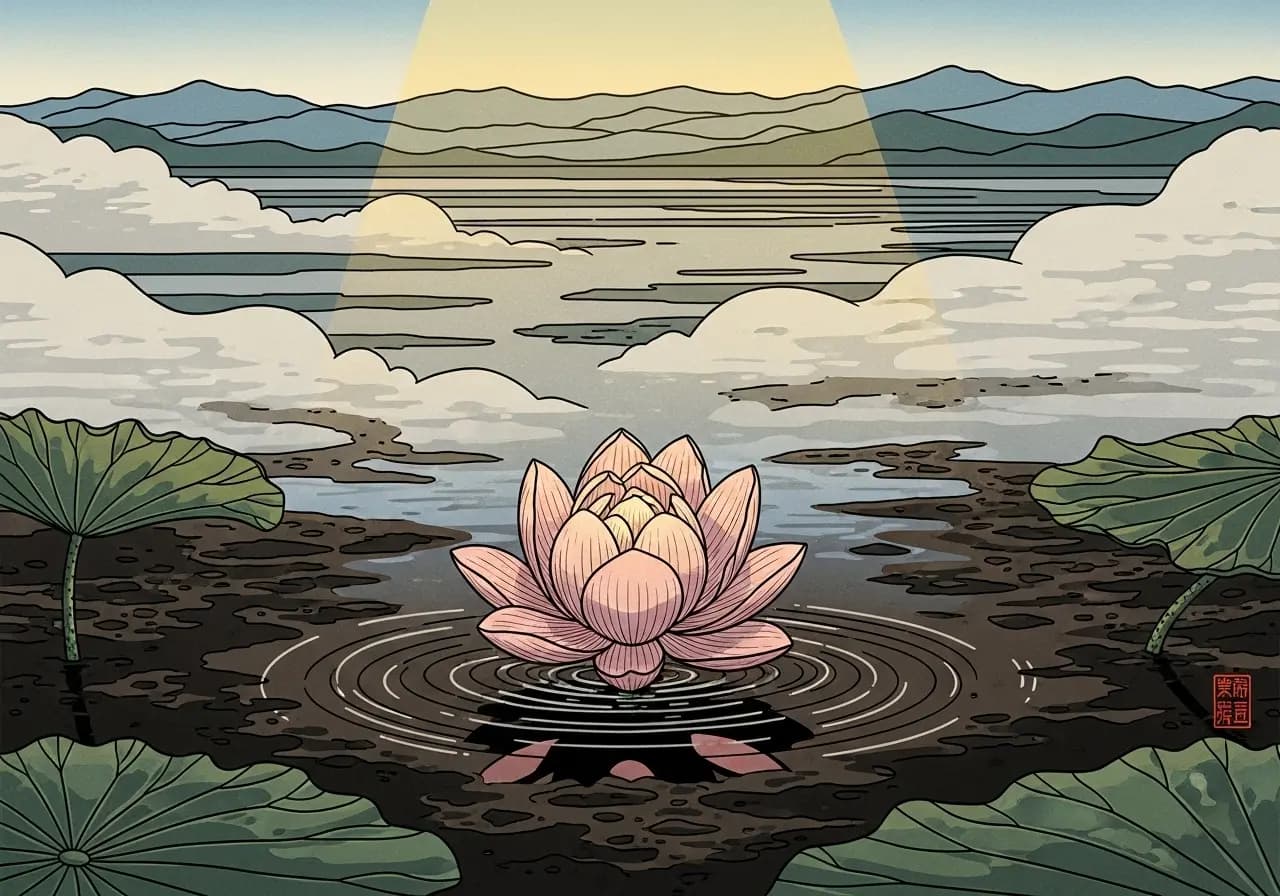
And now this brings up an idea from a teaching that I really like, and it comes from Thich Nhat Hanh. The expression is no mud, no lotus. The idea is that just as a lotus flower needs mud to grow—mud is where lotus flowers grow—we need our difficulties to develop wisdom and compassion. We need to experience suffering because it's in the midst of suffering that we can develop wisdom and experience kindness and compassion.
And if we know how to make good use of suffering, we can actually produce joy and happiness out of it, very much the same way that a lotus emerges from the mud. Hence the expression: no mud, no lotus.
I think we sometimes go through life wanting the lotus but not wanting the mud. And we fail to recognize a foundational truth there, which is that without the mud, you wouldn't have the lotus. Now, this doesn't mean that we need to go looking for suffering, or that when we do experience it, we should enjoy it. But suffering will come, and when it does, we can learn to work with it rather than just trying to get rid of it as quickly as possible.
I think that might be the essence of what I'm trying to convey with this particular topic today. It's that life is difficult and you will experience difficulties. And when you do, that default reaction—that default mode inside that says, "I want to just run from this, or I want to avoid it, or I want to distract myself from this difficulty"—we distract ourselves from difficulties in a lot of ways. It's what drives some people to unskillful actions. I'm sure you can think of lots of examples here.
Four Practical Steps to Transform Suffering
So how do we do this? How do we learn to make the best of suffering when we experience it?
The First Arrow and Second Arrow
One powerful teaching in Buddhism comes from the concept of the first arrow and the second arrow. The first arrow is the difficulty itself—the flat tire, the argument, the rejection, the illness. That's the first arrow. It's painful, and there's no way around it. That's just part of being alive.
But then there's the second arrow, and that's the story we tell ourselves about the first arrow. That's our response to the difficulty. The second arrow is the suffering we add on top of the first arrow. If you stub your toe, that's the first arrow. The physical pain is real. But then the second arrow might be, "I'm so stupid. How could I be so careless? This always happens to me. Why does life have to be so difficult?" Or if you don't get a job you wanted, the first arrow is the disappointment. The second arrow is the story: "I'm not good enough. I'll never be successful. Everyone else is better than me."
The difference between these two arrows is that the first arrow is something that happens to you. The second arrow is something you create. And here's where this teaching becomes really powerful: you can't always control whether you get the first arrow. That's just life. But you do have some control over the second arrow. You have the choice of what story you tell yourself about the difficulty.
Step One: Mindful Acknowledgement
One way to work with suffering is through mindful acknowledgement, which is as simple as paying attention to our experience of suffering, but without immediately trying to change or push it away. It's like saying to yourself, "Okay, this is tough. The thing I'm experiencing right now, this is difficult." And recognize it for what it is. This is a difficulty. This is the feeling I'm experiencing of wanting things to be other than how they are.
You can just pause right there for a moment and say, "Okay, now I know what I'm feeling. I'm experiencing dukkha." And then from there, the next step would be intuitive.
Step Two: Lean Into It
Pema Chödrön in her book When Things Fall Apart talks about the idea of leaning into our difficult emotions rather than trying to escape them. This is counterintuitive. Our natural tendency is to run away from difficulty, to distract ourselves from it, to numb ourselves from it. But what if, instead, we just allowed ourselves to feel it? What if we leaned into the difficulty just a little bit and said, "Okay, I'm not going to run from this. I'm just going to sit with this for a moment and see what I can learn from it."
This is where you can use the first and second arrow teaching. When you recognize that you're experiencing a second arrow—that you're creating suffering on top of the original difficulty through your stories and judgments—you can pause and ask yourself, "Is this a first arrow or a second arrow? Am I feeling the pain of the actual difficulty, or am I creating additional suffering through my reaction to it?"
Step Three: Cultivate Compassion
The third practical step that you can take is cultivating compassion. When you are suffering, try to treat yourself with the same kindness that you would show a good friend, someone that you care about.
So imagine you could put anyone in the situation that you're in and think, "Well, what if this was my mom going through this? What if this was my child? What if this was my best friend?" You'd probably be able to come up with some wisdom for them and say something like, "You know, this happens sometimes. I get why you're so upset." You might be able to feel like, "Well, I understand why you're frustrated because that's what people experience when their flight gets canceled or whatever."
You can extend that same compassion to yourself by saying, "What would someone who truly cares about me and loves me be saying to me right now?" And practice trying to express that to yourself. That can be an important part of this puzzle because, again, suffering is something that we will all experience. Learning to extend compassion to ourselves when we do experience suffering is a really important part of the whole picture.
And here's why that matters so much: if you don't have compassion for yourself, the way that you feel about the suffering you're experiencing—that becomes a second arrow. That's your third arrow. And there's no rule that says it's just a first arrow or a second arrow. You can have a whole quiver of arrows in this analogy.
Here's the thing that happened. I'm really upset that this happened because I believed it should have been another way. That's now the pain of the second arrow. Then I feel guilty and mad at myself because I shouldn't be mad. When I realize, "Man, that's a second arrow. I shouldn't be mad at myself." Now I'm giving myself the third arrow because I'm thinking I shouldn't be feeling the pain of the second arrow. And so on, right?
This can get really complex and layered really quickly. You could be mad at yourself for being mad at yourself for being mad at a second arrow, and you've given yourself a third or fourth arrow. You can see how this goes on and on.
To try to stem the flow of arrows, cultivate compassion and extend that compassion to yourself when you realize, "Oh, I'm experiencing the suffering of a second arrow."
Step Four: Remember Impermanence
The fourth and final practical step that you can work on to transform the relationship with suffering is to remember impermanence. When you're in a tough situation, remind yourself that it's not permanent. This, too, shall pass. That's the expression that is helpful both in the good times and the bad times. Remind yourself that this is how I'm feeling right now, but I won't always be feeling this.
When you combine those practical steps, now you have some tools in your toolkit to work with when you are experiencing suffering.
Experimenting with These Tools
These are just a few of the tools that you can start to experiment with. And remember, the goal isn't to eliminate suffering. We know that that's not possible. Suffering is something that is universal. You don't have to go looking for it. It will find you.
And this is why I love the analogy of life being like the game of Tetris. The pieces are coming. You don't know what the pieces are. You don't know what pieces are coming around the corner, and you don't need to try to influence what those pieces are. Instead, what if your goal was to change the relationship that you have with suffering? What if you learned from it and maybe, through curiosity and introspection, experienced some unexpected growth or insight along the way when you are experiencing suffering?
I know that for me personally, I can look back and some of the biggest growth that I've experienced comes from some of the biggest forms of suffering that I've experienced. I think a lot of people would say that. A lot of people who have been through difficulties and difficult experiences would tell you that at some point they can look back and say, "Some of the most growth I've experienced came from that event. It came from that suffering."
That can be a helpful thing to keep in mind. When you are experiencing suffering, rather than looking at it and saying, "Why am I experiencing this?"—because again, that's not a skillful response—our human tendency is to want to make meaning. And we're so good at it that we don't even realize that's what we're doing. Something happens, and right away it's "Why? Why is this happening to me?"
And maybe this can be one of those triggers for you: the moment you detect that you've asked the question "Why," say to yourself, "Wait a second, it's not about why." Reframe it and say, "What can I learn from this?"
It doesn't have to be "What can I learn from this right now?" Sometimes we don't learn from difficulties until years later, years down the road. So you could say, "I wonder what I will learn from this at some point in the future." Just acknowledging that you probably will learn something from this, no matter how difficult it is right now—ten years from now, you'll probably look back and you will have learned something.
For me, that just leaves me with curiosity in the moment. Even if I can't see it in the moment, I like to just imagine, "Huh, I wonder what I will learn from this at some point." And that is already the start of changing the relationship you have with the suffering while you're experiencing it.
Wrapping Up
I want to encourage you to take these ideas and just play with them in your own life. See if they resonate with you. Try the notion of the first arrow and the second arrow. Try the notion of not changing suffering, but changing the relationship you have with suffering. See what happens as you explore that concept.
Remember, Buddhism isn't about accepting a set of beliefs. It's about curiosity and investigating your own lived experience. And seeing what—if you pay attention—what will you see? What will you discover?
I think this is one of the areas that we tend not to want to spend time with because suffering isn't pleasant. It's an unpleasant experience, and we want to run away from anything that's unpleasant. But what if you didn't? What if you could allow yourself to just sit with the discomfort for a moment and say, "Let me look at you closely here. What can I learn from you? What can I see that maybe I haven't seen before as I pay attention?"
That's the general idea: with suffering, we can change the relationship we have with it. And remember, just like the lotus needs mud to grow, our difficulties and our challenges—like mud—can be the very thing that will help us to develop wisdom, compassion, and a deeper appreciation for life.
So the next time you find yourself knee-deep in the mud of life, pause, take a breath, and see if you can spot any lotus buds starting to emerge.
Closing Thoughts
That's all I have to share for this podcast episode. Thank you for listening. If today's insights resonated with you, there's so much more in store. You can extend your journey exploring these concepts and ideas by joining our online community of podcast supporters. Together in our weekly video conferences, we dive deeper, share experiences, and discuss how to learn more about the humanistic teachings and day-to-day life.
Discover all this and more at SecularBuddhism.com, where you'll find insightful articles, my books, online courses, and information on how you can become part of our thriving community. May you carry the wisdom from today's episode into your daily life.
Thank you for listening until next time. Keep exploring and stay curious.