

Learning to Live Artfully
Episode 19 of the Secular Buddhism Podcast
Hello. You are listening to the Secular Buddhism podcast, and this is episode number 19. I'm your host, Noah Rasheta, and today I'm talking about how to live life artfully. So let's get started.
Welcome
Welcome back to the Secular Buddhism podcast, a weekly podcast that focuses on Buddhist philosophical concepts and teachings presented for a secular-minded audience. In every episode, I like to remind my listeners of a quote by the Dalai Lama where he says, "Do not try to use what you learn from Buddhism to be a Buddhist. Use it to be a better whatever you already are." If you enjoyed this podcast, please feel free to share it with others, write a review, or give it a rating on iTunes. Now let's jump into this week's topic.
What Does It Mean to Live Life Artfully?
What does it mean to live life artfully? This is a topic I've been thinking about lately, and I wanted to discuss this concept with you.
In Western society—or perhaps even in Western thinking—there tends to be this notion that if something doesn't have a utilitarian purpose, then it doesn't have any value. Think about a lot of the things that we do in society. We tend to do them because they have a utilitarian purpose, and if they have a purpose, then we assign value based on the scale of the value that thing renders.
An example of utilitarian thinking would be: why would I spend the time to build this bench unless the bench is going to serve value for me? I could put it in my house and use it as a bench for the piano or something along those lines, but I wouldn't just make it to just make it.
Utilitarian Thinking and Relationships
Another example of utilitarian thinking applies to relationships. I'm going to spend time getting to know this person and try to be their friend because, if we become friends, I see some form of utilitarian value to it. Maybe they happen to be the manager of that store, so if this person is my friend, perhaps I'll be able to get a discount. We calculate the utilitarian value of the effort that has to go into making the friendship so that there's some sort of payoff. And if there wasn't some form of value in it, then we wouldn't see the need to spend time making friends with that person.
Now, with relationships, that's not entirely off from how a lot of Western society treats relationships in general. Think about the various acquaintances you have, and then you meet someone who happens to be well known or famous or very wealthy. There tends to be a desire to be even more friends with that person. I think that's in large part because of our utilitarian thinking in our society—it's to our advantage to have a friend who's powerful or wealthy. So we tend to put in more effort and more value into that friendship. The reality is that all relationships could be treated equally. That's an example of utilitarian thinking or assigning inherent value to things.
Living Artfully as Purposeless Purpose
So where this comes into play with the concept of living artfully is that the artful way of living doesn't necessarily focus on any utilitarian value. I say "artfully" because I think this makes sense when we think of the arts.
Think of somebody who paints. You might ask them, "Why do you paint?" There may not be a utilitarian value assigned to that. A painter paints just to paint. Now, they could benefit if they're selling their paintings, but typically, you don't decide "I want to be a painter so that I can make a lot of money." You paint because you enjoy the process of painting.
The same applies with singing. The same applies with dancing. I think dancing is a really good example. What is the utilitarian value of being on stage and performing a dance? From a strict utilitarian standpoint, the most effective way to get from one side of the stage to the other is to probably walk or run. And yet, why does a dancer enjoy doing a combination of moves, twirls, and spins and performing on stage? There may not be—or there doesn't have to be—a utilitarian value to it. This is the idea of living artfully. We live in a way where we do things for the simple joy of doing them.
The Japanese Art of Kintsugi
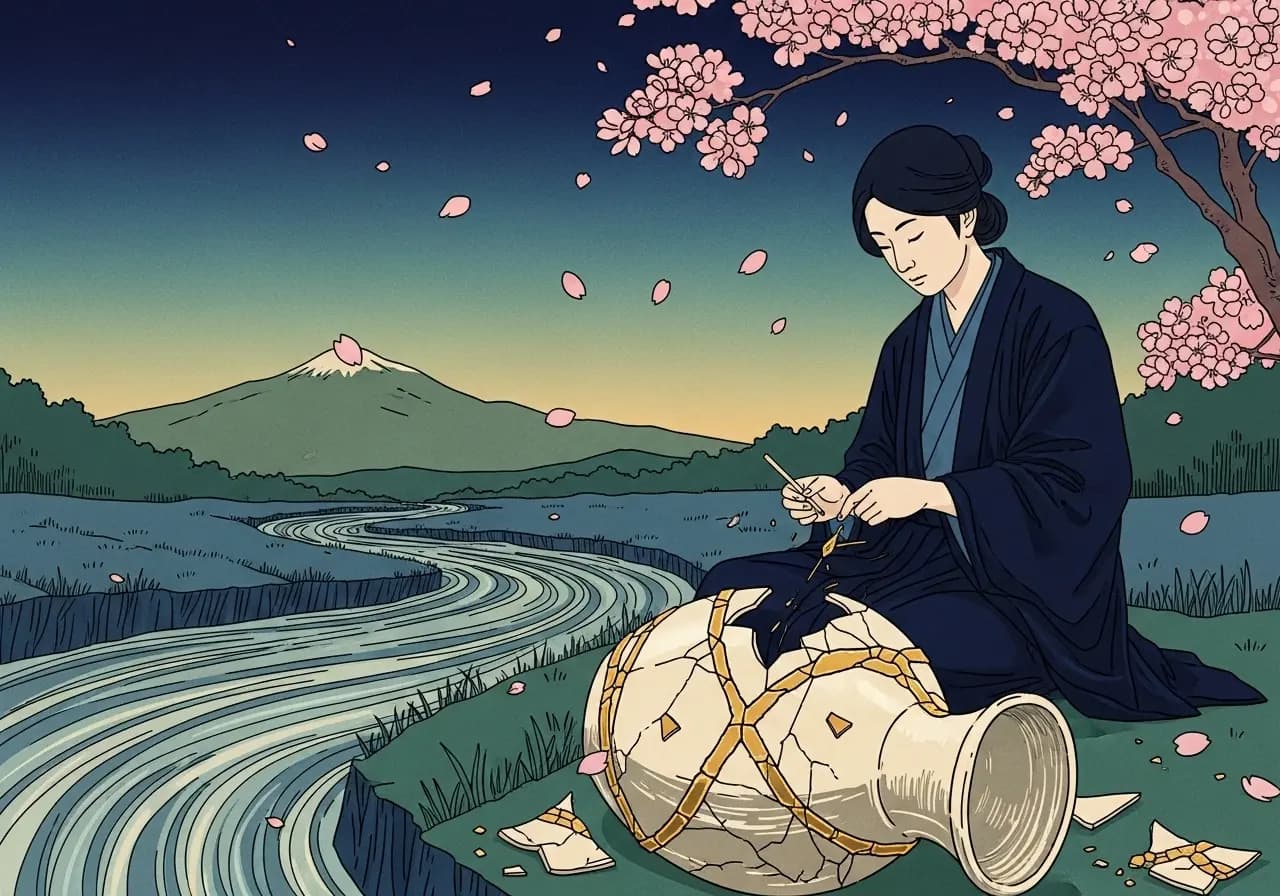
In Japanese culture with pottery, there's this idea called kintsugi. If your vase breaks, you can repair it, and then it has more value—more sentimental value or just more value in general—because it's repaired and now it has a story. Utilitarian thinking in the West would be, "Oh, it's broken. I don't want it."
If we go back to the example of the bench, you might have a wooden bench that you've had for years and years, and then a part of it breaks. If you only see it for its utilitarian value, you could say, "Well, this is broken. I don't want it anymore." Someone else might have sentimental value and say, "We've had this forever. I want to fix it." You could throw it out if you don't see any utilitarian value, and your neighbor who is trying to start a fire might see it and assign it value because now there's a pile of wood that he can use in the fireplace.
Causality Versus Meaning
These are just some examples to help you think about this concept. Ultimately, what I'm trying to get across is that in Western thinking, we do tend to lean a lot on utilitarian values for things. There are aspects of our lives that we look at and we calculate, and if it doesn't have value, then it's not that significant or meaningful to us. In Eastern thinking—or especially in the Buddhist philosophical concept of purpose and meaning—we find the opposite happening. There's the idea of purposeless purpose or meaningless meaning. This is the idea that we do things just to do things.
For example, a flower blooms because that's what a flower does. It doesn't have to have meaning. It just does what it does.
There's a way to live where, in a similar way, we can just live for the enjoyment of living—not because it has to have any meaning or any value or any purpose. This is the concept of living artfully. In fact, if you observe nature, this is exactly what we see. I like to think of a river that flows. When you're looking at a river that's flowing, there's no need to look at that and say, "What is the value? What is the meaning?" There is no meaning to the river that flows. Instead, there is causality.
Causality is a mindset that I've been working with for the last few years since studying Buddhism that I really enjoy. Instead of taking something and looking for the inherent meaning in it, you're looking at what is the causality behind it. Let me give you an example. Looking at the river, you can look at it and enjoy the beauty of the flowing water very much the way you would normally. But there's no need to look for meaning. There's no meaning to why the river flows. Instead, you can look at the causality and say, "Well, this river is flowing because the snow is melting further up in the mountains." You look for the causes and conditions of things, and that in its own sense can be a beautiful experience.
Causality in Daily Life
But I think where this really gets interesting is taking the mindset of causality versus meaning and applying it to our day-to-day living and experiences.
For example, I use the example of being cut off when you're driving because this is a common thing and I think everyone's experienced it. How easy is it when you get cut off to look for the meaning? "Why did this person do this to me?" If we're assigning meaning to that, we're typically going to be wrong in our assumption of what's happening. If we approach this from the mindset of causality, then we can understand what happened is just what happened. I got cut off, and there's a reason behind it. I may not know the reason. This person may have lost their job today. They're in a bad mood. Somebody maybe cut them off, and now the mood that they're in is part of the problem. This is the difference between causality and meaning.
Imagine in early times—I think our human tendency is to look for meaning. This is why, I would imagine, in the earliest of times, when a volcano erupts, people are thinking, "Why did that happen? The God of lava must be mad at us. Maybe we need to sacrifice something." If we're looking to create meaning, we're going to be wrong in our assumption of why things happen.
Now, granted, back then, looking from the mindset of causality, you wouldn't know why the volcano is erupting. But I think this is where it becomes very powerful to be able to sit with uncertainty. Something can happen, and we can say, "I don't know. I don't know the cause of that," and leave it at that. With time, we could find out. Science does a fascinating job of discovering causality in things. It can take us pretty far back.
Then when you get to a point where you don't know, you just stay with that uncertainty. You continue to explore and ask questions, test hypotheses until you find the causality of things. But to do the opposite and assign meaning to things can be very dangerous. When we're observing nature, we see our tendency is generally to have the mindset of causality. We don't question what is the meaning of a tree blooming. We just look at it for what it is—a tree that's blooming in the spring, it smells this way, and in the winter, the leaves fall. There are always causes and conditions to the things that we observe in nature.
The Mold on the Bread
A couple of weeks ago, I had this experience where I was at home and I was taking a piece of bread out of the bag to make some toast. I noticed one of the pieces of bread had some mold on it, so I decided not to eat it, but it got me thinking.
Here you have bread that's in a bag and it's by the window, so the sunlight comes in and warms up the temperature inside the bag. You give that enough time and now the causes and conditions have allowed for mold to exist. The mold is attached to the bread and surviving off of it, and I thought, "And that's life." The causes and conditions arise and suddenly, life exists. There's this mold sitting there on the bread.
As I thought about this, I thought: now, how silly would it be if, at some point, this mold—if we gave it enough time—was able to think and say, "I own this. This bread exists for me. This bread is my possession." The reality is that the mold only exists because of the bread and because the causes and conditions were acceptable to allow mold to come into existence.
Then I thought, "Wow, isn't that our experience of suddenly existing?" We exist on this planet very much like the mold that, with the right causes and conditions, exists on bread. Here we are, existing on the planet. And I thought about the mindset of thinking that all that is—this planet and everything on it—exists for me. Then I reversed that and realized: I exist because of it. I exist because of all of this.
I think that is, in a way, what it means to live artfully. Rather than assigning meaning, I'm just looking at the causes and conditions of things and realizing I am part of the process of causes and conditions that allow me to exist. There doesn't have to be any utilitarian purpose or any assigned value. This is purposeless purpose and meaningless meaning. There is no meaning, and it doesn't mean anything that it doesn't mean anything. And yet here I am, and I get to exist. Somehow in the middle of this process of existence, I actually have the ability to experience consciousness, to be able to think, to be able to process emotions and all these incredible experiences that go along with being alive. I think that's the main difference between simply living and living artfully.
Living Artfully Day to Day
With that in mind, I think something we can ask ourselves this week is: why do we tend to search for meaning? Why do we tend to want to assign some form of utilitarian value to the things in life, to life in general, and to the things that happen in life? What if it doesn't have meaning? Does that change anything?
I think one of the key concepts in Buddhism that I've really enjoyed is the idea that there isn't meaning—and that's not to say that we can't find meaning in life. So there's a difference between looking for the meaning of life and looking just for meaning in life. Looking for meaning in life through the lens of interdependence and impermanence, we can find meaning in so many things, and the meaning that we find in life evolves.
The meaning that I had as a college student is different than the meaning that I get in life now as the father of three little kids, and it was different being single than it is being married. This process is continually changing and evolving over time. Some people find an incredible sense of meaning by traveling, by exploring, by experiencing new things. Others get a sense of meaning following ritual or routine or repeating a lot of the same experiences in life. There's not a right way, there's not a wrong way—because we're just living.
To live artfully, I think, encompasses this idea of living for the sake of living. It's painting for the sake of painting and singing for the sake of singing. There could be other things that go along with it, but first and foremost, we're doing what we do because we're just doing what we do. It's what brings us joy, it's what makes us happy, and that can evolve over time. Dancing just to dance. There doesn't have to be a utilitarian purpose to dancing. Walking on the beach or all of a sudden, you start skipping. We don't pause and say, "Wait, why am I skipping? It's more efficient to be walking right now." We don't have to go through life that way.
There are some aspects in life where I think this is natural, and there are other aspects of life where we get caught up in utilitarian thinking. How enjoyable would it be to be able to pause and analyze those moments and think, "Why do I have to get caught up in looking for the meaning of this or that? Why can't I just enjoy doing this for the sake of doing it? Why can't I live artfully?" That's the concept I wanted to discuss today.
An Invitation
I'd like to invite you to explore a few aspects of your own life in which you may be living with a utilitarian mindset. What would it be like if you were to switch to this purposeless purpose or this meaningless meaning mindset—the mindset of living artfully? What would that look like? Just play with that a bit and see what you think. See how that changes the way you interact with the experience of being alive.
Foundation for Mindful Living
Now, before ending this podcast, I do want to share a couple of things with you that I'm really excited to share. A couple of podcast episodes back, I mentioned how I'm planning on bringing all of the work of the podcast under the umbrella of a foundation—a nonprofit foundation. Well, I'm excited to announce that that process is complete. The Foundation for Mindful Living is now official. It's a nonprofit, and I want to talk to you for a second about what I'm working on with this project because I think this is really exciting.
I really believe that if we want to contribute to making society or the world a more peaceful place, we must start by making our own lives more peaceful. How much anger, aggression, and impatience do we see and experience not only in our own lives but in society in general, especially in light of recent events? We can see that the world needs to have more kindness and more compassion.
This is something that I have been really focusing on since the start of the year, and it motivated me to do what I'm doing with Secular Buddhism. I believe that a peaceful world can only exist as a result of peaceful individuals. I feel like the way to making the world a more peaceful place is by making myself a more peaceful person. This is why I've decided to dedicate my time and energy to producing content and tools to allow people to learn mindfulness and to learn the philosophical concepts of contemplative living that allow us to live more peaceful and happy lives.
The Foundation for Mindful Living is a nonprofit organization dedicated to creating and providing tools and content to help people live more mindfully. I would love to ask for your help to partner with me to help me accomplish what I'm trying to do.
Three Current Projects
I have three current projects that I'm working on.
The Secular Buddhism Podcast
The first is the Secular Buddhism podcast, which is this podcast that you're listening to right now. We have 19 episodes so far, and I plan to continue making this a weekly podcast that touches on topics of Eastern philosophy and Secular Buddhism—Buddhism presented in a way that makes sense conceptually for secular-minded people like me.
By donating to the Foundation for Mindful Living, you're essentially donating to the Secular Buddhism podcast, allowing me the opportunity to continue producing content every week. From the time this podcast launched, it's grown exponentially. In fact, this week, we've hit over 100,000 listeners. It started out at zero at the beginning of the year. So it's been really exciting to see this grow, but the amount of time and resources that go into maintaining this—from the hosting of the website to the hosting of the audio files and everything that goes along with that—I've just been maintaining all of those costs on my own as my way of trying to contribute to making the world a better place. But it's grown to the point where I think it's starting to exceed what I'm capable of maintaining on my own. So I wanted to ask for your help with that.
If you enjoyed the podcast, I would invite you to contribute—either one time or monthly if possible—and you can do that by visiting Getmindful.org. When you go to that website, that's the foundation website. You'll see under current projects the three projects I'm working on. You'll see the Secular Buddhism podcast, and at the bottom of that page, you'll see a place where you can make a donation. It's really easy to set up—you can do a quick donation with your credit card or PayPal. You can select to make that a monthly contribution starting from $5 and up, or you can pick your own amount. Your generous donations will allow me to continue producing weekly content for the Secular Buddhism podcast along with content for the workshops, retreats, and seminars that I want to put on.
Mindful Living Workshops
The second project I want to talk to you about is the Mindful Living Workshops. The plan is to do one or two-day workshops, and we'll do these in various cities starting with the cities where we have the most listeners. I have a list of those. They include London, New York, Chicago, and several other cities. What I plan on doing is making workshops available where people can attend and, in one or two days, get an entire introduction to Buddhism—to Secular Buddhism.
When I first started studying Buddhism, I was fascinated by the topic. I got most of my information from books, and I was able to attend several retreats with Pema Chödrön, Thich Nhat Hanh, and several other teachers. Something that bothered me—and I understand why it works this way, but it bothered me—is that these workshops can be expensive. To go listen to someone and to learn from a Buddhist teacher can be expensive. I felt bad knowing that for me, this was doable. But to think that there's someone out there who may be interested in learning this but just doesn't have the resources to do it was sad. I feel like this is content that is really life-changing, and it promotes such a positive way of living that I don't want to restrict it to only people who can afford workshops.
That's where the podcast comes in. I know anyone can listen to that. It's always going to be free. But what about these workshops? Well, the contributions to the foundation also allow me to travel and set up workshops in places where listeners can come and attend a one or two-day workshop for free. The only expense involved would be paying for your food, or if there's a venue that we have to pay for, there will be a minimal cost associated with that. But I think we would be able to set these up so they could be completely free for anyone who wants to attend. That is a very important aspect of this for me. I want to make sure that all of this content that one can look for and learn in Buddhism will always be available to anyone interested. Money shouldn't be an issue. Then, of course, if you're able to attend and you want to make a donation, that would allow us to continue promoting these to a greater audience.
Mindful Humanitarian Expedition
So we've got the Secular Buddhism podcast and the Mindful Living Workshops, and then there's a third one—a new one that I'm experimenting with and I'm really excited to tell you about this. I know that this isn't one that's going to be open for everyone because this one does have costs associated with it. But this is the idea of doing a Mindful Humanitarian Expedition.
The thinking behind this is that these are three things that I really enjoy in life: mindfulness, doing humanitarian work, and experiencing adventure and expeditions. Fortunately, with my career and with what I do for work, I get to travel a lot, and I think it's a fascinating opportunity to experience new things. So I thought it would be fun to test this and see if anyone out there is in a position to be able to do something like this.
I would love to put together a trip—and it's already put together with the Africa Promise Foundation. The founder of the Africa Promise Foundation has an organization called Africa Promise Expeditions, and my friend Suzy, who runs that foundation, and I have decided to partner up and create this opportunity to be able to travel somewhere where you get to enjoy the benefits of learning mindfulness. Throughout the expedition, every evening we would be doing workshop work—teaching mindfulness, learning to meditate, learning all of the concepts and principles of Secular Buddhism. During the day, we're actually doing humanitarian work—building or digging wells and working with locals in Uganda—doing actual humanitarian work. It's a combination of working on ourselves through mindfulness while working for others doing humanitarian work.
Then the third component to the trip is to enjoy unique experiences while we're there—the adventure side of it. We would do an African safari and just gain new experiences while we're there because part of the beauty of life is gaining new experiences and doing things that are fun. This is a combination of all three of those things: learning mindfulness, doing humanitarian work, and experiencing adventure all in one trip.
You can get more information about this trip by going to Getmindful.org, which is my foundation for mindful living. When you look at the current projects, you'll see all three of these options: the Secular Buddhism podcast, the Mindful Living Workshops, and the Mindful Humanitarian Expedition.
The Uganda Expedition Details
This expedition already has dates set in mind. If you're available for that, I'd love to have you apply to join us. The dates are January 26th through February 4th of 2017 in Uganda. Everything included in the cost of this program covers everything that you would need from the moment you arrive in Uganda till you leave. The only thing you would have to do is get there. We can assist with affordable airfare, depending on where you're coming from.
Your Partnership Matters
I'd love to see if you're interested in any of these things. But if you're in a position to do this, it would be awesome if you would be willing to partner with me and become a monthly contributor to the Foundation for Mindful Living, which will continue to keep the Secular Buddhism podcast going. It would allow us to start doing workshops that you can attend and that anyone can attend without any cost associated. It would allow me to start putting together an online curriculum and online workshops that anybody could attend anywhere in the world—again, completely free.
Then, of course, if you're interested in the Mindful Humanitarian Expedition, click on that and apply. We only have a few spots available. I'm going to do this with some people who are close to me, and we're leaving the other spots open for anyone who's interested to apply. You can join us on this humanitarian expedition. I think it's going to be an awesome experience.
If you're interested in any of those things, please check out Getmindful.org. Please consider becoming a monthly contributor to the podcast through Getmindful.org, and please feel free to reach out to me if you have any questions or concerns about any of these things. I'm looking for people who, like me, believe that the key to making the world a better place is by providing tools and content to teach people to be more mindful. If that sounds like something you'd like to do, I'd love to have you work with me on this.
Visit Getmindful.org if you have any questions.
Closing
That's all I have for this week's podcast. I look forward to doing another episode next week. Thank you, and have a wonderful week. Until next time.
For more about the Secular Buddhism podcast and Noah Rasheta's work, visit SecularBuddhism.com