

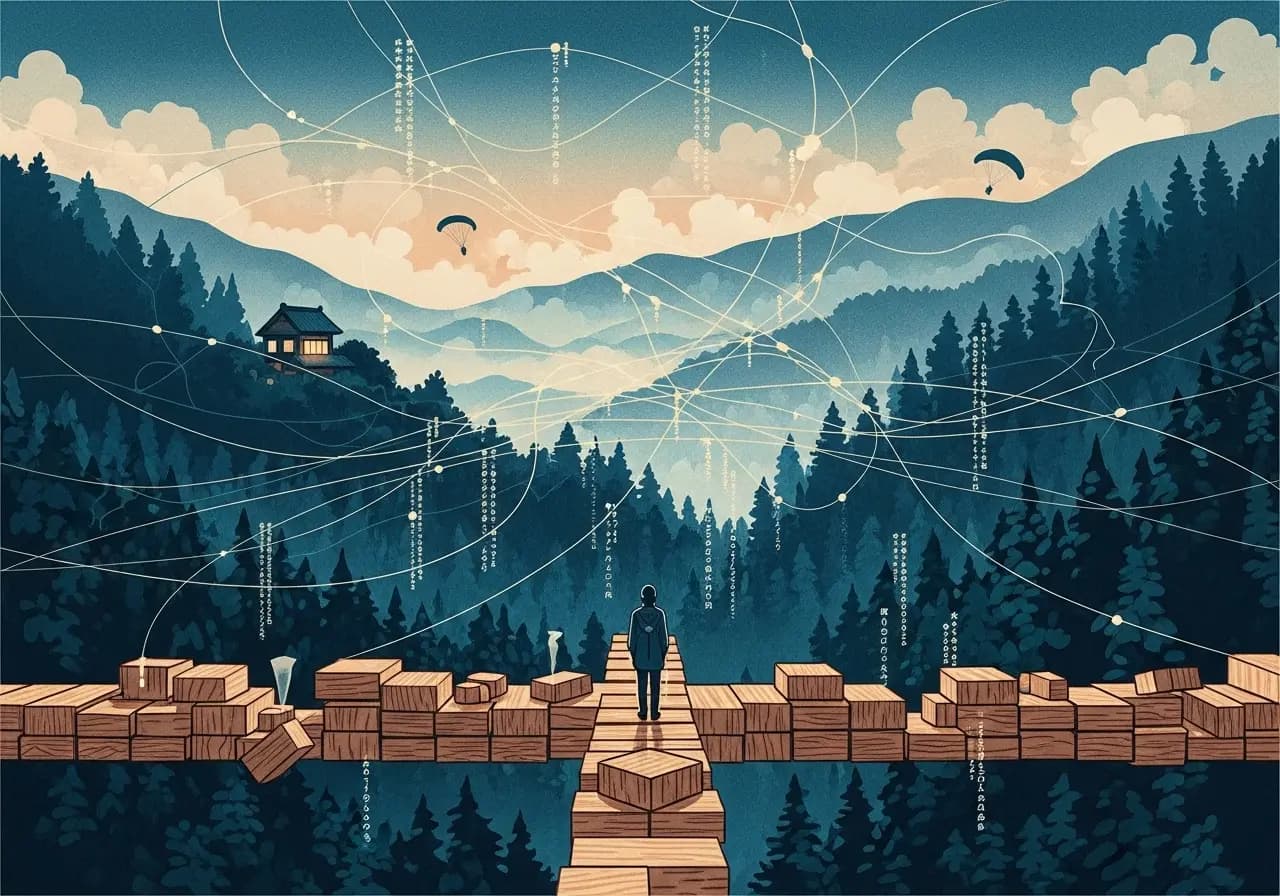
Life Update
Episode 188 of the Secular Buddhism Podcast
Hello. You're listening to the Secular Buddhism podcast, and today I want to give you an update on what's been going on in my life. It's been three months or so since my last episode—January 25th was the last one I uploaded. A lot has happened, and honestly, these have been some of the busiest months of my life.
The Decision to Change
I've been teaching powered paragliding for years, offering ten-day courses where people learn to fly. In the winter months, I have to travel down to Arizona because it's too cold here in Utah. So I'm on the road constantly—I usually arrive a day early to set things up, teach the course, and then drive home. It's at least a full day of driving each way, twelve to thirteen hours with my trailer. Sometimes I'm gone for twelve or thirteen days at a time, then home for a few weeks, and then back on the road again.
While I've made this schedule work for years, my kids are now at an age where it's much harder. They all have their own activities now. My son plays cello and is on the swim team. My daughters dance. My youngest plays soccer. There's a lot going on. My wife is also busy—it's her first year as the bilingual teacher in our local dual immersion program, which means she's doing a lot of curriculum planning and lesson planning.
So the schedule just became really difficult.
The Breaking Point
I came home in November after one of my courses. That month was particularly hard because I'd also gone to Nepal, so I was gone for almost the entire month. When I got home, I found that the family had decorated pumpkins for pumpkin carving night. They were all lined up on the stairs leading to the door. But there wasn't one for me.
That hurt. I'd missed the whole pumpkin carving thing.
Then I went out for another course in Arizona, and when I came back, I realized I'd missed the gingerbread house decorating that we do in December. That was the final straw. I saw all these gingerbread houses with everyone's names on them—Mommy, Noel, Gigi—but there wasn't one that said Daddy. There wasn't one for me.
I thought: I can't do this anymore. I'm no longer at the stage of life where I'm okay being gone that long.
So I started looking for a new job.
The Job Search
I love teaching, and I don't know if there's anything more fun than having a job that's also your hobby—doing something you genuinely love. But the price of that was being on the road constantly, missing out on my family's life. I wanted to find something I still enjoyed but that didn't require me to be gone for such long stretches.
I interviewed for a local job that was only twenty minutes from where I live. I went through three or four rounds of interviews over about a month. Then, at the very end, I got a pretty informal email letting me know I didn't get it. That was difficult to go through—a whole month of process for that outcome.
But I started searching again and found a new job, which is the one I have now. It's a remote position, which gives me flexibility to travel and work around my family's schedule while also giving me the stability of a regular job and income without being on the road all the time.
The New Role
I'm now the director of marketing for a company called Data Canopy. They're data infrastructure providers—cloud and colocation services. To be honest, I kind of knew what that was but didn't really understand it. Now I do. I've immersed myself in learning this entire new industry, trying to understand all the ins and outs.
Essentially, we provide the backbone infrastructure that runs technology. When you access a website, when you listen to audio like you are now—whether it's a podcast or anything else—all of that runs somewhere on hardware, probably in a data center somewhere. There's a lot that goes into maintaining that infrastructure. We provide that infrastructure for businesses, industries, healthcare, and so on.
It's all quite fascinating, actually. And I want to tie this into the main topic I have in mind for this episode, because it's been really eye-opening to learn about the deep layers of what runs the infrastructure behind our technology.
The Software and Hardware Connection
I've always been familiar with the surface layer—the software, the technology that allows us to post videos, stream audio, render content into formats we can consume. But I'd never spent time understanding the deeper layer: the hardware that makes all of that possible. And it's been really fascinating.
I want to correlate this with something I teach in the course I launched last year, the Inner Peace Roadmap. In the very first lesson, I talk about the cognitive cycle, and this is about understanding how my beliefs, thoughts, emotions, actions, and the consequences of those actions are all interconnected.
Here's how it works: beliefs affect our perceptions. Those perceptions influence our thoughts. Thoughts give rise to emotions. Emotions produce feelings. Feelings influence the decisions we make. Our decisions drive our actions. Actions produce behaviors. And behaviors have consequences and results. Those consequences then shape our experiences. And our experiences, in turn, shape our beliefs. Then the cycle continues.
Let me give you a real-life example to illustrate this. Imagine someone who has the belief that they're not good at public speaking. That belief was probably shaped by past experiences—maybe they stuttered once during a speech, or they were really nervous and forgot what they were saying. Because of that belief, when they perceive the opportunity to give another speech, their perception is filtered through that belief: "I'm bad at this."
That perception influences their thoughts: "I'm going to mess up. People will judge me. I won't be able to remember what I'm supposed to say."
Those thoughts give rise to emotions—anxiety, fear, dread. Those emotions produce physical feelings—maybe a tightness in the chest, butterflies in the stomach. Those feelings influence their decisions. Maybe they decide to avoid public speaking altogether, or they decide to give the speech but show up unprepared because they're already convinced they'll fail anyway.
That decision drives their actions. If they show up unprepared, they perform poorly. They stumble through it. The behavior has consequences. People might ask fewer questions, or they might look disengaged. These consequences produce an experience—the person leaves feeling like they did poorly, confirming their original belief.
And so the cycle reinforces itself. The belief becomes stronger, and the person becomes more convinced that they're just not good at public speaking.
The interesting part is that this entire cycle is driven by a belief. If we examined that original belief and questioned it—what if it's not actually true?—we could potentially interrupt the cycle. What if they could see that one bad experience doesn't define their ability? What if they prepared more thoroughly next time? What if they recognized that being nervous is normal and doesn't mean they'll fail?
If we changed the belief, then the entire cognitive cycle would shift.
Now, if we think of beliefs like software, it becomes really important to examine our beliefs. Are these beliefs beneficial? Are they skillful? This is the foundation of how we interact with the world and the actions we take in our day-to-day lives.
The Hardware and Software of Life
Here's where my new job comes in. I've had a lot of experience with software and technology, but I didn't really know this other layer of infrastructure—the hardware, the actual servers. What do they look like? What brands are they? How do they work? I didn't know any of this. But now I'm diving headfirst into the world of data infrastructure because it's part of my job. And specifically, I'm figuring out how to market it.
Something I've always tried to do—I do it here with the podcast—is take a complicated or complex idea and explain it in a simpler way. A lot of Buddhist teachings are complex. How do you explain them so they're easier to understand and implement into your day-to-day life? That's what I'm doing now for my company, helping businesses understand why they'd want a certain data infrastructure configuration instead of another.
Here's the thing: we rarely think about the infrastructure behind our technology because we don't need to. We just know it works. We don't need to know all those intricate details. But I think we make that same mistake with our own minds. We don't examine the beliefs that are running in the background of our own consciousness.
Why do I say what I say? Why do I think what I think? Why do I do what I do? Why did I react that way to that particular scenario? Why does it bother me when so-and-so says this or does that?
Much of our day-to-day life is driven by beliefs, and these beliefs are usually easy to identify because they often take the form of "should."
It bothers me that someone says what they say because they shouldn't say that. They should behave differently. They shouldn't be the way they are.
Where did that belief come from? Why shouldn't they be that way? If you examine the belief itself, you might recognize something interesting: if I didn't believe that they should be a certain way, then maybe it wouldn't bother me that they're not that way. Maybe I'd just accept it as how they are. The belief is creating the suffering.
Updating Your Mental Software
I think it's important for us to maintain our mental software and to understand it. In the real world of interdependent connections between servers and software, you have updates. Software that hasn't been updated gets really slow and becomes bogged down and ineffective.
Our brains are the same way.
If you retained the exact same beliefs you had as a five-year-old, and nothing changed, you'd view the world exactly the same way. But now, in the context of an adult trying to live a much more complicated life with jobs, relationships, and responsibilities, that wouldn't work very well.
Throughout our lives, we need to update our beliefs. We start with one belief and then gain new information from the world around us, from our experiences. Our beliefs adapt. You could reframe "beliefs" as "ideas" or "opinions," and it works the same way. How we think about things can evolve and change. It should evolve and change.
It's the same way with hardware and software. If you never update your software, anyone who's had an old computer knows what happens—it just gets slow. Then you get a new computer and think, "Oh, it's fast again!" But it's not always the computer itself. Yes, hardware changes and evolves and gets better, but the software is also constantly changing and evolving.
Think about your brain the same way. The brain is the hardware for us. It's also changing and evolving. What changes it? Well, the amount of rest you get. The food you consume. Those are just two examples that play directly into the correlation of hardware and software.
In the real world, physical servers run virtual environments. They consume a certain amount of power depending on what the desired outcome is for that server. Some consume a lot of power. Some don't need as much. They need to be cooled. Some servers are in cooled facilities maintained with air conditioning—like a refrigerator—because servers run really hot.
Our brain is the same way. Your brain needs to consume power (depends on what you eat—some things are good for the brain, some are not). What you consume in terms of music or entertainment also has a direct effect on your brain. But then there's the cooling part. Your brain needs to cool down because it's running hot. That's recognizing that you need to take breaks, practice meditation, be more mindful, and get enough sleep every night.
The Bigger Picture
My primary goal with this episode was to give you a life update and explain why you haven't seen a podcast episode in the last couple of months. But I also thought it was really interesting that transitioning into this new career has made me think more deeply about this metaphor of the mind as software and the brain as hardware, and how important it is to understand how our brain works on both levels.
So I wanted to share that with you, give you that update, and explore this connection.
I'm still busy for the next month or two, though. In addition to all of this, my wife and I and the kids are relocating. We're moving to a different part of the same valley where we live, but to a new home. And as you know, if you've done it before, moving involves a lot of work. Packing up one home, installing yourself in another.
To make matters more interesting, it's the busy season for dance. My wife is a schoolteacher, but she also runs a series of dance competitions. Our daughters are in dance as well. So every weekend from March through the end of May, there's a dance competition somewhere—either one the girls are dancing in or one my wife is running. And her competitions have grown to the point where she needs a second person helping with all the hardware and software for the competitions—recording judges' notes, tallying scores, all of that.
You can guess who that second person is. It's me.
A Practice for You
So I'd like to invite you to reflect on this analogy of the brain being like hardware and the beliefs or ideas that the brain has being like software. See if you can notice this correlation in your day-to-day life.
Notice how beliefs affect perceptions. How perceptions influence thoughts. How thoughts give rise to emotions. How emotions produce feelings. How feelings influence your decisions. How decisions drive your actions. How actions produce behaviors. How behaviors have consequences and results.
Look at the overall experience of all that and ask yourself: How does that experience, in turn, shape my beliefs? Does it reinforce and strengthen the belief? Or could it be the catalyst for changing it?
That's how the cycle continues, moment by moment, day by day, year by year.
If you can notice it in your day-to-day life, you can start to work with it consciously instead of just letting it run on autopilot in the background.
Closing
That's all I have for you today. As always, thank you for listening, and I look forward to recording another episode next time.