

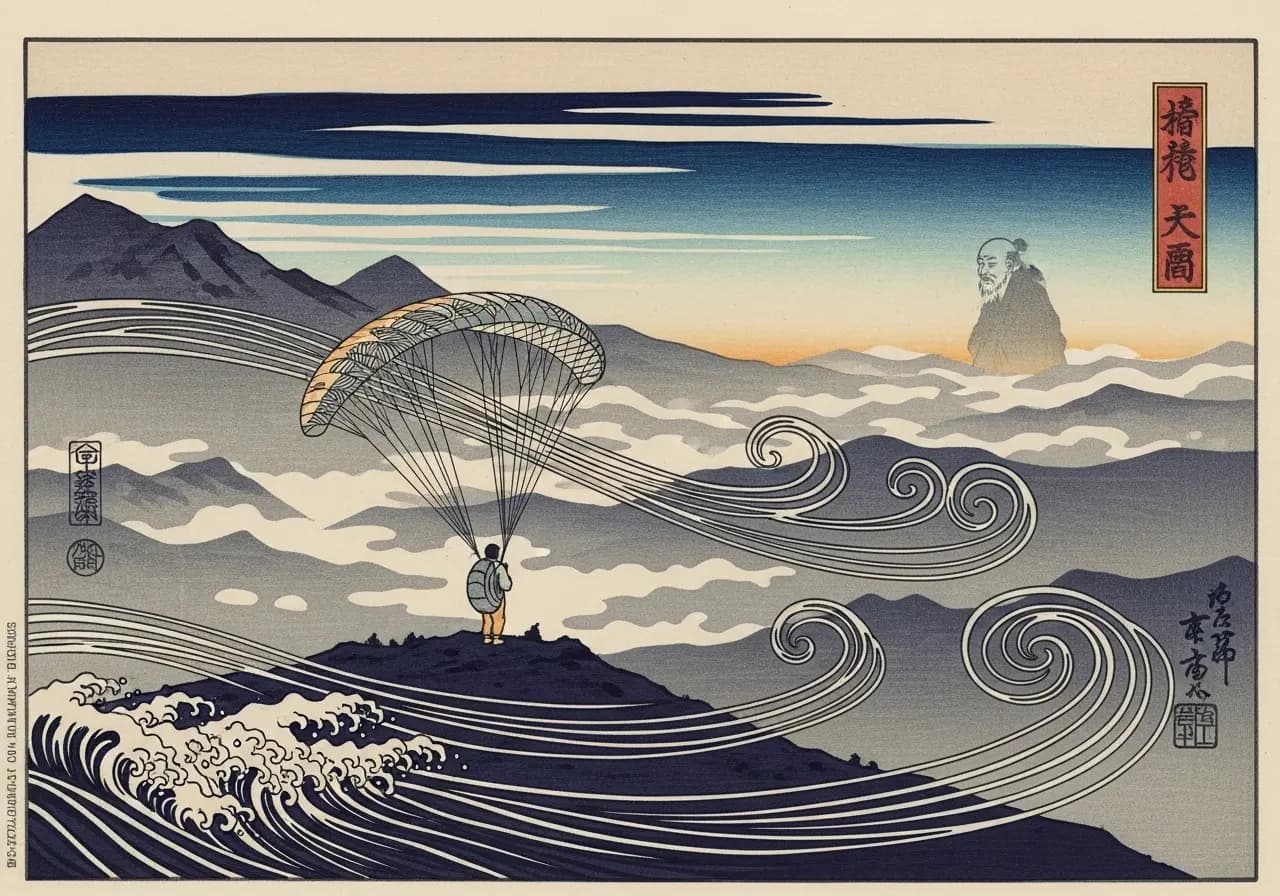
The Unseen Teachers
Episode 187 of the Secular Buddhism Podcast
Hello. You are listening to the Secular Buddhism podcast. This is episode 187. I'm your host, Noah Rasheta, and today I'm talking about the unseen teachers in our lives and how to transition from being a student to becoming your own guide. So let's get started.
A Humbling Lesson in Ridge Soaring
I want to start this podcast episode by sharing what I consider to be a funny story. This happened about eight years ago, and it was a time when I was so frustrated and so upset that I physically tore my shirt open out of anger and frustration.
Let me give you a little context of what was going on. At the time, we had Jonah, who was our German foreign exchange student, living with us, and it was the end of his year abroad. He came out to California with me to watch a paragliding trip that I was going to do. I had already been flying—I was still very much a novice—and I went out with my instructor to learn how to do a certain type of flying called ridge soaring.
Now, with ridge soaring, you ride the wind in a very similar way to riding the wave of water. So imagine surfing. If you can picture this: you have a board that's riding the wave, and it's the very shape of the wave that lets you surf. If you go too far out in front of the wave, you sink. If you get pushed back, you'll also go over the wave on the backside and you'll sink. So the wind works the same way. The wind will flow over a ridge, and the ridge is shaped like a wave. As the wind flows over it, you can soar inside of that space right along the ridge. This was new to me, so I went out there with all the excitement and enthusiasm to learn this new style of paragliding. And it turns out it's quite difficult.
If you've ever flown a kite, you may recall how on a very windy day you can feel that tension in the line of the kite, and it feels like the kite wants to pull you over and you have to hold it really strong. Well, imagine having a piece of fabric that's like a kite, but it's 30 times larger than a kite. And you can't just let go. You're connected to it. So I was out there learning first how to control the wing on the ground. It turns out it's much more difficult and much stronger than anything I had tried before, because for normal powered paragliding, you don't have strong wind. You run and you inflate the wing overhead, and then the faster you run and the motor starts pushing you, then you just climb up like an airplane does.
But to do ridge soaring, you have to launch this piece of fabric in very high wind. It's that same feeling of being tugged like a kite would tug you. But it's your body because you're connected to this wing. And I was just being thrown around like a ragdoll. I thought I knew how to control the wing pretty well, but not good enough to avoid being dragged around.
The temperature was cool—I'd say it was in the fifties or sixties—and you have this wind coming off the water. So I had suited up with a thermal liner, like thermal underwear, shirt and pants. And then I had a flight suit that's like a windbreaker, one-piece suit. And as I'm sitting there on the ground, really wrestling with the wing and it's just pulling me around and it's dragging me across the sand, I was putting in a lot of effort fighting it and getting really hot.
I've mentioned in previous episodes that I don't get hangry—you know, that term when you're really hungry and you start to get really upset because you're hungry. I don't have that, but I do have that for heat. As soon as I start to heat up and I feel that sensation of feeling really hot, I start to get really angry. And I don't know if anger is the right word. It's kind of like claustrophobic. There's nothing I can do about it.
So back to the story. I'm being dragged around the side of this hill because it's a sandy hill. Any effort of trying to go up and down the hill is a lot of effort. If you've ever tried to climb in sand, you'll know what I'm talking about. And I'm just being dragged around, fighting and resisting. Finally, I get the wing down, just under control so that it's not dragging me. And I go lay on the wing so that it won't fly up anymore.
That sensation comes over me, and I'm extremely hot and just instant frustration. I zipped down the flight suit that I was wearing, I took the collar of my shirt, and I just ripped it open and felt that sensation of air. And then I laid back down on my wing, just you know, frustrated and exhausted.
Meanwhile, Jonah, who's watching all of this, just starts laughing. He tells me, "You know, I've spent a whole year living with you and I've known you to be this super calm, patient person. I've never seen this side of you. It's actually really fun to watch you flailing around, being dragged in the sand and then out of frustration, rip your shirt open." And we had a laugh about that.
Where Does This Lead?
So where does this kick in with the overall topic? It turns out that learning a new skill, particularly ridge soaring in high winds, is difficult and it can be frustrating. And when I was there watching my instructor, he made it look so easy. He was effortless in how he would just dance around in the air. He would swoop down with his feet and he would pick up objects that were on the beach—like a chair or whatever was down there—and then soar back up to the top of that ridge and then place it very carefully wherever he wanted with his feet. He was making it look like it's something very easy to do.
I remember that day thinking, "Man, I want to be able to do that. I want to be like him and be that good at what he does." And instead, on that particular trip, I just got my butt kicked. And it was very frustrating and humbling. I asked him to help me because he was there, and we spent the rest of those three or four days learning. I did get to soar, but never gracefully. You know, it was my first trip there.
Now, fast forward eight years later. Now I'm an instructor, and when I go there, I can make it look easy and effortless, just as he did. And oftentimes, I'll have students there with me that will watch. And I can see that frustration in them and that questioning—wondering if they'll ever be able to do what I'm doing, what we're doing, those of us who spent the time to learn and master that skill.
From Student to Teacher
So today I want to talk a little bit about this idea of transitioning from being a student to becoming the teacher, and just the overall art of mastering a skill. And I want to correlate this with Siddhartha's journey. Siddhartha, if you'll recall, is the name of the Buddha—Siddhartha Gautama—and he started on his journey where he was living in a palace. He leaves the palace and he goes and he starts trying all these different methods and techniques to have greater peace in his life, greater inner peace.
Two of the teachers that he worked with early on in that process were Alara Kalama and Udaka Ramaputta. These are names that we get from the story of all of this. And the way the story goes, he starts working with these teachers. He learns everything that he can from them until he essentially outgrows the teaching and goes and finds another teacher. He works with that teacher till he reaches that level, and then at some point realizes he's going to have to go out on his own. This is all up to him.
I've been recently reading Karen Armstrong's book, Buddha, where it talks about the origin story of the Buddha. And I was deeply moved by this pivotal moment in Siddhartha's life where he comes to the decision that he needs to strike out on his own and to accept the dharma of no other teacher. Dharma means "teaching," and this pivotal moment was a profound choice—he needed to rely on his own insights. And that's a fundamental concept that I love about Buddhism: that we are our own greatest guides.
Life as the Teacher
Reflecting on Siddhartha's journey, I think about that pivotal moment when he was working with his teachers and he realized, "Okay, I can learn what I can from this teacher, and then I need to figure out the rest on my own." That's the essence of his journey to enlightenment—there's no relying on anyone else. It's like, "I've learned what I can from everyone else, and now I need to be confident in myself, in me, and I need to go out and just live and see how this is going to work."
I think about that a lot with my journey of paragliding and teaching paragliding, and that milestone where you realize, "Okay, for any more learning to take place, it's going to be on me." And of course, I can still learn from others. I can still read books and watch videos and absorb what I can from everyone. But what happens is mentally, I start to see everything as my teacher. "Oh, today the wind is extra strong. Well, that's my teacher." Whatever the scenario is, it's my teacher.
And I think this is where we can take this concept and apply it in a real-life context. The time comes where we have to allow ourselves to figure things out. I see this again with the paragliding journey. There comes a time when you have to allow a student to figure it out on their own. You've told them the technique, they've practiced it, and now the only way they really learn it is to just do it.
Early on in this stage of learning, this happens on the ground where you're kiting the wing above your head. And you're telling them, "You know, you have to lean this way and pull that brake and pull this left hand and twist your hips this way." You teach the technique, but then there's no other way for them to figure it out but to just do it until they figure it out. And that stage can be frustrating for both the student who doesn't get it and for the instructor who's like, "I don't know what else to tell you. I keep saying left and you're doing right. So there's nothing left for me to say now—you just need to do it."
But that's where it becomes a matter of practice. They do it, they do it, and then it kicks in and then muscle memory gets programmed. And before they know it, just like that transition of learning to ride a bike where you're struggling, struggling, struggling, and then suddenly it clicks and you're doing it—I think the same thing can happen on our spiritual path.
The Click Moment
I like to think about that in the Buddha's journey. It's like you're struggling and struggling, and at some point it all clicked and it came together and he realized, "I can do this. This is on me now." And I've thought about that often in my journey with Buddhism, and I've seen it the same way it happened with paragliding.
It's like you start to learn these basic things—meditation and how this technique works—and I put it into practice every day. And then before you know it, you're like, "Wow, I feel much more centered and I'm experiencing much more inner peace." Not because I've eliminated pain and suffering, but because I've learned to become comfortable with discomfort and to find peace and joy in the midst of pain and suffering.
And that is one of those big milestones where you start to say, "You know what? I can do all of this no matter what life is going to throw my way. I have confidence in me, my ability to navigate with whatever life is going to throw my way."
Life's Tetris Pieces as Teachers
So how does our journey transform when we start to become our own teachers? What insights can we gain from life's unpredictable Tetris pieces if we consider each one of these pieces as a teacher? When it comes and you're experiencing—"Oh, here's a flat tire. Oh, I just lost my job. Oh, I just lost a loved one"—whatever it is, not just negative ones, but also the positive pieces that come our way.
If we could ask ourselves, "What can I learn from this? And in what way does this experience that I'm having help me to be more skillful at living life?" I think that's one of those pivotal moments, like the one in the Buddha's life where he said, "You know, it's time for me to figure this out on my own." That's the essence of his journey to enlightenment—there's no relying on anyone else.
I think this is where we can take this concept and apply it in a real-life context. The time comes where we have to allow ourselves to figure things out. You've been told the techniques, you've practiced them, and now the only way you really learn is to just live. And that can be frustrating sometimes, but it's also where the real learning happens.
Taking Refuge in Yourself
I think that's one of the most important lessons we can learn. And I want to tie this in with the concept of taking refuge in Buddhism. You know, when you enter the path of Buddhism, there's a process of taking refuge where you take refuge in the Buddha, you take refuge in the Dharma, and you take refuge in the Sangha.
Now, if you think about this, taking refuge is finding security. Think of it like a boat that's out on the water and a hurricane's come in. To take refuge, you go into the harbor where you can be safe and ride out the storm. That's what we're doing. We're trying to find a place where we can feel safe and be at peace.
So taking refuge in the Buddha for me is taking refuge in this recognition that I'm learning to trust myself. The Buddha took refuge in who? In himself. So for me to take refuge in the Buddha, what that ultimately means to me is I'm going to learn to take refuge in myself and to be able to trust that I am capable of weathering the storm. I am capable of providing myself with that anchoring and with that safety net that says, "You know, we can figure this out. We"—meaning myself and all the other parts of me, my memory and my experiences and my emotions—"can figure this out."
That's what it means to me to take refuge in the Buddha. So I think that ties in with this overall concept of not having to rely on any other teacher, but learning that we ourselves can be the teacher that we've been looking for.
The Path Forward
So I encourage you to reflect on your own path, the path that you're on, and consider the transformative power of self-reliance and internal wisdom that you will gain on this path as you learn to look within. Instead of looking outside of yourself for these answers, learn to look inside and to find that wisdom on your own quest for greater inner peace and greater personal growth.
The most meaningful lessons often come from within. And knowing that can put us into this mindset that encourages us to learn to trust our own journey, to embrace the solitude and the discomfort of personal growth, and to acknowledge that life, with its ups and its downs, life is our greatest teacher.
I think this principle should form the foundation of every quest for wisdom. It should remind us that the most profound insight is the insight that we discover within ourselves. We don't need to be out there looking for this anywhere else, because it's to be found here looking within.
Closing Wisdom
So I want to end this podcast episode with a quote that I really enjoy from Matsuo Basho. The quote says: "Seek not the paths of the ancients, seek that which the ancients sought."
I like that as a closing quote for this overall lesson, whether it's applied to paragliding or the spiritual journey of Buddhism. Don't try to take the path of some other person that you look up to and admire. Seek what they sought.
You know, that's what I did with my instructor right away. I was like, "Wow, I want to be able to do the kind of stuff this person does." And I became like him as an example. I followed in the footsteps that would lead me down a very similar path. Now I am also a paragliding instructor, and he remains a very close friend of mine and a mentor. And I love thinking about it like that.
Rather than thinking there are these people that we need to look up to—like, "Oh, here's the Buddha. I need to try to be like the Buddha"—no. Don't seek the path of the Buddha. Seek what the Buddha sought. He was seeking to have greater inner peace in his life. And that led to the path that we all know now as the path of the Buddha. Seek your path to be like that.
So on your spiritual journey, don't try to walk someone else's path. Discover what they were seeking, and then seek that for yourself. Because when you do, you'll discover that the most profound teachers are not always the ones with credentials or followers. Sometimes, the unseen teachers—the wind, the struggle, the moment of breakthrough, the failures along the way—these are what shape us and guide us most deeply.
Thank you for listening, and I look forward to talking to you guys again next time. Take care.
For more about the Secular Buddhism podcast and Noah Rasheta's work, visit SecularBuddhism.com