

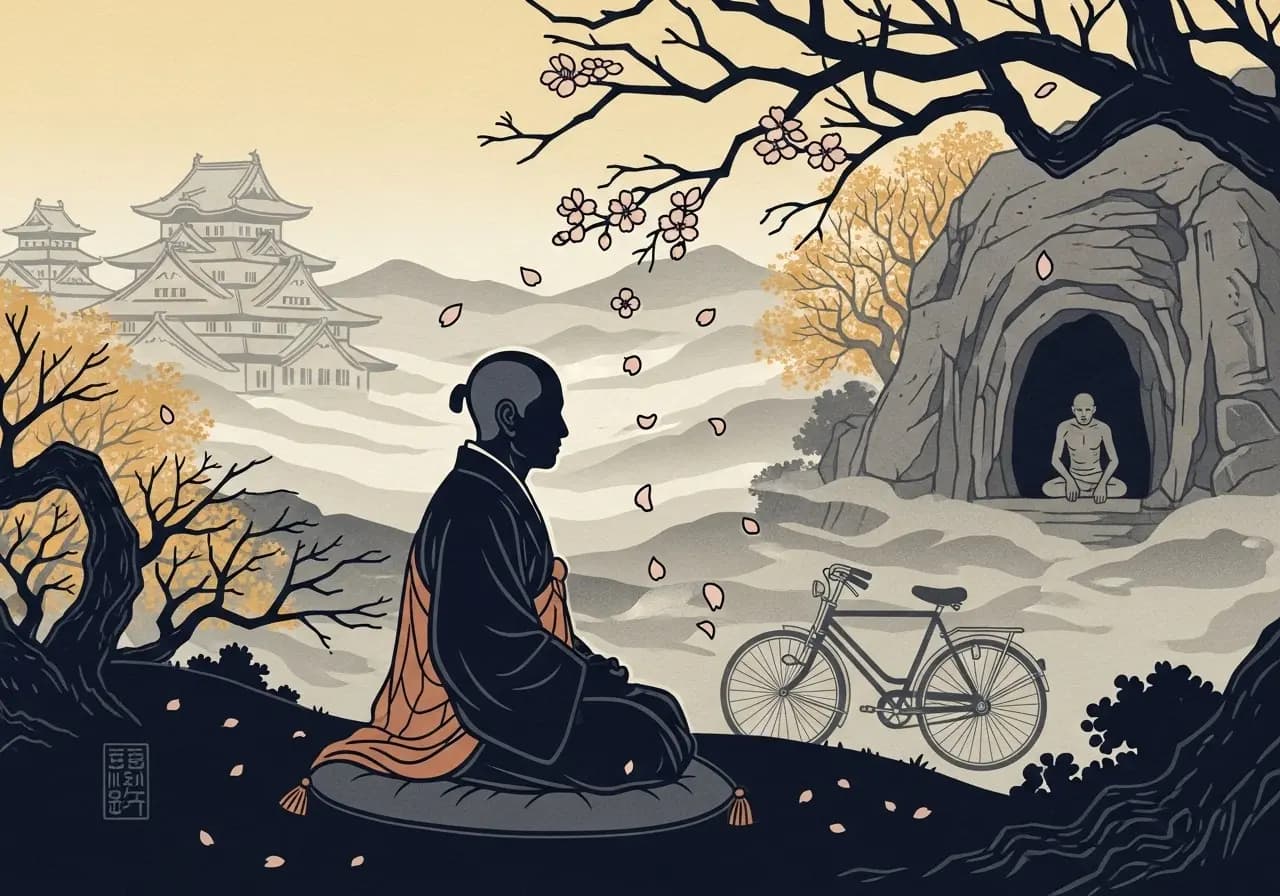
Renunciation
Secular Buddhism Podcast
Hello and welcome to the Secular Buddhism Podcast, a podcast that presents Buddhist teachings, concepts, and ideas from a secular perspective. You don't need to use what you learn from Buddhism to be a Buddhist. You can use what you learn to simply be a better whatever you already are. I'm your host, Noah Rasheta, and let's jump into today's topic.
The Journey of Renunciation
Hello and welcome back. Today, I want to delve into the concept of renunciation, specifically examining Siddhartha's journey from a life of luxury to a life of asceticism, and eventually to settling on what in Buddhism is referred to as the middle way. I'll explore the nuances of renunciation and how it applies to our daily lives—and how letting go of certain things can actually lead to gaining new things, gaining much more.
Remember the last time you decluttered your home or your desk? Perhaps it was giving away old things or making room for new things. That feeling of lightness and new possibility you felt once you cleaned things up—that's essentially what renunciation is about at its core. Today I want to discuss how this concept of renunciation can be transformative in our own modern, everyday lives.
Understanding Renunciation
One thing I've noticed is that when I hear the word renunciation, it often carries a heavy ascetic connotation. But in reality, it's essentially about making conscious choices about what we choose to hold onto and what we choose to let go of. When we understand and apply this concept of renunciation, it can lead to a more meaningful and more directed way of living.
In Buddhism, renunciation is not just about giving up material things or physical pleasures. It's a deep understanding and letting go of attachments that cause suffering. It's a shift from a way of living that is full of clinging—where you're holding on really tight—to freedom and living in a way that's much more liberated and free.
The Middle Way: The Bicycle Handlebars
One of the ways I've talked about this concept in previous episodes, at least the concept of clinging, is to imagine yourself riding a bicycle and holding onto the handlebars. There's the right amount of how much to hold on. You need to hold on just strong enough so that you don't fall off and so that you can move the wheel in the direction that you want to turn. But then there's also holding on too tight, and that's what I like to think of as clinging—and the middle way when it comes to attachment.
If you don't hold on at all, there are times when you can let go completely, right? You can ride a bicycle and let go completely. And there are times when you need to be holding on, sometimes tighter than other times. But the idea is finding the middle way—the balance—and it depends on where you are and what you're doing.
You can be cruising on the road and let go for a minute and ride a bicycle without even touching the steering wheel. But if you get into rocky terrain or you're trying to go downhill or uphill, it might be more skillful at that point to hold on to the handlebars and to not let go. But how tight do we hold on? That's kind of the idea here of the middle way. And you can think about that in the context of this discussion of renunciation and letting go.
The Buddha's Path: From Luxury to Asceticism to the Middle Way
Think of the story of the Buddha himself—the prince who renounced his royal life, who had a life of abundance and luxury to seek enlightenment. His journey teaches us about that balance because he finds that having everything isn't the way. It's not working for him. So he gives everything up and he goes out.
If you know the story, he becomes an ascetic monk where now it's the other side of the coin. He gives up everything and lives a life of complete austerity. And after some time, he ends up giving that up as well. He renounces having everything and he renounces giving up everything, and discovers this middle way. Again, I think it correlates really well if you visualize the idea of the handlebars and the bicycle.
This concept of renunciation is deeply embedded in a lot of Buddhist teachings that you'll find in the Pali Canon and other early texts, and it illustrates the central role of the path—the journey to awakening. While traditional Buddhism may sometimes depict this idea of renunciation as leaving the worldly life behind, becoming a monk and giving up your possessions, in reality, the modern everyday approach to this concept, I think, interprets it more as a mindful simplification and a prioritization of what truly matters. It aligns closely with the idea of modern minimalism and intentional living. But it's really about being aware of what it is that we truly want and knowing what is it that truly matters to us in our lives.
Applying Renunciation to Modern Life
When I think of the story of the Buddha and his renunciation—that's what starts him on his path—I like to think about that for me personally. It's the exploration of how my life is now and what is it that I really want? What would I be willing to give up or sacrifice to gain the thing that I want? So that entails knowing first, what is it that I actually want?
In our real-world application of this in our day-to-day lives, this could be choosing a simpler lifestyle or trying to limit social media consumption so that I can spend more time with family. It could be letting go of toxic relationships. There are examples of renunciation happening all around us all the time. We're always playing this balance of giving up one thing to gain something else.
That's how exercise works, right? If I want to gain knowledge in a new topic, I'm going to have to sacrifice some of the time that I spend doing other things to now study and read. But what is it that I gain in that exchange of one thing for another? That's the essence of this idea of renunciation. It's that we're always giving up something to do something else because we can't do everything. So we have to choose what it is that we do.
Practical Tips for Renunciation
Some practical tips for applying this concept of renunciation would be to first start small by identifying what you feel attached to that is no longer serving you. You can dedicate some time—maybe a week—to reduce or eliminate this from your life and then observe the changes.
Social media is a good example. You may enjoy spending time on social media, but you may realize that by doing that, you're sacrificing something else. Maybe it's spending time with loved ones or catching up with old friends, something like that. So you can decide, where's this trade-off? Where's my middle way? Am I doing too much of one thing and not enough of the other? And balance that.
My Meditation Practice: A Form of Renunciation
Another example for me—when I first started my journey with practicing Buddhism, the idea of meditation as a practice felt like a very lofty goal, kind of like exercise does. It's like, "Okay, I'm motivated, I'll do it for a while," but how do I make this a consistent habit?
I've realized over the years, and I've said this before, that consistency is much more important than duration when it comes to building habits, especially with meditation as a practice. So I decided to make it a goal to just sit every day. Instead of feeling like I need to make a goal that says I need to meditate every day, I realized I just need to sit and take time to do that. In that time, I'm not doing anything else, even if it's just 60 seconds.
That's what I did. I set my goal to sit every day for a minimum of 60 seconds. I have a little meditation cushion by my nightstand. And my goal every day that I'm home—if I'm not traveling, I'll do it when I'm traveling, but at home it's easy because I have my spot set up—is that I just need to sit every day, even if it's 60 seconds.
Now, more often than not, I'll sit longer. But on very busy days and times when I think, "Oh, I don't know if I can do this," I already know my goal is pretty easy. You just sit for 60 seconds. And that's still today the core of my daily practice—to just take time to sit, nothing else.
I'll usually sit down, close my eyes, and then I can count. I'm already knowing I'm going to count to 60, and sometimes I'll say, "Well, let's see how longer I can go." And then sometimes that'll transform into, "Okay, now I'm done counting at 60. Now I'm just going to sit here," and I'll adopt another of the meditative techniques or practices. But it all started with a simple goal of just learning to sit.
And that is a form of renunciation. I'm renouncing whatever I was going to do for 60 seconds to now do this other thing. And instead of thinking, "What did I give up?" I like to think, "What have I gained?" A new habit, and in that habit, I've gained a bunch of other benefits because of the practice of learning to just sit.
The profound impact of a small act of renunciation has been very important and powerful for me in my day-to-day experience.
Loosening Your Grip
So the idea is this: you can think about what it is that you're holding onto that might be holding you back. You might think about how your life might change if you were to let go of the thing that you're holding onto—whatever it is that you're clinging to.
And maybe don't think of it as "What should I let go of?" but maybe think of it as "What should I loosen my grip on?" We go around like the bicycle analogy, holding a death grip sometimes on things. We either try too hard or we're not trying hard enough. We're holding on too tight or we're not holding on tight enough. And we need to find that middle way in these things—whether it's exercise or a meditation practice or the time that you spend developing relationships with partners, loved ones, siblings, that kind of thing.
The Power of Perspective: Gain Over Loss
Renunciation in that sense, I think, can be very powerful as a concept where you spend a moment contemplating, or maybe even journaling about this and thinking about the notion of sacrifice—giving up something to gain something else. And maybe don't emphasize what is it that I'm giving up, but really emphasize what is it that I'm trying to gain? Because again, it's always a trade-off.
I teach this in our paragliding course with the way a wing works. Same with an airplane. But the idea is that there's always a trade-off between potential energy and kinetic energy. With an aircraft or with a wing, you gain potential energy by gaining altitude, and then as you descend and build speed, that turns into kinetic energy. That kinetic energy in the wing allows you to have a soft and smooth landing. If you lose that kinetic energy, you're going to have a hard landing or you could stall in the air and crash.
But I feel like in my day-to-day life, I'm juggling the same thing—potential energy and kinetic energy. The kinetic energy is the movement, what it is I'm actually doing. Potential energy might be built up through other practices where I'm rested or I'm exercising or I meditate. So there's that trade-off of the thing that I want to gain in exchange for the thing I have to give up in order to gain that.
Your Call to Action
Your call to action in today's podcast episode is to think about this. I challenge you to renounce one thing that you feel doesn't serve you or doesn't benefit you—something that's not skillful for you. Maybe it's something that brings negativity into your life—spending too much time on social media or the news or whatever it is.
Observe how in the process of maybe letting go of one thing, you can create space to allow something new, perhaps something more beneficial, more skillful that will bring greater peace and contentment to you in your life. It's a perfect time of year to explore this idea.
Deepening Your Practice
Thank you for listening. If today's insights resonated with you, then there's so much more in store. You can extend your journey exploring these concepts and ideas by joining our online community of podcast supporters. Together in our weekly video conferences, we dive deeper, share experiences, and discuss how to live these teachings in day-to-day life. Discover all this and more at SecularBuddhism.com—from insightful articles and my books to online courses and information on how you can become part of our thriving community.
May you carry the wisdom from today's episode into your daily life. Thank you for listening, and I'll see you next time.