

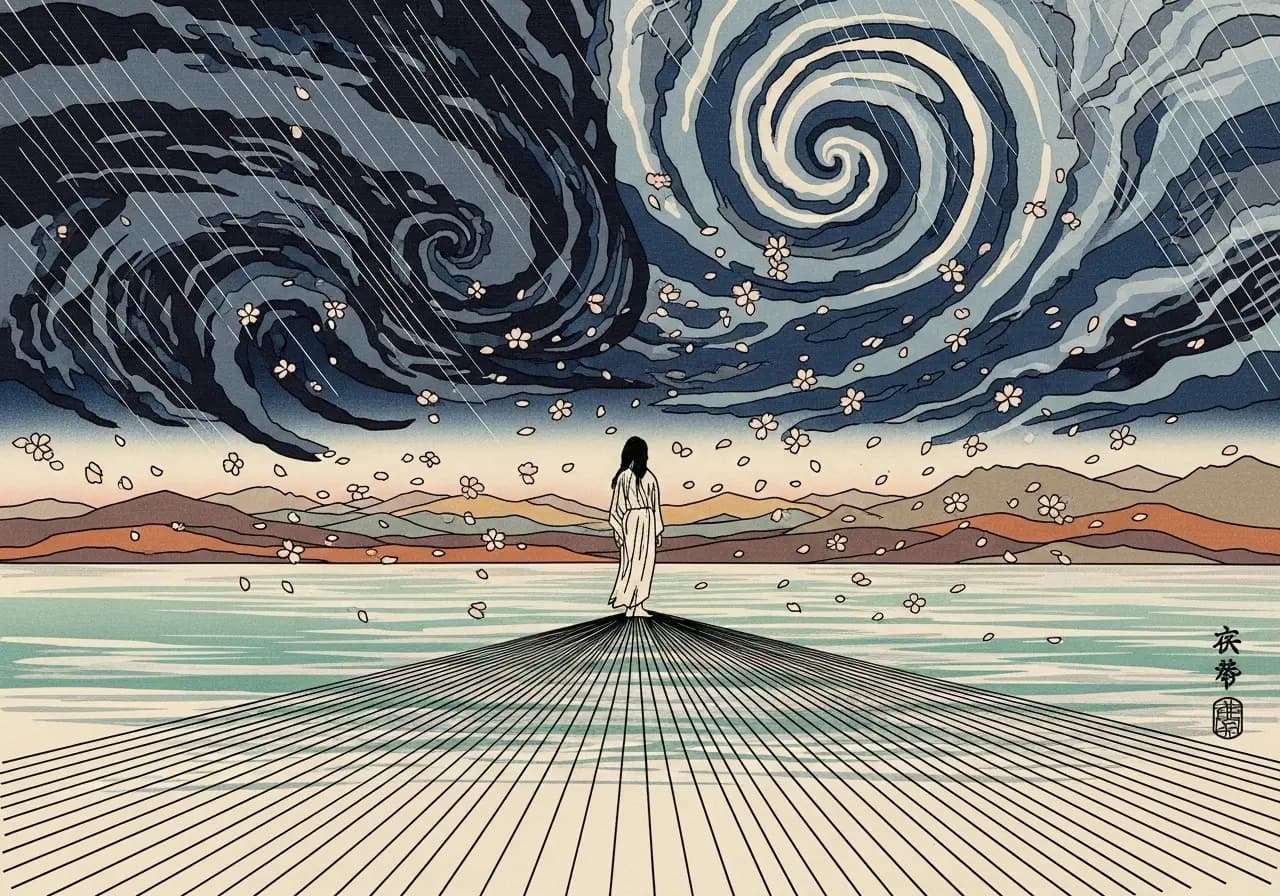
Emotional Equanimity
Episode 184 of the Secular Buddhism Podcast
Welcome back to another episode of the Secular Buddhism Podcast. Today we're diving into the topic of emotional equanimity and talking about how avoiding life's stresses may inadvertently make us fragile.
Have you ever found yourself wishing that life's challenges would simply disappear? Perhaps with just the right set of circumstances, emotional disturbances could be entirely avoided? If so, today's episode might offer a shift in perspective.
What if, instead of evading these challenges, we embraced them? Not just endured them, but actually harnessed them to become emotionally stronger? In this episode, we'll explore the Buddhist concept of emotional equanimity—a state of calm balance regardless of the chaos around us. We'll also explore the idea of antifragility.
Why this topic? Because in today's world, with its unpredictable nature, rapid changes, and polarized views, our emotional fragility is adding a tremendous amount of unnecessary suffering to the normal suffering that we already experience in life. By understanding and practicing emotional equanimity and antifragility, we'll be better equipped to face life's challenges head on, to grow from them, and to find a deeper sense of fulfillment and contentment.
Whether you're currently navigating a personal storm or simply preparing for life's inevitable rainy days, this episode is crafted with you in mind.
What Is Equanimity?
In Buddhism, equanimity is one of the four immeasurables. It's a state of balance and even-mindedness. It doesn't mean emotionlessness, but rather a calm, unwavering state of mind amidst the ups and downs of life.
Imagine the depths of the ocean, which remain calm and undisturbed regardless of the storm that's taking place on the surface. Now imagine a mental state that's similar to that. That's the essence of equanimity—remaining rooted in peace without being swayed excessively by the winds of joy, sorrow, praise, or blame.
There's a well-known tale in Buddhism about a monk named Sona. Sona was diligent in his meditation but found himself getting nowhere. He reflected on his predicament, likening it to his experience tuning a musical instrument. If the strings were too tight they could snap, but if they were too loose there would be no sound.
The Buddha, understanding his predicament, advised him to find the middle way in his practice. This story encapsulates the essence of equanimity. We are like the instrument, and our strings shouldn't be too tight or too loose. It's not about avoiding all stresses, nor is it about going looking for all stresses. Much like strings with too much tension that could snap, but on the flip side, with not enough tension we can't produce good music. It's about maintaining that middle ground where we can face life's challenges with greater balance and equanimity.
In the Mangala Sutta, one of the oldest and most revered texts in Buddhism, encountering both favorable and unfavorable conditions with equanimity is considered among the highest blessings. Think about that for a moment. Imagine how it would feel to genuinely welcome both the pleasant and unpleasant experiences in life. That's what the text is describing.
We typically want to encounter favorable or pleasant things and we definitely don't want to encounter unfavorable, unpleasant things. The Mangala Sutta is saying what a blessing it is to be able to welcome both. That's what we're going to explore.
Think of the Tetris analogy for a moment. Life has pieces that show up, much like the pieces of the game. Sometimes we get really stressed about what piece is coming next and we think, "Man, I really hope I don't get the square or the L-shape or whatever the shape is," or we're longing for it—"I really hope I do get this or that shape."
Imagine if you weren't caught up in that stress of really wanting the one you want and really wanting to avoid the one you don't want, and instead there was open curiosity: "I wonder what piece will show up next." That is the state of equanimity.
The Concept of Antifragility
Looking at an alternate perspective on this topic, Nassim Nicholas Taleb introduces a fascinating concept in his book Anti-Fragile. He speaks of things that gain from disorder. While the fragile breaks under stress and the robust or resilient remains unchanged, the antifragile actually grows stronger and thrives in chaos and volatility.
Think of the difference between a glass cup, a rubber ball, and a muscle. The cup shatters if it's dropped—it's fragile. The ball remains unchanged—it's robust or resilient. A bouncy ball bounces back. But a muscle actually grows stronger with resistance and stress. It's antifragile. Not only does the muscle grow stronger through exposure to stress, but it also gets weaker if it's not exposed to stress.
When an astronaut goes into space, they become weightless and their muscles aren't being used and they're no longer under stress. If they remain in that configuration for too long, they come back to Earth quite weak and they have to rehabilitate their muscles. Sometimes they can't even walk when they return. For example, astronaut Scott Kelly, who spent nearly a year in space as part of NASA's Twin Study, experienced muscle atrophy when he returned to Earth and needed assistance to get out of the aircraft and rehabilitation to regain his strength and mobility.
Taking this idea to our emotional well-being, it suggests that certain stresses and challenges, rather than breaking us, can actually fortify and strengthen our emotional resilience. But it also suggests that avoiding challenges and stress could weaken us and make us more fragile.
Neuroscientific and psychological research supports the idea of emotional antifragility. Studies on neuroplasticity have shown that our brains can reorganize themselves, forming new neural connections throughout life. This adaptability isn't just inherent—it's often a response to challenges and stimuli.
Similarly, stress inoculation, a concept in psychology, suggests that controlled exposure to stress can make individuals more resilient to future stress. It's kind of like a vaccine, where a little bit of the pathogen—in this case stress—can actually bolster our defenses for the future.
Equanimity and Antifragility Together
When we compare the Buddhist concept of equanimity with this modern concept of antifragility, a beautiful synergy emerges. Both philosophies emphasize not merely enduring or resisting life's challenges, but growing from them.
Equanimity teaches us to remain balanced, to neither be overwhelmed by life's storms nor to run from them. Antifragility, on the other hand, urges us to see these storms as opportunities, catalysts that can make us stronger. Together they propose a powerful way to approach life, where we face challenges with a calm, balanced mind and harness them as opportunities for growth.
We encounter situations every day that test our emotional balance and equanimity. Consider the frustrations of being stuck in traffic when you're already late, or receiving unexpected negative feedback at work, or even something as simple as dropping your favorite mug. While the immediate reaction might be anger, anxiety, or sadness, these moments present an opportunity—an opportunity to practice equanimity and to cultivate an antifragile emotional state.
By facing these small daily stressors with a calm mind, we're essentially training our emotional muscles, preparing them for bigger challenges that life might throw at us. And for me, this doesn't mean that we try to suppress whatever emotions we'll experience when we are stuck in traffic, or when we do receive criticism, or when we do lose something that we care about. For me, it means that we welcome whatever emotion appears in that moment.
Five Practical Tips
So let me share five practical tips for developing equanimity and emotional antifragility.
One: Practice Mindful Breathing
The first tip is to practice mindful breathing. When you find yourself caught in an emotional reaction, just take a moment to focus on your breath. A few deep, conscious breaths can help calm the nervous system, giving you space between the stimulus and your response.
Two: Reflect Rather Than React
The next tip is to reflect rather than react. Before responding to a stressful situation, just take a moment to reflect and ask yourself: "Is the way I want to react going to benefit me in the long run? Is this the skillful thing to say or do in this moment? Or perhaps is there a way to turn this challenge that I'm experiencing right now into an opportunity?"
Be reflective rather than reactive. I think so often an emotion comes into the kitchen of the mind and we immediately go into reactivity mode, where we start picking up the pots and pans and throwing them at whatever emotion is there, because we don't want it to be there. But instead, what if we just reflect and say, "Huh, okay, this is what I'm experiencing. I wonder why. I wonder why I'm feeling this strong reaction that I'm feeling." Just be reflective with the experience.
Three: Take a Walk
The third tip is to simply take a walk. Physical activity like walking or really any form of movement can help in diffusing the emotional tension that we're experiencing and it provides greater clarity. Sometimes it's while you're out walking that insight may arise as you practice reflection. So don't hesitate to take a walk when you need to.
Four: Seek Perspective
The fourth tip is to seek perspective. When faced with a challenge, try to see it from a zoomed-out or bird's eye view. I think often widening our perspective can diminish the magnitude of the problem.
I like to do this every time I go flying, because when I'm seeing everything from up high it puts things into perspective. If you do this when you're in an airplane, you can look down and you can see a town or a city, and then you think, "Man, that little car I see on the road down there—they have all their thoughts and problems and concerns. But from up here it all just seems so different."
It's not that what we feel doesn't matter, but the intensity of what it is feels so much more reduced when we see it from a new perspective. So seek a new perspective.
Five: Practice Journaling
The fifth tip is to practice journaling. At the end of the day, you could jot down moments where you were feeling emotionally challenged and reflect on how you responded. Maybe think about how you could have handled the situation in a similar way or in a different way if you encounter it again in the future. Journaling presents us with the ability to practice reflection, and you can take your time doing it because you're writing.
So those are the five tips: mindful breathing, reflect instead of react, go take a walk, seek a new perspective, and practice daily journaling.
A Personal Story
Now I recall a time when I faced a particularly harsh criticism about a project that I was working on and was passionate about. My initial reaction was to defend my stance. But taking a moment to breathe and to reflect, I was able to approach the criticism and the critique with curiosity rather than simple defensiveness—which was my first reaction.
This open curiosity not only led to a more productive conversation around the topic, but it also allowed me to rethink and refine some of the details of this project in ways that I hadn't considered before. Here was a clear challenge, but approaching it with equanimity, I was able to experience growth. In that growth I recognized my own emotional antifragility.
I'm sure many of you have similar stories, moments, or experiences where you were able to turn what felt like a moment of adversity ultimately into an advantage, simply by shifting your perspective. So think of a time when you braved life's weather. How did it shape your emotional landscape?
Dancing in the Rain
And remember this: it's not about eliminating the storms from our lives, but it's about finding peace and strength within them.
The weather, I think, is a great analogy for this. Weather is an ever-present, ever-shifting force in our day-to-day lives. Just as we can't control when a rainstorm might appear, we can't always predict or control life's emotional storms. Yet there's a beauty in this unpredictability.
The rain, when it comes, nourishes the earth and allows life to flourish. In a similar way, our emotional storms can foster emotional growth if we approach them with the right mindset. To hide away and avoid all rain? Sure, it might keep us dry, but it also robs us of the experience, the lessons, and the growth that can come from these events.
Emotional equanimity isn't about merely weathering life's storms. It's about learning to dance in the rain, to find joy and growth in the very challenges that we face. Now, I do want to acknowledge that it may be unskillful to seek out certain storms in life. But it's also unskillful to think that we can go through life without ever experiencing a storm or ever being affected by rain.
And I think that's what we do sometimes. We go through life doing everything in our power to control the weather, which we can't do, or avoid at all costs any form of storms. The fact is that in life, storms arise. That's the First Noble Truth—that's the understanding of the First Noble Truth. In life, suffering arises. So we don't need to hide away from it. Instead, we can look at these things as opportunities.
Equanimity is about occasionally weathering the storm, but it's also about occasionally dancing in the rain.
Recap
To recap this episode, I wanted to share some of my thoughts on this Buddhist concept of emotional equanimity. Again, it's a state of balance amidst the ups and downs in life.
I also compared it to the idea of antifragility, where we recognize that challenges and stress not only do they not break us, but they can be the catalyst that makes us stronger and more resilient. Think of the metaphor of exercise, the idea of muscles and how muscles grow stronger through resistance as an additional way to visualize this idea of antifragility.
So as you go about your week, I invite you to observe your emotional reactions when a challenge arises—whether it's a big one or a small one. Pause and breathe and ask yourself: "How can I approach this with greater equanimity? How can this situation, however uncomfortable it might be, actually help me grow?"
Whether it's a disagreement with a colleague, a setback in your personal projects, or simply getting caught in the rain, remember: every moment offers an opportunity for emotional growth.
I want to end with a quote by Carl Rogers, who once said: "The good life is a process, not a state of being. It is a direction, not a destination."
In our quest for emotional equanimity and greater resilience, it's essential to remember that it's the journey—the continual process of growth and learning—that truly matters. It's the moments when we pause and say, in general, I'm headed in the right direction, and recognize that each challenge, each storm along the way, is nothing but a step on that path. The path that is moving us in the overall direction that we want to be moving towards.
As always, remember: you don't need to use what you learn from Buddhism to be a Buddhist. You can use these ideas to be a better whatever you already are. Thank you for joining me on this exploration of this topic today.
I'm wishing you a week filled with emotional equanimity, growth, and perhaps the occasional dance in the rain.
Until next time.
For more about the Secular Buddhism Podcast and Noah Rasheta's work, visit SecularBuddhism.com