

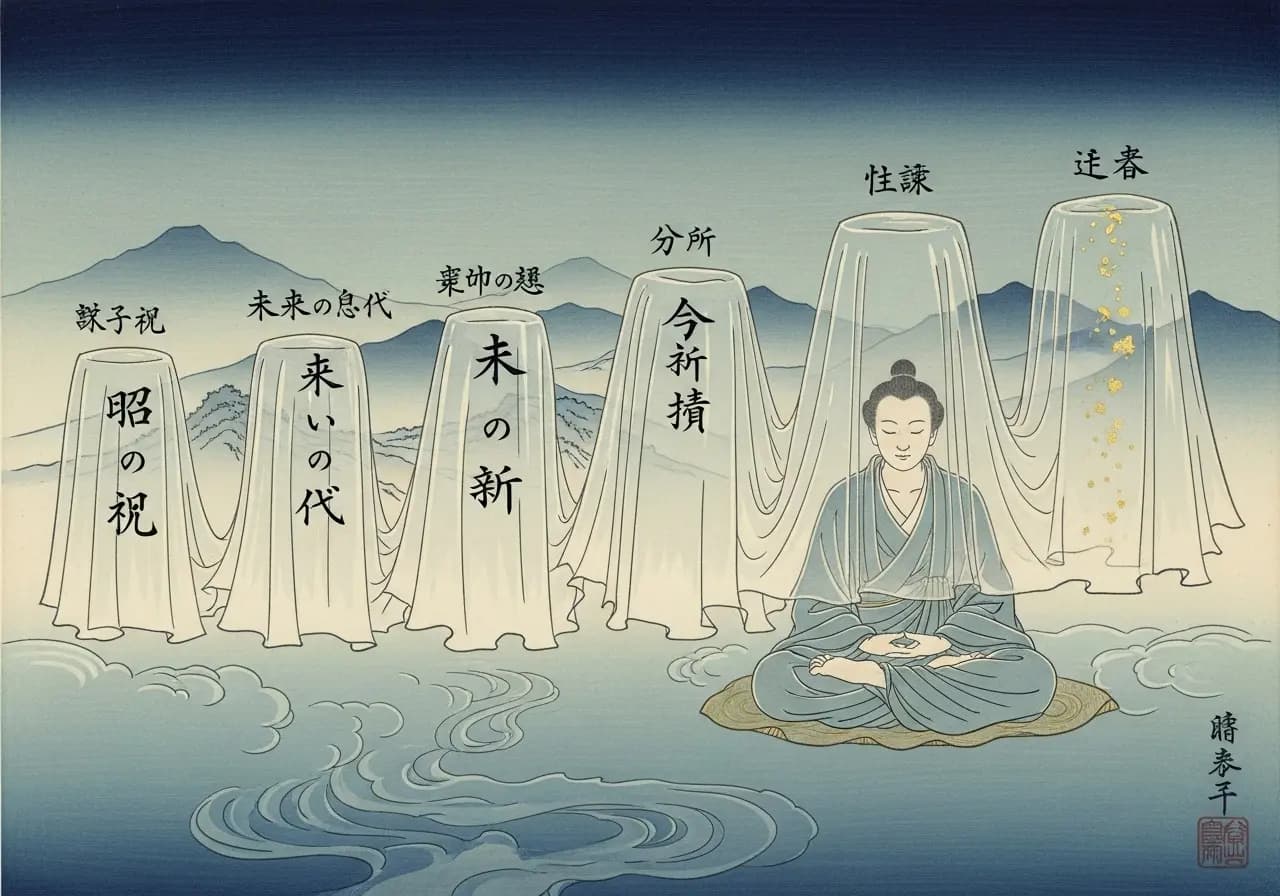
Six Words of Advice
Episode 183 of the Secular Buddhism Podcast
Hello and welcome to the Secular Buddhism Podcast, a podcast that presents Buddhist teachings, concepts, and ideas from a secular perspective. Remember, you don't need to use what you learn from Buddhism to be a Buddhist. You can use what you learn to simply be a better whatever you already are. I am your host, Noah Rasheta, and let's jump into today's topic.
Welcome
Welcome back to the podcast. In today's episode, I want to talk about a teaching called the Six Words of Advice. This comes from Tilopa, a key figure in Tibetan Buddhism. Tilopa's Six Words of Advice provide meditation guidance for people of all levels, including beginners and experienced meditators. And despite their apparent simplicity, these six instructions hold deep meanings. One can spend a lifetime studying these simple instructions and still uncover new insights.
These teachings are central to the Mahamudra tradition, a form of meditation in Tibetan Buddhism where Tilopa is considered a key teacher of meditation. They emphasize direct experience and a non-conceptual understanding of reality. So let's look at these six instructions and see what they are.
The six words of advice are:
- Don't recall
- Don't imagine
- Don't think
- Don't examine
- Don't control
- Rest
Remember, these are in the context of meditation. While practicing meditation, these are the six instructions. And these come from Ken McLeod's translation of the Mahamudra. So let's look at each of these one by one, keeping in mind that you're thinking about this in the context of meditative practice.
The Six Instructions
One: Don't Recall
The instruction "don't recall" is essentially the understanding to let go of what has passed. During meditation, it's common to dwell on past experiences that often hinder your ability to stay present in the here and now. It's like you're walking around with a cloud of fog that surrounds you, making it difficult to see what's here in front of you right now.
This fog can be the thoughts of the past—childhood memories, thoughts about people from your past, or even yesterday's events. They can invade your mind and cause physical tension and restlessness. So here you are trying to be present, but you can't stop thinking about events that have already transpired.
To truly be present, it's important to recognize the tendency that you have to cling to the past and then repeatedly practice releasing it.
Two: Don't Imagine
The next set of instructions says "don't imagine." While you're sitting in meditation, you need to learn to let go of what may come. Along with rehashing old memories, the mind likes to wander. It wanders into the future, and then you anticipate events that haven't occurred. You create hopeful and fearful scenarios of possible future outcomes. You spend time worrying, daydreaming, planning, and devising ways to achieve the desired results you have for the future.
During meditation, worrying about the future could be as simple as just wondering about how much time is left in this particular meditation session, or it could be more complex, like being stressed about the future of your health or your financial situation, your career choices, or anticipating other potential future events.
If you find your mind wandering towards the future and your body tensing up in anticipation of events that have not yet occurred, the idea is to gently release these thoughts and return to the present moment.
Three: Don't Think
The third instruction says "don't think." Now, this can be interpreted as letting go of what is happening now. In order to be fully present, we must let go of our thoughts about the past and the future. It's common to momentarily feel present, only to be pulled away by the propensity that we have to ruminate about the past and worry about the future.
And sometimes when we are focused on the present moment, we can get caught in thoughts about the present. We think to ourselves while meditating, "Oh, my nose is itching," or "I shouldn't worry about my itchy nose." We often get caught in the habit of judging and thinking about the present rather than allowing ourselves to simply experience the present moment.
That's what's at the heart of this particular instruction: don't think. But let me clarify—this line of instruction is not about not thinking. It's about not overthinking. We can't force ourselves to not think. The mind produces thoughts in the same way that your heart pumps blood. The heart does what it does and the mind does what it does. Thinking is simply what the mind does.
But we can overthink the whole process, and then we find ourselves thinking and also thinking about thinking. So this instruction is less about stopping thoughts and more about recognizing how the mind tries to grasp the present moment, to claim it, to have a sense of "me" experiencing this. I have an itchy nose, rather than just the recognition of, "Oh, the nose is itching."
But when we try to hold on to the present, it's like trying to hold water in your hand. The tighter you hold, the more that water slips away. The present moment is in a constant state of unfolding and change. It can't be pinned down because it's a process, not an object.
So notice whatever comes up in the present while you're meditating, and just observe it and let it pass. You can think of the present like you would think of a surfer riding a wave. The present rises from the past and dissolves into the future, and you, the surfer, are right there riding the wave in the moment that wave exists. But you can't hold or change the wave. All you can do is ride it, enjoy it while it lasts, and let it go, then see if you can enjoy the next wave. That's one way to think of this particular instruction.
Four: Don't Examine
The next one is "don't examine." So don't try to figure anything out. While meditating, you might hear a voice in your mind that is analyzing or commenting about the experience you're having. It produces thoughts like, "Am I doing this right? Is this the right way to do this? What should I be feeling right now? Do I look silly sitting here meditating?"
This line of instruction to "don't examine" is an invitation to notice and recognize how your mind always wants to review your present experience, questioning it, doubting it, always analyzing what is with what we think should be. This is the habit we want to let go of.
Try to feel your experience without the need to understand or overanalyze anything that's happening in the present moment. Try to be present and let the experience just be what it is.
I think this is a difficult one in meditation because we often find ourselves meditating specifically because we don't want to be experiencing what is. We want to be experiencing something else. That's why we're meditating in the first place. But this instruction comes along and tells us: whatever you are experiencing, allow yourself to experience it. There's no need to figure anything out. If I'm sitting here wishing I wasn't sitting here, be with that and just allow that to be the experience that you're having.
I think that's a really important aspect of understanding these instructions, especially this particular form of meditation.
Five: Don't Control
The next one is "don't control." Don't try to make anything happen. Again, you might start meditating with these lofty goals and ideas of the peace and the enlightenment that you want to reach. That's why you're doing it in the first place. But often, your detailed plans just fall apart, and at the end, you find yourself trying to rebuild the mental image of what you think should happen rather than sitting with what is actually happening.
This is similar to managing a project, but the thing is, you can't treat meditation like a project. You can't force your mind into peace or quiet or mindfulness. These aren't states that you reach by simply trying really hard. You naturally enter these states when you stop trying to control everything.
Here you can imagine the visual image of a glass with muddy water. The more you stir that water in an effort to make it clear, the cloudier it becomes. The less likely it is for it to become clear, because you're trying to make it clear. You can't will it through action to become clear. But if you leave it alone for a while, the dirt will sink to the bottom, and then the water's natural clarity starts to show.
The idea here is that you can't force that clarity to happen, but you can stop interfering with it. It's about stepping back and letting things be. In meditation, it's similar. There's no need to force things to happen. Just let everything be.
Six: Rest
Which takes us to the final instruction: rest. This is simply relax right now and rest. This final instruction summarizes the previous five. Each instruction requires us to let go. We let go of the past, of future possibilities, of overanalyzing ongoing events, and the desire for specific outcomes.
This last instruction is simple, yet challenging. Relax and rest in the present moment, allowing your senses to simply experience what is. And despite their simplicity, these six instructions encapsulate the essence of meditation: simplicity in action and thought. They teach us to unlearn habitual thought patterns and instead embrace raw experiences, using focused awareness to gently and organically observe what unfolds in the present moment.
Practicing with These Instructions
Now, these six words of advice can be recited before or during a meditation session. You can think to yourself these six things: don't recall, don't imagine, don't think, don't examine, don't control, rest. It depends on what strategies work best for you. If you want to repeat those almost like you would a mantra, that works. Or once you recite them once, you can just sit with the experience and allow yourself to observe everything that happens from that moment on.
Remember, meditation practice takes time. It's called practice for a reason. We may want to skip working out and jump straight to the state of being healthy and fit, but that's not how it works. Similarly, with meditation, we may want to skip the practice and jump straight to its benefits, but we can't. It's the practice itself that changes the relationship that we have with our own mind and with the lived experiences that we're having.
Summary
In summary, Tilopa's Six Words of Advice provide a simple yet profound guide for meditation practice. By letting go of past, future, and present thoughts, we can fully embrace the present moment, and in doing so we cultivate a more focused awareness. Remember, meditation is a practice, and it takes time to see its benefits.
I hope you feel inspired to continue practicing and that you remember to enjoy the journey along the way. And hopefully, through this practice and through these six words—these six instructions—you'll gain some new insight into the nature of your own mind and the nature of the experiences that you're having in your day-to-day life.
Thank you for listening to the Secular Buddhism Podcast. If you enjoyed today's topic and you want to learn more, visit secularbuddhism.com, where I have links to my books, courses, podcast episodes, and information for how to join the Secular Buddhism Podcast community. Thank you for listening. Until next time.
For more about the Secular Buddhism Podcast and Noah Rasheta's work, visit SecularBuddhism.com