

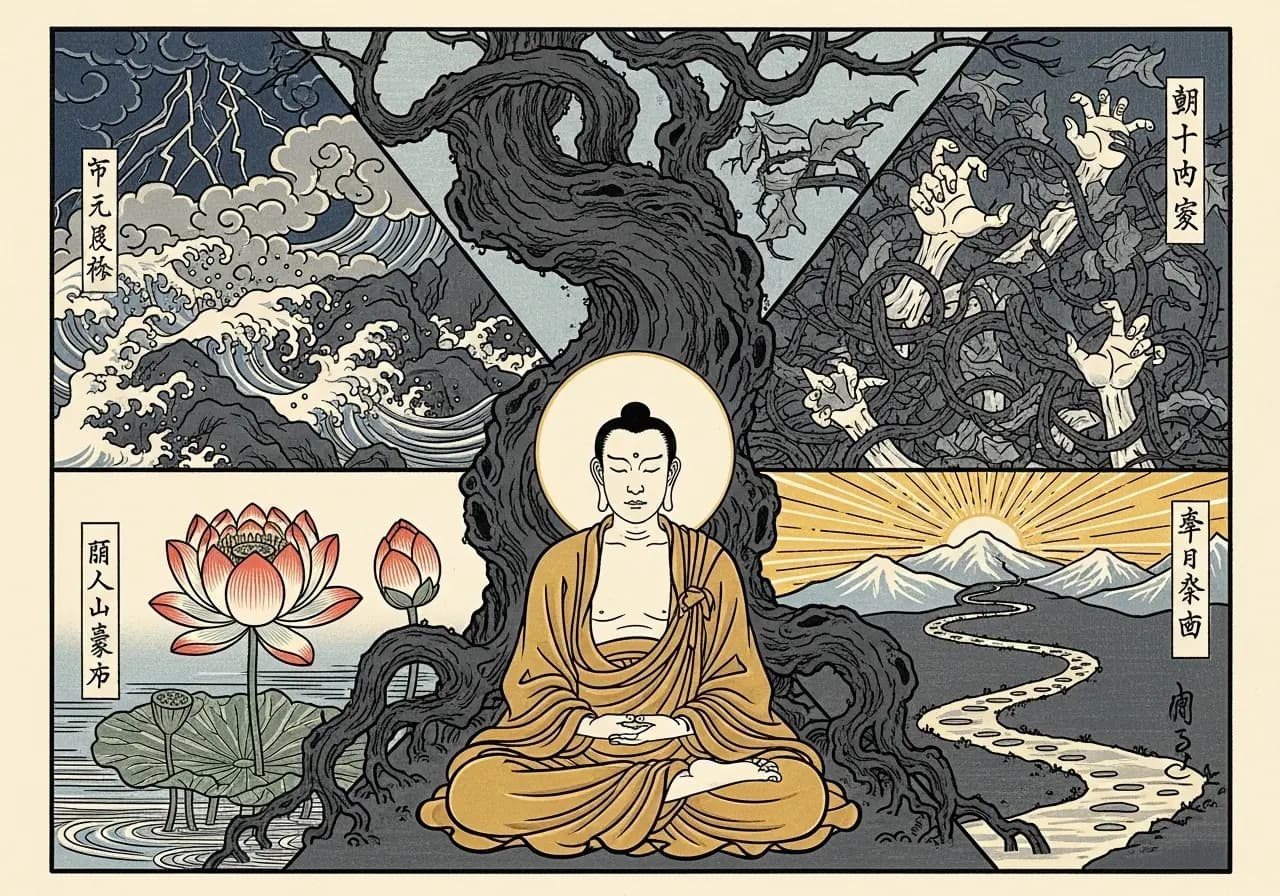
The Most Fundamental Teaching: The Four Noble Truths
Episode 182 of the Secular Buddhism Podcast
Hello. Welcome back to the podcast. Today I thought it would be fun to revisit one of the most basic and fundamental teachings in Buddhism—the teaching of the Four Noble Truths. The Four Noble Truths are the most fundamental teachings of Buddhism. They serve as the foundation of the entire Buddhist worldview, and they offer a path to understand the nature of existence and suffering.
Before jumping in, I want to share a quick note about language.
A Note on Translation and Language
The Buddha likely spoke a language called Magadhi Prakrit, the language of ancient Magada in northern India. His teachings were initially transmitted orally around 500 BCE and were later written down in Pali, as found in the Pali Canon. Many Buddhist terms are still expressed in both the Pali and Sanskrit languages. So understanding these ancient teachings in English can be a little challenging. Sometimes the meaning may be lost in translation—similar to the children's telephone game where a message is altered as it's relayed.
Keep this potential for distortion in mind, not only with Buddhist teachings, but really with all ancient teachings.
The Four Noble Truths as individual words in the original Pali language are dukkha, samudaya, nirodha, and magga. These words again have different translations. There are different ways we can use these words. Dukkha is suffering or unsatisfactoriness, stress or unease. Samudaya is origin or cause. Nirodha is cessation, ending or confinement. And magga is path.
The reason I want to highlight this is because it'll make sense as I go into the more in-depth explanation of each part of the Four Noble Truths.
The Four Noble Truths: An Overview
Let's start with the first one: Life is characterized by suffering or dissatisfaction. That is the first Noble Truth. This includes frustration, dissatisfaction, and distress as part of the normal human experience. In other words, this is to say, life is difficult.
Which leads us to the second Noble Truth: The cause of suffering is clinging or craving, driven by ignorance of the true nature of reality. This includes craving for sensory pleasures, clinging to desires, and holding to things that are impermanent. The cause of suffering is essentially wanting things to be other than how they are.
So we have the first one: life entails a certain amount of difficulty and suffering. The second one: suffering arises from wanting things to be other than how they are.
This leads us to the third Noble Truth: It is possible to be free from suffering by letting go of craving and attachment. This state is achieved when one lets go of grasping and aversion and rests in the calm clarity of the present moment.
The fourth Noble Truth is the path—there is a path that leads to the complete liberation from suffering. This is called the Eightfold Path, also known as the Middle Way Path, and that's the path that leads to the end of suffering.
So the Four Noble Truths diagnose the problem of suffering, identify the cause of suffering, assert that suffering can be overcome, and then provide a path to do so. This process is akin to a doctor identifying an ailment, determining its root cause, confirming its curability, and then outlining a course of treatment. That is the essence of the teaching of the Four Noble Truths.
Understanding Dukkha: The First Noble Truth
I want to look at each one of these in greater detail because, as I mentioned at the beginning, these are the most fundamental teachings of Buddhism. It's important to understand these teachings in detail because every other teaching makes sense in the context of the understanding of this specific teaching.
The first Noble Truth essentially states the problem. What is the problem? Well, the problem is that life is characterized by suffering or dissatisfaction. The first Noble Truth, known as the truth of suffering, is the word dukkha. This is where it's helpful to know some of the other translations of this word. Dukkha can be translated as suffering, but it can be so much more than suffering. It can be unsatisfactoriness. It can be stress. It can be unease. And that helps to highlight the situation that's happening here with this truth of suffering.
This teaching recognizes the pervasive nature of dissatisfaction and suffering in life. According to Buddhist teachings, there are different types of dukkha—different types of suffering.
The Suffering of Suffering
The first is called the suffering of suffering, and this is the most apparent form of suffering. It includes physical pain, emotional distress, and all kinds of discomfort or difficulties that we might experience in life. Sickness and old age are examples of this type of suffering.
The Suffering of Change
The second type of suffering is called the suffering of change, and this refers to the suffering that arises from the impermanent nature of happiness and pleasure. Everything that brings us joy and satisfaction is temporary. So clinging to these pleasures can lead to suffering when they inevitably change or disappear. For example, the joy of a new environment or a new possession eventually fades, leading to dissatisfaction. Things are impermanent, so that refers to that second type of suffering.
All-Pervasive Suffering
The third type of suffering is called all-pervasive suffering, and this is a more subtle form of suffering. It refers to the underlying unease or dissatisfaction that comes from our conditioned existence. It's a deep-seated discomfort that comes from being subject to the constant change and impermanence of life, even when things seem to be going well.
This form of suffering is usually rooted in unskillful views or beliefs about ourselves, others, or the world around us. And this type of suffering is said to be the result of ignorance. It can only be fully understood and overcome through cultivating awareness and wisdom.
So this truth teaches that suffering is not always overtly painful or dramatic. It's often subtle, and it underlies our entire experience of life. It's not just about physical pain or emotional distress, but it includes a more profound sense of dissatisfaction and unease that characterizes our overall existence.
The Positive Message Within This Teaching
Now, understanding this teaching—the teaching of the first Noble Truth—it's not meant to lead to pessimism or to create a negative outlook on life. Instead, recognizing the presence of suffering in life is considered the first step toward awakening and liberation in Buddhism. By seeing the reality of suffering, one becomes motivated to investigate its cause and follow the path leading to its cessation.
It encourages mindfulness, compassion, and a deeper understanding of ourselves and the world around us.
I think this first Noble Truth is a very important one to understand because it's the recognition of life as it is—not how we want it to be, but the radical recognition and acceptance that this is what is.
The Eightfold Path: The Fourth Noble Truth
I want to talk about this path for a moment—the Eightfold Path, or the Middle Way. In Buddhism, the Eightfold Path is the fourth Noble Truth. It's commonly referred to or known as the Middle Way or the Middle Way Path. It advocates for a balanced and harmonious approach to living where we avoid extremes. The Middle Way strives for a balanced approach to living life.
The Eightfold Path includes eight parts of the path that are categorized into three fundamental elements of Buddhist practice. Those three elements are wisdom, ethical conduct, and mental discipline.
The Eight Parts of the Path
Under wisdom, we have understanding and intention. In traditional Buddhist teachings, you'll encounter these described as "right"—in other words, right understanding, right intention, right speech, right action.
There are various scholars who will tell you that the translation giving us the word "right" is a little misleading. When we think of "right," we think of it in terms of right and wrong—as in right understanding versus wrong understanding. That's not the connotation of the word.
Earlier in the description with the words and the translations I mentioned how you can take a word from one language, translated to another, and then to another, and you lose a little bit of the meaning. Some of it gets lost in translation. Alan Watts was talking about this in a lecture series that I thought was really fascinating. He says the word that was used to translate or to give us the word "right" in the description of these eight parts of the path is more along the lines of a fulcrum—like the Middle Way. It's not to this and it's not to that. That's what's meant by "correct." It's just the right amount, no more, no less. Rather than "right" as in right and wrong, it's more like "right" as in the correct amount.
That makes a lot of sense when you think about this as the Middle Way, because the Middle Way is a balanced thing. Don't be too far to the left or too far to the right. You need to find the middle way.
Breaking Down the Eight Practices
So when I go through these eight, rather than saying "right," I'm going to just give you the word itself of the eight things. But you can understand this in the context of the Middle Way. What is the middle way of understanding? It's understanding this and that. Somewhere between this and that is the middle way.
So you have:
Under Wisdom: Understanding and intention
Under Ethical Conduct: Speech, action, and livelihood
Under Mental Discipline: Effort, mindfulness, and concentration
When you think about these in the context of the Middle Way, it makes a lot of sense. When I'm studying my intentions or my thoughts, I'm trying to find that middle way. When I think about my ethical conduct—what I say, speech, action, livelihood—it's the middle way.
Going through each of these individually:
Understanding is essentially how we view ourselves and the world, how we see and understand the world to be.
Intention is cultivating intentions of non-attachment, goodwill, and harmlessness.
Then we have speech, which is speaking truthfully, harmoniously, and kindly.
We have action, which is acting ethically and compassionately.
We have livelihood, which is earning a living in a way that doesn't cause harm to others.
Then under mental discipline, we have effort, cultivating wholesome qualities and abandoning unwholesome qualities.
We have mindfulness, which is developing mindful awareness of the body, feelings, our mind, and all things in the world around us.
Then we have concentration, which is cultivating deep concentration and using meditative practices to be good at concentrating.
The Heart of Buddhist Practice
I think it's a whole separate podcast episode to just go through these eight in more depth, so I won't go into them further right now. But at the heart of all Buddhist teachings, you have this: the understanding of the Four Noble Truths, with the path—the fourth one—that entails these three practices of cultivating wisdom, having ethical conduct, and mental discipline. Then, within those, you have the actual eight: understanding, intention, speech, action, livelihood, effort, mindfulness, and concentration.
Every Buddhist teaching that you will encounter from here on out—if you look at it back in the context of this teaching, the original teaching of the Four Noble Truths—you'll start to have a better understanding of why certain things matter and why certain practices are beneficial or how they fit into the overall equation.
The primary goal of Buddhist practice is to live your life in a way where you are cultivating, walking the path, or cultivating the method that will lead to a cessation of unnecessary suffering in life.
I think that's such an honorable goal and aspiration to have—to try to essentially have greater inner peace in your own life.
Inner peace is one of those interesting things because it's a gift that I can give myself while simultaneously benefiting everyone around me. If I cultivate that as a gift in me, it benefits my wife and my children and my co-workers and the people on the street that I'm driving by. It benefits everyone. It's the gift that keeps on giving.
I don't know that there are a lot of gifts like that, because a lot of the things that we aspire to have for ourselves don't necessarily benefit everyone else. But inner peace does.
I think that's an important thing to clarify here with this teaching of the Four Noble Truths: the problem is that in life, life is difficult. Part of why it's difficult is because we don't want it to be difficult. But there is a way to not have it be so difficult. It's to cultivate a path where our thoughts, words, actions, and everything end up making it so that we have a little bit more inner peace.
It's like I say at the start of the podcast—we're trying to be a better, whatever we already are—because that benefits everyone.
Website Update and Community Announcement
By way of news, I do want to announce that I have completely revamped the website. One of the concerns I've had with the website for a while now is it's a platform intended for me to share the audio of the podcast. One of the ways that I like to share is through writing. You know this. I've done this through writing books. I have three books that I've written. I've been wanting to share more by way of writing on the website—to have a blog or a newsletter or something—but I've never had the system in place to really effectively use the website as a publishing platform or as a blog or as an email newsletter.
I finally put in the time and effort to revamp the whole website.
If you visit secularbuddhism.com now, you'll notice it's completely different. It is set up where you can subscribe for free. You just click Subscribe, enter your email, and you'll receive the email newsletter that I intend to publish at least once a month—maybe a little bit more often, maybe when a new podcast episode comes out.
In addition to the content you get through audio—through the podcast—you'll be able to read shorter blurbs and consume content through reading. I think that'll be a fun thing for me to be able to put more writing out there, but also for you to be able to consume more of these concepts, ideas, and teachings, not just in the audio format of the podcast, but you can go on there and read, like you would a newsletter or a blog.
So I encourage you to go visit secularbuddhism.com and make sure you sign up for the newsletter by just entering your name and email address into the field there.
Of course, if you're interested in having a community to practice with, you can explore the options of supporting the podcast, supporting the work that I'm doing, and joining the community where we do live Sunday Zoom calls. Every week we have lively discussions taking place in our own community platform where we talk about Buddhism and Buddhist teachings, concepts, and ideas.
Closing
All right, well, that's all I have for now. Thank you for listening, and I look forward to connecting again in another episode soon.
Take care.
For more about the Secular Buddhism Podcast and Noah Rasheta's work, visit SecularBuddhism.com