

Redefining Kindness
Episode 181 of the Secular Buddhism Podcast
Hello and welcome to the Secular Buddhism Podcast, a podcast that presents Buddhist teachings, concepts and ideas from a secular perspective. You don't need to use what you learn from Buddhism to be a Buddhist. You can use what you learn to simply be a better version of whatever you already are. I'm your host, Noah Rasheta, and let's jump into today's topic.
This is episode number 181. Today I wanted to talk about the topic of kindness, specifically self-kindness or self-compassion.
Some Background: The Inner Peace Roadmap
Some quick background here. You may recall I've mentioned this in previous podcast episodes, but for the last several months I've been developing an online course called the Inner Peace Roadmap. Part of this course involves presenting several new frameworks to help understand what it is that's happening in our minds and which techniques are beneficial for learning to develop greater inner peace or cultivating inner peace.
One of the lessons in the Inner Peace Roadmap is called the KNOW Self Method. That's K-N-O-W, in other words, to know yourself. Self-knowledge, I believe, is a critical component in cultivating inner peace. By gaining a better understanding of ourselves, we can develop a more skillful relationship with all of the different parts that make up who we are and how we function.
The KNOW Self Method: Eight Pillars
The KNOW Self Method is a unique blend of concepts and ideas from Eastern philosophy—specifically Buddhism—combined with modern psychology and practical wisdom. It's designed to guide you toward a better and deeper understanding of yourself and the way you experience being alive.
KNOW Self is an acronym that invites you to explore eight powerful concepts:
K - Kindness N - Non-Self O - Observation W - Wisdom S - Stress E - Emotions L - Liberation F - Fluid Flexibility
Together, these eight concepts form the pillars of this method. Whether you're seeking to navigate life's challenges with greater ease, cultivate a deeper sense of inner peace, or simply understand yourself better, the KNOW Self Method offers a comprehensive approach to introspection, mindfulness and resilience.
The Key Questions
At the heart of each of these eight concepts is a key question:
- K (Kindness): How do I express kindness towards myself?
- N (Non-Self): How closely does my self-perception align with reality?
- O (Observation): What patterns can I identify in my behavior?
- W (Wisdom): How have my experiences shaped my self-perception?
- S (Stress): What triggers my stress response?
- E (Emotions): How do I navigate my emotional landscape?
- L (Liberation): In which areas of my life do I feel confined?
- F (Fluid Flexibility): How well do I adapt to life's changes?
This is an introspective method of getting to know yourself. Today I wanted to focus on the first of these eight topics: kindness. I do plan on presenting the other seven topics over probably the next seven podcast episodes, so if you're listening to this and you want to hear the rest of this method, follow along.
Redefining Kindness
I want to share something that I wrote about this. On my personal website, NoahRasheta.com, I'm starting to collect writings—just things that come to mind as I try to present concepts and ideas. A lot of these are concepts I'm working through as I prepare this course. If you want to follow along and subscribe to my newsletter for occasional mindful musings, feel free to do that. There you'll find my thoughts on what I'm sharing today with this notion of redefining kindness.
Beyond the Traditional Definition
To comprehend the essence of kindness, we must venture beyond its traditional definition. While kindness is commonly defined as being friendly, generous and considerate, I believe the concept of true kindness is far more profound, especially in the pursuit of inner peace.
True kindness is a conscious commitment to deep understanding. It's a deliberate exploration and engagement with the complex nature of our own selves as well as others. It implies introspection—a relentless quest to understand our beliefs, thoughts, feelings and actions.
I believe the essence of true kindness lies in our ability and willingness to understand and connect with the core of our humanity, both within ourselves and in others. It's about striving to see the world from another's perspective and acknowledging that what may seem like an act of kindness to one may not hold the same meaning for another.
The Monkey and the Fish
This idea is expressed perfectly in a quote by the philosopher Alan Watts. He says:
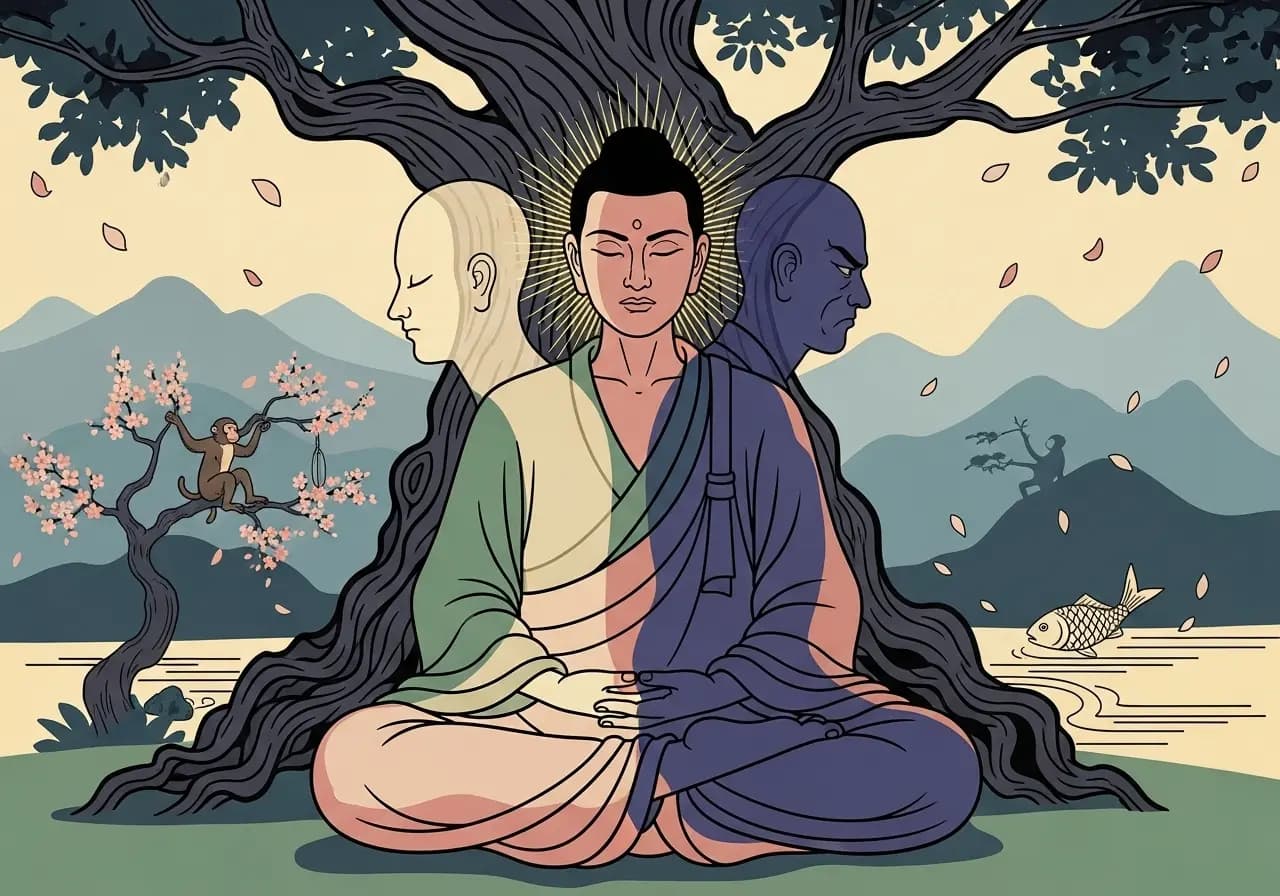
"Kindly, let me help you or you will drown," said the monkey, putting the fish safely up a tree.
The monkey, despite its well-intentioned efforts, is blinded by its own perspective. Its kindness, while sincere, is inadvertently harmful. Similarly, our attempts at kindness may unintentionally lead to undesired consequences if they spring from a place of misunderstanding or lack of self-awareness.
This is what I mean by redefining kindness, especially in the context of an introspective practice. To be nice is one thing, and it's pleasant to be around someone who's nice. It's great to be nice to yourself, too. But I don't think that's at the heart of this introspective practice of kindness.
When Kindness Becomes Self-Deception
Just like the monkey unintentionally causes harm to the fish by trying to be nice and put it in the tree, the same thing happens to ourselves when we're trying to practice self-kindness. I think we can mistake self-care for short-term comforts or try to suppress our painful emotions, thinking that to be kind.
For example, I might not say what's really on my mind to you because maybe it would be kinder for me to keep it to myself. But in the process, I'm stewing on these feelings and emotions. That's just one example. Obviously, you can go to the other extreme, where some people share everything when maybe the kind thing would be to hold back. Think of the middle way as you approach this.
The Kindest Act
Perhaps the kindest act that we can offer ourselves is to confront the uncomfortable truths and to understand our vulnerabilities and accept them as part of our growth.
I could be kind to myself and not work on the aspects of me that need to be worked on, thinking "Well, I want to be nice to myself, so I'm just going to pretend this isn't an issue I need to fix." But that would be a misunderstanding of kindness, and it's not beneficial.
Instead, I could say, "No, this is something that I need to sort out. These strong emotions I'm feeling—I need to see where they're coming from. I need to put in the hard work. It's not going to be easy." It might seem like the kind thing is to just put this aside and pretend it's not a big deal. But that's not what kindness is. The kind thing is to say, "This is going to be hard work and I'm going to go put in the time and the effort to do this work to make things better." Because that ultimately benefits me and my well-being, but also everyone around me.
Embracing true kindness means being willing to do the difficult inner work.
Three Practices for Self-Kindness
So how do we practice this? Let me share three practices that can help cultivate a kinder relationship with yourself.
Practice One: Daily Self-Compliments
Give yourself a genuine compliment at least once a day, and center this compliment around character or actions. Don't make this about appearance.
For example, you put in the hard work and accomplish one of your goals. You could tell yourself, "Good job for completing the goal." But even more importantly, you could say, "Good job for putting in the effort to complete this task you wanted to achieve." That way, you're complimenting the hard work, not necessarily the outcome, but the work it took to produce that outcome.
I like to imagine there are two of me, and one is complimenting the other. Rather than thinking of myself as just one single person or entity, it's almost like this voice is complimenting this other aspect of me. "Hey, good job for putting in the effort. The part of you that worked hard—that needs to be rewarded." You can play around with this overall idea, but the point is to give yourself a daily compliment.
Practice Two: Mindfulness Without Judgment
Another practice is to practice mindfulness. This brings a non-judgmental awareness to the present moment, including your thoughts, emotions and physical sensations. This helps cultivate greater self-compassion and develop a kinder relationship with yourself.
When you start to pay attention in a non-judgmental way to what's happening inside, you notice there are a lot of processes—like these inner voices I was mentioning. There's a part of me that has the voice of the inner critic. There's the part of me that has the voice of the inner narrator. There's the part of me that has the voice that's almost like the angel and the devil on the shoulder—one saying "good job," the other saying "no, you didn't do good enough."
Both of those are aspects of my thoughts. I like to practice mindfulness where I just pay attention. What am I hearing? What am I feeling? What am I thinking? What am I sensing? But I do this in a non-judgmental way. I'm not trying to shush one voice or amplify another. I'm just paying attention to what's actually happening.
In the process of doing that, I start to feel a greater sense of compassion for each of those aspects of myself. So in this case, the voice of the inner critic—you can have compassion for that voice. Like, "Wow, okay, I see you're all riled up. Why does this mean so much to you? Where's that coming from? I feel compassion for you for being so wound up with this." It's an interesting practice, but give it a try.
Practice Three: Challenging Your Criticism
Then challenge yourself and your criticism. When you do have these harsh thoughts arise, just remember: just because you think it doesn't mean it's true. You can challenge your own thoughts and beliefs.
I like to add "Yeah, but" at the end of every harsh thought. So if I notice that inner voice saying something like "Ugh, you're such an idiot," I challenge it and say, "Yeah, but am I so?" Let me give you a quick example.
Last night, I had been writing for months and I had six chapters of my writing completed. I thought I could edit the heading of that section of my book, and in doing so, I didn't realize it deleted all of the chapters. This was done on new software that I'd been using, and I didn't have it backed up anywhere else like in a Word document. It was a very silly mistake on my part, but I lost six chapters—literally all of it gone.
Because it's all hosted online on this website I'm using, I called them and asked, "Is there any way you can recover these chapters that I accidentally deleted?" They said, "No, the software doesn't allow that." Oh man, it was so disheartening to lose all that writing and literally not have it anywhere. I'd probably spent ten hours on that writing, and when I went to edit it, I deleted it instead.
Of course, that inner voice immediately came up and said, "You idiot." And right away I thought, "Yeah, but am I an idiot?" I mean, it was an honest mistake on my part. It's almost like this dialogue was happening in my head, with one side saying "I can't believe you didn't back it up," and I was like, "Well, yeah, but 95 percent of the time I do back things up. This time, because I had just finished all of this writing today, I didn't."
This dialogue's happening in my head, and I felt compassion for the part of me that was mad at the part of me that made the mistake. It was like, "Well, all right. This is what is now. So let's pivot and let's get right back to writing." It was still disheartening. I felt all of the emotions. But I challenged the self-criticism. I challenged that inner voice and said, "All right, well, I'll just do it again. There's nothing I can do now, and I won't make that mistake again. I can guarantee you that."
So that's one way to challenge the voice of the inner critic.
Practice Four: Gratitude
And then there's a final practice: a gratitude journal. I feel like when we spend the time to think about what it is that we're grateful for, gratitude produces a sense of contentment and joy that arises naturally. Simply because we're thinking about the things that we're grateful for.
In the context of kindness, I believe it's easier to be kind and to seek understanding when we're feeling that sense of gratitude. And this is directed at the self—self-kindness.
So I can think, "I'm grateful that I have the ability to be resilient when a mistake happens and I can rewrite it." I'm grateful for that. "I'm grateful that I can bounce back and I can rewrite this, probably the very next day, rather than stew on it for a week being mad at myself or, even worse, saying 'Since I made that mistake, then I'm done. I'm not going to write anymore.'"
I'm grateful that I don't have those tendencies. I'm going to rewrite it all, and I'm going to spend the time to redo it. That sense of gratitude that I feel gives rise to a greater sense of kindness to myself.
Extending This Practice to Others
So that's the topic I had in mind for today's episode: practicing self-kindness and redefining what kindness means to you. It's not just being nice to yourself, but thoroughly spending the time to understand yourself. Really get to know you. Try to analyze: Is there a part of you that's the monkey that's treating another part of you that's the fish and doing unskillful things with all the best intentions? That's the self-portion of it.
But then you can also take this and analyze your relationship with others. Do you do this to other people? Are you the monkey that's taking the fish and trying to put it in the tree with all the best intentions?
Or consider the flip side of that. Are you the fish? Are there people in your life that are trying to pluck you and put you in the tree? You can be deeply offended by that. Or you can look at it like this: if they're the monkey, they don't realize. They don't know. And then the goal becomes to help them understand you better. Maybe, just maybe, they won't try to pluck you and put you in the tree.
Now, we can't control others. But I think that's a helpful visual. It makes me feel kindness instead of deep offense. When the monkey's trying to put me in the tree, instead of me being deeply offended at this monkey because they're intentionally trying to cause harm, I recognize it's not intentional. It comes from a lack of understanding—very much like the monkey and the fish.
So those are different ways to think about this overall topic of redefining kindness.
Thank you for listening to the Secular Buddhism Podcast. If you enjoyed today's topic and you want to learn more, visit SecularBuddhism.com, where I have links to my books, courses, podcast episodes, and information for how to join the Secular Buddhism community.
Thank you for listening. Until next time.