

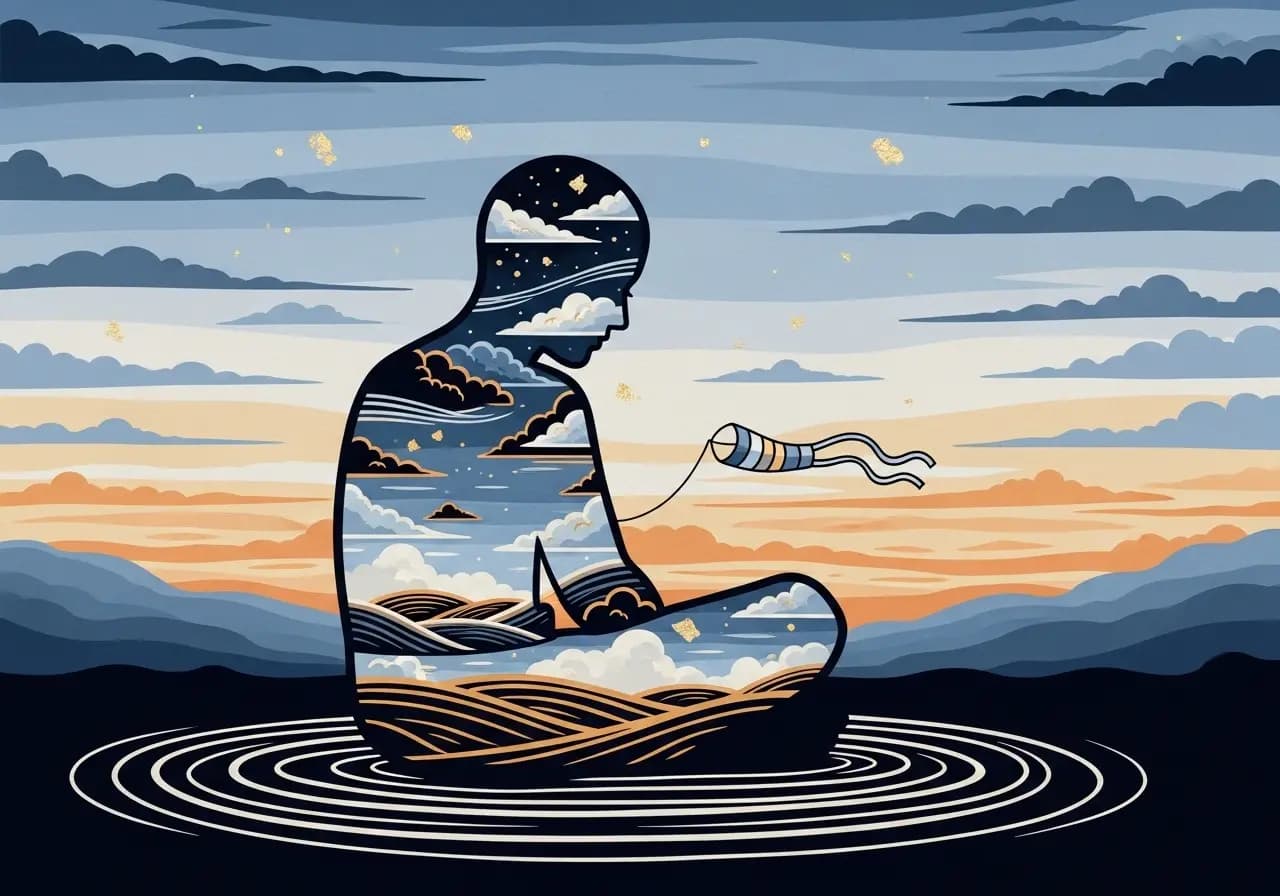
Thoughts, Words, and Actions
Episode 179 of the Secular Buddhism Podcast
Hello and welcome to the Secular Buddhism Podcast, a podcast that presents Buddhist teachings, concepts, and ideas from a secular perspective. You don't need to use what you learn from Buddhism to be a Buddhist. You can use what you learn to simply be a better whatever you already are. I'm your host, Noah Rasheta, and let's jump into today's topic.
The Opening of the Dhamapada
This is episode number 179, and the topic comes from the opening lines of the Dhamapada. The Dhamapada is a collection of sayings of the Buddha and perhaps one of the most widely read and best-known of the Buddhist scriptures. According to the Theravada Buddhist tradition, each verse in the Dhamapada was originally spoken by the Buddha. You can read the Dhamapada translated online at accesstoinsight.org. There are various translations available, and you can also purchase it as a book.
The opening line of the Dhamapada says: "Mental states are preceded by mind, have mind as their master, are created by mind." Now, this depends on which translation you're reading. There are a few different versions, but I like Gil Fronsdal's translation of the Dhamapada, which says:
"All experience is preceded by mind, led by mind, made by mind. Speak or act with a corrupted mind, and suffering follows as the wagon wheel follows the hoof of the ox. All experience is preceded by mind, led by mind, made by mind. Speak or act with a peaceful mind, and happiness follows like a never-departing shadow."
To me, the essential lesson, the essential message, is that the mind determines whether or not we suffer. I think this is a lesson in psychology, and it drives home the importance of getting to know our own mind, the importance of paying attention to our mind, and perhaps more specifically, paying attention to our thoughts.
Thoughts, Words, and Actions
From a Buddhist perspective, thoughts are interdependent with actions and with words. In fact, it is only when our thoughts, words, and actions are in harmony that we have the conditions for inner peace. Our words and actions are driven by our thoughts, and therefore, thoughts play a vital role in learning to understand why it is that we say and do the things that we say and do.
The Buddha taught that we are the owners of our actions. We're reminded of this with the teaching of the Five Remembrances. If you'll recall, the Five Remembrances are:
-
I am of the nature to grow old. There's no way to escape growing old.
-
I am of the nature to have ill health. There is no way to escape having ill health.
-
I am of the nature to die. There's no way to escape death.
-
All that is dear to me and everyone I love are of the nature to change. There's no way to escape being separated from them.
-
My actions are my only true belongings. I cannot escape the consequences of my actions. My actions are the ground upon which I stand.
This fifth one, I think, works really well with the topic of today's episode—this notion that we cannot escape our actions or we cannot escape the consequences of our actions. I think it's true that the expression "actions speak louder than words" holds real weight. I think it's also true that words perhaps speak louder than thoughts. However, it is our thoughts that serve as the foundation for both words and actions. And therefore, it makes a lot of sense to me that we would use thoughts as the starting point in the practice of getting to know ourselves.
How We Create Reality
Consider this: our perception of reality starts in the mind. We experience reality through our senses. When our brain uses the information from the sense organs to understand the world around us, it paints a picture of reality. In addition to sight, hearing, touch, taste, and smell—which are the five classic senses from the Buddhist perspective—we have the mind that produces and senses thoughts, feelings, and emotions.
In the same way that my nose can smell and my mind can process the experience of smelling, my mind will attach a feeling to the experience of smelling. That's how I go from the simple experience of smelling something to smelling something that, to me, feels like a good smell or a bad smell, or a smell that I like or a smell that I dislike. So that's happening in the mind.
My hand can touch something hot, and my brain will sense the pain and pull my hand away. The reality in my mind that gets created is this notion that touching hot things hurts. My eyes are capable of seeing a certain spectrum of light, but outside of that spectrum, my eyes might send information to my brain to produce a reality that says, "There's nothing to see here, it's dark."
I think the important thing to know is that our reality is interpreted through our senses and therefore will always be relative to how our mind perceives and what data comes through the sense organs to our mind. So why is that important to know? Because, again, my reality is my reality, but it's governed by my senses.
Reality Is Relative to Perception
Consider the case of hearing and our ability to hear something versus another species. Let's say a dog, for example. What a dog can hear and what a human can hear—we have two different ranges of ability to hear sounds. So where in my reality I might say, "It's silent. There's nothing. I don't hear anything," a dog would say, "No, there's a very loud sound going on here." That's just the nature of how sensing works.
Or consider seeing. If I were to look at a spectrum of light, like looking at a rainbow, I might say, "Oh, I see seven or eight colors." Whatever I see there in that spectrum, a gecko, for example, has eyes that are 350 times more sensitive to color than ours. So they may look at something and say, "No, there's an incredible spectrum of light going on there that you just don't perceive it that way."
Sight, hearing, touch, taste, and smell—these are senses that get filtered through the brain. Our brain uses the information from the sense organs to understand the world around us. And therefore, our mind is like another sense organ. It's the one that pieces everything together and paints a picture that we end up interpreting as our reality, my reality.
The Tool of Words
The mind uses tools to help make sense of what we experience. Words are one of the most widely used tools that we've inherited from our culture and our society to help us make sense of reality. But remember, words are limited, and we are bound by words and the meaning that we've given to them. I think this is a really fascinating thing to understand about myself—the idea that words are what we've come up with as humanity in our attempt to express the inexpressible.
Here's a thought experiment that I like to do: How would I make sense of an experience if I didn't have words to use in my thoughts? Or a variation of that: What are my thoughts without words? I think for most of us, it's common to think of thoughts as words—but they're words that stay in my mind rather than the words that come out and end up being said.
But what would thinking be without language? What would happen if I couldn't translate my experiences into words? Well, I'd still have the experience, but I wouldn't be able to put it into language, and I wouldn't be able to communicate it to others. In fact, what would my sense of self be without language?
These are really fascinating questions to contemplate, because I think that by understanding the limitations of language and the way that language shapes my experience and my sense of self, I start to understand the nature of my mind better. Words are a tool, and we use them to try to capture and express our experience. But the words will always be limited, and the experience will always be bigger than the words we use to express it.
Now, in the Buddhist tradition, there's something called Right Speech. Right Speech is one of the eight aspects of the Noble Eightfold Path. And it means that we try to use words in a way that is honest and harmless. We avoid lying, we avoid exaggerating, we avoid gossiping, we avoid using harsh language. We try to use our words in a way that promotes harmony and understanding.
I think this is a natural consequence of understanding the limitations of language and understanding how powerful words are. When I really understand that my thoughts, words, and actions are shaping my experience and the experience of others around me, I start to want to be more mindful of how I'm using those tools.
Observing the Mind
Now, there's something that I've been practicing for a long time, and I think it's one of the most valuable practices that I've come across. And that's the practice of simply observing my own mind. Not trying to control my thoughts, not trying to suppress my thoughts, not trying to encourage certain thoughts. Just observing. Just noticing what's happening in my mind.
And I think the best way that I've found to illustrate this is through a hobby of mine that I've been passionate about for many years: paragliding. I've been paragliding since I was a teenager, and over the years, I've come to understand a lot about the sky, about weather, about wind, about thermals, all of these things. And I think the way that I've learned to understand these things is through observation.
There's a book that I read called "Understanding the Sky," and it talks all about weather and what causes weather, how to read the sky, and how to notice certain clouds and what that means based on the terrain. The whole point of this is to be able to decide: when is it safe for me to be in the sky, and when is it safer for me to be on the ground? That's really important to know as a paragliding pilot.
But one of the things I've noticed with new students or new pilots is that we don't have an intuitive sense of understanding the sky because it's something that we don't really pay attention to. When I have a new student and they're out there standing in the field, they don't have an intuitive sense of simple things like the wind. Which way is the wind blowing? What strength is the wind? Those are things that unless you really pay attention, you don't know. You're like, "Well, I can sense that it's windy, but I wouldn't know if it's four miles an hour or eight miles an hour. How would I know the difference?"
But as you spend time and you observe, you start to become much more intuitive and familiar with the sky and with the wind. In that process of learning, we use tools.
Using Tools to Observe
A really good example of this would be a flagpole or a windsock. You can go to virtually any airport and you'll find a windsock there. What is the whole point of the windsock? The windsock is a tool that helps you to understand what the wind is doing. And windsocks are designed a certain way. If the windsock is all the way out, that tells you the wind is blowing at a certain speed. If the windsock is 75% out or 50% out, all of that helps you to interpret what the speed is of the wind.
In paragliding, we use not necessarily aviation windsocks, because we want to be able to read the wind at lower levels. So we'll sometimes use a streamer, and the streamer just hangs there. When it stands out, you can read it to know which way the wind is blowing. But the way that the streamer moves will give you a lot of information about the wind. If it just stands out and it's not flailing, if it's just stiff and almost looks like it's frozen, that's very smooth laminar wind. If it's kind of fluttering, the intensity of the fluttering—all the way to where you can see and hear it as it flutters in the wind—that tells you what type of wind you're dealing with, the intensity or the spread of the gusts.
Because it's not common for wind to just be a fixed speed. It may be that the average wind is five miles an hour and it's gusting to six or gusting to eight. That will look a certain way on the streamer, whereas if it's five gusting to ten, that will look a very different way on the streamer.
The idea here is that you start to pay attention, and as you pay attention, you start to notice. The better you are at paying attention, the better understanding you'll have of what's happening, and the better understanding you have of the conditions, the more wise you can be with your decisions. Should I take off or should I not? In what direction? Which wing should I use? All of those decisions come into play.
Meditation as a Tool for the Mind
Well, that technique is very much what we do in our mind as we start to practice mindfulness. The invitation here is, just like we do with sky gazing, the flagpole in the field or the windsock is the tool that I use to watch and take an assessment of what the sky is doing. Meditation is like the anchor that I put in my mind to notice: what is my mind doing? I think the most basic of these would be breathing meditation. If I start to observe my own breathing, while I'm observing my breathing, I can get a lot of information from what's happening.
I can say, "Oh, wow, I sense agitation," just like I would with the wind looking at the windsock. So the invitation for this podcast episode and this topic is this: knowing that you can't escape the consequences of your actions and that actions originate with thoughts, the invitation is to spend some time observing your own thoughts in the same way that you would sit in a field and observe a windsock and try to decide, "What does this say about the wind?" Or like with sky gazing, go out and just sit and look at the sky and observe and say, "Based on what I see in the sky, what does this tell me about what's going on?"
I promise, if you did that long enough, you would have a very intuitive sense of weather. That's how you learn it—by observing. And I don't mean, "Okay, I'm going to go watch the sky for a day, and now I'm an expert on the weather." No. But if you go out and observe the sky—let's say you did this every evening, and you observe the patterns and all the details of what's happening in the sky, and you did this every day for years—you would have an expert understanding of the sky. You would know things about it that the average person would be like, "Wow, that's amazing. How did you know that?" Through observation. Lots of time observing.
The Wisdom of Observation
I believe that's the key to the Zen masters and the people who have achieved a great amount of inner peace. They have spent a lot of time observing their mind in the way you would if you were out observing the sky. And what does that do? Well, you acquire knowledge. Through knowledge, you acquire understanding. And with that understanding, you develop wisdom. That is the wisdom of the sages, the wisdom of the masters—they've spent a considerable amount of time learning to just pay attention and noticing.
So that's the invitation I want to leave you with: noticing your thoughts. I invite you to spend time observing your own thoughts. Remember, mindfulness is the non-judgmental observation of the present moment. It's the anchor to the reality of how things are.
If you have those three little worlds that you reside in—there's how things are, there's how I want things to be, and there's how I think things should be—mindfulness is all about awareness. It's not about insight. It's about awareness. It's the way that we immediately anchor ourselves in the reality of how things are right now. That's where you notice.
What do I notice? Well, let me pay attention. What do I see? Are you the observer of your thoughts? You can be the observer of your thoughts and the one experiencing the thoughts, because thoughts are something that's happening to you. This is what I find fascinating.
Being the Observer
In the same way that my heart just beats—heartbeat is something that's happening to me—well, mind just thinks. Mind has thoughts and feelings and emotions, and this is something that happens to me. Usually, we go about our day-to-day lives in habitual reactivity. I'm just habitually reactive to the experience I'm having. There's this thought. Oh, that thought brings up this emotion. Oh, this emotion reminds me of that memory, and that memory reminds me of that, and we just go along, and that's how we live our lives.
This practice is about stepping out of that for a moment and saying, "I want to get into the world of just observing how things are." It's just about noticing. So I can be the observer of my thoughts. I learn to pay attention, and then with time, I can start to see: what am I noticing, and what understanding arises from that noticing? With that understanding, I develop a sense of wisdom around the nature of my own mind and how my mind works in the same way that I would do looking outside and observing the weather.
So that's the invitation for this podcast episode: paying attention to your thoughts, just observing them like you would the open sky, and notice and see what's there. If you went out and did this right now, looking at the sky, you may notice things that you had never noticed before. Now imagine what would happen if you do that with your own mind.
Thank you for listening to the Secular Buddhism Podcast. If you enjoyed today's topic and you want to learn more, visit SecularBuddhism.com, where I have links to my books, courses, podcast episodes, and information for how to join the Secular Buddhism Podcast community. Thank you for listening. Until next time.
For more about the Secular Buddhism podcast and Noah Rasheta's work, visit SecularBuddhism.com