

The Four Investigations
Episode 178 of the Secular Buddhism Podcast
Hello, and welcome to the Secular Buddhism Podcast, a podcast that presents Buddhist teachings, concepts, and ideas from a secular perspective. You don't need to use what you learn from Buddhism to be a Buddhist. You can use what you learn to simply be a better whatever you already are. I'm your host, Noah Rasheta, and let's jump into today's topic.
The Teaching of the Four Investigations
This is episode number 178, and the topic I want to discuss with you is a teaching called The Four Investigations. This comes from the Yogachara School of Buddhism, one of the original Mahayana forms of Buddhism. Yogachara was influential in shaping what we know today as Tibetan Buddhism as it spread from India to Tibet.
According to Yogachara teachings, the key to understanding reality is to understand the mind. And there are four investigations that we can use to explore reality. These investigations are intended to help us obtain a correct view, or a correct understanding of reality.
When we talk about correct view, you might recognize this from the Eightfold Path—it's the first step. Sometimes it's translated as skillful view or right view. And "right" here isn't right as opposed to wrong. It's more about correct view as opposed to incorrect understanding. I think this will make sense as we explore the four investigations together.
The Four Investigations
Let me give you all four so you know what we're working with:
- The investigation of the names of things
- The investigation of things
- The investigation of the nature of things
- The investigation of the separateness of things
Now let's explore each one.
Investigation One: The Names of Things
The first investigation is the investigation of the names of things. This practice leads to the correct view that names are just names. They're symbols of things, and the key understanding here is that the symbol of a thing is not the same as the thing itself.
Let me give you an example. The word "tree"—that's the name we have for a thing. Tree is the word, and tree is also the thing. When I say tree, I conjure up an image in your mind and in my mind. It may not look the same. It may not be the same type of tree or the same size, but we're at least thinking of the same thing. You know what I mean when I say tree.
So keep in mind there's real usefulness to the labels and the names. The point of this exercise isn't to make names out as if they were bad things, or labels as if they were bad things. The idea here is to see things for what they really are. This first investigation is about separating the name of a thing from the thing itself.
I think it's pretty obvious to all of us that the word "tree" is not the same thing as a tree. But it's an important thing to understand and be consciously aware of.
Investigation Two: Things Themselves
Now that we have that foundation, we move on to the second investigation: the investigation of things themselves.
This leads to the correct view that things are just things, and our attempt to describe a thing will always result in the creation of another name or another label. But the thing itself is always going to be beyond words. I think this is kind of an interesting conclusion.
Consider the tree again. Yes, it's useful to create labels and words. But at the same time, how would you describe a tree if you didn't use any words or any concepts? How do you describe a tree without ideas?
I think you would find that things are always beyond words. What is a tree if I'm not calling it a tree or if I don't use any words to describe what it is? The truth is that things are always beyond words. That's the second investigation: the investigation of things.
Investigation Three: The Nature of Things
The third investigation is the investigation of the nature of things. What words do we use when we investigate the nature of things?
This leads to the correct view that what seems like the intrinsic nature of things is really just an illusion. There is no intrinsic nature of things. Why? Because all things have causes and conditions. They're made up of other things.
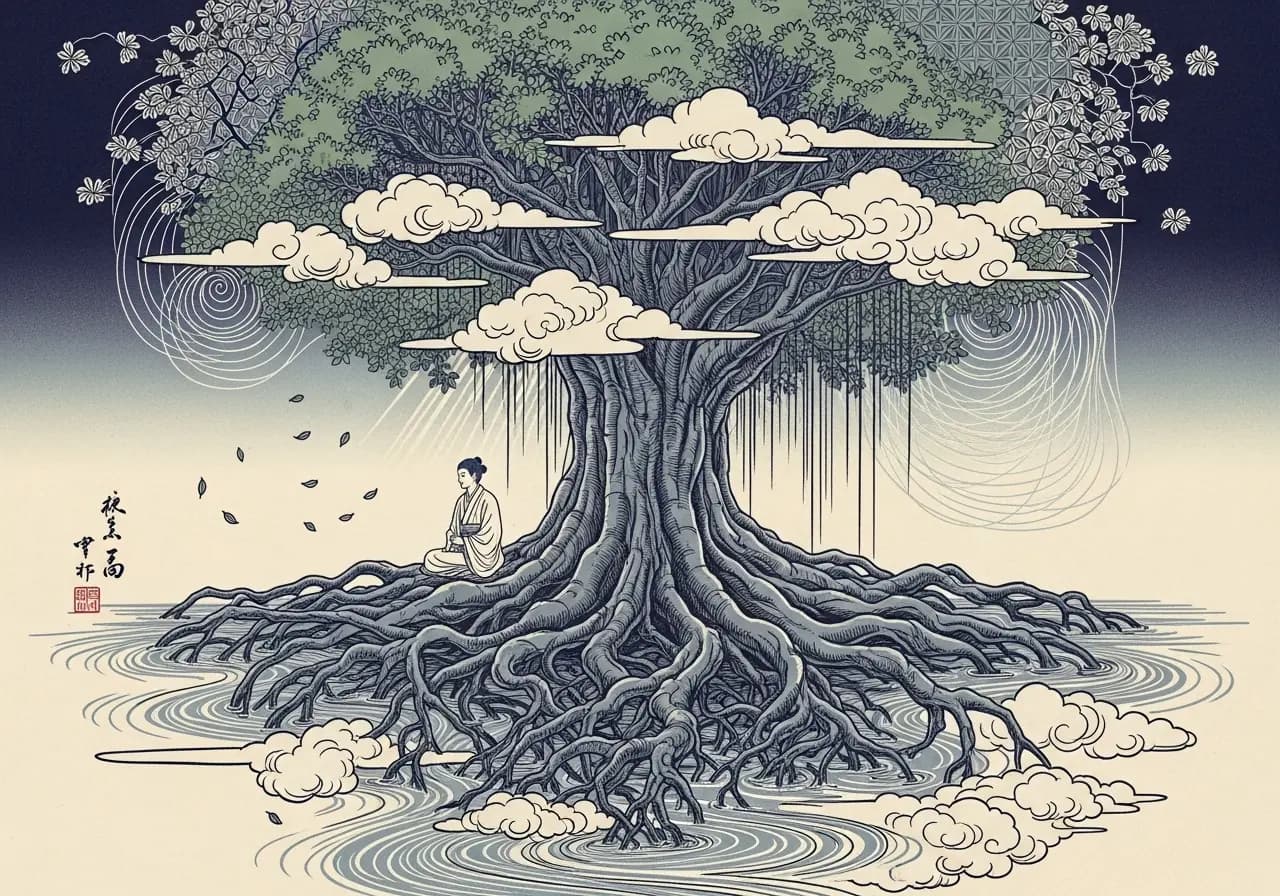
When we look closely at the tree, what we see is that the tree is interdependent with all of the non-tree elements that make the tree a tree. For example, to look at the tree, you have to also recognize that the tree interacts with the sun and sunlight through the process of photosynthesis. It interacts with clouds and rain. The rain gets absorbed through the ground and into the roots through the dirt and the soil. The tree breathes the air.
What you end up with is this recognition that the tree is not just a tree. The tree is interdependent with all the other things that make the tree what it is—all the non-tree elements. In other words, there's no such thing as a tree without everything else that is not a tree.
This gives us a peek into the nature of things, and that takes us to the fourth investigation.
Investigation Four: The Separateness of Things
This is the investigation of the separateness of things. We use words when we separate things into categories—things that are something and things that are not something.
Looking at a tree, we could do this. We use words to create separateness. For example, with a tree, we would use words like branches, trunk, bark, leaves. These are words that we use to describe this thing. But here's the key: the investigation of the separateness of these things leads us to the correct view that things go beyond notions of "this" and "not this."
It's inaccurate to say, "This is a leaf and this other part is a branch, but the branch is not a leaf and the leaf is not a branch." While that's useful for creating meaning and being able to communicate among ourselves—"Hey, bring me the branch, I don't need the leaves"—that usefulness doesn't coincide with reality.
The nature of reality is that these things go beyond the notions of separateness we give them. For example, what is the tree and what is not the tree? Can you really separate these things?
In Buddhism, you encounter the word "suchness." I think this is what's being referred to when you hear this word. The nature of reality is that things are not separate. Things are not independent entities. All things inter-are, and they form part of the suchness of reality. The very fabric of the nature of reality is suchness—the interdependent nature of all things.
Separateness is something that we see and something that we create in the process of labeling, of giving words and giving meaning to things. But at its true nature, reality is not characterized by separateness. It's characterized by suchness. It's one with everything.
Practicing the Four Investigations
The idea behind doing this sort of practice—picking an object and doing the four investigations—is to help us start to see the nature of reality and things. What does it look like when we move past all of the conceptualizations and ideas that we've superimposed over the accurate picture of reality?
This can be done on any object. I've done this before, looking at my kitchen table.
The investigation of the name of things: I call it a table, but that's just a name, a label that's been given. We could have called it anything else. In different languages, we actually do call it different things.
Then there's the investigation of things themselves. What is a table beyond the word "table"? You start trying to describe it, and you realize every word you use to describe it fails to accurately describe exactly what it is.
Then the investigation of the nature of things: What is the nature of a table? Well, the nature of a table is to place things on it. But who decided that? Sure, we use it for that. But what if you put the table upside down? What if you removed the legs of the table and used it on its side to cover the window when a hurricane is coming? Is that a table or is it now something else?
The idea here is recognizing there is no inherent nature of a table. There's only the table being used for something, but that's not the same thing as the nature of that table.
And then there's the investigation of the separateness of things. Can you really separate the table into parts? Where is the table and where do the legs of the table begin? Where do you draw these lines of separateness? Is the top of the table the table, but the bottom of the table is not? You'd realize it's words that create that separation.
In reality, the nature of the table goes beyond words. It transcends the categories and separations we've created for it.
Turning the Investigation Inward
Now, I think this practice can be a powerful exercise when you look at objects like a tree or a table. But it can become an extremely powerful exercise when you turn the focus from an object and instead look at yourself.
Look at yourself through the same investigative lens. See what you notice when it comes to the investigation of the name that is used to portray you, the investigation of you, the investigation of your nature, and the investigation of the separateness that you see between you and everything that is not you.
I think you'll find a really neat process that unfolds when you do that.
Connection to The Two Truths
This practice ties in well with a teaching called The Two Truths. The idea here is that there are two ways we can see the truth of reality, and I want to clarify something important. The teaching of the Two Truths is not the understanding that there are two truths—one that is true and one that is false. It's not that one is accurate and one is not.
This is a nondualistic approach: there are two perspectives of seeing the truth, but they are both true. It's not that one is higher than the other or better than the other or more accurate than the other. It's just two different lenses through which we interpret and see the truth of reality.
Relative Truth
The first lens is the lens of the relative. Relative truth is any truth that is relative to either space and time—when and where we stand—as well as circumstances (both inner and external), sense faculties (the senses we use to perceive our reality), and the mind (the views and beliefs we hold that interpret our understanding of what is true in reality).
Space and time: This is represented in the Buddhist teaching of the blind men describing the elephant. You have people placed at different spots around the elephant, all describing a reality that is partially correct but missing the larger picture because of where they stand in space and time. The person standing at the side of the elephant will describe something different than the person standing at the front, feeling the trunk. Each person's truth is relative to where they stand in space and time.
Circumstances: Consider H2O. We can say H2O is water—it's a liquid. Well, that's a relative truth because it's relative to the conditions at certain temperatures. What we know to be water would actually be hard—it would be ice—at other temperatures. At other temperatures, it would be vapor, something you can't even feel. It's not hard or soft. It's just a vapor. But change the circumstances, and the truth of a thing also changes with those circumstances.
Sense faculties: If I say, "That sound is really loud," that's a relative truth. It's relative to how I hear versus how you hear. For you, it may not be loud. For me, it may be loud. When we compare across other species, this becomes obvious. There are sounds that dogs can hear that we can't. Some animals would interpret a sound as a really low frequency, but for us, it would be a really high frequency.
Another example: what I interpret to be cold is relative to me. A polar bear might say that's not cold at all—to the polar bear, it feels warm or hot. These are truths conditioned by our sense faculties.
The mind: These are influenced by views or beliefs—personal, family, societal, religious, and cultural norms that we've adopted. An example would be that red means stop and green means go. There's no absolute truth to that. That's a relative truth—a cultural truth that we all collectively believe in. Because of that collective view, we're able to safely stop and go through intersections. So it's not to say that relative truths are bad. They're just a different lens for looking at what is true.
Absolute Truth
The absolute truth would be seeing things through the lens of impermanence and interdependence. It's about trying to see things without the conceptualizations we've superimposed—the words, the ideas, the names, the labels. What does it look like when you strip all of that away and you see it with the interrelationship it has with all the other things that are not that thing?
That is the essence of the teaching of the four investigations.
Bringing It All Together
I hope that today's topic gives you something to think about. When it comes to how we see things and how we interpret our reality, I hope this exercise—or at least this new perspective—will help you have a new outlook on what it means to see reality as it is and what that does for you.
May this become a practice, an exercise, or just a concept in your mental framework as you go about engaging with your own reality. May it help you see more clearly.
As always, I look forward to recording another episode on another topic at some point, sometime soon, hopefully. And thank you for taking the time to listen.
Thank you for listening to the Secular Buddhism Podcast. If you enjoyed today's topic and you want to learn more, visit secularbuddhism.com, where I have links to my books, courses, podcast episodes, and information for how to join the Secular Buddhism podcast community. Until next time.