

Working with Our Propensities
Episode 176 of the Secular Buddhism Podcast
Hello and welcome to another episode of the Secular Buddhism Podcast. This is the first episode of 2023, and this is episode number 176. I'm your host, Noah Rasheta, and today I want you to think for a moment about some of the people that you know best—perhaps close family members or close friends. Think about them for a moment, and then ask yourself: Have you ever noticed if any of them have a natural inclination or a natural tendency to behave in a particular way? And if so, what is that natural tendency?
Then focus on yourself. How about you? Do you have certain propensities that you're familiar with? Today I want to share my thoughts around the topic of propensities and how mindfulness as a practice plays a crucial role in both helping us notice our own propensities and also developing a more skillful relationship with them once we've identified them.
As always, keep in mind that you don't need to use what you learn from Buddhism to be a Buddhist. You can just use what you learn to simply be a better version of whatever you already are.
A Quick Year-End Review and New Year Report
Before I jump into the topic of propensities, I want to give a quick year-end review and starting-of-the-year report.
Last year was a great year. Toward the end of the year, I dropped off a little with the podcast episodes, especially in December. The main reason is that I attempted to record three or four episodes, and for some reason, halfway through, there was an audio glitch. My microphone would start producing a very skittish, almost scratchy sound. I know it happened in one or two podcast episodes in the past—one of them many of you detected—and then I had to correct it.
In November, I did a podcast interview on another podcast where someone was interviewing me. About 15 minutes of that episode ended up being unusable audio because of this weird glitch. For whatever reason, it was getting worse toward the end of the year. After multiple failed attempts at recording a new episode, I gave up and thought, "Okay, I'm not going to try to record a new one until I can figure out this microphone thing."
After doing some troubleshooting—I tried several different microphones, and I have a really nice one—it turns out the issue was my computer. The computer was old in computer years. It was a six-year-old computer, which in computer life, I guess, is old. But it turned out that the port the microphone was plugged into wasn't capable of pushing that much data at the speed the data was traveling, especially if I had other devices configured and connected like my camera and other devices I'd been using to interact with the podcast community. All of that was causing these audio issues.
I fixed it by getting myself a new computer—that was my Christmas present. So here I am now with the first recording on my new setup. I've already done multiple tests with it, and I don't anticipate having the audio issues I was having before. In fact, if you're hearing this, it means I didn't have audio issues, and that's why this podcast episode finally came out.
With this new year, I also want to say that I have some goals I've set for how I want to move forward with the podcast and be more consistent. I want to schedule out the topics I want to do rather than waiting until the last minute, second-guessing the topic I have, and then ending up just not recording because I'm not sure if I should. I'm going to do a better job at that.
Thoughts on New Year's Resolutions
Because we're at the start of a new year, I want to share some thoughts about the New Year. I've always enjoyed New Year's resolutions and setting goals. I think it's a fun time, and I think it's interesting that there's so much more excitement at the end of the year or at the start of the new year about making these big changes.
I've often wondered: Why do I feel this at yearly intervals? Why don't I feel the same at the start of every new month and say, "Oh, I'm going to set new goals for the month," or at the start of each week, or at the start of each day, or at the start of each new hour? Where is that line put? Why is it put there for one year? I don't know. I know it's just conditioned societal conditioning, but it is fun for me to think of it that way. And then sometimes I go all the way down to moment-by-moment changes and say, "Well, for this moment, this is my new goal. And that was a moment ago—I'm done with that."
I think that plays off that quote I often use and enjoy from Alan Watts, where he says: "I'm under no obligation to be the person that I was five minutes ago." So here we are—new year, new you.
But I do want to emphasize something about New Year's resolutions and goals. I think one of the unfortunate societal norms we've been conditioned to believe is that our life and ourselves are incomplete. We're lacking. And we get to reset every year and say, "Well, I'm going to identify these key areas where I'm incomplete, and I'm going to try to make myself complete by adding this new goal or this new resolution."
That's an unfortunate way to approach these things because then you fail the resolution and you think, "Well, now I'm just going to remain incomplete, or lacking, or unhole." From the Buddhist perspective, you have to remember: You are not incomplete. You are already whole. You are not lacking. And from that perspective, approaching New Year's resolutions and goals in general can be a really fun, healthy thing. But the key is the perspective of how you view yourself and the relationship you have with your goals or your resolutions.
I like to imagine you're a cake. The cake's already baked—it's done. The cake is the cake. Now, everything else is just icing on the cake. The cake is already whole. It's already complete. It's not that something is missing—it's that something can always be added and something can always be removed. You may have this layer of frosting or these decorative pieces that you think, "Yeah, I don't like those anymore. I'm going to remove those and do a new layer of icing with a new design."
You can add and remove and make changes, but the essence of the cake is already complete. It's a great cake. That's how all of us are. We are perfectly fine the way we are. And if you think of yourself that way, what will happen as you add new resolutions or goals is that it becomes a more skillful way to approach it. It's exciting, and sure, we should take advantage of the new year as a milestone to say, "These are the changes I want to make." But it'll be a much more healthy thing to think of it in that context: "I'm just fine the way I am, but I can go ahead and make these little tweaks and improvements that might make me a more skillful cake." Rather than approaching it from the perspective that we're never whole or complete.
I think we get enough of that from societal norms and marketing. Your life is not complete until you own this product, or until you sign up for this service, or whatever society and marketing are trying to sell us. So let's move beyond that.
Building the Podcast Community
One more thing I wanted to talk about quickly: Last year we added the podcast community using a new app, and I've been very happy with this new format. I've tried Discord, Facebook groups, and different things, and the setup we have now is the one I'm actually happy with. For me personally, it's easier to engage with people in that community because I can get on there and record a voice response, or do a video response, or type it out. It allows for all of that.
So if you're interested in joining the community and being part of that, you can check that out. I enjoy that space quite a bit, and I think that's a really great way to stay connected with people who are interested in the Secular Buddhism Podcast and Buddhist philosophy in general.
Understanding Propensities
Now, let's get to the main topic of this episode: propensities.
What exactly is a propensity? A propensity is a natural tendency or an inclination to behave in a particular way. It's something that has become a habit for you—something that's become more or less automatic.
For example, some propensities that I have are: I have a propensity to avoid conflict. I have a propensity to be very trusting of people. And I have a propensity to be organized. These are just natural tendencies that I have that have developed over time, and now they kind of happen automatically without me really having to think about them.
We all have propensities. They're not unique to me, and they're not something that's wrong or bad. They're just part of who we are. Some of them are beneficial, and some of them can be challenging. But what's important is that we develop an awareness of them and a more skillful relationship with them.
Propensities and Mindfulness
The practice of mindfulness is crucial to working with propensities. Let me explain what I mean.
Mindfulness is the practice of being present and aware of what's happening right now, in this moment. It's about noticing our thoughts, our feelings, our sensations, and our behaviors without judgment. When we practice mindfulness, we develop the ability to observe our propensities without automatically acting on them.
Here's why that's important: Most of the time, we're not aware of our propensities. They're operating automatically, beneath the surface of our conscious awareness. We just react based on these deep habits we've formed. It's like we're on autopilot.
But with mindfulness, we can step back and observe what's happening. We can notice our propensities as they arise. And once we notice them, we have a choice. We can choose to act on them or not. We can choose to respond in a different way.
This is where the real power of mindfulness comes in. It creates space between the stimulus and our response. Viktor Frankl talked about this. He said that between stimulus and response, there is a space, and in that space is our freedom to choose. Mindfulness helps us access that space.
Personal Examples: The Propensity to Avoid Conflict
Let me give you a personal example. One of my propensities is to avoid conflict. For a long time, I didn't realize this was a propensity I had. But then I started to notice it. I noticed that whenever there was a potential for conflict or an uncomfortable conversation, I would find myself wanting to avoid it, wanting to sidestep it, wanting to smooth things over.
At first, I thought, "Well, that's just who I am. That's just how I am. I'm a peaceful person who doesn't like conflict." But then I started to examine this more closely with mindfulness. I started to observe what was really happening.
What I realized is that while there's nothing wrong with wanting peace, my propensity to avoid conflict all the time was actually causing problems. It was creating more issues down the line. It was like I was kicking the can down the road. Issues that needed to be addressed weren't being addressed, and they just kept growing bigger and bigger.
For example, I once had someone come by and throw a few small pebbles at me. Just little pebbles. Nothing that hurt. It was kind of annoying, but it wasn't a big deal. My propensity was to just let it go, to not say anything, to avoid any kind of confrontation. And I could do that because it was just small pebbles.
But then I thought, "Well, what if instead of small pebbles, he was throwing darts?" At what point do I decide that this propensity to avoid conflict is no longer skillful? At what point do I need to address something?
That's the question I started asking myself: Is this propensity skillful right now? Is it beneficial? Or is it causing problems?
And I realized that sometimes it's skillful to avoid conflict, and sometimes it's not. Sometimes you need to address something. Sometimes you need to have a difficult conversation. Sometimes you need to set a boundary.
So I started working with that propensity. I didn't try to get rid of it completely. I didn't try to become a different person. But I started to develop a more skillful relationship with it. I started to notice when it was arising, and I started to ask myself, "Is it skillful for me to avoid conflict right now? Or is it skillful for me to address this?"
And based on my assessment of the situation, I could make a more conscious choice.
Another Example: The Propensity to Trust
Another propensity I have is a natural tendency to trust people. This is generally a good thing. It's benefited me way more times than it's ever cost me. But I've also noticed that there are times when this propensity has gotten me into trouble.
I remember one occasion when I lived in Mexico. Someone came by and offered to put a new seal around my car door so water wouldn't get through. They asked how much it would cost, and they gave me a price. I thought, "Sure, go ahead and do it. I'll help them out by giving them this work while I go do some shopping."
But when they finished, I realized they had phrased things in a particular way. They said something like, "We're almost done with door three." I realized what they were doing. They were making it seem like the price they gave me was per window, not for all the windows. So it was four times more than what I thought it would be.
I asked them to clarify, and they basically said, "Of course, that's what I meant"—making it seem like I was dumb for not understanding.
In that moment, I recognized what had happened. My propensity to be very trusting, combined with my propensity to avoid conflict, had set me up for this situation. I hadn't asked for enough clarification, and I hadn't wanted to make waves, so I just went along with it.
What I learned from that experience was that my propensity to trust is generally good, but I can counteract it with another propensity: being thorough. Now, when someone makes an offer or makes a proposal, I ask for clarification. I say, "This is what I think you're saying. This is what I interpret you're going to do. Can you clarify that for me?" And then I give them the option to confirm.
This approach has helped me avoid similar situations. I'm not trying to become a distrustful person. I'm just developing a more skillful relationship with my propensity to trust.
The Process: Notice, Assess, Develop Skillfulness
So here's the process I'm describing:
First, notice your propensities. Develop awareness of your natural tendencies. Ask yourself: What are my propensities? How do I naturally tend to behave? If you're not sure, ask people close to you. Ask a partner, a sibling, a parent. What do they notice about your natural tendencies?
And here's the thing: Your list of propensities might not match their list. That's actually really useful information. It means there are propensities you're not aware of. So rather than saying, "Well, they got it wrong," start by saying, "Wow, I didn't notice I have that propensity. Why am I not noticing what they're noticing?"
Second, assess each propensity. Ask yourself: Is this propensity skillful? Is it beneficial to me and to those around me? Or is it the opposite? Does it cause unnecessary suffering?
And here's the important part: A propensity that might seem negative on the surface could have positive results in certain situations. And a propensity that seems positive might sometimes be unskillful. You have to look at each situation individually.
Third, develop a more skillful relationship with each propensity. Once you've identified a propensity and assessed whether it's skillful, you can decide what to do about it. You might decide to develop a counteracting propensity. You might decide to practice noticing when it arises so you can make a more conscious choice about whether to act on it. You might decide to work on a completely different propensity that will help balance it out.
The key is that you're not trying to eliminate propensities or become a different person entirely. You're working skillfully with what you have. You're developing awareness and choice. You're learning to respond more consciously instead of just reacting automatically.
The Role of Teaching Others
I've had this thought with my kids, where I recognize that I don't want to teach them what to think. I want to teach them how to think. And it's the same with propensities.
Rather than saying, "You shouldn't be shy" or "You shouldn't be impulsive" or "You shouldn't be stubborn," I want to help them understand their propensities and develop a skillful relationship with them.
This is the practice. This is what mindfulness allows us to do.
Breaking Old Ruts and Creating New Ones
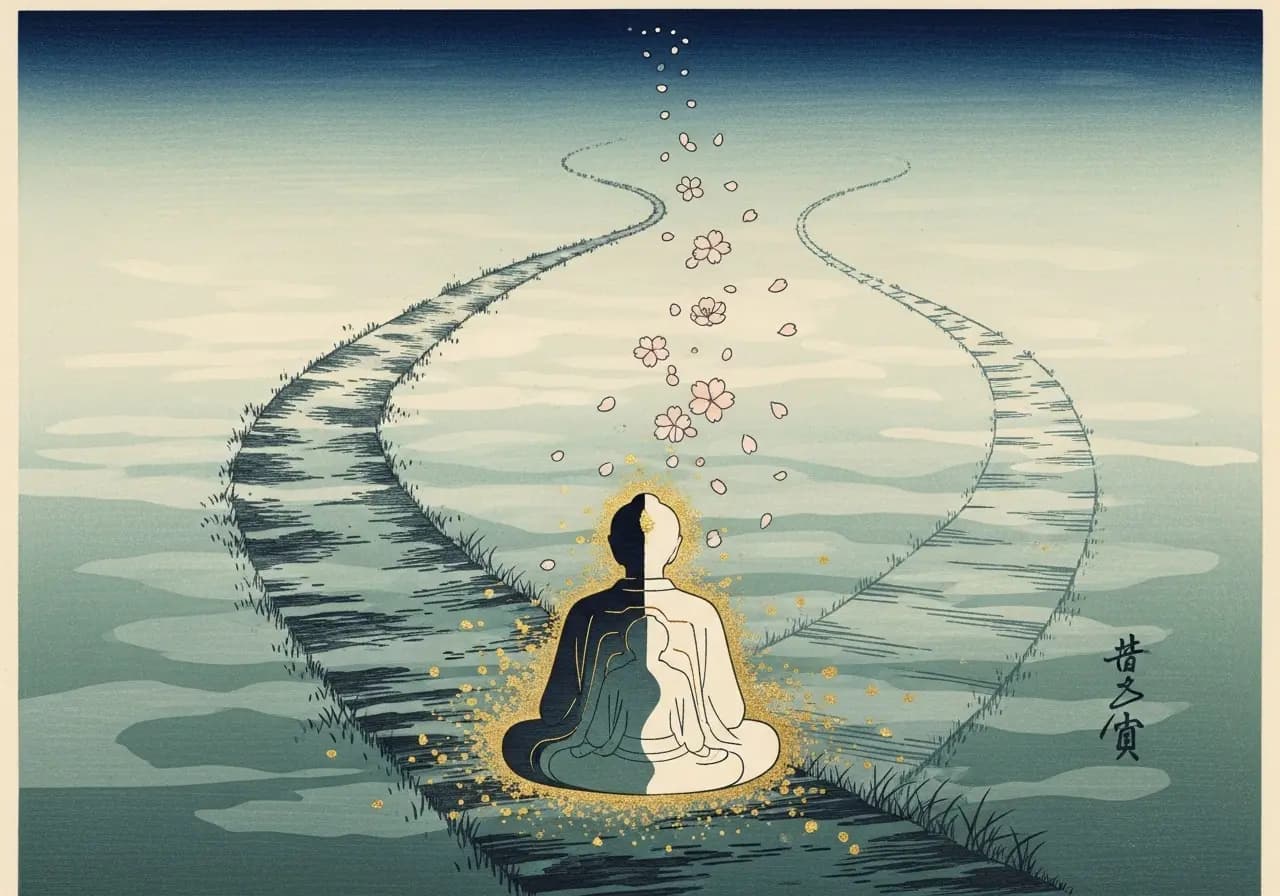
There's a beautiful image I like to use when thinking about propensities and habits. Imagine that you're in a rut. You've been driving down the same path so many times that you've worn a deep groove into the earth. Your propensities are like these ruts. You fall into them automatically.
Now, the question is: How do you get out of the rut and onto a new path?
You don't get out by suddenly trying to drive in a completely different direction. That doesn't work. Instead, you start slowly. You gradually shift the steering wheel. You move a little bit at a time toward the new path.
And at first, it's hard. It takes conscious effort. You have to really pay attention and deliberately move toward the new direction. But if you keep doing it, if you keep making that small shift over and over and over, eventually you start to wear a new groove. Eventually, you develop a new rut.
And here's the thing: Now the new way of being starts to become automatic. It becomes the new habit. It becomes the new propensity.
That's how you work with propensities. You don't try to destroy the old rut all at once. You develop a new one. You keep practicing the new way until it becomes natural. Until it becomes the new automatic response.
The Tyranny of Habitual Reactivity
The whole point of this work is to recognize that we're somewhat trapped or caught up in our natural tendencies. We're hooked by the tyranny of habitual reactivity—the tyranny of our habitual way of being.
But what if you could be a different way? Where would that start?
It starts with small changes. It starts with mindfulness—with noticing. And then it continues with repetition. You do the new thing over and over and over until it becomes the new normal. Until it becomes the new rut.
The old rut doesn't completely close up. But you develop a new path that you can take instead. And as you walk the new path more and more, it becomes more familiar, more natural, more easy.
That's the practice. That's what mindfulness and working with propensities is all about.
A New Year's Goal
So as we think about new changes, as we think about resolutions and New Year's goals, perhaps one of them can be to develop a greater understanding of your own propensities.
With that understanding, develop a more skillful relationship with your propensities by analyzing: Is it skillful? Is it beneficial? Does it cause harm? Where do I need to counteract this propensity? What new propensities could I start working on and developing so that they become my habitual ways of being?
The ultimate goal is recognizing that we have the freedom to be different. We're not trapped by our propensities. We can develop new ones. We can respond more skillfully. We can access the space between stimulus and response that Viktor Frankl talked about. And in that space is our freedom.
Resources for Your Journey
If you're interested in learning more about Buddhism in general, you can always check out my book, No-Nonsense Buddhism for Beginners, on Amazon. Listen to the first five episodes of this podcast, and soon you'll be able to take the Inner Peace Roadmap course. That will be a really effective way of guiding you through the core concepts and ideas that lead to a path of greater inner peace.
Closing
That's all I have for this episode. I look forward to sharing more thoughts soon in another episode on a different topic. Thank you for listening, and I wish you all the best in this new year.
Until next time.