

The Two Truths
Episode 175 of the Secular Buddhism Podcast
Hello, and welcome to another episode of the Secular Buddhism podcast. This is episode number 175. I'm your host, Noah Rasheta.
Take a moment to imagine what is the most beautiful thing you've ever seen. Can you picture it? Can you recall it? Put that image in your mind for a moment—the most beautiful thing you've ever seen. And now imagine someone comes along, looks at the same thing, and thinks out loud: "Wow, that's so ugly."
It's true that it's beautiful, and it's also true that it's ugly. Both are true. But how can that be?
Today I'm going to share my thoughts about the Buddhist teaching of the two truths.
As always, keep in mind: you don't need to use what you learn from Buddhism to be a Buddhist. You can use what you learn to simply be a better version of whatever you already are.
What Is Truth?
In Buddhist teachings, you'll encounter the concept of the two truths. The exact meaning of this teaching varies between the various Buddhist schools and traditions, but they are not to be understood as two separate truths. Rather, they are two separate dimensions of a single reality.
I like to think of them as two levels of truth—where perhaps one is superficial and the other is more deep. Or sometimes I like to think of them in the context of truth where one is truth with a capital T, and the other is truth with a lowercase t.
The two truths are often referred to as absolute truth and relative truth, where absolute truth is that capital T truth, and relative is the lowercase t. Absolute truth is how things really are, and relative truth is how things seem to be.
So that's it. The teaching of the two truths helps us understand that there is the truth of how things seem to be, and then there's the truth of how things really are. The important thing to know here is that how things seem to be will always be dependent on our perception and on how we perceive.
For example, if I were to wear yellow-tinted sunglasses, I would see everything with a yellow tint. That's how things would seem to be, right? But it's not an indicator of how things really are.
We misunderstand the nature of reality when we make the assumption that how things seem to be is indeed how things really are. That's what is sometimes referred to as the great misunderstanding.
The Goal of This Teaching
The goal of the teaching of the two truths is to become aware of our misunderstanding and to become less attached to our perceptions as indicators of absolute truth.
In other words, if I see yellow, instead of trying to understand or make sense of why the world is so yellow, I can focus inward and ask myself: Why is it that I see yellow? How is it that I see? Understanding how is more skillful than trying to understand what it is that I perceive.
Through the process of introspection and getting to know the how, I may conclude: Oh, the world looks yellow because I'm wearing yellow-tinted lenses.
Relative Truth
We live in a world of relative truths. These are the truths that emerge not based on how things really are, but based on how things seem to be. They are based on perception, and the process of perception begins with our senses.
From the Buddhist perspective, we have six key sense organs that are responsible for what we see, hear, smell, taste, touch, and think or perceive. The organs that correspond to these are the eyes, ears, nose, tongue, body, and mind.
Everything we perceive is based on the current configuration of our sense organs. The important thing to know here is that we all have unique configurations that will give rise to unique interpretations of what we perceive and how we go about experiencing life.
This is why we can look at the same thing and some will see beauty while some will see ugliness. This is why some can smell the same thing and some will like the smell while others will hate it. This is why you can taste food and some will say this is good, while others will say no, this tastes bad.
This is why in the same circumstances someone may feel cold while someone else will say no, it feels a little bit warm. And think about this—not just in the context among humans, but among life forms. Think of a polar bear compared to an alligator, both trying to decide if it's warm or if it's cold.
And then finally we get to the incredibly complex sense organ that we call the mind. This is where someone will think or believe one thing, and another will think or believe an entirely different thing. And for both, the perceptions feel like indisputable and undeniable truths.
That's how relative truths work. They are true for me. It's true that some things taste good and other things taste bad. It's true that some things look beautiful and other things don't. It's true that some temperatures to me feel cold and others feel hot. And it's also true that some of the beliefs that I hold feel like they are true, and others don't feel like they're true.
But I recognize that these truths are relative. They're relative to how I perceive, and how I perceive is determined by how my sense organs are configured—and not only how my sense organs are configured, but also where I stand in terms of space and time.
It would be a fundamental misunderstanding for me to assume that how things seem to be for me is indeed how things really are.
The Power of "For Me"
For me, this is why I always try to emphasize the expression "for me." I'll say something like "For me, this doesn't smell good" or "For me, this particular belief doesn't seem to make much sense" or "For me, scrambled eggs taste better when I put hot sauce on them."
It's a way that I deliberately try to remind myself of this teaching of the two truths and to remind myself that the vast majority of the truths for me are relative truths. That's not to say that just because I perceive it that way is indeed how things really are.
I recognize that my reality and what I perceive has to be true, mostly because of how I see—and not really how things actually are.
The Blind Men and the Elephant
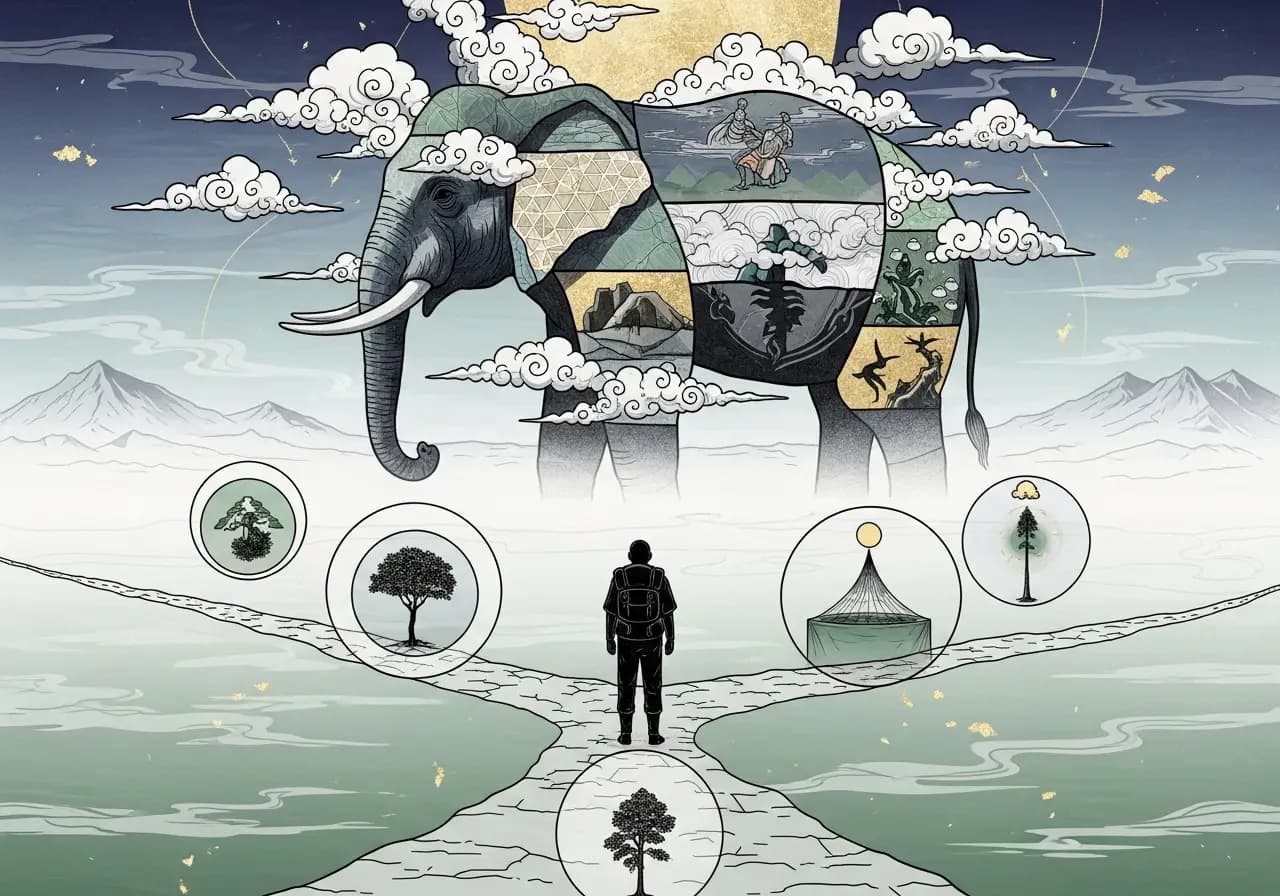
One of the teachings in Buddhism that alludes to this notion is the teaching of the Blind Men and the Elephant. If you'll recall, this teaching is about the relationship between relative and absolute truth. In this teaching, you have several people at different positions around an elephant trying to describe it. They're all blind in the story, so there's one sense organ that's factored out. They're using the other sense organs to try to describe something that cannot be seen—in this case, because it cannot be perceived.
Sometimes when we listen to this story, we think: "Well, they didn't get the whole picture, but I do, because I have seen a full elephant. I know what an elephant looks like, so I can understand that they were limited in their description of reality. But I'm not—I can actually perceive what the whole elephant is like."
But that's not the point of that teaching. The key takeaway is that none of them are actually wrong in their description of reality, but also none of them have the complete understanding. It's impossible to have the complete or absolute understanding of reality in this case because they're missing some of the sense organs. But also, we're limited by how we perceive based on the configuration of our sense organs and also our position in space and time.
That's why the person standing at the tail of the elephant will describe it one way, while the person standing at the front or at the side will describe it an entirely different way.
I recognize that I can perceive things a certain way, and that gives me a particular perspective. But that doesn't mean that I have the complete or accurate picture of what the elephant is like. I only have the perspective from where I'm standing.
The Limits of Our Perception
I cannot perceive the world through the eyes of other people. I cannot perceive it through the senses that I simply don't have. There are so many ways of sensing and perceiving that I have zero awareness of and no way to become aware of them because I don't have those sense organs.
If a snake were describing the elephant, the snake would be using heat sensors to understand what the elephant is. The snake might be perceiving something entirely different than what the blind men with their sense of touch are perceiving. Yet the snake's perception is as valid as anyone else's because it's based on the sense organs that the snake has.
This becomes very important because it's the foundation for the teaching of the two truths. We can only ever perceive reality in a limited way, through the lens of what we have available to us in terms of sense organs and our position in space and time.
This is something that I find extraordinarily humbling—the recognition that my reality is necessarily limited and incomplete.
The Tree Becomes a Staff
There's a famous Zen story about this. A Zen master holds up a staff and asks his student: "What is this?"
The student says: "It's a staff."
The master says: "If I say it's a staff, I have fallen into relativity. If I say it's not a staff, I have also fallen into relativity. What is it?"
This illustrates the problem perfectly. When I look at a tree and see a tree, I'm experiencing a relative truth—I'm seeing the tree through my particular configuration of sense organs and my position in space and time. But if someone were to cut that tree down and make it into a staff, then I see a staff. Same material, same form in many ways, but now it's no longer a tree—it's a staff.
This happens because I've labeled it, I've given it meaning relative to my cultural understanding and my perception. Now it's no longer perceived as a tree; it's perceived as a separate and independent thing. A staff is not a branch. A staff is not a tree. It's just what a staff is.
That is the relative truth. And most people at that point no longer see the tree because all they see is the staff. Then again, we add relative truths to the staff by describing it. We can call it a long staff or a short staff. Those are also relative truths.
Zen Koans and Great Doubt
This brings me to the topic of Zen koans. If you'll recall, a koan is a story, a dialogue, a question, or a statement which is used in Zen practice to provoke what is called great doubt.
Hakuin says: "At the bottom of great doubt lies great awakening. If you doubt fully, you will awaken fully."
So what is it that we awaken to through these riddles, through these questions, through these stories? I think perhaps it's simply that we wake up to the recognition that the world as we perceive it is not the world as it really is.
Here is one of those koans. Shuzan held out his short staff and said:
"If you call this a short staff, you oppose its reality. If you do not call it a short staff, you ignore the fact. Now, what do you wish to call this?"
To me, the teaching of the two truths allows me to call it a staff. I can even call it a short staff. But I'm not going to attach myself to that reality because I know that it's a relative truth.
The short staff is only short in relationship to another longer one next to it. The short staff could immediately become a long staff if it was placed next to an even shorter staff. And then, of course, the whole notion of the staff itself—again, it's a relative truth.
A Subjective Reality
The world as we perceive it will always be a subjective reality—a reality that is relative to our unique perspective in space and time and also unique to our current configuration. Everything that I perceive is based on my configuration. This is an important thing for me to know about myself.
Ordinary human life is always attached to the relative. We can't help but perceive as we currently perceive. Therefore, the goal isn't to stop or alter our perceptions. The goal is simply to not be so attached to them.
The essence of the Buddha's teaching is non-attachment. And I like to think about this in the context of attachment to truths that seem to be absolute when in reality they are relative.
For me, I'm talking about thoughts and emotions. A thought arises, and I take that thought to be true. Then, when I believe that the thought is true, it gives rise to feelings and emotions around that thought. Those feelings and emotions feel like the absolute truth of how things are instead of just how things seem to be.
If I have the thought, for example, "I'm not good enough"—that's a thought that has causes and conditions that give rise to that thought. The problem is not the thought itself. The problem is believing that thought to be true, and even worse, thinking that it is an absolute truth rather than relative.
So that, for me, is the understanding of relative truths.
Absolute Truth
When we talk about absolute truth—how things are in reality—we know through contemplation and through observation that things are impermanent and things are interdependent.
For me, the essence of this entire teaching is that we as humans perceive the world in a certain way, and our perception is incomplete.
Going back to the teaching of the Blind Men and the Elephant, what I extract from that teaching for me personally is that every single aspect of my perceived reality is always going to fall short of what it actually is.
Rather than focusing so much of my time and energy trying to figure out reality and what is true, I think it's more skillful to spend time looking inward and trying to understand: How is it that I perceive reality? Am I looking through colored lenses or tinted lenses that make the world seem a certain way when in reality it is not that way?
That, to me, is a very skillful question to be asking. To focus on how we perceive rather than what it is that we perceive.
Ultimately, this becomes a practice of non-attachment because it allows me to continue going through life experiencing things the way that I do, but in a non-attached way. I can always remember that the way things seem to me is not the way things actually are.
The Vastness of What We Cannot Perceive
For me, it's simple. I'm not thinking that maybe I have a more accurate picture than you, or someone else has one that's more accurate than me. For me, it's simply recognizing that I cannot have the big, clear, accurate picture of reality. I can't look into the night sky and see what it is to look at the universe through infrared. I don't have the ability to sense that way.
There are so many senses that I just don't have. Like sea turtles with their ability to sense magnetic fields, and all of that. I mean, imagine all the other possible combinations that we just don't have. We can't even imagine these other ways of sensing because it wouldn't occur to us that it's even a possibility.
That would be getting more in line with understanding absolute truth.
So what that leaves me with, again personally and in my experience, is this: I live in a world of relative truths. Almost everything I perceive is a relative truth. Perhaps every now and then I can get a glimpse at the larger reality of how things are. But I can't describe it because the moment you do, the moment you try, you make it relative. Because again, it's relative based on how I'm experiencing it.
A Sense of Peace
That, to me, is just a fascinating thought. And it leaves me feeling a sense of peace, I guess, or relaxation. I don't have to figure it out because I know that I can't.
What I can do is be skillful in the world of relative truths. That's the world that I live in. And to not be so attached to what feels like a truth to me—because most likely, it's a relative truth.
The Invitation
So that is the invitation: to consider these concepts of the two truths. The relative truth and the absolute truth. The truth of how things seem to be versus how things actually are.
And to remember that we are the blind person trying to describe the elephant. Whatever description we come up with is always going to be falling short of what actually is. Because anything I can conjure up in my interpretation or description of reality will always be according to things as they seem to me, not things as they actually are. I don't have the ability or the sense organs to go into that realm of the level of absolute truth.
Closing Thoughts
All right, so yeah, that's what I have to say about this teaching of relative and absolute truth.
As always, if you're interested in learning more about these ideas, you can check out my book, No-Nonsense Buddhism for Beginners, available on Amazon. Or you can listen to the first five episodes of the podcast.
Also, if you're looking for a community to practice with, to interact with, to continue discussing these topics that come up in the podcast, consider supporting the podcast by becoming a patron. You can do that by visiting SecularBuddhism.com and clicking on the link there to join our community.
All right, that's all I have for this episode. But I look forward to sharing more thoughts in another future episode.
Thank you for listening, and until next time.
For more about the Secular Buddhism podcast and Noah Rasheta's work, visit SecularBuddhism.com