

Be Whatever You Already Are
Episode 174 of the Secular Buddhism Podcast
Welcome to another episode of the Secular Buddhism Podcast. This is episode number 174. I'm your host, Noah Rasheta, and today I'm going to share some thoughts about becoming whatever you already are.
As always, keep in mind: you don't need to use what you learn from Buddhism to be a Buddhist. You can use what you learn to be a better whatever you already are.
The Invitation to Be Yourself
The expression "be whatever you already are" has somewhat become a slogan or tagline of our online community, and I really like this expression because it feels like an invitation. It's an active process—the invitation is to embrace yourself as you already are. And it has hints of the Buddhist teachings of emptiness, aimlessness, and formlessness. I want to go into this a little bit because I think it's a powerful teaching and a powerful mindset to have in our day-to-day life. It can be a mindset that helps us feel more liberated.
But liberated from what? From unsatisfactoriness—that feeling that arises when we want things to be other than how they are. That's the classic formula for what Buddhism calls suffering: that anguish or unsatisfactoriness that arises when we want things to be other than how they are.
The Roots of Dissatisfaction
I think it's important to explore this in the context of how we see ourselves. How often do we experience the thought, "I wish I was other than how I am"? I think we're bombarded with messaging from the very moment we're born that starts to tell us that you need to be other than how you are.
Think about this from the perspective of a baby crying and a parent trying to do everything to stop the baby from crying. Now, I understand that crying is a natural thing, and it can arise as an indicator of needing something—like when a baby needs food. I'm not saying there's anything wrong with crying. All I'm saying is that the messaging of "how you are right now, I want you to be different than how you are"—that seeps through as a form of conditioning from the very earliest stages.
Growing up, we have toddlers making messes or being naturally curious, doing what kids do. We want them to not do that thing that they're doing. I know this from the perspective of a parent. Then it hits big in the years as we start to develop. I remember as a school bus driver, I could see a very clear distinction starting to happen between the elementary kids, the middle school kids, and the high school kids—because I would pick up all three routes. You see this change start to happen where kids are very comfortable in their skin, and then that comfort starts to go away as they get older. Suddenly they're not so comfortable in their skin.
I think it's because they start playing that game, unintentionally. The game of "who am I?" and "how should I be?" "What should I say?" "I don't want to look silly." They start to craft a persona almost of who they think they should be, and that's different than who they are.
Of course, this continues through high school, through college. We see it in the workplace, in any form of interaction with other human beings. We start to really believe that if we were other than how we are, things would probably be better. For me, that is the Buddhist teaching of suffering. There are different types of suffering, and this would fall under the category of all-pervasive suffering—that nagging feeling that something's just not right. You don't feel comfortable in your own skin because there's this feeling somewhere deep down inside that says, "You're not exactly how you should be yet. You might be able to get there."
The Business of Dissatisfaction
Companies know this, and they feed off of that. "Here's how you are, but here's how you could be if you owned our product. If you drove this kind of car. If you use this kind of watch." Whatever it is, that's the tactic used to ultimately sell us stuff we don't need, but somehow we desperately want. Because we do sort of feel that each new thing is getting us closer to finally being that version of ourselves that's going to be better than this current version.
I think we see this when it comes to our thoughts and emotions too. Societal norms and upbringing have conditioned us to believe that we should feel a certain way and not feel another way. You may have thoughts you're not supposed to think or feelings like, "I'm feeling anger, but I'm not supposed to be angry."
In my own experience, I really struggled with this notion of anger. I thought it was wrong to feel anger. I had been conditioned to believe that I'm supposed to always be nice, turn the other cheek, not feel anger. The better man in me is the one that doesn't feel anger. But I went through an event that made me feel anger, and I felt a very strong aversion to that anger. That aversion to the anger only strengthened it into hatred. Then I fought the hatred, and the hatred got stronger. That was a really difficult ordeal, and it's also what led me to discover Buddhism as a form of practice.
The Sticky Hair Monster
I really think the key comes from the Jataka tales—these are collections of stories. In the story of the sticky hair monster, we see how as a foe or as an enemy, the sticky hair monster could not be defeated by aggression or by weapons of any kind. Everything that would be thrown at it would stick to it and strengthen it. In the end, the key to defeating that monster was to befriend it and change the relationship with it—to turn it from an enemy to a friend.
That was the experience I had with my anger and hatred. I finally realized that I was done fighting with it. I was going to allow myself to feel everything that I was feeling. In that process, what happened is I defeated it by befriending it. I thought, "I'm so sorry, anger. I've pushed you away all this time. Let's just sit here and be angry." I allowed myself to really experience the full range of what it is to be angry.
It's kind of like Abraham Lincoln's quote where he says, "Do I not destroy my enemies when I make them my friends?" I think it's worth pondering the question: What kind of relationship do you have with your thoughts and emotions? Do you have certain thoughts or certain emotions that you would categorize as enemies versus friends? And what would happen if that relationship changed and you befriended all of your thoughts and all of your emotions?
Self-Improvement Without Self-Rejection
To be clear here, I'm not opposed to the idea of change in the form of self-improvement. I'm not saying we should sit by and do nothing. I think we can absolutely become better versions of whatever we already are. I mention that in the podcast every time. But there is a big difference between thinking we have to improve versus thinking we can improve.
Maybe instead of "self-improvement," we should call it "skillfully embracing constant change," because that's what's happening. We go through life and things are changing. For me personally, I've had the desire for some time to be a better paragliding pilot. Over the years, I have become better. But not because there's something telling me, "You're not good enough the way you are. You need to be better." It's not that. It's out of a playful curiosity and a desire to enjoy the thing that I enjoy doing in a safer way. I feel compelled to be better at it, not because I have to, but because I can. Because why not?
And I feel that that's the same approach we can take with anything we do. The difference between the two approaches is subtle but profound. One comes from a place of self-rejection, and the other comes from a place of self-acceptance combined with the joy of growth.
Three Reminders: No One to Be, Nothing to Do, Nowhere to Go
So I want to break down this teaching, "be whatever you already are," into three simple reminders. These three reminders help me navigate my day-to-day life. The first one is: "No one to be." The second one is: "Nothing to do." And the third one is: "Nowhere to go."
Let me explain what I mean by each of these.
No One to Be
First, "no one to be." For me, this is a reminder that there's no fixed identity that I need to achieve or embody. The Buddhist teaching of emptiness and anatta—which means "non-self"—speaks to the idea that we don't have a fixed, permanent, independent identity. Instead, we are constantly changing based on conditions and circumstances.
I can think of myself as a collection of different roles: I'm a father, I'm a husband, I'm a podcast host, I'm a teacher, I'm a paraglider, I'm a student. But none of these roles is who I fundamentally am. They're all just temporary expressions of something that's always shifting and changing.
So when I say "no one to be," I mean that I don't need to achieve some fixed version of myself. I don't need to look a certain way or act a certain way to be acceptable. I'm already acceptable as I am. And that's a really liberating realization. In this moment, I'm whoever I am being right now, and in the next moment, I might be something slightly different. That's fine. That's the way things are.
For me, this is a call to action. The word "be" in "be whatever you already are"—that's not a call to be passive or to do nothing. I believe it's an active process of constantly being skillful about embracing yourself as you are in this moment. So that's the reminder: there's no one to be. I'm just going to be me.
Nothing to Do
The next one is: "Nothing to do." For me, this is a reminder to pause when I notice a really strong emotion arising. Suddenly I feel the need to do something, and that's a great time to think, "Well, maybe there's nothing to do."
I experienced this just recently. I was in the car with my son, and he said something that frustrated me. My first instinct was to react, to lash out, to do something. But I took a moment to pause, and I realized, "There's nothing to do. I don't need to fight this anger I'm feeling. I'm just going to sit with it. I don't need to talk. I don't need to lash out. I'm just going to sit with this for a moment."
And this connects directly to another core Buddhist teaching: interdependent co-arising. The Buddha expressed this notion when he said, "This is because that is. This is not because that is not. This comes to be because that comes to be. This ceases to be because that ceases to be."
What I was experiencing in that moment of sitting with my anger and frustration was an understanding that my reaction could have evolved in so many different ways. But it didn't evolve into those ways—it evolved into what it did because I was able to pause and recognize, "This is because that is. I can change this, which will change that."
When I understand that doing something and doing nothing are both forms of action that will alter whatever happens next, I suddenly realize that sometimes doing nothing is much more skillful than doing something. That's the reminder: nothing to do.
Nowhere to Go
The third reminder is: "Nowhere to go." One of my favorite quotes is by the Japanese Zen monk Ikkyū, who said, "Having no destination, I am never lost." This reminds me of the Buddhist teaching of aimlessness.
For me, this goes hand in hand with the teaching of interdependent co-arising. I think we can spend our whole lives being here and always feeling like we need to be there. You know the expression: the grass is always greener on the other side. But sometimes we cross to that other side, and we realize that there is now here. Once again, we face the dilemma of being here and wanting to be there.
It's kind of like the story of the monk at the river with someone trying to cross. The person asks the monk, "How do I get to the other side?" And the monk simply replies, "You are on the other side." You are on the other side.
There's an expression—and it's also the title of a book by Jon Kabat-Zinn—that says, "Wherever you go, there you are." I really like that too. How often do we find ourselves being here but wishing we were there? How often do you find the peace and contentment of just being here in this present place, in this present moment, with this present thought or feeling?
That is what I mean by "be whatever you already are." It's also like saying, "Be wherever you already are."
Now, this is not an invitation to sit back, to be stuck, or to feel like there's nothing you can do about it. It's a reminder that where you are is always changing. Here and now are always transitioning to there and then. So for me, "nowhere to go" is an active process where I embrace the here and now with open curiosity. And I often find that what arises in that process is actually gratitude.
You can think of "nowhere to go" in terms of time. It's like we pause for a moment—it's like a brief intermission. Right now, where I live, the season is changing. The colors of the leaves on the trees are turning red and yellow and brown. Watching this change reminds me of the transitory nature of things.
Moments can feel ordinary sometimes. They can feel repetitive. And yet moments are always unique in the sense that they arise as something that has never been and something that will never be again. I think we often make the mistake of measuring the value of a moment by how pleasant or unpleasant it is. By doing so, we miss the fact that what made that moment so precious was the fact that it was unique.
Every moment is a gap, a transition between what was and what will be. I like to imagine that life is like this grand show filled with intricate storylines, plot twists, and beautiful scenery. Fascinating and interesting characters. Sometimes the show feels a bit overwhelming. That's when I can hit the pause button. The present moment is like the intermission. It allows me to take just a quick second to marvel at the things I've seen and felt, or to pause from that overwhelming feeling of "Oh, this is too much."
It enables me to process what's happened so far and to relax for a moment from the stress and anxiety of trying to anticipate what's going to happen next. There's nowhere to go. You're here.
The Sweetest Strawberry
There you have it. The overall expression "be whatever you already are," for me as a teaching in and of itself, reminds me that there is no one to be, there's nothing to do, and there's nowhere to go. For a brief moment, I can simply experience the suchness of all things. I can allow myself to settle into the uniqueness of this present moment and this current configuration of reality, only to notice that it's already morphing into whatever is going to be next.
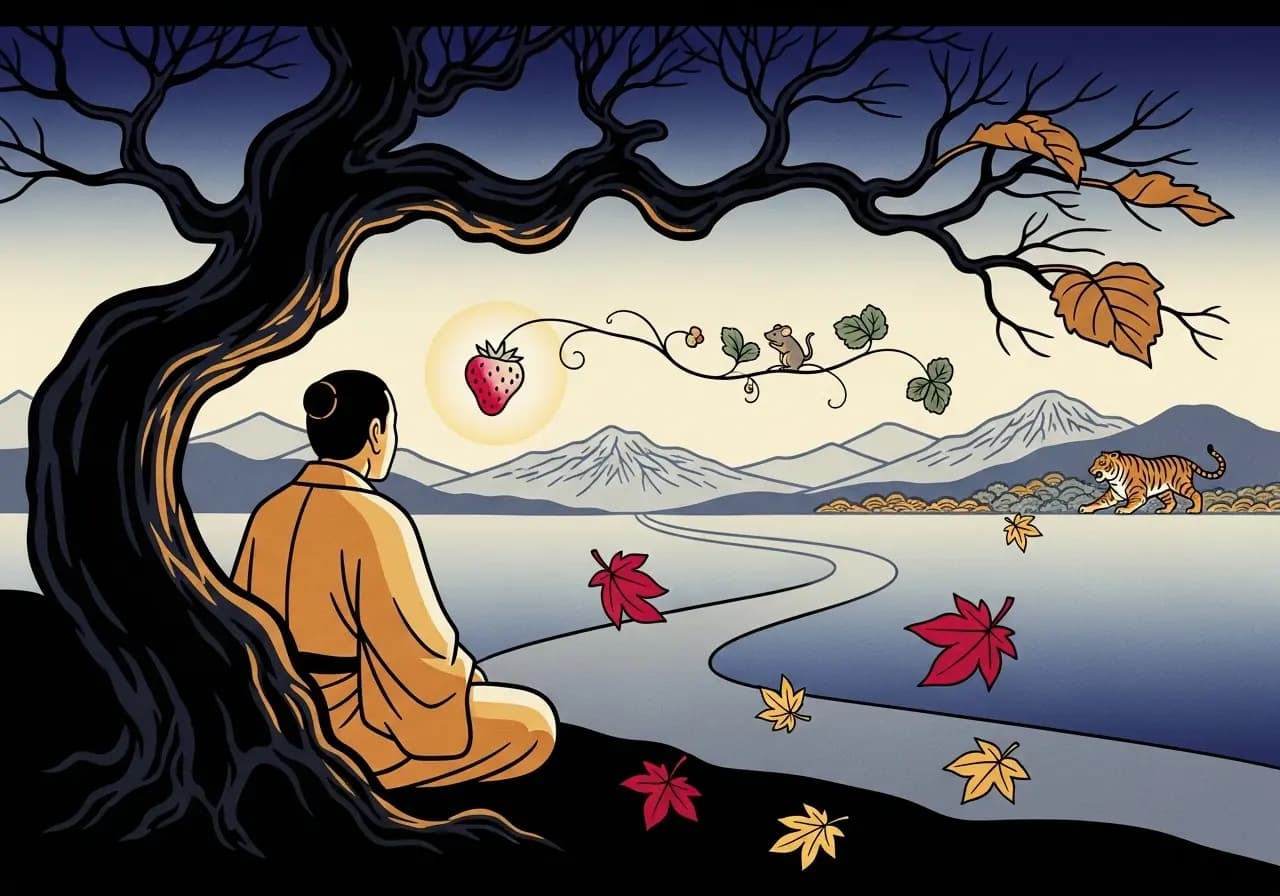
These moments of awareness remind me of the parable of the strawberry. If you'll recall, it's the person running from the tiger. Down below are alligators, and hanging onto a vine, the person notices a little mouse gnawing away at the vine. The inevitable end is approaching, and the timing we don't know. That mouse is gnawing away on the vine. How long will the vine last? I don't know.
In that moment, this person looks and sees a strawberry and tastes it. I think that's the important part. Noticing is one thing, but then there's the experiential aspect of it. Tastes the strawberry and says, "This is the sweetest, best strawberry I've ever had."
If I pause for a moment, I can ask myself: What can I notice here? And how does it feel if, even for just a few seconds, I experience that sensation of nothing needing to be other than how it is? I don't need to be any different than how I am. I can be whatever I already am.
That is the essence of what I wanted to communicate in today's podcast episode. Give it a try this week. See what arises for you as you think of these things. No one to be. Nothing to do. Nowhere to go.
Resources and Community
As always, if you are interested in learning more about Buddhism, you can check out my book, No-Nonsense Buddhism for Beginners, or listen to the first five episodes of the podcast. You can find those on SecularBuddhism.com. Also, if you're looking for a community to interact with or practice with, consider becoming a patron by visiting SecularBuddhism.com and clicking the link to join our community.
We have a weekly Zoom call every Sunday, and we also have a really nice online community where we share asynchronous video, audio, and text. We can communicate regardless of what time zone you're in, and we discuss different topics usually centered around the podcast but also other Buddhist concepts and ideas.
Well, that's all I have for this podcast episode, but I look forward to sharing more thoughts in a future episode. Thank you for listening.