

The Causes of Unsatisfactoriness
Episode 173 of the Secular Buddhism Podcast
Hello, and welcome to another episode of the Secular Buddhism podcast. This is episode number 173. I'm your host, Noah Rasheta, and today I'm going to share some thoughts around the topic of unsatisfactoriness.
As always, keep in mind you don't need to use what you learn from Buddhism to be a Buddhist. You can use what you learn to simply be a better whatever you already are.
The Starting Point of Human Experience
Imagine that you suddenly wake up in a world where you don't recognize anything or anyone. Everything is new—all new sights and sounds that you've never experienced before. Everything that you look at is foreign and completely new.
At first, you look around and just try to figure things out, get comfortable with just being there, with the fact that you are in this whole new place. Imagine you don't have any of your memories. You don't understand the languages being spoken. Literally everything is entirely brand new.
Once you orient yourself and realize that your basic needs are being met, at some point you'll start to think a little more about some of the natural things that pop into the mind in a scenario like this. Questions like: Where am I? What am I doing here? That, to me, is the scenario of the fundamental human experience.
We wake up in this new world where everything is foreign and slowly start to figure things out. It starts with figuring ourselves out—our own body. You look down and see these things that move. Oh, those are my fingers, these are my hands. You touch things and start to have sensations: this feels sharp, this feels hot, this feels pleasant, this feels unpleasant.
Throughout this process of orienting yourself to this world that you live in and to this experience of experiencing sensations, at some point the questions arise: Who am I? Why am I here? What is the meaning of all of this? You observe other people as they die, and then you start asking: Well, what happens when we die?
This, to me, is the essence of the human experience.
Freedom Versus Liberation
First, let's talk about freedom versus liberation. These are concepts that arise in Buddhism, and liberation is defined as the act of something being made free. So when Buddhism is referred to as the path of liberation, it's the path that is setting you free from things. But what is it that we're being set free from? What does freedom mean in that sense?
Freedom is usually in relation to or from something. Freedom to do this or freedom from having this thing happen to you.
One definition I came across in the dictionary for freedom was: it is a thing that is not determined by anything beyond its own nature. That's an interesting one, because in that sense, the notion of freedom is something that we can't actually obtain. Because of the nature of interdependence, we recognize that we are not free from all the things that are not us.
The very fact of having to breathe air means I am not free from the air that I breathe. It's something that I depend upon. The food that I eat, the people who cared for me when I was born, all of the interdependent processes that take place to help me stay alive means I'm not free from everything else.
So keep that in mind as we explore this notion of freedom and the topic of unsatisfactoriness.
The Problem of Human Existence
What is the starting point of the human experience? I think it's like the scenario I brought up, where you imagine that you wake up in a whole new world. That dilemma, that starting point of the human experience is what the existentialists call the problem of human existence.
It's interesting to think there's a problem with existing. It centers around the fact that because we exist and because we have intelligence, then we start to have questions: What is the meaning of this? Then we start to explore potential answers: What if there is no meaning to this?
All of this starts to manifest what they call existential angst. That is the recognition that because we are aware, because we are capable of thinking, that thinking puts us in a state where we recognize that we exist and we recognize that we might not exist. And that starts to make us feel antsy inside, like, oh no, I need to figure things out.
One of the key questions I think that comes up in this is: What is the purpose of human existence? Why are we here? Who am I? Any form of these existential questions.
That's the starting point for humanity, for the experience of being human. I think that angst that arises around these questions, over time, has led to virtually every worldview and every ideology that arises to try to satisfy this perceived problem: We need to figure out why we're here and what happens, who we are, and what the meaning of all of this is.
Two Approaches to the Existential Question
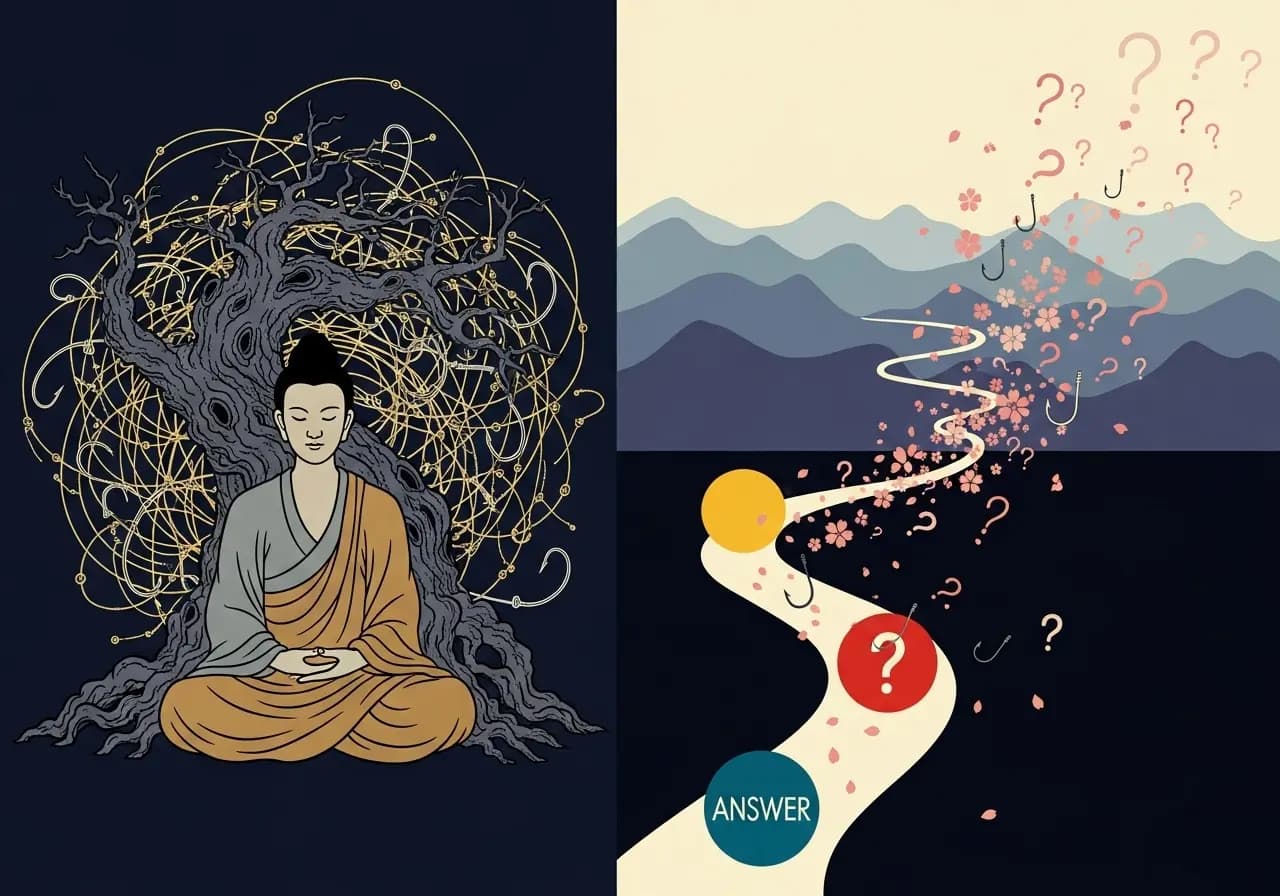
If you were to take all the ideologies and categorize them, I think there are two main approaches to satisfy this dilemma: One is to find the answer and the other one is to scrutinize the question.
Finding the Answer
Finding the answer is like: okay, I don't know the answer to all these questions. And someone says, you know what, I think it's about A, B, C, and D. Oh, okay, well, that makes sense to me. So now I'm team A, B, C, D. That satisfies this inner angst that I'm uncomfortable with. I woke up in this new world, I don't know what's going on, but someone said it's A, B, C, D, and E. Okay, well, now that satisfies that turmoil that I was experiencing.
The problem with this approach and with answers is that there may be many, right? Someone else comes on and says, no, it's not ABCD. It's 1, 2, 3, 4. Oh, okay. Well, that also could work.
And at the end, you still have a sense of discomfort. But I don't think it's about whether the answer is 1, 2, 3, 4 or ABCD. It's because you have an answer. It doesn't matter what it is. As long as it's an answer, then what you don't have is uncertainty.
As long as you anchor your sense of peace to the belief that 1, 2, 3, 4 is the answer or ABCD is the answer, then yeah, it will satisfy that inner angst. So that's the approach of the answers, and a lot of ideologies approach it from that perspective.
Scrutinizing the Question
Then you have Buddhism. That approaches it from the opposite end of that spectrum. They study the question. They analyze the question. They cast doubt around the question.
For example: What is the purpose of human existence? You may go down the path of: well, is there a purpose? Does there need to be a purpose? What if I don't need to know what the purpose is?
The more time you spend with the questions, what you may encounter is the question loses some of its relevance. You use a sense of curiosity and exploration with a question, and what you may find is that you start to anchor your sense of peace or your sense of ease around the discomfort of not knowing, with the recognition that maybe you don't need to know.
Both approaches do give you a sense of peace, a sense of ease around the discomfort of the original dilemma: What am I doing here?
For me personally, the approach of the question seems to be a more lasting sense of peace. Because if the need to know goes away and you have that sense of peace because you no longer need to know, that can't really be messed with or threatened.
If it's anchored in the answer, that can be messed with. Because someone else can come along and say: Hey, it's not 1, 2, 3, 4—it's A, B, C, D. And now I sense this turmoil. Oh no, is it 1, 2, 3, 4? Or is it A, B, C, D? Or is it any other combination? Until I feel like I have the answer that satisfies my mind, I'm going to have that turmoil again because I'm back to not knowing.
That's how I view Buddhism. I view it as a practice that's dealing on the end of the spectrum that deals with questions, not on the end that deals with answers. Another reason I think that's a good thing is because it doesn't compete with any of those answers. You may have a mental framework, an ideology that works for you that does give you the answers. Buddhism is not going to counter those answers because it's not focused on the answers. It's focused entirely on the questions.
The Buddhist Perspective: The Four Noble Truths
From the Buddhist perspective, what is the starting point of the human experience? This is the teaching of the Four Noble Truths, which are:
- The truth of unsatisfactoriness
- The truth of the cause of unsatisfactoriness
- The truth of the end of unsatisfactoriness
- The truth of the path that leads to the end of unsatisfactoriness
More simply put: unsatisfactoriness exists, and it has a cause, and it has an end, and it has a cause to bring about its end.
From the Buddhist perspective, we start with the view that life is fundamentally unsatisfactory. You may say, "Well, geez, that sounds a little harsh. Why is that? Why is life fundamentally unsatisfactory?"
It's because of craving, which is the second noble truth. Unsatisfactoriness is what arises when we want things to be other than how they are.
Well, how often do you want things to be other than how they are? It turns out that everybody at some point does, whether it's while you're going through the loss of a loved one, dealing with a flat tire, or the stress of raising kids—whatever it is—there are instances in life where we want things to be other than how they are. That's why we start with this view that life is fundamentally unsatisfactory.
From the existentialist point of view, it would be as simple as recognizing: I'm aware and I'm awake and I'm alive. Wow, the moment I recognize I'm alive, I recognize, well, I don't want to not be alive. And there you have it. There is the fundamental unsatisfactoriness that arises with the realization that I don't ever want to not be alive.
The Various Ways We Experience Craving
Let me talk about some of the various ways that we experience this form of unsatisfactoriness. The second noble truth talks about unsatisfactoriness having causes. The cause is craving—wanting things to be other than how they are. I think there are a few key areas in our lives that all of us, to some degree, experience this form of craving.
The Craving to Know
One of them is the craving that we have to know. Going with the initial example, imagine you woke up in an all new place. What is one of those things that will eventually come to mind? The need to know. Where am I? What's going on here? What is this place?
I think that's a core aspect of being human. We want to know. We want to know things. What is it that we want to know? Well, a lot of things. We want to know the existential things—the big ones, right? Who am I? Why am I here? Is there meaning behind all of this? Those are natural questions that come to mind.
What are the other things that we want to know? We want to know if there's a sense of stability or certainty with the things that are going on. On one scale of this, that would be the small things, like: okay, I just found food. I need to eat this food. How do I make sure I'll have food tomorrow? I need the certainty that my needs are being met and that they will continue to be met.
I think this need to know with certainty also manifests in things like career choices and the relationships that we get into. It's all around the basic needs that need to be met. We want to be certain that we are doing the right thing with the right person and for the right reasons.
Another example of where unsatisfactoriness arises is around career choice. The moment I think, "Am I in the right career?" I might think, "What if I'm not in the right career? What if there's another career that's better for me?" So now I have a tinge of unsatisfactoriness with what I'm doing because I'm entertaining the thought that there might be something that's even better or that makes more sense for me.
The Craving for Meaning
We do this around meaning. We want to know what things mean. I think this is another fundamental part of human nature—we seek to make meaning of things.
We are a species that is capable of looking at a piece of burnt toast and maybe seeing a face in it. We look at the contour of a mountain on the horizon and saying, "Oh, that looks like..." and then we describe what it looks like. We are pattern seekers and we naturally want to find meaning in things.
A sense of unsatisfactoriness arises when we don't find the meaning in things. Take life, right? You're alive. Well, then why am I alive? You see this manifest in so many things. We desperately want to find meaning in things.
I don't know if you recall that video that went viral several years ago with the double rainbow, where the guy is filming and he sees the double rainbow and he says, "Double rainbow, all the way." And then what's the first thing that he says? "What does it mean?" It's like such a human thing to see something and want to make meaning of it. That sense of unsatisfactoriness that can arise from not knowing the meaning or questioning the meaning—that's unsatisfactoriness.
The Craving to Be Right
Another aspect is we want to be right and we don't want to be wrong. If I feel like I'm wrong and maybe you're right—or even worse, if I think I'm right and you're wrong, but you think that you're right—then there's unsatisfactoriness that arises until I can convince you that you're wrong and that I'm right.
The Craving to Be Liked
Another area where unsatisfactoriness arises is around the topic of being liked and disliked. We want to be liked and we want to avoid being disliked. If I perceive that I'm disliked, there's a tinge of unsatisfactoriness that arises because I want things to be other than how they are. I want to be liked. I don't want to be unliked.
This is another example of a human tendency. It's an evolutionary hardwiring of the brain that makes us want to be liked and to avoid being disliked. Because as social creatures, there was a point in our evolutionary process that our life and death depended upon being in with the in-group and to avoid being mistaken as the other, as them, right?
In the world of us and them, you need to be sure that you're part of team us and that you're not perceived as them. Now that's evolved over the years and it's not quite as dangerous and violent as it was before. But there are still tinges of that in how we interact in society. We're always trying to seek who's us and who's them. And how do I make sure the us like me and the us don't confuse me as being them or dislike me?
The Craving for Comfort
Another area where we experience craving and unsatisfactoriness centers around comfort. We want to avoid discomfort and we want to seek being comfortable. We don't like being uncomfortable. This causes us to spend a tremendous amount of time and energy in our life to chase after the things that we think will make us more comfortable and to run away from the things that we think will make us uncomfortable.
A good example of this is with emotions. We chase after what we think will make us happy and we run away from the things that we think are going to make us sad. Fear is another example. We're uncomfortable when we're afraid. So there's this level of unsatisfactoriness that arises around the fact that in life, sometimes we're going to be afraid. And there's no way around it.
I used an analogy early on in the podcast, in one of the first few episodes. Imagine you're starting out on a trail and you're going to hike through the forest or through the woods. And right before you go, someone warns you: "Hey, someone's dressed as a bear and they're jumping out and scaring people."
That, to me, is a neat visual of reality. In life, unsatisfactoriness is something you will experience. It's like saying: in life, you're going to get scared. You're going to experience this. I think it's a lot more beneficial to know that going into it. That way, while you're on this trail, when the thing jumps out to scare you, it still startles you, but you know—you knew that that was going to happen.
I think this is the same with unsatisfactoriness. If I start out with the understanding that life is fundamentally unsatisfactory, then when I experience these moments of unsatisfactoriness, I don't have to get all bent out of shape because I wasn't expecting it. I can say, "Oh yeah, I knew that—that's just something I'm going to experience in life."
The Societal Lie
I feel like there's this weird societal lie that has spread somehow that makes you think: if what you're doing is hard, then you're doing it wrong.
I can see why that lie is enticing because, to some degree, it is true that we can make life harder on ourselves. You can be in a relationship that's way harder than it needs to be because it's just not the right relationship.
But it's also a lie to say that if you are in the right relationship, you don't ever have to work for it. It's just always easy. Or parenting—even worse. There are a lot of parents that believe because parenting is hard, I must be doing it wrong.
It's like, well, yeah, to a certain degree, there's truth to that. But nowhere ever is there the example of parenting being easy. Like that's the whole thing. Parenting is hard. If you are going to have the experience of being a parent, you're going to encounter difficulties along the way.
If you're going to have a relationship with another human being, there are going to be difficulties along the way, because that's the nature of parenting and that's the nature of human interaction.
That's what Buddhism is saying about life. The experience of being alive is going to bring about instances of unsatisfactoriness. The problem isn't that there will be unsatisfactoriness. The problem will arise with the relationship you have with that unsatisfactoriness.
Same with parenting, right? The problem isn't that parenting is hard. The problem is that parenting is hard, and I think that it's not supposed to be hard. So the problem is the belief, not the thing itself.
That's what Buddhism is trying to get at with this notion of craving—craving being the cause of unsatisfactoriness.
Scrutinizing the Cause
So what we can do as a practice is start looking at the instances of unsatisfactoriness, the craving behind it (in other words, the cause), and then what belief or view might be a contributing cause of that cause, and then scrutinizing that. Maybe you'll find that it's a view that's not skillful to hold.
For example, parenting. If I'm a parent and it's hard to be a parent sometimes, and I believe that it shouldn't be—well, right there is the problem. The problem is the belief.
If I could somehow figure out, "Oh no, parenting actually is hard. It's going to be hard no matter how I do it," then when those hard times arise, it's not that big of a deal because I know. Just like I knew that someone dressed as a bear was going to jump out and scare me—like that was what I was set up with from the get-go. On this path, that's what's happening.
I think that can be a very useful form of knowledge to carry with you when it comes to craving and the understanding of unsatisfactoriness: in life, unsatisfactoriness is a thing that we're all going to experience.
The Stories We Tell
Another aspect where unsatisfactoriness arises is in the context of stories—the stories that we have, the stories that we make up. Going back to the fact that we make meaning, we're so good at making meaning that our minds do it without us even realizing that's what we're doing.
I use the example all the time of driving, and a car cuts you off. Not only will you experience the discomfort of that event (you were now cut off), but your mind will instantly create a story. The story arises from every former experience that the mind has ever had with the action of being cut off. The story that gets developed is influenced by past experiences. You can't help it. It just happens.
So for one person, that story might be: "That's a jerk. That jerk just cut me off." So now I'm experiencing not only the unsatisfactoriness of being cut off by a car, but I'm experiencing a deeper unsatisfactoriness around the fact that it was a jerk that got in front of me and all the injustice that goes along with that story.
And this is where it gets really interesting. You could sit with the initial experience and maybe even realize there's actually nothing unsatisfactory about that. In fact, all the unsatisfactoriness arises around the story, not around the event.
For a car to cut me off, it might startle me and I might have to pump the brakes once and then the car's in front of me and that's it. Nothing else happened. I slowed down by five seconds of time on my trip. But all the unsatisfactoriness will arise involving the story and the belief.
So we have craving as the cause of unsatisfactoriness, and the various ways that craving manifests: knowing, stability, uncertainty, meaning, right, wrong, being liked, being disliked, comfort and discomfort, stories and beliefs. And then, of course, there's always the managing of the story that we have of ourselves and the story that we have of others, that others have of us.
So many different layers here.
It's helpful to remember, to recognize: first of all, I'm not even that certain about the story I have about myself. There's who I am, but then there's who I think I am. That's already removed once. And then there's who I think you want me to be. That's another layer. It gets really, really complicated fast and you can experience unsatisfactoriness in any of those layers.
I would say a lot of the unsatisfactoriness takes place in these deeper layers, not on a superficial one.
The Question of Freedom
So how do we get back from all of this to the notion of freedom?
Johann van Gogh famously said, "None are more hopelessly enslaved than those who falsely believe they are free."
I like this expression when I think about it in terms of mindfulness as a practice, in terms of Buddhism as the path of liberation. I need to recognize: in what areas do I think I'm free when really I'm not?
Because there's something that takes place when we're not free. There's a way that Pema Chödrön talks about this in a visual that I really like, where she talks about hooks. The term she uses is shenpa, I think. It's a Tibetan term. And it's a hook.
What she says is that there are areas in our life where we're not really free, and these are hooks. When you're hooked, that hook will trigger habitual tendencies, habitual responses. While you are engaged in the pattern of habitual responses, you lose a tremendous amount of freedom because you're not doing what you would want to do. You're doing what you are habitually conditioned to do.
The visual here is you can picture a fish, and the fish is free to swim around wherever it wants in the ocean. But the moment that fish bites on the hook, and that hook is connected to the line, that fish is now hooked. And while it's hooked, it's not free. It's going to go into the habitual pattern of doing what you do when you're hooked. That's all you can do. You can't go wherever you want. You have to go where the hook is leading you.
And she says that's kind of how we go through our lives. We go around getting hooked. What are the things that we get hooked on? Well, there are all kinds of examples. The hook would be the need to be right, or the desire to be liked, or the need to feel a sense of certainty, or the need to know things. All of these things act as hooks.
The Practice of Freedom
So what we can start to practice is the freedom to be okay with not knowing, or freedom from the need of certainty. This is freedom to be comfortable with uncertainty. Freedom from the attachment we have to our views. Freedom to hold our views lightly.
When we start to experience this sense of freedom, what we start to experience as well is a reduced amount of unsatisfactoriness—the unsatisfactoriness that arises around these things. It's not that we rid ourselves of unsatisfactoriness. It's that we rid ourselves of the unnecessary causes of unsatisfactoriness.
In other words, if we use emotions as an example: let's say it's unpleasant to feel angry, but anger is an emotion. It's something that humans experience. So to be human means at some point you may experience anger. That's not the problem.
The problem is holding the belief that says, "I shouldn't experience anger." Or even worse, if you do all of these things in life and you avoid these other things in life, you will never experience anger. Because now it's the belief. I experience anger because it's bound to happen. And when I do, I experience anger around the fact that I'm experiencing anger.
That is that second arrow that is so often talked about in Buddhism. It's that other layer, the unnecessary layer. Anger is enough. You don't need to be angry about being angry.
And that's the hook. What do I experience when I'm being angry about being angry? Well, now I might be going into the stage of allowing my habitual responses to kick in. I don't like how I feel. So I start doing this, which causes that, which causes this other thing. And there you go on that trajectory of unskillful habitual reactivity.
So freedom in this context—the Buddhist form of freedom—is not freedom from unsatisfactoriness. It's freedom from the causes of unsatisfactoriness that don't need to be there. There's no reason for them to be there. They may be linked to unskillful views or unskillful beliefs.
Bringing It All Together
That is the overall topic for this podcast episode: freedom, unsatisfactoriness, the causes of unsatisfactoriness. And then starting to look at the views—what are the views behind the causes, or what are the beliefs behind these causes of unsatisfactoriness?
Let me get back to the example of relationships, parenting, or life in general. If I start out with the view that life is fundamentally unsatisfactory, that is going to be much more healthy than if I start out with the view that there's a way to live life to ensure you don't experience unsatisfactoriness. That would be an unskillful belief that you're going to run into over and over and over—the sense that something's wrong.
The reason I use parenting as an example is because I see this in parenting all the time. I see people who are struggling with parenting (which, again, that's normal—that's what parenting is), but then they're struggling with the fact that they're struggling around parenting because they have the belief that it shouldn't be hard.
It should be easy. If I read the right book or I happen to parent using the right technique, it should only be easy. We do that with parenting. We do that with relationships. And especially we do that with life. If it's hard, I must be doing it wrong.
And this is saying: no, it is hard. Life is hard. Life is going to be hard. Just because it's hard doesn't mean you're doing it wrong.
Applying This to Your Life
How does this knowledge affect my day-to-day lived experience? I think for me personally, I like to recognize the instances of unsatisfactoriness and say: "Oh, here it is. This is me experiencing wanting things to be other than how they are."
And then I start to scrutinize the craving. Why do I want it to be other than how it is? What do I think would happen if it was this other way? And I start looking at the question.
Going back to the initial scenario: from one path, you can say it's about the answers—just get the right answer and you'll be good. But this other path, which is the Buddhist path, is saying: it's not about the answers, it's about the questions. Scrutinize the questions.
If I do that with unsatisfactoriness and with craving, I may be able to uncover some form of awareness around the craving that I'm having and why I want it to be other than how it is. And maybe the belief that leads to that craving, manifesting the way that it is.
And in that introspection, what could go away is the belief or the view or the question itself. And then I arrive back at this sense of peace because I am not wrestling with that thing anymore.
Closing
I hope some of these ideas make sense. I just wanted to share my thoughts around this, around the causes of unsatisfactoriness, and how this all correlates with the Four Noble Truths—especially those first two: that life is fundamentally unsatisfactory, and that unsatisfactoriness has causes.
If you are interested in learning more about Buddhism, you can check out my book, No Nonsense Buddhism for Beginners. You can also check out the podcast's first five episodes. And we also have a new community tool for the online community. We're using an app that now allows us to engage with video, audio, and text.
We've tried different tools in the past, and the online community is all about going a little bit deeper into these concepts. We have discussions online where we take the general topic of the podcast and then scrutinize it a little bit more, maybe go a little bit more in depth around some of the specific things that were brought up in the podcast.
I think the most beneficial aspect of it is that you get the perspective of many other people in different stages of life. That's what I enjoy most about our online community. We have discussions every Sunday, a live Zoom call, and then we have an ongoing asynchronous discussion that takes place on the app where it doesn't matter. You don't have to schedule time when everyone's available. It's just whenever you're available, you get on and you participate.
All right, well, that's all I have for this episode. I look forward to sharing more thoughts in another episode later. Thank you for listening.
Until next time.
For more about the Secular Buddhism podcast and Noah Rasheta's work, visit SecularBuddhism.com