

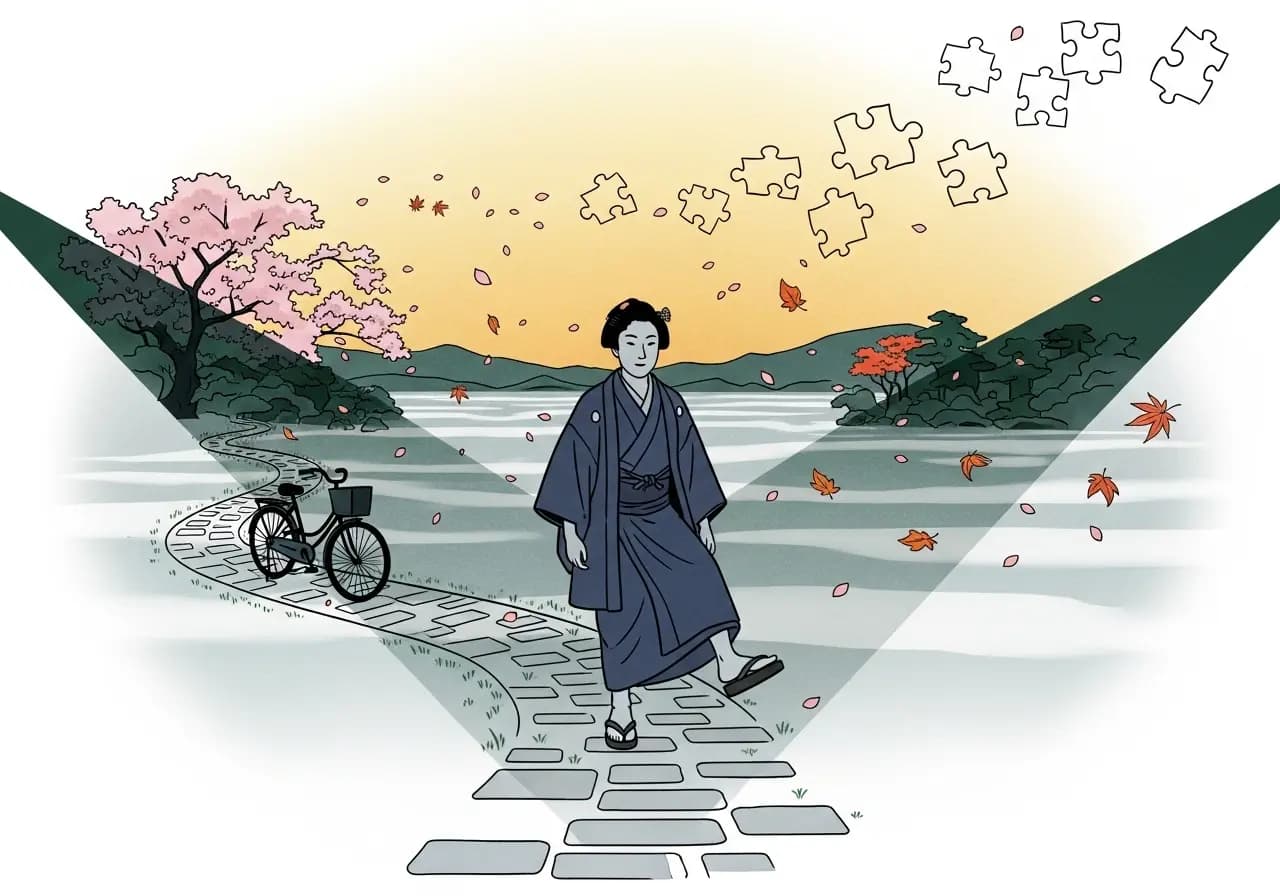
Practicing Acceptance
Episode 172 of the Secular Buddhism Podcast
Hello and welcome back to another episode of the Secular Buddhism Podcast. This is episode number 172. I'm your host, Noah Rasheta, and today I'm going to talk about acceptance—what it is, how we practice it, and this notion of acceptance in general.
As always, keep in mind: you don't need to use what you learn from Buddhism to be a Buddhist. You can use what you learn to simply be a better whatever you already are. So let's jump right in.
Understanding Acceptance and Suffering
To understand what acceptance means in the Buddhist context, we need to remember that we're working on the assumption that suffering arises not from pain itself, but from the feeling we have about pain. In other words, suffering comes from our resistance to pain.
Let me give you an example using the teaching of the aggregates, which I mentioned in the last episode. The five aggregates—form, sensation, perception, mental formations, and consciousness—are what make up you as a person in Buddhist teachings.
A Real-Life Example: The Stubbed Toe
A few weeks ago, I was working on a project that required light, so I went to grab my headlamp—the kind that's like a headband with a light on it. I normally keep it in my nightstand, but it wasn't there. I needed to go to the shed to get a tool, so I eventually remembered I'd used the headlamp in my cargo trailer. I put on my flip-flops and ran out the front door in complete darkness.
It's already pitch black outside, and I'm running. I can't see well because I don't have the light—that's the whole reason I'm trying to find it. On my way there, I suddenly ran into something and stubbed my big toe. It hit hard and it hurt.
I realized I'd hit my son's bicycle. He'd been out practicing his mountain bike skills and came home from a session. Instead of putting it away where it belongs, he'd laid it down right on the path I was running. When I grabbed my toe, I discovered that a significant portion of my toenail was missing—it had broken clean off.
In this moment, multiple parts of the aggregate system kicked in:
Form and Sensation: My physical body was experiencing pain in my toe.
Perception: My mind immediately categorized this as an unpleasant sensation. It hurts.
Mental Formations: This is where things get more interesting. My mind conjured up memories of the last time I'd broken a toenail—how inconvenient it had been with socks and shoes. My mind also began developing beliefs and views: this is going to hurt for several days, and this wouldn't have happened if the bicycle had been put away where it's supposed to be.
But here's the really telling part—my mental formations also included self-directed anger. If I'd been better at putting things away, I wouldn't have been running out there looking for the light in the first place.
Consciousness: This is the part that ties it all together and gives rise to a sense of self. Not only is there pain in my toe, but this whole sequence of events resulted in someone hurting me—the individual that is Noah. In my mind, I was thinking: your actions, my son, hurt me.
The Distinction: Pain Versus Suffering
So there I was, feeling pain and starting to feel the distinction between pain and suffering. Pain is what I felt in my toe. But suffering was what I was feeling in my mind as I became aware of how I wanted things to be other than how they are.
I felt pain in my toe, and I didn't want to be feeling pain in my toe. The bicycle was blocking the path, and I didn't want the bike to be there. My son doesn't always put things where they go, and I wanted him to be putting things where they belong. And then it goes back to me: I don't always put things back where they belong, and I want to always be putting things back where they belong.
In all of those different contexts of not wanting things to be how they are, that's where suffering arises. Outside of that suffering, there's still the pain I have to deal with. The pain is the pain, right? If you stub your toe and break a toenail, that's going to hurt no matter what. But suffering—that's the realm where it's about what you do with that pain. That's the realm where we have some power.
What Does Acceptance Really Mean?
This is where it gets a little tricky, because a simple Google search for the definition of acceptance will show you various definitions:
- "The action of consenting to receive or undertake something offered"
- "The action or process of being received as adequate or suitable, typically to be admitted into a group"
- "Agreement with or belief in an idea, opinion, or explanation"—like the acceptance of the teachings of a specific ideology
- "Willingness to tolerate a difficult or unpleasant situation"—which carries the tone of "resigned acceptance"
That last definition is the one most people have in mind when they think about acceptance. But when we talk about acceptance in the Buddhist context, we're talking about something more active and engaged than mere tolerance or resignation.
Acceptance as Active Embracing
In Buddhist practice, I would define acceptance as the active embracing of a subjective experience. This is crucial: acceptance is definitely not a passive process. It's not resignation. It's what's taking place while we observe and while we orient ourselves to reality.
Think about it this way. If acceptance is merely tolerating something unpleasant, then it's easy to fall into a passive, victim-like mentality. But if acceptance is actively embracing reality as it is, then it becomes empowering. It becomes a skill we can develop.
The OODA Loop and Acceptance
I want to introduce you to a decision-making model called the OODA loop, which stands for Observe, Orient, Decide, and Act. It was originally developed by military strategist John Boyd, but it applies beautifully to our everyday lives.
Here's how it works:
Observe: You perceive something happening in your environment. You gather data about what's actually present in this moment.
Orient: You take that data and you filter it through your beliefs, values, experiences, and cultural context. This is where your perspective shapes how you understand what you've observed.
Decide: Based on your observation and orientation, you decide on a course of action. You consider your options and choose what seems most skillful.
Act: You take action based on that decision.
The key thing about the OODA loop is that it's a loop. After you act, the environment responds. You observe those new conditions and the loop continues. Things are always changing, new variables are introduced, and you're constantly reassessing and adjusting.
Let me give you an example. Imagine you're flying an airplane and you see dots on the horizon. You don't know what they are—could be birds, could be weather, could be other aircraft. You observe them. You orient yourself: based on my knowledge and experience, these could be a potential threat. You decide: I should check my instruments or adjust my course to be cautious. You act.
But then you notice more dots on the horizon. Now you have to re-evaluate. Maybe the first action was skillful, but now other variables have changed. Maybe you need to turn around and find another way. Maybe you need to stay the course. The assessment is always evolving because reality is always unfolding.
This aligns perfectly with Buddhist concepts of impermanence and interdependence. Things are always changing, so our assessment of how things are should also always be changing. The OODA loop allows for that because it's a continuous cycle of observation and adjustment.
Practicing Acceptance
So how does acceptance fit into all of this? If acceptance is the active embracing of a subjective experience, then practicing acceptance is essentially those first two steps of the OODA loop: observe and orient.
I perceive dots on the horizon. Okay, that is the reality of the situation. There are dots on the horizon. I'm not going to pretend that they're not there. I'm going to acknowledge the reality of that situation. And then I actively embrace that. I embrace the fact that I'm in an airplane and there are dots on the horizon and I don't know what they are.
That's all that is. That is what it means to practice acceptance.
The reason it's important to practice this is because of how easy it is to be reactive, and how that reactivity becomes habitual. Habitual reactivity is where we get more and more comfortable doing unskillful things. When we're lost and we immediately start running in the wrong direction, we're not actually thinking about it—we're just reacting. And honestly, our brains are amazing organs, but they're also known for being quite faulty sometimes.
Our brains get reactive: "Oh, I'm feeling this emotion. I don't like that. So I'm going to do something unskillful without even thinking about it." Our brain becomes habitually reactive, and that's where the suffering compounds.
What Our Brain Actually Does
A few weeks back, during one of our live Sunday Zoom calls, someone shared a quote from Alia Crum, who appeared on the Hidden Brain podcast in an episode called "Reframing Your Reality." She said: "Our brain's whole job is to prepare, prioritize, and regulate the internal body based on what it believes to be true about the external environment."
I really like that quote. Think about what that means. The brain regulates what's happening inside your body based on what it thinks is happening outside. If my brain's entire job is to regulate what's happening inside based on what it thinks is happening outside, then it seems to me like it would be a pretty good idea to use decision-making tools—like practicing acceptance or the OODA loop—to make the most accurate assessment of what's really going on.
Because here's the thing: it's not what's actually going on out there that affects what's going on in here. It's what my brain thinks is happening out there. That's what affects what's going on in my body and mind. So my brain—that's the key. I gotta understand how it works.
Going back to my toe and the correlation between pain and suffering: externally, I'm feeling the pain of my encounter with a bicycle tire. But internally, my mind is actively embracing the subjective experience that it's having. It's gathering data. It's orienting itself to decide what to do next. It's coming up with scenarios and decisions I could make, and ultimately it picks what it believes is the most skillful.
In my case, that meant I'm going to pick up the bicycle and put it where it goes so that doesn't happen again. I'm also going to talk to my son and show him my toe, explaining why it's important that we put things away. It also motivated me to try to be better at putting things where they belong and making sure I leave my headlamp in the nightstand.
But nowhere in that process was there unskillful reactivity that could have triggered greater suffering for myself or for others. One arrow was enough. I didn't need a second arrow.
I didn't run into the house angry, screaming at my son. Could I have made him feel guilty? Sure. Would that have helped? I don't think so. I think he was capable of seeing the consequence directly: look at the pain I'm in. I caused that. Not making him feel guilty, but just helping him understand that this is what happens when things are left where they shouldn't be.
Acceptance Is Not Resignation
Notice that practicing acceptance doesn't mean I'm going to accept that if the bike is just going to be in the way, I won't do anything about it. That's not it at all. I took active steps to prevent that from happening again. Acceptance is an active process. It's not a form of resignation like "Oh well, bikes will always be in the way." It's not that.
For me, it's a very active practice. I don't think we need or want to go through life simply tolerating negative experiences. When we actively embrace the situations that are outside of our control without judging them, it reduces the suffering we would normally experience from those situations.
That, in a nutshell, is the practice of acceptance—the practice of actively embracing our subjective experience of life as it unfolds.
The Tetris Analogy
We do this all the time with other concepts, remember? Think about the game of Tetris. These pieces show up, and I can actively embrace the experience of "okay, now this is the piece that I have. What am I going to do with it? How am I going to be skillful with it?" What doesn't have to happen there is resignation—"oh well, I guess I won't do anything because I got the square."
It's not that. It's "I'm going to actively embrace—dang, I got this square. I sure didn't want it, but okay, what do I do with it now?" That's the active embracing of subjective experience as a practice.
Putting It Into Practice
My invitation to you is to take this concept of practicing acceptance—practicing the active embracing of reality as it is—and give it a try. See how it works out for you. Pay attention to the relationship you have with the experiences you're having as they unfold.
Notice when you slip into passive resignation and when you're actively engaged. Notice when your brain is reacting habitually and when you're using the OODA loop to respond skillfully. Notice the difference between pain and suffering.
Because that's where the real freedom is—not in trying to avoid difficult experiences, but in how we embrace them and work with them.
If you're interested in learning more about Buddhism, check out my book, No Nonsense Buddhism for Beginners, or listen to the first five episodes of this podcast.
If you're looking for community to practice with and interact with, consider becoming a podcast supporter by visiting SecularBuddhism.com, clicking on Community, and you'll get more information there.
That's all I have for this episode. Thank you for listening. Until next time.