

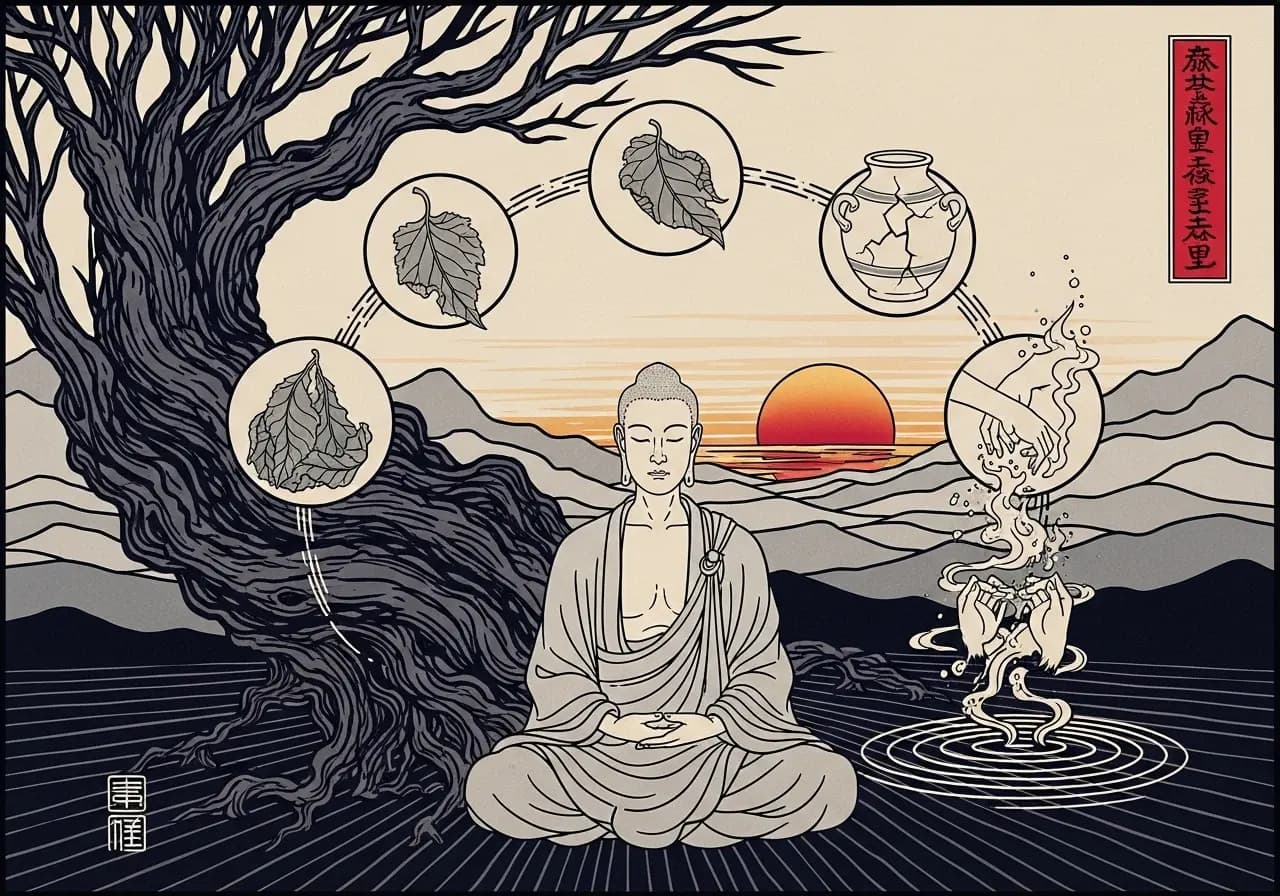
The Five Remembrances
Episode 170 of the Secular Buddhism Podcast
Hello and welcome to another episode of the Secular Buddhism Podcast. This is episode number 170. I'm your host, Noah Rasheta, and today I'm going to talk about the five remembrances.
As always, keep in mind you don't need to use what you learn from Buddhism to be a Buddhist. You can use what you learn to simply be a better whatever you already are.
If you're interested in learning more about Buddhism, you can check out my book, No Nonsense Buddhism for Beginners, available on Amazon, or listen to the first five episodes of the podcast. You can find those first five episodes easily by visiting secularbuddhism.com and clicking on the link that says "Start Here."
If you're looking for a community to practice with and to interact with, consider becoming a patron by visiting secularbuddhism.com and clicking the link to join our community. We do have a live Zoom call every Sunday where we talk about different topics, concepts, and ideas similar to what's discussed in the podcast. That happens every Sunday and is available to members of the Patreon community.
Returning to the Five Remembrances
So to the topic I wanted to discuss today: I wanted to share some thoughts regarding the five remembrances. I first recorded a podcast episode in 2019 around this topic, and that was episode number 108. The title of that episode was "Important Things to Think About Often." So you can revisit that one if you want, but this is a revisit of the topic of the five remembrances.
It's been a while since I've recorded a podcast episode. I've been busy with life and travel and things that I have to do for work, being a dad and a husband, and all the other things that you do in life. Yeah, I think it's been over a month now since I recorded a podcast episode. I just returned from a trip where I was able to go to Europe and then to North Africa for work, and I had the opportunity to do some flying there. It was a really neat trip—a really neat experience.
One of the benefits of being a team pilot for one of the microlight wing manufacturers in Europe is that for their annual team pilot gathering, I got to go to France to join this meeting. My twin brother is also on the team, so it was really fun for both of us to be able to go, fulfill our duties as team pilots, and also do some fun, exciting travel and flying centered around that.
Our primary responsibility as team pilots is to go out and fly and capture footage, photos, and videos. So if any of you have looked for me on social media thinking you'd follow and see if I share any podcast-related stuff, everything you'd encounter if you see me on social media is centered around flying. That's because all of the content that I capture is part of my obligation as a team pilot to produce content that helps promote that specific brand.
Anyway, that's why I was on that trip and had a really good time. And while I was there, I was thinking a lot about the five remembrances.
What Are the Five Remembrances?
The five remembrances come from a discourse attributed to the Buddha called "Subjects of Contemplation," and they are five profound ideas that we are invited to think about often. The Buddha said, "Of all contemplations, that of impermanence is the deepest and most supreme." These five remembrances are intended to be wake-up calls that help us to see more clearly the nature of reality—wake-up calls that help us to live more intentionally and perhaps more skillfully.
I really like thinking about them framed in that context. As we go through life, it's very easy to forget these five important truths. These are intended to be the five reminders or the five wake-up calls that, if you think about them often, will truly change the way that you live your life.
There's a quote I've heard on social media, and I don't know who it's attributed to, but it says: "We all have two lives, and the second one starts when you realize you only have one." I really like that. I think the remembrances kick in as reminders of this reality that we have one life.
Before I go through these, I do want to mention something on a separate note. We don't need to take these truths so personally. In fact, in the book The Four Agreements by Don Miguel Ruiz, he discusses the self-limiting beliefs that rob us of joy and end up creating unnecessary suffering. These are topics we discuss quite often in Buddhism. But the four agreements are: be impeccable with your word, don't take anything personally, don't make assumptions, and always do your best.
I really like that second one: don't take anything personally. I want to emphasize this second agreement and add it as a powerful reminder when you're contemplating the five remembrances.
The Five Remembrances
From the Buddhist perspective, the five remembrances are:
One: I am of the nature to grow old. I cannot escape old age.
Two: I am of the nature to get sick. I cannot escape sickness.
Three: I am of the nature to die. I cannot escape death.
Four: All that is dear to me and everyone I love are of the nature to change. There is no way to escape being separated from them.
Five: I inherit the results of my actions. My actions are my continuation.
These five remembrances, the way they're worded here, come from the Plum Village School of Buddhism, which is Thich Nhat Hạnh's way of teaching Buddhism. In the fifth one, he actually specifies: "I inherit the results of my actions of body, speech, and mind." I do like the fact that he talks about those three, because what we say, what we do, and what we think—those actions combine together.
You don't want to just take this in the context of what I do. The thoughts are equally important. What I think and what I say are equally important to have in mind. If I think a certain way, that will affect the actions that I take. So I do need to pay attention to what I think and why I think the way that I think.
When we're talking about actions in this context, we're talking about not just physical actions, but actions in the context of body, speech, and mind.
The First Three Remembrances: Old Age, Sickness, and Death
Let's start with the first three: that of being of the nature to grow old, to get sick, and to die. Sickness, old age, and death—these are three of the key realizations that led Prince Siddhartha, who would later go on to be known as the Buddha, onto his path of awakening and the path of exploring the meaning of life.
At first glance, when you think about these first three, it can seem a bit sad, a bit sobering, right? It's like somebody throws cold water on your face. But these aren't meant to be depressing. They're meant to be wake-up calls that help us to see clearly both the nature of reality and the nature of what's in store for us if we each live long enough. We're all going to experience those three, right? Sickness, old age, and death. There's no way to escape that.
So let me go through each of them one at a time.
The First Remembrance: I Am of the Nature to Grow Old
The first one: I am of the nature to grow old. I cannot escape old age.
I find it interesting that society seems to have programmed us with an aversion to growing old. We don't want to look old. You know, if you start getting gray hair, you don't want the gray hair. You color your hair. If you get wrinkles, oh, here's this cream you can use that'll help hide the wrinkles. It's like we're trying our hardest to not let anyone know that we're growing old.
I get it. I mean, I'm conditioned in the same societal norms as everyone else. I see that and I feel a lot of the same feelings, especially as I see signs of aging in me. I have a lot of gray hair now in my hair and in my beard, and I'm starting to see that, yeah, I look older than I used to.
But here's the thing: I can recognize this and I can accept it. I am of the nature to grow old. I cannot escape old age. Rather than denying it or running from it, I can acknowledge it. And in that acknowledgment, there's a freedom that comes with it.
What happens when we deny that we're growing old? We suffer. We fight against reality. We invest in creams and procedures and whatever else we can do to try to make it seem like we're not aging. But the reality is, if you're alive, you're aging. That's just what happens.
So when you think about the remembrance of old age, the invitation here is to change your relationship with aging. It's not about accepting that you have to like getting old—no, that's not it. It's about accepting that this is what's happening and not fighting against it so hard.
The Second Remembrance: I Am of the Nature to Get Sick
The second remembrance: I am of the nature to get sick. I cannot escape sickness.
This one is pretty straightforward. All of us, at some point in our lives, will experience some form of sickness. Whether it's a common cold, the flu, or something more serious, we're all vulnerable to it. This is just the nature of having a body.
But I think what's interesting about this remembrance is that we live in a time where we have this expectation that we should never be sick. We live in a time where, if we get sick, we're surprised by it. We're frustrated by it. We think, "Why is this happening to me?"
Well, the answer is: because you're of the nature to get sick. That's what it means to be alive in a body. And when we can accept that, when we can recognize that this is part of the human experience, then perhaps we can relate to sickness differently. We can still do what we can to take care of ourselves. We can still try to prevent sickness when we can. But when sickness does come, we can meet it with acceptance rather than resistance and frustration.
The Third Remembrance: I Am of the Nature to Die
The third remembrance: I am of the nature to die. I cannot escape death.
This is the big one. This is the one that really stops people in their tracks. Because for most of us, we live our lives in denial of death. We don't really think about it. We don't really want to think about it. We have this sense that death is something that happens to other people, but not to me—not anytime soon, anyway.
But the reality is, death is coming for all of us. I don't know when it's coming for me, and you don't know when it's coming for you. But we know it's coming. That's a certainty in life.
And I think there's something really powerful that can happen when you sit with that for a moment. When you truly consider: I am going to die. I don't know when, but I'm going to die. What happens to your priorities? What happens to the things that you worry about?
I've had a couple of profound experiences recently that have really driven this home for me. My father fell off a ladder a few weeks back and had a pretty bad injury. He's recovering, but it was touch and go for a moment there. And then my wife's aunt passed away earlier this week, and her funeral was yesterday.
As we sat there in the funeral, this thought flooded my mind: I am of the nature to die. I cannot escape death. And looking at everyone in the chairs there, partaking in this funeral experience, I had the same thought: You are of the nature to die. You cannot escape death. And it had a profound impact on how I felt about all of these people.
It's like, man, I just want you to make the most of the time that you have, because you don't know how much time you have, and neither do I.
I thought about this notion that people seeing others die all around them still don't ever think about their own death. People who have encountered death can still get caught up in the thick of things, still get all bent out of shape because a car cut them off or because the line they're standing in is taking too long.
And it's almost fascinating to me. It's like, wow, in the context of the big picture of what we know—the five remembrances—that one alone should make it so that this little thing that feels like it matters so much really doesn't matter. I'm not gonna get bent out of shape over this anymore. Why? Because I just thought about the fact that I am of the nature to die, and I cannot escape death. You are of the nature to die, and you cannot escape death. And I think that has a really powerful effect on changing the dynamic of how we're relating to the experience that we're having.
The Fourth Remembrance: Everything Changes
All that is dear to me and everyone I love are of the nature to change. There is no way to escape being separated from them.
This one's about impermanence and loss. And it's about recognizing that nothing is permanent. The people we love, the things we value, the circumstances of our lives—they're all going to change. And at some point, we will be separated from the people and things we love.
This doesn't mean that we should stop loving or stop investing in our relationships. It means that we should love more deeply, knowing that it's temporary. It means we should appreciate the people in our lives more fully, knowing that time with them is limited.
When we truly accept this remembrance, it can actually deepen our relationships and our lives. Because we're not taking things for granted. We're not assuming there will always be another moment with the people we love. We recognize that each moment is precious and finite.
The Fifth Remembrance: I Inherit the Results of My Actions
The fifth remembrance: I inherit the results of my actions. My actions are my continuation.
This is about karma, about the law of cause and effect. It's about recognizing that what we do, what we say, and what we think have consequences. Not in some cosmic punishment kind of way, but in the simple fact that our actions ripple out into the world and come back to affect us.
We are creating our reality with every thought, every word, every action. And we are also inheriting the results of those actions. So if we want to live differently, we have to act differently. We have to think differently. We have to speak differently.
This remembrance is an invitation to take responsibility for our lives. To recognize that we are not victims of circumstance, but co-creators of our reality.
Relating to Fear Through the Five Remembrances
Let me share some closing thoughts here about the five remembrances. I want to talk about how the five remembrances relate to fear.
I feel like, as I mentioned before, our societal views and beliefs have conditioned us to be afraid of growing old, to be afraid of getting sick, to definitely be afraid of dying. But we're also afraid of being separated from the people and the things that we love. I don't want to lose the car that I love or the smartphone that I just got. We're afraid of losing these things. We're afraid of being separated from the things that we want in our life, and we're afraid of change. I think we're afraid to take bold actions sometimes because we're afraid of failing.
The five remembrances can help us to change the relationship we have with fear in general, but specifically the fear we have around these five things.
And I don't think the goal is that we need to get rid of fear. I think fear is natural, but we can change the relationship we have with fear. And I think that's really important to remember.
If I think about death, for example, and I recognize that I'm afraid to die, don't also think on top of that, "Well, I shouldn't be afraid to die." No, that's not the point of these remembrances. If you're afraid to die, then fine, be afraid to die. That's fine. But the relationship you have with that fear—that is where you can spend time and introspection.
You can say, "Yeah, I am afraid to die. Why am I afraid to die?" And you can get to know that fear, become comfortable with the fear to the point where you can feel it, but the relationship you have with it is no longer there—or it's no longer what it was. It'll change.
And I think this is where this becomes a really powerful practice: to think about the five remembrances. Recognize, how do I feel about the fact that I'm gonna grow old? How do I feel about the fact that I'm subject to sickness or to death? Or that everything around me is gonna change? How do I feel about that?
That feeling tone that arises could be aversion, and you're like, "Oh man, I don't want that to happen." Don't think, "Well, crap, now I gotta practice until I don't fear death." That's not the point. That's not the goal. You can sit with that discomfort and recognize, "Wow, I really do have a discomfort around the thought of dying." Okay, well then let's sit with that. Where does that come from? Get curious. Become curious about what you feel and why you feel, and get rid of the thought of having to change it. You don't need to change anything. Just observe it and see what happens to the relationship between you and that feeling, and see if that relationship changes.
It's the relationship with the discomfort that changes. You're not trying to defeat it or change it or make yourself not afraid of it. You're trying to change the relationship you have with it.
And I think there's a really powerful thing that can happen when we do that. And again, we don't need to get rid of fear, but we can change the relationship we have with it.
Sitting with Discomfort
It can be uncomfortable to think about these things. I think we generally regard any form of discomfort as something that's unwelcome in the space of our mind. So we do everything that we can to not let it occupy any space in our mind. We want to get thoughts about sickness, old age, death, constant change out of our mind.
But if you are serious about walking the path of awakening, then you should feel eager to encounter what is true and what is real. And these five remembrances are a direct encounter with what is real.
We are of the nature of growing old. We are of the nature of getting sick. We are of the nature of dying. We are of the nature of experiencing change all around us. And we are of the nature of having to live with the consequences of our actions.
And we don't have to take any of this personally. Everyone is of the same nature. It's not the universe out to get you and say, "Haha, I got you. Now you're gonna get sick, but no one else will." No, everyone at some point will. And if it's my time and I'm the one who now has a sickness I'm dealing with, I don't need to take that personally. I'm of the nature of that. Same with old age. Oh, it's time for my beard to turn white. Okay, well, I'm of the nature of growing old.
I think when we're willing to sit with the discomfort of these remembrances—even if just for a brief moment, but if we do it often—our relationship with that discomfort will change. And we will gradually learn not to fear these things.
Again, society has conditioned us to feel an aversion to these things. We want to run from these truths. But the path we walk as practitioners is to turn and face these truths and to change the relationship we have with them.
These remembrances, I think, can awaken our hearts and they can help us to live more fully and more deliberately.
Conclusion
So these five remembrances are quite profound and quite powerful. And I think when we contemplate and really think about them, they're more than enough to act as wake-up calls that help us to decide: What is it we really want to do with our lives? Do I want to keep doing what I'm doing, or am I going to change?
Both of those may be what's most skillful for you. But how will you know? These are great ways to get into that introspective way of thinking.
So I hope that you'll think about these five remembrances often. And I hope that they will help you on your path to living a more mindful life and ultimately to allow you to experience more joy and more contentment in your life, as you recognize these instances of what is real and true.
That's all I have to share for this episode, but I look forward to sharing more thoughts in another episode later.
Thank you for listening. Until next time.
For more about the Secular Buddhism Podcast and Noah Rasheta's work, visit secularbuddhism.com