

Who Are You?
Episode 17 of the Secular Buddhism Podcast
Hello. You are listening to the Secular Buddhism Podcast, and this is episode number 17. I'm your host, Noah Rasheta, and today I'm talking about our sense of self.
Welcome
Welcome back to the Secular Buddhism Podcast. Before we start, I want to mention something that I mention every single time I record one of these podcasts, and that's a quote from the Dalai Lama where he says, "Do not try to use what you learn from Buddhism to be a Buddhist. Use it to be a better whatever you already are."
Please keep this in mind as you listen and learn about the topics and concepts discussed in this podcast episode. And if you enjoy the podcast, please feel free to share, write a review, or give it a rating.
Let's Jump In
All right, let's jump into this week's topic. This week I'm excited to continue along the lines of what we discussed in last week's podcast episode. In the last episode, I talked about the concept of truth being relative in space and time and the implications of that understanding. If reality or truth is relative in space and time, what does that mean for us individually? This is where the Buddhist Doctrine of No Self comes in.
I've talked about this before in one of the earlier podcasts, but I'd like to discuss this in a little bit more detail here, mostly because it's coming right on the heels of the understanding that truth is relative. And if truth is relative, then the self is also relative. I want to explore that a little bit, and hopefully this makes sense.
In Buddhism, there's the term "Anatta" or "Anatman," and this refers to the Doctrine of No Self. It says that there is no unchanging, permanent soul in living beings. This is a central Buddhist doctrine, and it appears in several of the old, original teachings of Buddhism. You'll find this concept taught within every Buddhist tradition today.
The reason this is so important to understand is because we have the tendency to relate to ourselves—this sense of self—as a permanent, fixed thing. And that can be the source of a lot of suffering for ourselves and for others. I wanted to get into that a little bit and see how this actually applies in our day-to-day living.
The Western View of Self
In the West, Western psychology views the function of the mind that helps us create a sense of self as simply a function of the mind that helps us organize our experiences. It takes all the raw data—our memories and all of our cognitive functions—and it puts them into a recognizable narrative. This narrative is what allows us to feel such a strong sense of self.
If we didn't have this strong sense of self, we wouldn't really be able to make sense of anything as it's happening to us. That's how psychology in the West explains why we have this sense of self.
In Buddhism, the sense of self is approached differently. The answer to "there is no self" isn't that you don't exist. I mean, that's obvious—you do because here you are, experiencing life through the lens of your own unique collection of memories, experiences, and emotions. But that doesn't mean there is a "you" that's permanent inside, a fixed thing.
Fire and Rivers: Two Analogies
One way to view this is through two analogies that I really like. The first is fire. We're all familiar with fire. If you have the right elements in place to create fire—fuel, oxygen, and the process of lighting it (whether it's flint or however you start it)—the moment you have fire, fire remains as long as the elements, or the causes and conditions, required for fire to exist remain. As long as you have fuel to burn, like wood, and oxygen to combine with it, the fire keeps going.
At the same time, fire is not a fixed, permanent thing. You can't freeze it and then look at it and say, "There it is. That's fire." Fire is the constant process of the causes and conditions that enable fire to exist. The flickering of the flame is constant change.
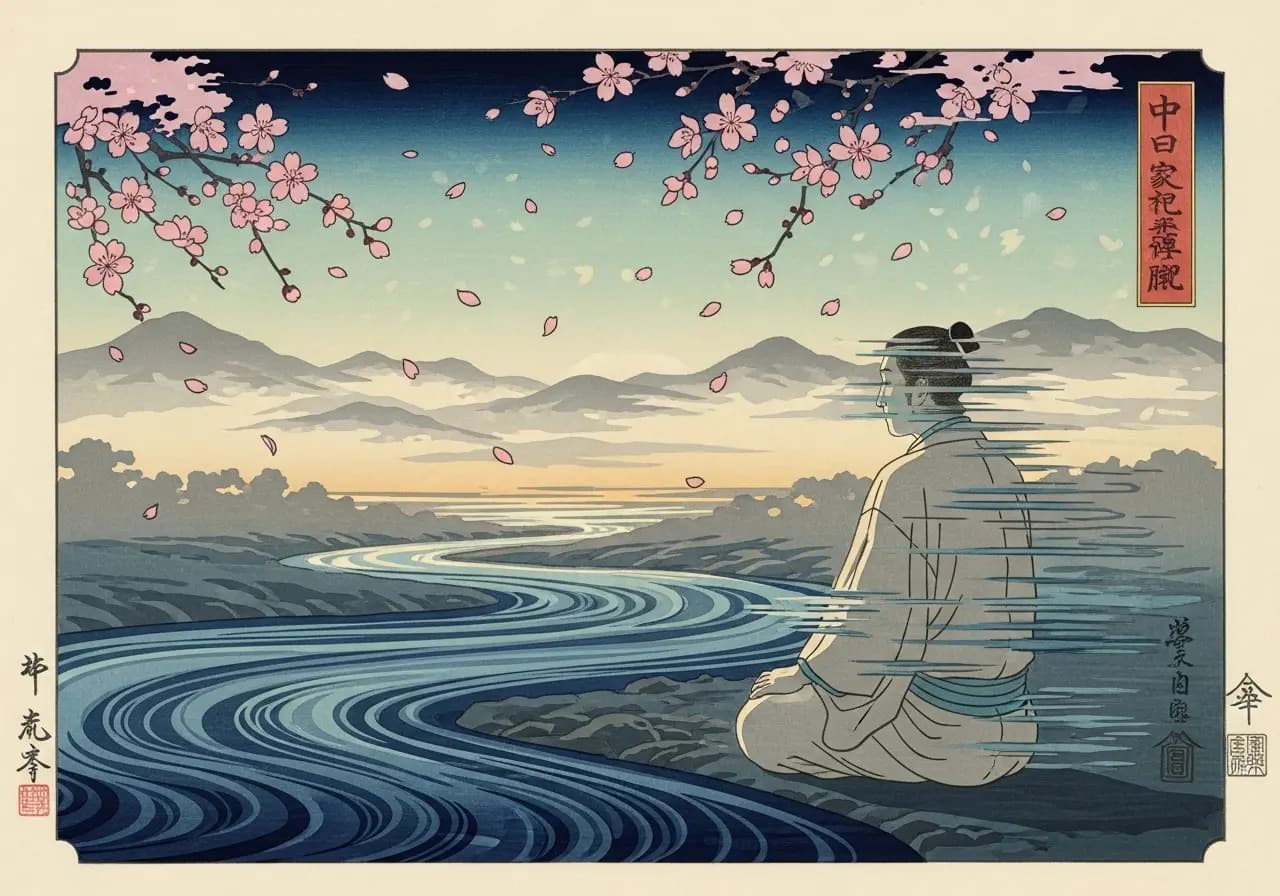
Another analogy I like even more is a river. A river seems like a fixed thing in our mind. Think of the Mississippi River or the Nile River—it's this fixed entity. But when you look closely, there's really no aspect of it that's entirely fixed. The water that flows to create a river is continually changing. The water that was flowing in the river ten years ago is not the same water that's flowing there today.
Even the banks of the river—what you might say defines the edges, what shapes the river—change and evolve over time. The sand on the banks is continually being washed away, and then new sand forms the edge of the river. Sometimes even the direction can change. If you have a big storm and the water rises, the river may carve an entirely new path. Then as the waters recede, the old path is replaced, and now there's a new path on that specific leg of the river.
Almost every aspect of the river is continually changing, and yet when we think of a river, we think of it as this fixed thing. It's always the Mississippi, but there's no aspect of it that is fixed or permanent.
The Self Is Like a River
The Buddhist view of the self is very much like that river. We are a collection of many things that make us "us." Our memories, where we were raised, how we were raised, the experiences we have, the DNA that we inherited from our parents and our ancestors—every aspect of us is constantly changing. And yet, in the present moment, the culmination of all these things allows us to be experiencing life through the specific lens that we're experiencing it.
We're like the Mississippi River right now. In its present form, it has a defined shape and a defined direction and a pretty regular water level height. But all of this is changing. None of it's fixed or permanent, and our sense of self is the same. Our memories are continually changing—we're constantly adding new ones and constantly forgetting old memories. Our emotions are constantly changing.
What's interesting to me is that I think there's a part of us that actually understands and grasps this concept—that we're not fixed entities, that we're constantly changing and evolving. And at the same time, there's another part of us, the ego, that clings to the sense of self and says, "I am fixed, permanent, and unchanging."
We Know This Already
We see evidence of this understanding everywhere. You've probably heard, or perhaps even experienced, statements like, "When I said that, that wasn't me. I was angry," or "When I did that, don't hold that against me. I was afraid." When we act under fear or emotions like anger, we tend to look back on those moments and say, "That wasn't me."
Well, the thing is, that was you. That was you in a constantly changing state of who you are. That happened to be you ten minutes ago when you were mad, and then ten minutes later, the "me" that's here now and is no longer mad looks back and says, "That wasn't me." That's right. But that's how everything is. It's not just when we're mad or angry.
I think Snickers has done a really good job teaching this concept through their commercials. If you've seen them, you'll recall they show somebody acting in a certain way, and then it says, "You're not you when you're hungry." Then another character will feed them a Snickers bar, and they become someone else entirely. The whole concept they're trying to suggest is, "You're not you when you're hungry," and that's true. But the thing is, it goes beyond that. It's not that you're not you when you're hungry. It's that there is no "you" that's a permanent, fixed "you."
The way you are when you're hungry may be different than how you are when you're satisfied. It may be different than how you are when you're completely overstuffed and full. You're a different you when you're angry. You're a different you when you're happy. You're a different you if you just found out you won the lottery, and you're a different you if you just found out you lost your job.
Because there is no fixed, permanent you. That's the idea—you're a continually ongoing, changing process, much like the Mississippi River, which seems like a fixed thing. I mean, we call it the Mississippi River. It's not like we have other names for it. It's constantly there, and yet there's not one single aspect of it that's fixed.
With the self, it's the same. We have a sense of self that seems permanent and fixed, but the reality is that there's not a single part of you or me that is fixed or permanent.
Looking Back in Time
We seem to notice this when we look back in time. I think it's pretty clear to say, "The 'me' that was me ten years ago is not the same 'me' that is me today." It doesn't have to be ten years. If you're going through a drastic change in your life, you might say, "The 'me' that was me a year ago when I was in that marriage is not the same 'me' now that I'm divorced and single," or "The 'me' in college that was very active and partying is not the same 'me' five years later that has two or three little kids."
Think about almost any example of yourself extending into the past, and you'll understand that the you of then is not the same you that you are now. There may be aspects of you that haven't changed—certain forms in your personality—and that only aggravates this illusion that there must be a permanent, fixed you. We think, "The permanent, fixed me is this or that." But the reality is, just because a certain part of you hasn't changed doesn't mean that it can't change.
Some of the things that we tend to cling to in terms of a fixed sense of identity are personality traits. Somebody who tends to always be a certain way only feeds that idea of, "Well, then there must be a permanent, fixed me." But every aspect of you can change. All it takes is a fluctuation in hormones or a change in how your mind works because you've been in an accident. A traumatic brain injury can change you. There are so many things that can change you.
What part of you is then actually permanent and fixed? Well, you're not going to find it, because there is no part of you that's permanent and fixed. You are a continually changing thing, very much like a river is a continually changing thing. I think it's awesome when we think about that.
Fixed Mindset vs. Growth Mindset
Now in the world of psychology, this concept is explored by Carol Dweck. Carol is a professor of psychology at Stanford University, and she's done a lot of work on the idea of fixed mindset versus growth mindset. I really like what she's done in her work, and I want to talk about this a little bit.
The concept of a fixed mindset versus a growth mindset is essentially that everything we do has much more to do with our mindset than it has to do with specific skills and talent. She did more than twenty years of research to show that our mindset is more than just a personality trait. It's not a fixed thing, and our mindset determines whether we become optimistic or pessimistic. It influences our goals, our attitudes, our relationships, how we are, how we raise our kids, and ultimately whether or not we live up to our full potential.
Her research has found that we essentially have two basic mindsets: a fixed mindset and a growth mindset.
The Fixed Mindset
The fixed mindset is when we tend to believe that all the things we are—whether it be your talents, your abilities, or personality traits—are all set in stone. Intelligence is viewed as static, and that leads to the desire to want to look a certain way. "I want to look smart," and then we have the tendency to avoid challenges because we don't want to fail at something that's going to change how we perceive ourselves to be.
People with a fixed mindset tend to give up easily. They see effort as fruitless, and they ignore useful negative feedback because it's negative. With a fixed mindset, you're continually threatened by the success of others. With a fixed mindset, you generally plateau early and achieve less than your full potential. You tend to feel that you just are what you are.
This fixed mindset would be something like, "I am," and then fill in the blank. Think about yourself here. Think about in what way you view yourself with a fixed mindset. "I am smart," or "I am dumb," or "I am," whatever it is.
The Growth Mindset
Now the growth mindset is different. With a growth mindset, you view the world and believe that your talents, your abilities, and your personality traits are all things that are continually evolving and can be developed. Intelligence is something that's developed. This mindset leads to the desire to continually learn, and therefore a tendency to embrace challenges and to persist in the face of setbacks and to see effort as the path to success. It's easier to learn from criticism.
With a growth mindset, you find lessons and inspiration in the success of others, and it's with a growth mindset that you can achieve high levels of achievement.
Implications for Parenting
Dweck's research on fixed mindset versus growth mindset has a lot of implications for parenting. This is what interested me as the father of three little kids. The idea here is that with your kids, you don't want to give them the idea that things are fixed. This is the difference between saying, "Good job on your test. You're so smart," versus saying, "Hey, good job on your test. You studied really hard and you got a good grade. Good job for working hard."
One tends to create a fixed mindset that makes people think, "I am this. I am that." And if you've been told your whole life, "I'm smart, I'm smart, I'm smart," and that's what's happening in school, the first time you fail, instead of thinking about whatever other circumstances were involved with failing, the first thing that comes to mind is, "Oh no, I'm no longer smart. This fixed part of me is not what I thought it was, and therefore now I have problems."
In the last podcast episode, I talked about a Facebook meme or quote that says, "What screws us up the most in life is the picture in our heads of how it's supposed to be." Well, that same thinking applies here. I think what can really screw us up in life is to have a picture in our minds of who we are and who we're supposed to be, while completely ignoring the fact that there is no fixed version of you. It's like this growth mindset versus the fixed mindset.
In the growth mindset, or in the Secular Buddhist paradigm of understanding the world, all things are continually changing and evolving, including and especially you and your sense of self. This creates a very, very big difference.
If you were to look at yourself with a growth mindset—a mindset that's not fixed, where nothing's permanent—and look at how you view your own successes and your own failures, these are not fixed, permanent things. The way that we view ourselves can change drastically simply by understanding whether we are fixed or we're not fixed, permanent things.
If you spend time looking for what part of you is a fixed, permanent, unchanging thing, you're not going to find it. And I hope that you do spend time trying to explore that. If you do find something, you'll find it's conceptual. I've talked about conceptual and empirical truths in the past, and the idea here is you can look for a fixed self and you might have an idea or a concept in your mind that "I am this or I am that," but it doesn't stand up to the scrutiny of psychological evaluation or scientific or empirical research.
What you are is constantly changing and constantly evolving.
My Story: A Name, an Identity
Instead of this being a sad thought—"Oh no, there's no self"—it's actually very empowering to realize, "Wow, what I am is just what I am." If someone were to ask me, "Who are you?", traditionally I'd say, "Well, I'm my name," and I'd give them my name. But so what? That's just what I'm called.
In my case, this one's always been interesting to me because I'm an identical twin. Growing up, I've always been confused with my brother, and we were always called Nick and Noah—almost like it was one name. I've always had this sense of, "Well, there's me, but then there's us"—my brother and I. And to this day, if I'm out in public and someone says, "Nick," I always turn because I think they might be trying to get hold of me. They just don't know if I'm Nick or Noah, so I'm both. I'm Nick and I'm Noah. At least when you're calling that name, I'm going to look at both.
For me, that's always been a fascinating form of introspection, thinking, "Well, I'm Noah," and I've also thought, "What if we were switched at birth? What if I'm actually Nick? What if I've always been Nick and he's always been Noah, and nobody knew because when we were born, somebody got confused and didn't realize which was which? Then they just started calling us the other name? What if I was always meant to be Nick and he was always meant to be Noah?"
I don't know. Maybe those are just some of the things that twins think about, but it's something I've always thought about. It gets even more interesting later in life with my last name. Only about a year ago, I was doing a lot of family history and research, and I'd always known that my last name is Serbian. I felt this strong sense of identity with my last name and what it means and where it came from and all the implications of my last name.
About a year ago, while doing ancestry DNA tests and 23andMe DNA tests and coupling that with everything I knew about my family history, there were aspects that did not add up. Eventually what that led to was the discovery that my dad's mom was not the daughter of who she thought her dad was. She had a different dad. And the DNA is what proved all this when I was doing the DNA testing for myself and then for my parents.
It was fascinating to discover this whole sense of identity that I have with a name—a name that isn't even my name. I'm not even supposed to be Rasheta. I'm supposed to be Moody—that should be my last name. But it didn't work out that way, and I still have a sense of attachment to my last name because that's the last name that my grandfather gave to my dad when he adopted him. But it's just a name.
A Thousand Names
This happens with one name. Three or four generations back, there's this twist in the story that changes it all. Imagine in your case it's very similar. We tend to carry one last name with us. It's always the parental name, at least in our society, and it goes back generation to generation. It's always one line. But if you go back just two generations, you actually have four last names. All four of them are equally parts of you.
One is the one that you're going to carry with you, but you are just as much the other three in terms of DNA as you are the one that you happen to use. And that's only two generations back that you have four. Keep going ten generations back, and you've got over a thousand people who contributed to your genetic makeup, to your DNA. Out of those thousand people, perhaps up to a thousand different last names, only one is the one that you carry today. And you feel this strong sense of identity with that last name, like that's who you are, completely forgetting that you are also all those thousand other ones.
But we don't really think like that. That's just part of our societal conditioning, I think.
It's interesting to think about. Our sense of self tends to want to attach and feel permanent and feel like it's unchanging, and yet there's no part of it that is permanent or that doesn't change.
Freedom in Impermanence
Think about the fixed mindset versus the growth mindset applied to how you view yourself. There should be a sense of feeling liberated or free to be a continually changing version of you. I can't think of a more exciting thing than to know, "Wow, what I am is just what I am, but it's not permanent and it's not fixed. That gives me freedom to work with it and to change and evolve. If I have the tendency to always be in a bad mood, I'm going to work towards trying to change that."
There's a lot of freedom in understanding that we're flexible. While some things are hardcoded in us through our genetics, not all things are hardcoded or permanent. A lot like the Snickers commercial—"You're not you when you're hungry"—think about that. You're not you when you're mad. You're not you when you're ecstatic. You're not you when you're afraid. There are so many versions of you that you would happily say, "Well, that's not me." But why stop it with the negative ones? Apply that to everything.
Every version of you under whatever set of circumstances you're in, that's just who you are under that set of circumstances. And the "you" that you are right now is the you that you are right now.
With truth, we talked about how what was true yesterday may not be true today. Well, think about the implication of that. That means that the "you" that you were yesterday may not be the "you" that you are today, and that is actually very liberating. There's a tremendous amount of freedom when you understand that you're not permanent and you're not fixed.
Compassion Through Understanding
What I hope you get out of all this is a sense of determination to grow, to have fun, to experience the process of being. I love that "human being" implies it's a process grounded in the present moment. You're being, and what you're being is always contingent on time. Your being is grounded in the present moment.
Play with that and be. Go be, and see how you're being. Compare it to different stages in your life. Compare those stages and the different emotions that you're experiencing. See how those change you and how you can work with those. Notice what part of you evolves and changes over time. It's a fascinating process.
When you can completely allow yourself to just be with the understanding that you're continually changing, there's a stronger sense of self-compassion. What you start to notice is that when you look back at a previous version of you, you can have compassion for that because you'll say, "Well, of course I acted the way that I did. Based on what I knew at the time or what I was experiencing at that specific phase of my life, I did exactly what that me would have done. That may not be what the 'me' now would do, but I'm not that same person, and that person is not who I am now."
That's so much more healthy than to look back and think, "Why did I do this? I was so dumb," or "I would have never done that." Well, of course you wouldn't, because that you isn't the same you that you are now. We're continually changing, continually evolving.
Practice this sense of compassion for yourself when you understand that the "you" that you are is not the same "you" that you've always been, and it's not the same "you" that it will always be.
Extending Compassion to Others
Where this gets really exciting is when you extend this freedom to someone else. The person who cut you off on the road and you think, "That guy's a jerk"—that's applying a permanent, fixed attribute to someone who's not permanent and not fixed. It may be that the person they were in that moment is who they were in that moment. They did what they did in that moment because of all the circumstances going on in that moment.
Think of the Snickers commercial. This may be the easiest way to picture it, but just think, "Oh, they must be hungry. That's not the real them." And next time somebody does something, think about that a bit. Think, "What could it be? Are they hungry? Are they angry? Are they afraid of something? What part of them is causing them to do this?" And understand that it's not a permanent, fixed thing. That person who's doing what they're doing is not permanent, and they're not fixed, just like you are not permanent and you are not fixed.
I think this makes it a lot more easy to have compassion for other beings because we're all doing the same thing. We're all being. In the present moment, based on the set of circumstances that are completely unique to each of us—our memories, our experiences, they're all unique. And I think one of the bravest things you can do is to just show up and be seen as you. And one of the most loving things that you can do is to allow others that same sense of freedom and let them be what they are.
What they are right now is what they are right now. It may not be what they were in the past, and it sure isn't going to be what they are in the future, because that's the nature of continual change. I think it gives us a lot more flexibility with how we view ourselves and how we view others.
Closing
That's what I wanted to discuss this week in the podcast: the concept of the ever-changing self, the sense of self that's not fixed and not permanent. I think that's what makes us so beautiful. We're continually changing, continually evolving.
Hopefully this makes sense to you. I'd love to discuss this further. For those of you who are in the Facebook Secular Buddhism study group, that would be a fun place to discuss it. Or on our Facebook page or on the blog in the comments—wherever you want. I look forward to hearing from you and to discussing another topic in the next podcast episode.
Thanks again. If you enjoyed this, please remember to share, give it a rating, or write a review. I take all of your feedback very seriously, and I'm trying my best to improve these podcasts every day.
Thank you very much for your time and attention, and until next time.
For more about the Secular Buddhism Podcast and Noah Rasheta's work, visit SecularBuddhism.com