

The 84,000 Gates
Episode 169 of the Secular Buddhism Podcast
Hello and welcome to another episode of the Secular Buddhism Podcast. This is episode number 169. I'm your host, Noah Rasheta, and today I'm going to talk about the teaching of the 84,000 Gates.
As always, keep in mind you don't need to use what you learn from Buddhism to be a Buddhist. You can use what you learn to simply be a better whatever you already are.
If you are interested in learning more about Buddhism, check out my book, No Nonsense Buddhism for Beginners, available on Amazon. Or you can just listen to the first five episodes of this podcast. You can find those by visiting secularbuddhism.com and clicking on the link that says "Start Here."
If you're looking for a community to practice with and to interact with, consider becoming a patron by visiting secularbuddhism.com and clicking the link to join our community where we do weekly Zoom calls and there's a study group book club as well.
The Three Doors of Liberation
In the last two episodes, I shared my thoughts around the teaching of signlessness and aimlessness. These are two of the three doors of liberation. The teaching of the three doors of liberation specifically refers to signlessness, aimlessness, and emptiness.
Today I want to conclude my thoughts on that third door: the teaching of emptiness, but specifically how it pertains to meaning and the meaning that we assign to things. For me, this can be summed up in the teaching of the 84,000 Gates.
A Quick Recap
Let me give you a quick recap of the three doors of liberation: emptiness, signlessness, and aimlessness.
Starting with aimlessness, this is having no goal. This can be summed up in the expression: "Having no destination, I am never lost."
Then there's signlessness. This is the reminder that the outer appearance of things—in other words, their sign—can mislead us to thinking that this thing you see is permanent. The example given is that a cloud looks like a cloud, but if you look at a cloud long enough, the cloud becomes rain. Rain can become the water that's absorbed by plants. Plants become the thing that gets eaten by animals, and so on. So this thing you see isn't always what it is. It becomes other things. In other words, a cloud doesn't die—it transforms into something else.
The form changes, but nothing is ever lost. And when we realize signlessness, then we no longer feel attached to the temporary form that we're looking at in that moment.
There's an expression that the Buddha supposedly said: "Where there is a sign, there is deception." I like that because it's a reminder that change is a constant and permanence is the illusion. The thing you see, no matter how permanent it might feel—like rain—is rain, but it's also all these other things that are not rain.
Understanding Emptiness
Then there's emptiness, which some call formlessness. Emptiness hints at this notion of interdependence. It's the understanding that a thing isn't permanently a thing without seeing it through the lens of the causes and conditions that make that thing what it is.
With the analogy of the cloud, time is what separates a cloud from rain. They're the same thing but in different times. With signlessness, form is the differentiator. With emptiness, I think space is the differentiator.
The analogy I use often is the car. You can take a car and separate it into all of its parts. Now you're in the same dilemma: if a cloud becomes rain—they're the same thing but at different times—what happens with a car when you break it into its causes and conditions?
When you take a thing and break it down into its parts, you don't see the thing anymore. You can see a car, but then you break it down and now you can see an engine, a wheel, a window. But those things aren't the car anymore. Those are the things that they are.
But you break those down as well. You take the engine and break it down, and now you no longer see an engine. You see a piston, a carburetor, and all these different things that make an engine an engine.
So the idea with emptiness is that we see the thing and we give it meaning. All these things come together to make this thing, and we call it this or that. We ascribe meaning to things.
What Are the 84,000 Gates?
I've talked about the car analogy many times, and I want to bring up another perspective here: the teaching of the 84,000 Gates.
So what are the 84,000 Gates? Well, there's a story in several Buddhist traditions that says the Buddha taught that there were 84,000 gates or 84,000 methods that lead to awakening. I believe the 84,000 Gates is intended to be a method or an expression to imply that there are numerous methods to learn about the nature of reality.
I don't believe it's meant to be interpreted as an exact number. In other words, here are the 84,000 methods and then you can describe all of them, but there's not 84,001. I don't believe that to be the case. For me, this is just an expression meant to imply, "Hey, there are numerous ways to arrive at the same place."
And the irony here is that my interpretation of this is merely one of many interpretations of this teaching. Which only strengthens the idea that there are many ways to see the same thing.
I may see this and say, "Oh, well, what that means is there are a lot of ways." Someone else may see this teaching and say, "No, it means there are exactly 84,000 ways—not one more and not one less."
I'm reminded of a poem or a quote by Rick Fields where he says: "84,000 gates to the Dharma, and mine is best. What a waste. Do your practice, enjoy your life, and let the world argue and discuss itself to death."
For me, what this means is: look, there are a lot of different ways. Getting caught up in the interpretation of things doesn't feel useful or necessary to me. If somebody else wants to, fine, go for it.
The Blind Men and the Elephant
The 84,000 Gates, for me, is similar to the teaching that the Buddha gave about the blind men describing the elephant. You'll recall that none of them are completely right and none of them are completely wrong. It's just where you stand in space and time that limits your ability to describe reality as it is, because you have an incomplete picture.
For me, what this alludes to—this nature of emptiness—is that things are empty of meaning until we come along and we assign meaning to the things we see.
The Night Sky and Human Interpretation
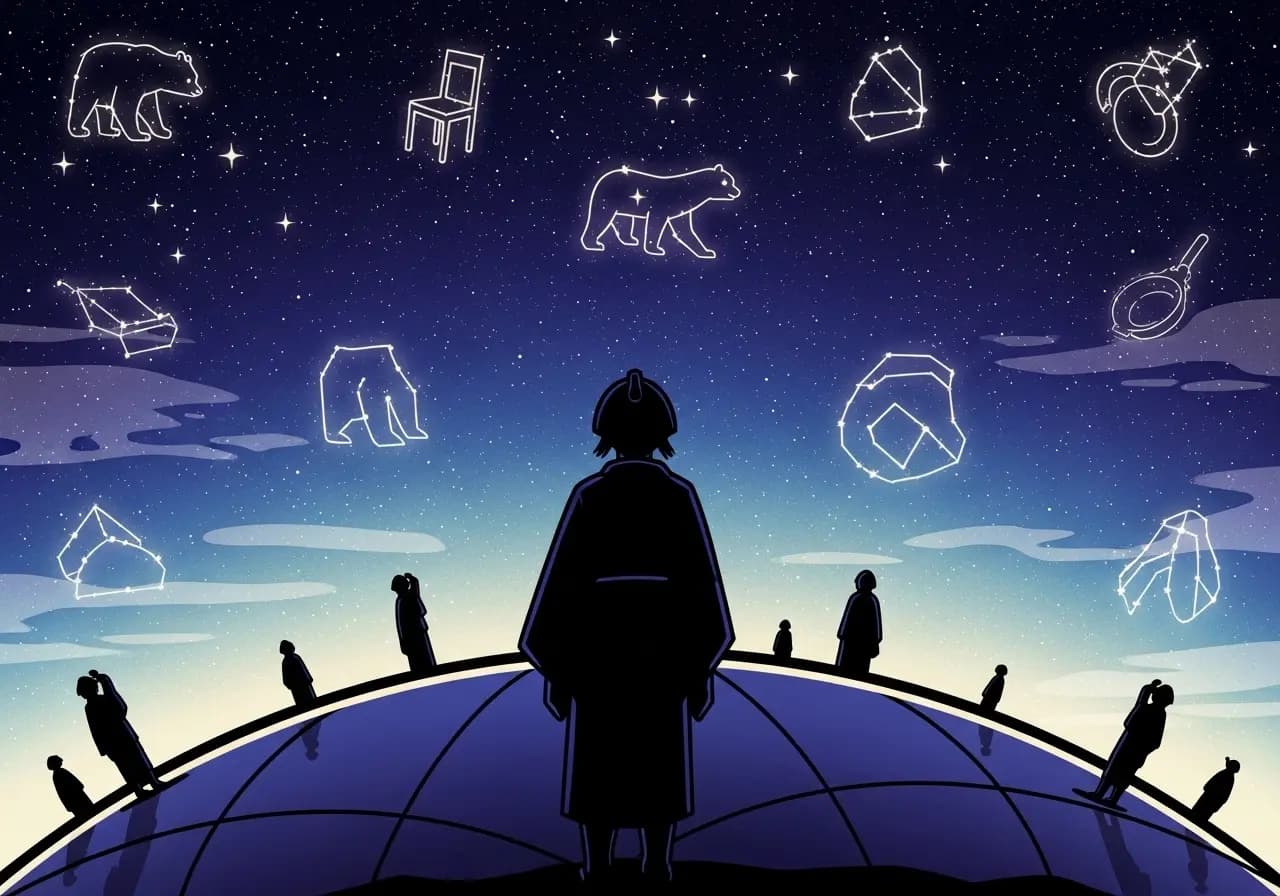
One of the greatest examples of this for me is the way that we interpret the night sky. There's a website called Figures in the Sky that talks about how cultures across the world have seen their myths and their legends in the stars. The website explores 28 different cultures and what they each saw in the skies—in other words, in the patterns of the stars.
This is fascinating to me. Have you ever gone out and looked at the night sky, looked at the stars, and if you look long enough, you kind of start to see a pattern or a figure in the stars? We do this with clouds too. If you're out there looking at the clouds, some may say, "Oh, that one looks like a mouse," and someone else would see a figure that looks completely different.
It could be that when someone tells you what they see and you look at it hard and long enough, you say, "Oh, I think I can see that too." But it's also likely that you'll say, "I cannot imagine how on earth you're seeing that. I just don't see that."
Well, it's no different with constellations. This website points this out. It shows how various cultures have formed different stories and pieced together different constellations from the stars, even though everyone is really looking at the same thing in the night sky.
The Big Dipper and Multiple Perspectives
There are different interpretations that arose to explain what each culture saw. You can look at one culture and they'll describe what looks like a pan—the Big Dipper. Another culture will say this is the two diamonds or the elk. Reading through that website, it was very interesting to see the various explanations that are completely different from each other.
Some are totally out of left field and others are totally out of right field. They're so different from each other that they seem incompatible. But each one makes sense and is specific to that culture and time. If you were of that culture at that time, it might make sense to you. Others may see it and say it makes zero sense to me.
The Implications for Meaning-Making
Now, if this is the case when we look at the night sky and see the stars—remember, we're looking at the same thing—how can it not be the case when we try to do much bigger things? When we start extrapolating meaning out of reality and trying to come up with an explanation of the meaning of life, why are we here, what happens when we die, we're extracting out of our cultural lens and everything that makes us who we are—not just as an individual, but also as a culture.
We try to assign and ascribe meaning and say, "Well, then this must mean this. This is what I'm seeing." And then everyone around you says, "Oh, I think you're right. Maybe I see that too." But someone else says, "No, I see this other thing." And then they have a cluster of people around them who say, "Yeah, I think that's how it makes sense to me too."
Could that be the origin of religions? It makes perfect sense to me. I believe that any attempt to describe or ascribe meaning to reality is going to be similar to how these cultures have interpreted different versions of the night sky.
Like the analogy of the blind men and the elephant, none of them are right and none of them are really wrong. But they are empty in the sense that they only make sense in the context of interdependence.
In other words, if I am of this culture that has this belief and lived in this time, then that picture makes sense to me. But you start to remove some of these causes and conditions and the picture changes. If I were a Hawaiian who looked at the night sky through the lens of ancient Hawaiian culture, I may see things that someone from another culture simply won't see. And I like that.
Spirituality and the Dalai Lama
In the book The Art of Happiness by the Dalai Lama and Howard Cutler, in one of the final chapters, the Dalai Lama actually talks about the context of religion. He believes that however many people there are, that's about how many religions there should be. So if there are seven billion people on the planet, there are seven billion flavors of religion, or what we could call spirituality.
I like the term spirituality. For me, the notion of spirituality is two things: how we relate to anything that's not us, and how we make sense of the bigger picture outside of ourselves. So connection and meaning for me is what spirituality is—the meaning I give to life and reality, and the connection I feel to anything beyond me.
In that sense, my flavor of spirituality is very unique. It applies to me. And it has this hint of what I think the Buddha expressed: that there are 84,000 paths, a myriad of ways, and none are right and none are necessarily wrong. It requires knowing what specifically works for you.
We Are Each Unique
What works for you is suited for you because you are unique. You are the combination of your family views, your genetics, your cultural norms, perhaps your religious upbringing, your lived experiences—which are unique. All the things that make you uniquely you mean that what you see when you look at the night sky is pretty unique.
You're seeing what makes sense to you, and if you extract out of that some kind of pattern and suddenly you say, "Ah, I see it. I see Orion's Belt or whatever it is that you see," it's unique to you.
Now, that doesn't mean someone else won't see the same thing. Maybe someone else will see the same thing. But that's just one view. Look 20 feet to the left. What do you see there? Maybe we still see the same thing. Now look 50 feet in the other direction. What do you see there?
At some point you'll start to see that we see nine out of ten things the same, but then there's the one thing we see differently. That unique formula is so vast that if you look at the night sky, it's not that you can see ten objects. You could see a countless, unlimited amount of shapes and objects.
I think you would probably agree with me that if we all looked at the night sky and listed what we see, that list would be unique. Your list of a hundred things compared to any other person on the planet won't be the same list.
So if there are seven billion people, there are seven billion views. Keeping that in mind makes a lot of sense to me.
Love Languages and Beyond
This is also expressed in other ways. For instance, what is the proper way to love someone or to be loved? We know that's different for everyone. In fact, there's a book called The Five Love Languages by Gary Chapman where he talks about five specific love languages: words of affirmation, quality time, physical touch, acts of service, and receiving gifts.
The whole notion of this book is that we all have a different scale where one of those five is the most dominant, another is the second most dominant. You could rank them. For example, my formula might be: number one is words of affirmation, number two is quality time, number three is physical touch. For you, my number three might be your number one, so there we have a different formula.
Even beyond the order of the formula, I think you have a different number that would represent the strength of each one. So let's say words of affirmation for me is 80%, and the second is 20%. For you it might be 79% and 32%. Now we have the same ranking, but they're still different because the percentages might be slightly off.
This is something simple that's been distilled into five languages, but it doesn't mean everyone falls within one of five different ways. There are countless ways to express the exact formula of what it means to love or what it means to be loved.
Now, if that's the case with something like love—which seems so universal—of course that's going to be the case with something much more difficult to pin down, like a belief or religious views or your interpretation of the night sky. Of course we're going to have billions of explanations of it because there are billions of people.
Tying It Back to Emptiness
Tying all of this back to this notion of emptiness, what it reminds me of is that there are 84,000 ways—countless ways—to understand or to see something. My way of seeing it is mine.
When I think of emptiness, what I'm reminded of is that my way isn't right or wrong. It's just what makes sense to me. But it's empty of meaning until I give it the ultimate meaning that says, "My way is right." That's meaning.
Again, it doesn't mean that's incorrect. It means that if it's correct for me, it doesn't have to be correct for you. I think that's at the heart of this notion of emptiness.
The car isn't really a car, right? The car is actually a motor and windows and wheels and tires. But the motor isn't actually a motor. It's a carburetor, springs, and needles. Suddenly you realize: wow, everything works this way. Things are empty, and so we give them meaning. We assemble these things together and now we call it this. We say it's this because it does that.
Yes, that's true, but it's still empty because you can always tear it down and deconstruct it into its causes and conditions. You're left with a new thing that isn't the thing that you started with. That's really at the heart of the notion of emptiness, at least for me—how it makes sense in my mind when I think of the meaning I give to all things.
Everyday Application
In day-to-day application, you're driving along and a car cuts you off. Right away, meanings arise. These arise out of past experiences and cultural norms, but that meaning is empty. I don't actually know what's going on in that car. I've used this analogy a lot before.
We don't know if that person is in a rush to get home because of an emergency, if they're just a jerk, or if they could always do that. There are countless other explanations. The point isn't that I shouldn't ascribe meaning to things. For me, the point is that when I do ascribe meaning to things—because we all do, that's a human tendency—I can pause and say, "Yeah, but do I really know that's what it is?"
I hold space for the uncertainty.
Love Languages and Understanding
I've learned to do this with other things. The love languages are a good example. When you're new and get into a relationship, you kind of think, "Well, this is the way I communicate love. If you love me, you do this and you don't do that." Well, that formula is different for everyone. And for newer couples, certainly in my case, it didn't occur to me that someone else could have a different love language.
Understanding that was very helpful for me so I could try to be more effective at communicating my love language and also interpreting my partner's love language.
Imagine if we could do this with each other as cultures and as a society—not just for love languages, but our spiritual language. In other words, the language we use to make sense of reality. If I recognize that mine is empty in the sense that what makes sense for me only makes sense for me, but it doesn't mean it's going to make sense for you, then I don't have to be so attached to my way being the only way.
The Night Sky and Friendship
Imagine if we did this with the night sky. I look up and see this shape, and you see a different shape. Then I don't want to be your friend because you're not seeing the same shape as me. That almost seems silly, but that's exactly what we do with so many other things, so many other interpretations of reality.
I get it—there are other topics that affect us much more than the night sky. If you see something different in the night sky than what I see, it probably won't affect our day-to-day. But if we get into political views or religious views, your interpretation may very well be affecting my lived experience and vice versa.
But still, the understanding here is important: I'm seeing it one way, you're seeing it another way. Let's explore this. Help me understand how you're seeing it, and I'll help you understand how I'm seeing it.
Imagine if we did that rather than just immediately anchoring ourselves in "my way is the right way" and "my path is the correct path."
The Teaching of 84,000 Gates
I think that's what the Buddha was implying with the 84,000 Gates—the 84,000 ways or paths. It's saying, "Hey, this way is working for me, but let me see your way. Why is that working for you?" And I may be able to say, "Oh, okay, well, hmm, let me try that. That way might be more effective for me."
But I may also look at it and say, "No, no, I definitely think that way won't work for me, and I'm going to continue on my way."
The Climate Analogy
I've used another visual that works for me in my mind. I pretend the earth is round, right? There's no specific place that says this is where you have to be. This is just where you are. Based on where you are, you may be dressed in different ways.
If you're somewhere up north where it's really cold and the terrain is ice and snow, you wear clothing that's suitable for that terrain. Somebody who's in another part of the world that's tropical, with sand and heat, may be wearing sandals or flip-flops or a t-shirt rather than a jacket.
To simply say, "Hey, no, you need to be wearing a jacket because look, we're all wearing jackets"—yeah, but we're in different places. Where I'm standing and how life is for me, it would be completely unskillful to wear a jacket in the hot temperature. And it would also be unskillful for you to take off your jacket simply because you look at me and say, "Well, he's not wearing a jacket, so I'm going to take my jacket off."
It Depends
So again, it becomes a very introspective thing. What's working for me? Why does it work for me? Could there be another way that works for me? And not getting caught up in "this has to be this way."
For me, that is emptiness. It's recognizing that things are because of how things are, but there's no permanence to it that says the answer is always "wear a jacket." And it's also incorrect to say the answer is always "don't wear a jacket."
The answer is: it depends.
And that's what happens if you look at the night sky. What do you see? It depends. If you look at the cloud, what do you see? It depends. And that's emptiness for me. There is no solid "this is what it always is." There's just the "it depends"—right factors, causes and conditions, time, space, and all these different things.
Bringing the Three Together
So those are the thoughts I wanted to share. Now, once you couple these three concepts together—emptiness, aimlessness, and signlessness—the idea here is that if you can keep those things in mind and look through those doors, those lenses, you're going to start to have probably a more skillful view of reality.
For me, what that looks like in day-to-day application is that the skillful way to look at the night sky is to look at it, see how it appears, and notice what I see in the night sky. But then don't attach to it and say, "Well, I see a bear in that pattern of that constellation, therefore everyone needs to see that bear."
No, I could maybe help you understand why I see it like that, but it's totally okay if you don't see a bear and instead you see a chair or something that's completely different from the shape I'm seeing. That's fine.
What we want to do is be more effective at communicating. Emptiness implies a sense of non-attachment. I don't have to attach to my way being the only way and get all bent out of shape if you don't see the bear.
That's been very beneficial in my lived experience, especially in a marriage where we're two different people attempting to do the same thing—raise our family and kids. We're living in a very similar set of circumstances because we're partners on the same boat, but we're both looking out and seeing different things. We're both interpreting things at all times because we're two different people.
If there are seven billion people, there are going to be seven billion interpretations of what we're seeing. That, for me, is the teaching of emptiness, the teaching of the 84,000 Gates.
A Final Thought
Hopefully you can take some of these ideas and experience a little bit less of the strong sense of attachment that we feel sometimes to saying, "If I'm interpreting this or seeing this the way that I'm seeing it, it must be the right way."
Instead, try saying, "If I'm seeing it this way, sure, that's how I'm seeing it, but it doesn't mean anything. It's empty of meaning until I give it the meaning that I'm giving it."
And sometimes that meaning we give things is pretty much the cause of a lot of our problems.
Well, that's all I have to say about this topic. That's all I have for this episode, but I do look forward to sharing more thoughts on another topic in another episode at some point later in time.
Thank you for listening. Until next time.