

Signlessness
Episode 168 of the Secular Buddhism Podcast
Welcome back to another episode of the Secular Buddhism Podcast. This is episode number 168. I'm your host, Noah Rasheta, and today I'm going to talk about practicing signlessness.
Keep in mind, you don't need to use what you learn from Buddhism to be a Buddhist. You can use what you learn to simply be a better whatever you already are.
If you're interested in learning more about Buddhism, check out my book, No Nonsense Buddhism for Beginners, available on Amazon, or listen to the first five episodes of this podcast. You can find those by visiting SecularBuddhism.com and clicking on the Start Here link.
If you're looking for a community to practice with and to interact with, consider becoming a patron by visiting SecularBuddhism.com and clicking the link to join our community.
Getting Started
Now, let's get started with today's episode on signlessness.
In the last podcast episode, I mentioned the three doors of liberation. This is a concept or teaching that appears to be universal. In other words, every school of Buddhism talks about these three doors of liberation. The three doors are emptiness, signlessness, and aimlessness.
I talked about aimlessness in the last episode, and I thought I would go backwards and talk about signlessness in this one. I know I've done an episode on emptiness, perhaps even more than once. But I haven't done one specifically about signlessness, so this is that episode.
A Quick Refresher on Emptiness
Just as a quick refresher, emptiness alludes to the understanding that things inter-are. This is the understanding that comes from things being interdependent. When we grasp interdependence, we realize there is no permanent thing that exists independent of any other things. In other words, all things have causes and conditions.
I like to use this analogy to visualize it: think of a car broken up into all of its parts. You can't take one single part once it's broken down and say that's the car, because the car is the sum of all of its parts. The overall idea is that all things are that way. You can take anything and look at its causes and conditions, its parts, and conclude that the thing you think is a thing doesn't actually exist independent of its causes and conditions.
Aimlessness, which we covered in the last episode, is about having no goal, having no destination. I am never lost.
And then there's signlessness, which I wanted to spend time exploring today and sharing some of my thoughts on how this notion works and, more specifically, how you practice signlessness.
What Is Signlessness?
So as a summarized version, signlessness is the teaching that the outer appearance of things—in other words, their sign—can mislead us into thinking that appearance is the thing itself.
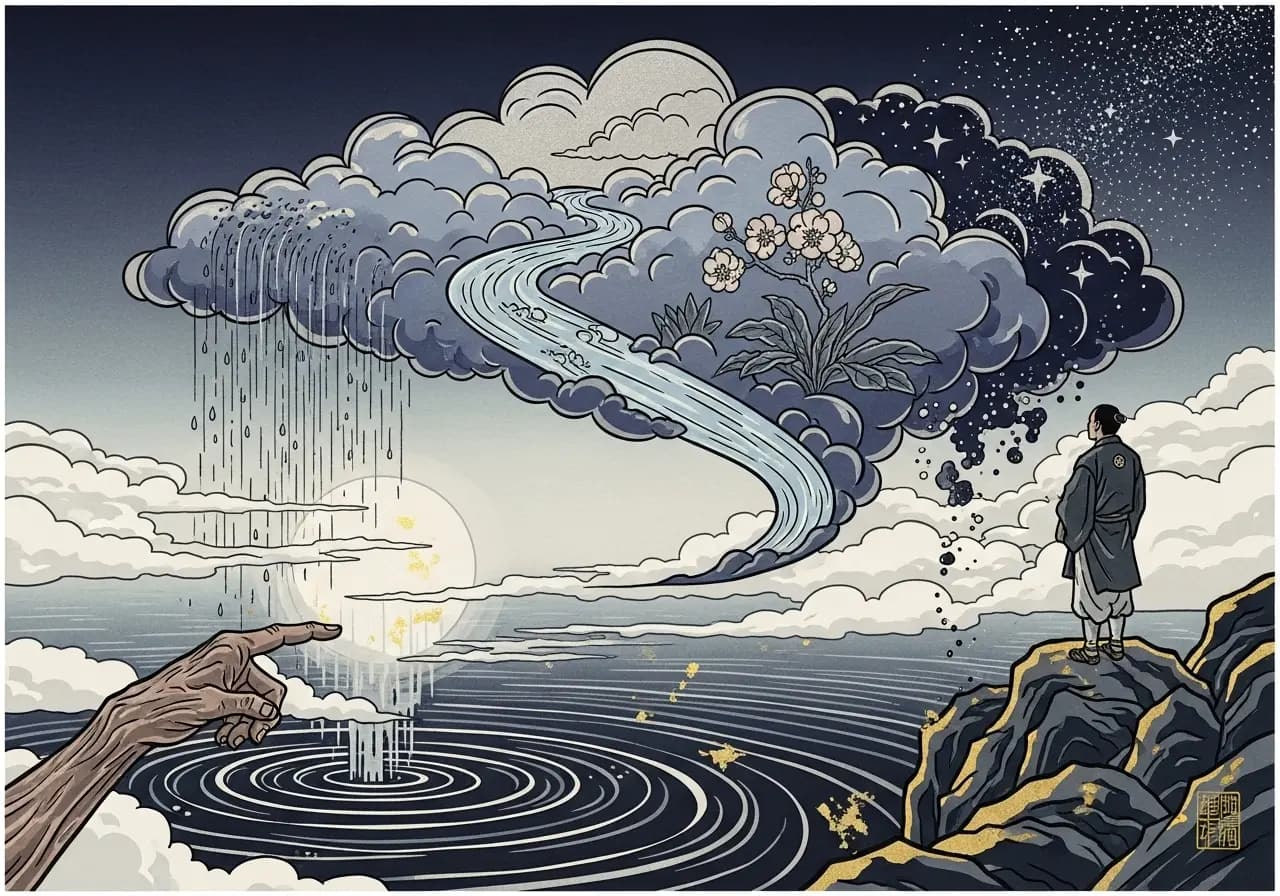
A cloud looks like a cloud, but if you look at it long enough, you'll realize that a cloud is also rain. Rain pours down, gets absorbed by plants, gets eaten, and becomes part of a continuation. Rain can be found in all of those things. You can look at a river and see rain. You can look at a cloud and see the river.
If emptiness has to do with interdependence, I would say signlessness has a lot to do with impermanence. Meaning the thing that it is right now isn't always that thing. If you look at it through the lens of time and zoom either forward or backward in time, the thing isn't the thing anymore. It's connected to other moments of time where it would be something else.
In that sense, a cloud doesn't die. It simply transforms into something else. The form changes, but the energy of a thing is never lost. When we realize the signlessness, the nature of signlessness, then we don't have to be so attached to the temporary form or the temporary sign of a thing as it is.
Signlessness is an important lens to have when we're looking at the nature of reality or the nature of our minds. In fact, the Buddha is purportedly said to have said, "Where there is a sign, there is deception." That's a powerful understanding. In other words, the thing that I'm looking at isn't what I think it is.
This is echoed in other Buddhist teachings, going back again to the parable of the six blind men and the elephant. The idea is that whatever you're perceiving from whatever position you happen to have, wherever you're standing—if you are a blind person describing an elephant, you're limited based on where you are in that space and time.
If I'm standing at the tail, I will perceive it a certain way. If I'm standing at the trunk, I will perceive it a different way. In that analogy of the blind men and the elephant, you can kind of see this through the lens of both space and time. Space is where you're standing. Time is what's happening in that moment. If the elephant is rolling around on the ground, you will perceive it one way. If it's sitting, it's another way. If it's dead, if it hasn't been born yet—there are different points in time that also affect your perception of what the elephant is and how you would describe it.
Keep in mind here this notion of constant change, this notion of impermanence.
Signlessness and Rebirth
This leads me to my first thought: the correlation of signlessness with the Buddhist concept of rebirth, or the notion of rebirth.
Rebirth is one of those topics that can be a little tricky. In our framework, we typically think of birth as the beginning of our existence, and death as the ending of our existence. We think in concepts of birth and death, and concepts of existence and non-existence.
But rather than thinking of rebirth as what happens when we die, think about rebirth as what's happening while you're alive. It's something that, when you frame it in the context of the present moment, I think it has a much more powerful and significant teaching.
Moment to moment, one moment gives rise to the next moment. The moment that we have right now is the result of the death of the previous moment, and the moment that we have right now needs to die for the next moment to exist. So instead of framing it in terms of birth and death, think of rebirth as essentially alluding to continuation. It's pointing to the first law of thermodynamics: energy can neither be created nor be destroyed. It can only be transferred from one form to another.
When we recognize this, we understand that a thing doesn't exist and then cease to exist. Energy doesn't cease to exist.
As Alan Watts framed this, he said, "You are something the universe is doing in the same way that a wave is something that the ocean is doing." When we understand that, if we were to say a wave is born and then it dies, that's simply a misunderstanding of reality. The notion of birth and death, the notion of existence and non-existence, when you realize this, it seems unskillful. It's an unskillful notion to hold.
We don't have to think of the wave in terms of birth and death. You can think of it in terms of continuation. The wave was the ocean, and then the ocean gives rise to a wave and the wave does what a wave does. And then when the wave crashes it goes back to being the ocean, but there is no birth and death. There's only the continuation of water and the forces of the moon and wind and all these causes and conditions that give rise to waves.
Think about it through that context. And why would it be any different with anything else in the universe, including or perhaps especially us?
Signlessness as Practice
Signlessness is not a mere philosophical concept in Buddhism. It is a practice. And that's why I wanted to do a podcast episode about this. We practice signlessness by recognizing that the appearance of a thing—in other words, its sign—is not the same thing as the thing itself.
There's an expression in Buddhism that says the finger pointing at the moon is not the moon. This comes from a story in Thích Nhất Hạnh's book, Old Path, White Clouds. There's a passage where the Buddha is talking to his disciples.
Let me read that section. It starts like this:
Bhikkhus—bhikkhus is a term used in Buddhism, especially in the old tradition when talking about the time of the Buddha. Bhikkhus were the followers, the disciples—the teaching is merely a vehicle to describe the truth. Don't mistake it for the truth itself. A finger pointing at the moon is not the moon. The finger is needed to know where to look for the moon, but if you mistake the finger for the moon itself, you will never know the real moon. The teaching is like a raft that carries you to the other shore. The raft is needed, but the raft is not the other shore. An intelligent person would not carry the raft around on his head after making it across to the other shore. Bhikkhus, my teaching is the raft which can help you cross to the other shore beyond birth and death. Use the raft to cross to the other shore, but don't hang on to it as your property. Do not become caught in the teaching. You must be able to let it go.
That to me is a really powerful teaching that encompasses the overall notion of Buddhist teachings. The Buddha says the teaching is a raft and it carries you to the other shore. What is the other shore? He says it right there—it's the shore beyond birth and death. Birth and death are notions. We carry these notions. And once these teachings help us understand that birth and death is a notion we can go beyond, wouldn't that be enlightenment?
I mean, that's the whole teaching of the three doors of liberation—that through these three concepts of emptiness, aimlessness, and signlessness, you can open the door into a more enlightened world, a world where you now perceive reality more accurately as it really is. I think that's a really neat thing to think about.
In that sense, signlessness is really about letting go. It's perhaps letting go of what you think you see, and this can be applicable in our everyday lives.
Signlessness in Everyday Life
One of the main focuses I have when I talk about Buddhist concepts and teachings is how do these things come into play in everyday life? Because most of us—myself and probably you included, those of you listening—we're just everyday people. We're not out sitting in a cave in the Himalayas meditating on these things. Most of us are just going about our day-to-day lives doing what normal people do.
I'm a father. I'm a spouse. I deal with all the things that encompass those two roles. I have coworkers. I have people that I interact with. I go to the store. I have the cashier that I have to interact with. It's a very ordinary day-to-day life.
Here's an example of signlessness in practice. When I interact with someone—let's say you go to the store and you're interacting with someone and they seem very angry, very short-tempered—well, immediately I see the sign, right? Here's an angry person. Here's a mean person. This person is a jerk. However I perceive that person to be, that is the sign. That's the first layer of what you see. And we make meaning of that.
But this practice of signlessness is saying, wait. What I'm seeing here, if it's signless, meaning it's not permanent—what I would want to do when I interact with an angry person is ask, what's really going on? Is this an angry person? Or could it be that there's a layer deeper under the anger?
Perhaps it's sadness. A person who's grieving. A person who's dealing with guilt or shame. It could be as simple as someone who's just embarrassed about something that just happened, and that embarrassment gets translated into anger or something else. This would be the start of practicing signlessness.
You keep looking, and what do you see? You keep in mind this notion that the finger pointing at the moon is not the moon. So when I see a person who's angry, that is a sign. What is this pointing at? This could be pointing at something else. An emotion that's beneath the anger. And it could go way deep, all the way to how this person was raised, the interactions they had with their parents. It could be incredibly deep and complex, to the point where it's not really knowable, maybe they don't even know it, and you at best would just be guessing.
But the point isn't to identify exactly what's really happening. The point is that you recognize what's happening is probably not the real thing that's happening. That's the notion of signlessness. You perceive this thing as what it is, but you think this thing is connected to other things, and there's more to it than what you see.
We do this again with the example of looking at a cloud, right? I can see a cloud in its present state, and the cloud has the sign of being a cloud. But just like a cloud isn't born and a cloud doesn't die—it's a continuation of energy—to see signlessness is to see the cloud and everything that led to it and everything that will come from it.
I can do the same thing with people. I see here an instance of a person experiencing anger. What could have given rise to this? And what things could come of this? If I take this person's anger and their interaction with me, and now I allow that to make me experience anger and affect how I interact with the next person I'm about to meet, is that the skillful approach? Or could there be a more skillful way?
Again, I want to emphasize here, don't make this about right or wrong. It's not saying it's wrong to be angry. It's not saying that it's wrong for you to get angry when someone else is angry. Don't think of it through that context. Think of it through the lens of skillful and unskillful.
If I can recognize through practicing signlessness that when I'm experiencing something or encountering a person who's experiencing anger, how I take that and how I interact with the next person—is it skillful to perpetuate that? Or would it be more skillful to pause for a moment and analyze? Huh, why did that ruffle my feathers? This person is clearly upset about something. Do I need to be upset about that? That pause alone may be enough to change the interaction that's going to happen next with you and the next person you interact with.
That's what I mean by signlessness.
The Nature of Reality and Continuation
So we know that energy is not of the nature of birth and death. It is of the nature of continuation. This is the lens we should apply when we're thinking about how we practice signlessness.
Reality is not of the nature of birth and death. That's a concept. The concept of start and finish, birth and death, existence and non-existence simply doesn't fit the mold of what we understand reality to be, which is that reality is of the nature of continuation.
This is because that is. That is practicing signlessness.
The Element of Not Knowing
There is an element of not knowing that has to be tied into signlessness. If I sit here and I start interpreting what was this thing before it was this thing, at some point the answer is "I don't know," right?
If I do this with a person—here's this person who's angry. Okay, they're angry. I wonder why they were angry. I can imagine stories. Maybe someone cut them off on the road. Maybe they had a fight with a loved one at home before coming to the store. Sure, those are possibilities, but they're all uncertain. We don't know what it is. It very well could be that this person is a jerk because of how they were raised. We don't know, right?
So again, hold space for the uncertainty. The element of not knowing is a very important part of Buddhist practice. This is why there's that expression: "With little doubt, there's little awakening. With big doubt, there's big awakening. With no doubt, no awakening." I'm paraphrasing that, but you get the gist of it.
The idea is that we need to hold space for not knowing. You can do this on the small scale of things, like interacting with a person and not knowing why they're actually angry. But you can also do this as an introspective practice with the big things, the big existential questions. Why is there a universe? Is there a God? What happens when we die?
You can sit with the answer: I don't know. It's perfectly fine to not know.
In fact, any tradition out there that gives you answers eventually runs up against this "I don't know." Science, for example, can give us answers all the way to where we think there was a big bang. Well, what was there before the big bang? We don't know. What was there before the thing that was before the Big Bang? We don't know. You're always going to encounter we don't know, or I don't know.
On the religious side, this is the same, right? If you frame your understanding of reality through the divine and you have a belief that there is a God and God is the creator of all these things, well, what was there before God? You run into the same issue. I don't know.
Of course, you can come up with potential answers, stories that, like science theories, say maybe it was this. But uncertainty is the key element here. We don't know.
Practicing signlessness is holding space for this uncertainty. The important thing is that you recognize things—the finger pointing at the moon is not the moon. The thing that I'm perceiving in this moment is not the complete picture. In other words, it's not the permanent thing that it is.
In the same way that a cloud is impermanent, all things have causes and conditions.
Signlessness and Aimlessness
The last correlation I want to make is signlessness correlated with aimlessness, which was the topic of the last podcast episode. So we don't have to go seeking the truth of things, right?
If continuation is the nature of things and it's cyclical in nature, I may not be able to get to the heart of a matter. You know, what is the thing before it was that? Well, I might be able to go two or three layers deep, or six or seven layers deep, but it keeps going, and you can't ever get to the beginning of it because there isn't a beginning of it, at least not in any concept, way, shape, or form that we could fathom or understand.
That is where aimlessness can become a powerful practice correlated to signlessness. You don't have to go seeking what was before birth. You don't have to go seeking what happens after death. You don't have to go seeking enlightenment. What is enlightenment? What is Nirvana? What is non-enlightenment? You can experience the peace that comes from seeing past the notion of birth and death, beyond the notion of being and non-being, of enlightened and non-enlightened.
This is what it means to let go. This is one of the key teachings that the Buddha taught towards the end of his life: a meditation on the ability to let things go. This is what was implied in his statement to his bhikkhus about learning to let go even of his own teachings, which I think is a pretty powerful statement. It's saying, all these things I've taught you, please don't attach to them. These are all merely tools.
That's a notion that I would echo in everything I've taught in the podcast and in the books. These are just tools to put in your tool belt, in your quiver of tools, to help with a slightly more skillful understanding of your own mind. But that's all they are. Don't attach to them.
Summing Up
Overall, as we sum this up, remember signlessness is a practice. It's not just a concept. Remember, one of the last teachings was the meditation on letting go, letting go of notions. And it was specifically letting go of notions like birth and death. Birth and death are notions. Being and non-being, those are notions.
What happens when we let go of those notions or those signs? Again, if you were to apply this to something like a wave, it seems like common sense, right? I don't have to get caught up in the birth and death of a wave. It seems silly. But why do we get caught up with the notion of birth and death when it comes to ourselves and our loved ones?
What does it look like to go beyond the notion of birth and death and to see all things through this lens of continuation, just like we see in nature and in reality? The nature of a cloud is not the nature of birth and death. It's the nature of continuation.
With that, I think signlessness is a form of liberation. It's liberation from the notions that we carry that bind us to a wrong perception of reality. And when we are bound to that wrong perception of reality, we experience a sense of suffering and discomfort that arises simply from having an unskillful notion of reality.
Birth and death, to me, certainly fit in this description of an unskillful view of reality. To go beyond the notion of birth and death is to practice this notion of signlessness. And you practice it with the little things, so hopefully you'll carry this thought with you over the next few weeks.
Practice this notion of signlessness—signlessness as a practice. Look at it through the lens of time. This thing that I see, yes, that's what I see, that's what it is now. But what is it pointing to? What came before it? What will come after it?
That little exploration may create a gap in how you're perceiving things to be. And who knows what could open up? That's walking through the door of signlessness. What's on that other side? I don't know. But I've experienced it on multiple occasions practicing this.
What will you experience as you practice this notion?
Well, that's all I have to share with you today. That's all I have for this episode, and I look forward to sharing more thoughts on another topic in another episode later.
Thank you for listening. Until next time.