

Aimlessness
Episode 167 of the Secular Buddhism Podcast
Hello and welcome to another episode of the Secular Buddhism Podcast. This is episode 167. I'm your host, Noah Rasheta, and today I'm going to talk about the Buddhist teaching of aimlessness.
As always, keep in mind you don't need to use what you learn from Buddhism to be a Buddhist. You can use what you learn to be a better whatever you already are.
If you're interested in learning more about Buddhism, check out my book, No Nonsense Buddhism for Beginners, available on Amazon, or listen to the first five episodes of this podcast. You can find those episodes easily by visiting secularbuddhism.com and clicking on the Start Here link.
If you're looking for a community to practice with and to interact with, consider becoming a patron by visiting secularbuddhism.com and clicking the link to join our community.
The Three Doors of Liberation
The Buddhist teaching of the three doors of liberation includes three doors: formlessness, signlessness, and aimlessness. In this episode, I want to talk about the third one specifically—aimlessness. But just as a quick recap, let me touch on the first two.
Formlessness, the first door, is also talked about as emptiness or interdependence. This is the understanding of non-self or the realization that there is no permanent thing. All things have causes and conditions or parts that make it what it is. The expression "this is because that is" is the understanding of the interdependent nature of things.
The analogy I use often when I talk about this is to picture a car. If you were to take that car and disassemble it into all of its parts, you wouldn't be able to pick out which one of those parts is the car because there is no car without all of its parts. You may have wheels, a steering wheel, an engine—all the parts that make the car—but none of those are the car. It's all of it together that makes the car.
The implication of this understanding is that there is no such thing as a car that exists independent of its parts. This is a very powerful teaching when you visualize this and understand it about a car. It becomes even more powerful, or more important, when you start to view yourself and others through the same lens of formlessness.
The second door is signlessness. This is the understanding that the outer appearance of things—in other words their sign—can mislead us into thinking it's a permanent thing. An example is when you look at a cloud. A cloud looks like a cloud, but if you look at it long enough, the cloud eventually becomes rain. Rain ends up watering the plants, plants get plucked out and eaten, and so on.
What you discover is that the cloud is never permanently what it is. Things are always changing. Signlessness is another way of thinking about impermanence. The cloud never dies, right? It transforms into something else. The form changes, but nothing is ever lost. Everything that went into making the cloud be a cloud—all those elements are still there in some other way, in some other fashion.
When we realize signlessness, we realize it when we're no longer attached to temporary forms. The Buddha taught that where there is a sign, there is deception. If I look at a cloud and all I see is a cloud, then I'm not seeing clearly what's really there. To see the cloud also involves seeing all the other things that make the cloud a cloud—sunshine, temperature, the cloud turning into rain, flowers, all the things. Constant change or impermanence—that's another good way to think of signlessness.
The Third Door: Aimlessness
Now we move on to this third door, and this is the topic for today: aimlessness.
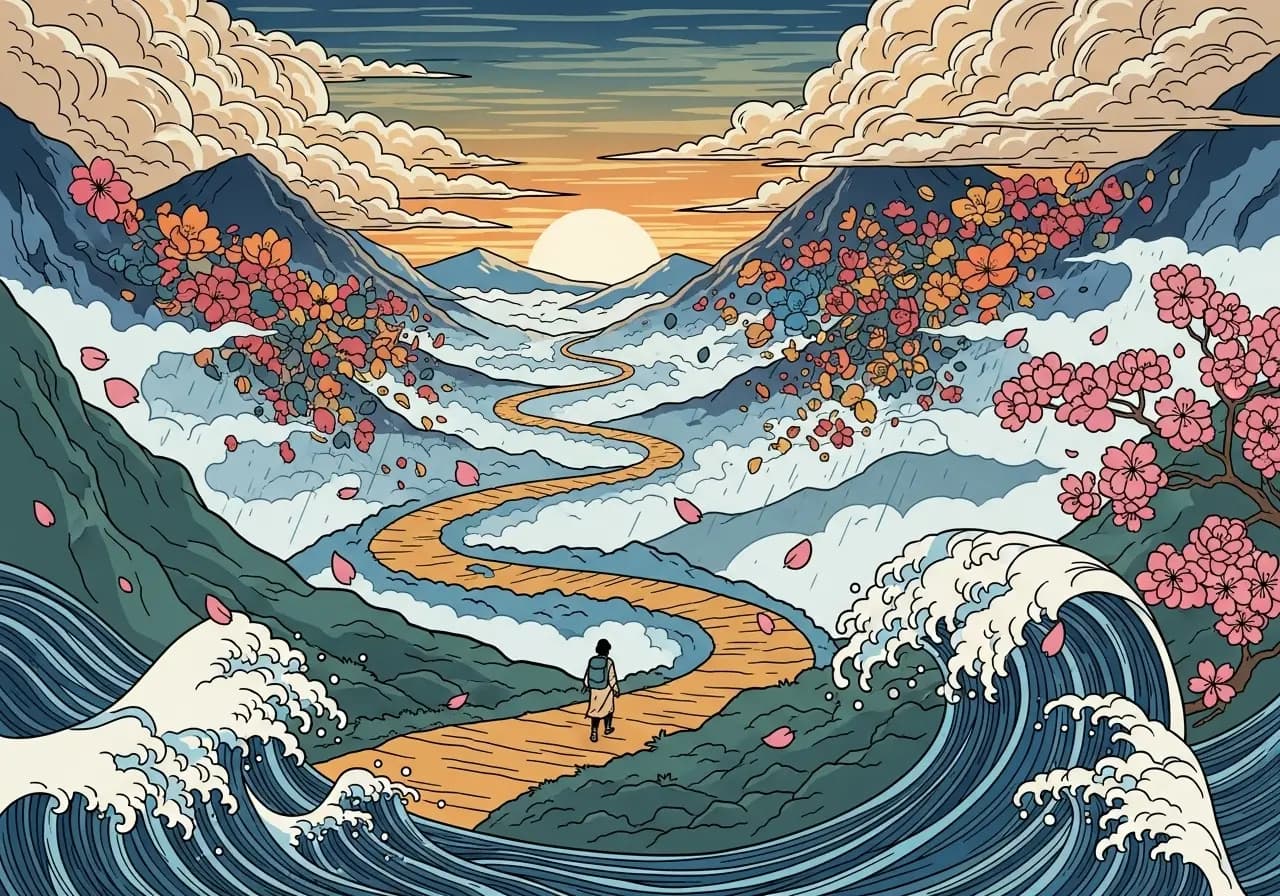
Thich Nhat Hanh says that we are endlessly running after love, wealth, happiness, enlightenment—whatever. Aimlessness means you are not attached to the goal. In other words, there is no object of pursuit. The path itself is the goal.
What arises out of this understanding is the realization that you really have no agenda that you need to be working on. There's nothing that you need to prove to anyone. A sense of liberation or freedom arises when you realize this.
Now, the word that is used in Buddhist teachings to refer to aimlessness is translated as aimlessness, but it's also translated as wishlessness. I like this translation better. Think of it as having no goal.
You know, when we talk about Buddhism, the most important—perhaps the key teaching of Buddhism—is that suffering or discontent or discomfort or anguish (there are many translations for this) arises when we want things to be other than how they are. Think of aimlessness as the flip side of that.
What is it that we experience? What arises when we don't wish for things to be any different than how they are? This is the notion of wishlessness or aimlessness. When I don't wish for anything to be any different than how it is right now, what is that feeling?
I know that we've all experienced this from time to time, perhaps only for brief moments. It may be while you're looking at a sunset or enjoying a song or a dinner or the company of a loved one or holding your child for the first time. In these instances, for a brief moment—for however long that moment lasts—you don't need anything to be any different than how it is. In that moment, you're experiencing aimlessness or wishlessness. You don't want anything to be any different than how it is.
The idea is that we can experience more of this feeling in our lives when we understand the nature of reality.
Having No Destination
One expression that comes to mind is a quote attributed to Ikkyu, the Zen poet and master. He says, "Having no destination, I am never lost." This hints at the notion of aimlessness. If I don't have a specific place where I think I need to be, I'm not lost, right? You're only lost when you're not where you intended to be. But if you have no intention to be anywhere, then you're not lost.
I think as funny and silly as that quote can sound, it's actually quite profound. To imagine what it would be like to live a life of wishlessness where you can't ever be lost because you have no destination where you intend to be.
Aimlessness implies that you don't need to put anything in front of you as the object of your pursuit. We can achieve this when we realize that what we are looking for is not outside of ourselves. Everything we need, everything we're looking for is already here inside of us.
The expression "you are what you are looking for" or "you are the one you've been waiting for" hints at this notion. I think concentrating on aimlessness eases the longing and the craving that we so often experience—craving that's centered in focusing on the future and elsewhere rather than on the here and now.
A lot of people spend their lives running after things instead of enjoying the simple experience of just being alive. We run after happiness. We run after love, relationships, money, fame, success, and even spiritual enlightenment, right?
We tend to chase after whatever the carrot is that we say: when I reach that, when I finally achieve this thing I'm after, then life will be okay. Then I'll be happy. But the reality is that the happiness and contentment we're running after is something we could experience right now if we stopped running.
The Prison of Goals
We live in a culture where goals are paramount. From a young age, we're told to set goals, chase after them, achieve them, and then set new goals. While goals can be helpful and useful, there's something we overlook in this constant pursuit. We overlook the fact that the experience of pursuing is actually where life happens, not at the destination.
Think about this. If I tell you I have a mission or a goal, and I set out on a path to achieve that goal, I start walking. As I'm walking, I'm thinking about the destination. I'm imagining what it's going to be like when I get there. I'm probably stressed about whether or not I'm going to make it. I'm wondering if I'm walking fast enough, if I'm on the right track, all these things that are pulling me away from the present moment.
But what if I just went for a walk without a destination in mind? Without a goal? Just walking for the sake of walking. Then I could notice everything as I'm walking. I could feel the breeze. I could see the trees. I could listen to the birds. I could be present with the experience of walking itself.
When we have a specific goal that we're attached to, we lose the present moment experience because we're always focused on somewhere else, some time in the future. This is the essence of what aimlessness is teaching us. It's not that we shouldn't walk. It's that we should walk without being so attached to where we're trying to go.
Now, here's where this gets interesting. When you look back at your life, have you ever noticed that you ended up in a very different place than where you thought you were going? And sometimes that place was even better than your original plan? That's the magic of having some aimlessness mixed into your pursuit.
The Death Meditation
Let me bring in another perspective on this. There's a meditation practice where you contemplate your own death. And I know that sounds morbid, but bear with me. When you contemplate your death—when you really sit with the reality that your life is finite and your time is limited—something interesting happens. Your priorities start to shift.
Things that seemed so important before suddenly don't seem as important anymore. You realize that you don't have the time or energy to pursue everything, so you're forced to get honest about what actually matters to you. And often, what you discover is that the things you've been chasing after weren't actually what matters to you at all. They were just things you thought you needed to achieve to be okay.
This is where aimlessness teaches us something really valuable. Yes, pursue things. Yes, have goals and ambitions. But attach to them lightly. Be willing to let them go if something else comes along that feels more aligned with who you are in this moment.
Impermanence and Non-Being
Now, there's another layer to this teaching that I want to explore with you. It has to do with our fear of death and non-being. We're often afraid of death. We think about what will happen after we're gone. We wonder what we're missing by not being here. It's interesting, though, because we don't have that same fear from the day before we were born.
Think about that. If what I'm fearing is "what's gonna happen when I'm not here?" why don't I feel that same fear at the beginning, thinking, "Man, had I been born a day earlier or a year before I actually was born, I would have been around for that time"?
We don't feel that anxiety on the front end. We only feel it on the back end. But the process is the same. Being and non-being. As long as you look at those as notions—separate things—you experience fear. But what happens when you eliminate those notions? When you think of being and non-being the same way we think of a cloud?
The wave has no fear of going up and going down, of going in and going out, of doing what a wave does. Because at the end of the day, the wave is just the ocean. We're no different than the wave.
Aimlessness in Practice
So here are some of my thoughts around this notion of aimlessness. Aimlessness doesn't mean that you don't pursue things or that we shouldn't have goals. We can still have goals. We can still pursue things. But how attached are we to the things that we pursue? How thoroughly do we understand why we're even pursuing those things?
Could it be that some of what we're pursuing is unskillful pursuit? How would you know if you've never stopped to give it time to think: "Is this something I should be pursuing? Why am I pursuing this?"
These are two questions I think we should all be able to answer when we get really honest with ourselves about why we're pursuing what we pursue: What is the object of your pursuit, and why is it that you're pursuing it?
It's a practice to avoid running your whole life without living it. You don't want to spend your whole life running only to realize at the end—if you're lucky, if it's not an abrupt ending—that you have regrets about not having lived life the way you wanted. What will you notice? What will you experience if you slow down and start to analyze the objects of your pursuit?
Walking Meditation
When we're practicing walking meditation, the aim of the practice is not to arrive anywhere. You don't say, "Okay, I'm walking from point A to point B, and I'm done when I get there." It doesn't work that way. Walking meditation is the practice of just walking—where you put one foot in front of the other and you're just walking. You're practicing walking peacefully.
What you may experience is a sense of contentment and joy that arises with the simple process of walking. No goal needs to be attached to it. If you enjoy walking, it doesn't matter where you end up, because it wasn't about ending up anywhere specific anyway. In other words, there's no goal attached to it.
So what if we were able to take some of that same style of aimlessness and apply it to our overall day-to-day life? In our Western culture, we're always walking after something—the career you're after, the financial goals, whatever it is. We have goals and we're attached to those goals. So what would happen if you allowed yourself to have a little bit more aimlessness in life?
Where you recognize: I don't have to arrive at this place, but sure, I'll still walk towards there unless something else comes along. And it's funny because if you look back at your life, you actually see that this happens, right? You have your life plan, but then things change. Life throws something at you, and you adapt.
My Own Journey
Let me give you an example from my own life. From a young age, my plan was to be a helicopter pilot. I had posters in my room about helicopters, and I knew that's what I was gonna do. When I reached the age to start doing it, right out of college, I jumped into flight school and started flying helicopters.
But as life would have it, things changed. The school I was in went bankrupt, which left me in a position where I wasn't able to continue down that path. I had to entertain other ideas—possibly joining the military and other avenues that didn't seem to work out well. Eventually, I had to pivot and say, "Okay, this path I tried—I tried multiple angles—and it's just not working. Let's try this other path."
That path was windy. It led to a place where I thought, "Okay, now I have a clear picture of what I want and what I'm chasing after." Well, that didn't pan out either. If you've listened to the podcast long enough, you know that the company I ran for eight years selling mobile phone photography accessories collapsed. I was left once again saying, "Okay, time to pivot."
And here I find myself at this specific point in time in my life—the here and now for me—doing something I never would have imagined. I teach people how to fly powered paragliders and paragliding. And I find so much joy in it. To be completely honest, I enjoy it more than flying helicopters. It's a more fun, more liberating style of flying.
If I had the opportunity to go back to flying helicopters and stop doing this, I don't think I would. I'd say, "No, no, I found this now." But this was never the destination I intended to be at. But it is exactly where I am now.
I think that's a little bit of that sense of aimlessness. Whether it's intentional or unintentional, a lot of us can look back and see we are where we are because of everything that's happened. We didn't intend to be here. But what if we had started at the beginning of the journey with that sense of aimlessness, saying, "I'm gonna try this, but we'll see where we go in the moment"?
Life throws a new Tetris piece at you, you pivot and you say, "Okay, well then, here's this new thing I'm doing." I think you would have a similar journey, but probably a lot more stress-free, a lot more enjoyable, and with a lot less unnecessary, self-inflicted suffering.
That's the overall notion hinted at in this Buddhist teaching of aimlessness. Hopefully some of that resonates and speaks to you. I know it certainly does to me.
A Mindfulness Trekking Adventure
Speaking of walking meditation, a couple years ago I led a group on a mindfulness trekking expedition to Nepal. It was a really fun experience, and we planned to do it again, but the following year COVID hit and cancelled it. The following year we planned it again, and travel restrictions were still in place, so twice it was cancelled.
Now we're going back this year. November 2022 is when we're returning to Nepal. I'm taking a group. I invited everyone who had signed up for the two years that it was cancelled, and the trip filled up with those individuals. I've since had several spots open up—about five spots that are open right now.
So I decided I would put it out there and mention it in the podcast. If you happen to be listening to this and you have any desire to trek in the Himalayas combined with a mindfulness retreat, it's a blend of a trek plus a retreat. It's fifteen days long. You can learn all about it and see all the details on mindfultrekking.com.
If it's something you're interested in, you can apply right there on the website to take one of these last remaining spots. If you have any questions, you can contact me on that same form. My contact information is on there.
That's just a side note I wanted to mention in case somebody's been thinking, "Hey, I'm up for some adventure."
Closing Thoughts
Well, that is all I have for this episode. I look forward to sharing more thoughts in a future episode.
I hope some of these concepts and ideas resonate for you and help you experience a life with a little bit more aimlessness and a lot more peace, contentment, and joy. Remember: you're not lost because, having no destination, I am never lost.
Thank you for listening. Until next time.
For more about the Secular Buddhism podcast and Noah Rasheta's work, visit SecularBuddhism.com