

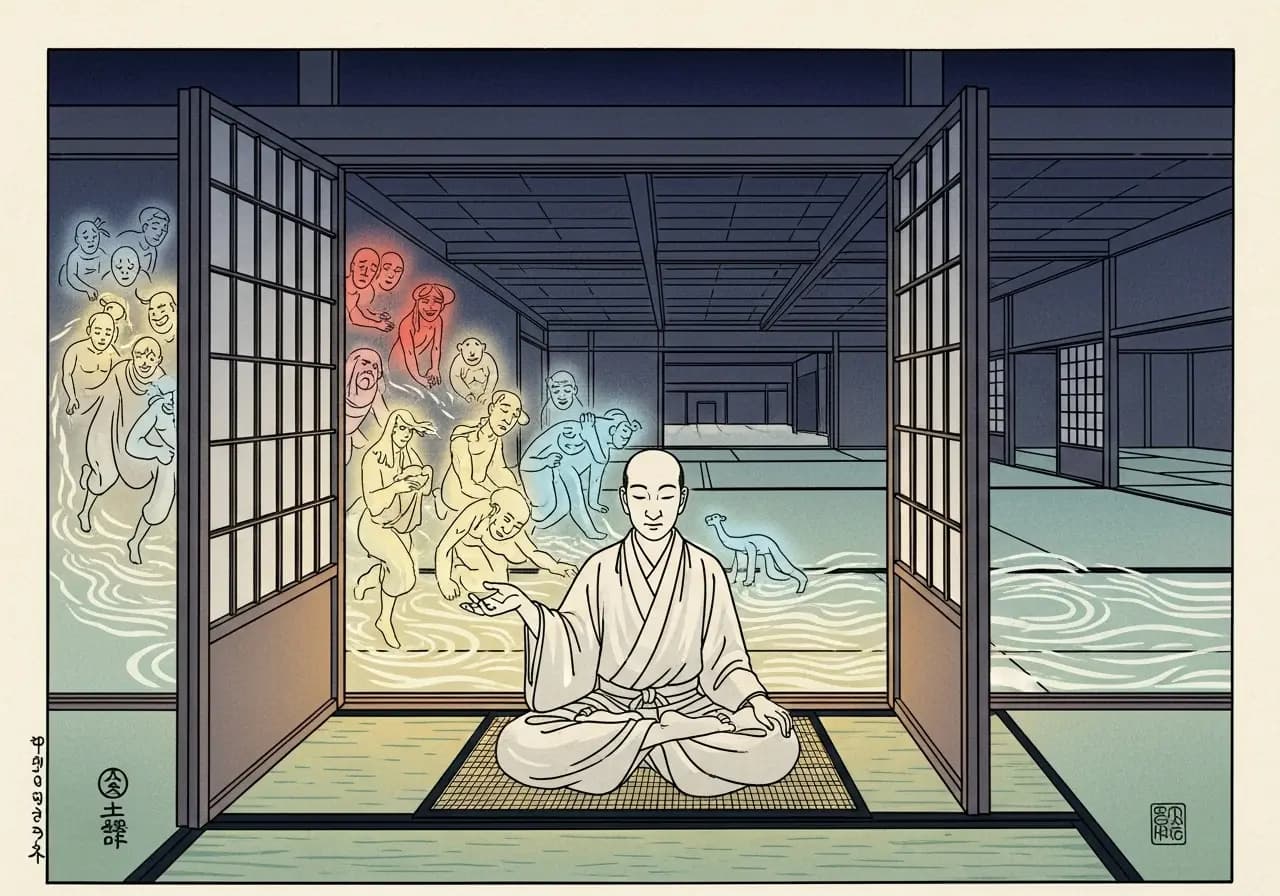
Welcoming the Unwanted
Episode 166 of the Secular Buddhism Podcast
Hello and welcome to another episode of the Secular Buddhism Podcast. This is episode number 166. I'm your host, Noah Rasheta, and today I'm going to talk about emotions.
Keep in mind that you don't need to use what you learn from Buddhism with the goal of becoming a Buddhist. You can simply use what you learn to be a better whatever you already are.
If you're interested in learning more about Buddhism, check out my book, No Nonsense Buddhism for Beginners, on Amazon, or listen to the first five episodes of this podcast. You can find those episodes easily by visiting SecularBuddhism.com and clicking the link that says "Start Here."
If you're looking for a community to practice with and interact with, consider becoming a patron of the podcast by visiting SecularBuddhism.com and clicking the link to join our community.
Introducing Vedana
In today's podcast episode, I want to introduce you to a word, a term, and a concept that comes from Buddhism: Vedana.
I'm not sure if I'm pronouncing that correctly, but it's V-E-D-A-N-A, and this comes from the Pali and Sanskrit. It's an ancient term traditionally translated as either feeling or sensation.
In general, the word Vedana refers to the pleasant, unpleasant, or neutral sensations that occur when our sense organs come into contact with sense objects and the associated consciousness. This is what psychology refers to as the hedonic tone.
Vedana is a term identified within several Buddhist teachings: the teachings of the universal mental factors, the teaching of the twelve links of dependent origination from the Theravada school of Buddhism, the Mahayana schools of Buddhism. It's one of the five skandhas—the five aggregates that make up who a person is in all Buddhist schools. And it's also one of the objects of focus within the four foundations of mindfulness practice, which is another major common practice within all schools of Buddhism.
So it's a concept that's very well known in Buddhist practice and Buddhist thought. I wanted to talk a little bit about it.
In the context of the twelve links of dependent origination, craving for and attachment to feelings—or in other words, I'm going to use the word "feelings" from here on out—craving and attachment to feelings is what leads to suffering. And the flip side of that is awareness and understanding of our feelings is what can lead to enlightenment and the extinguishing of the causes of our suffering and anguish.
So I want to unpack this concept a little bit. What does it mean to welcome the unwelcome?
Understanding the Concept of Welcome
Well, first of all, let's talk about welcome. To welcome something is to behave in a polite or friendly way to a guest or a new arrival, something that arrives. I like to use this analogy in my own personal practice.
I like to picture in my mind a giant table, perhaps a room—a room with a table—where the room and the table represent my mind. The doors and windows that are open are the way that things enter this room. All the guests that come and go—these are memories, thoughts, feelings, emotions, sensations. These are all the things that come and go.
And the emotions, specifically the emotions, those are the guests.
You see this represented in the animated film for kids, Inside Out, which I think did a really good job of representing the way the mind works. In the show, you have the main character—a little girl—and in her mind, you have a control booth, a table of sorts, but it's the command module for this girl, for her mind. At the table, you have the various emotions: anger, disgust, joy, sadness. And these are the characters that often influence or command the inputs at the table.
And it's very much the way our mind works. It's what psychology teaches us about the way the mind works, and it's also the Buddhist understanding of the correlation between emotions and actions.
Labeling Our Experiences
So again, going with this visual to work with, you can picture an empty room in your mind where thoughts come and go, memories come and go, feelings come and go.
But imagine when they do come in, we tend to put a sticker on them. You know those little stickers that you wear that say, "Hello, my name is..."? Like that. We label: "Here comes joy. Let me put a sticker on to make sure I know this is joy."
And not only do we label what it is, but we also have a feeling tone associated with this. And this is where that concept of Vedana comes in. It's the feeling tone that I have of whatever it is I'm experiencing.
So here comes joy. Joy enters the room. Okay, that's joy. I'm going to put the green sticker. Green is the one I like. I want joy to be here.
Oh, here comes anger. Okay, I'm going to label this anger. But this gets the red sticker: "You are not welcome here."
That labeling—that feeling that arises in association with the experience we're having—immediately alters the relationship we have with the guest that just showed up.
The Three Types of Guests
There are three types of guests. There's the welcome guest, there's the neutral guest, and there's the unwelcome guest.
The relationship with the welcome guest varies. It ranges from "Hey, I like you, please stay here longer" to, on a more unhealthy level, "Please don't leave. I'm going to tie you to this chair so you can't leave this room."
We have relationships like that with thoughts and feelings and emotions that come into our mind, don't we? With some of them, it really is like that. It's "please stay longer." But with others, don't we go way out of our way to try to prevent that feeling from leaving?
Then there's the neutral guest. It kind of just comes and goes. I won't even spend much time with it because it's neutral and we don't focus heavily on the things that make us feel neutral that way.
But then there's the unwelcome guest. This relationship ranges from, "Oh crap, here it walked into my room. Let me shoo it away. Let me take this broom and swat it. Come on, get out of here," to more aggressive approaches. I take a pointy thing and poke and prod at it. Get out of here. Or even more aggressive: Now I'm going to put bars on the window. I'm going to dig a moat outside my door that you can't cross. I'm going to get very aggressive and try everything in my power to get you out of here or to keep you from coming in.
The Key Insight: It's About Relationship
What I want to focus on here from the Buddhist concept of feelings and what we call feeling tones in Buddhism is this: It isn't about the guest, it's about the relationship that you have with the guest. In other words, it's the feeling that arises when that guest appears.
With feeling tones, they are pleasant, unpleasant, or neutral. And the Buddha taught that attending to feeling tones allows us to be present with the experience where we then have the ability to discover that perhaps something that is pleasant can also be unpleasant, or vice versa. Something that's unpleasant could also be pleasant. And neutrality does play a role in this too.
But we're not focused on changing the feeling. In other words, we're not trying to change the experience we're having. What we're trying to do in the context of Buddhist practice is see if we can have a more skillful relationship with the experience we're having by paying attention to the feeling that arises throughout the experience.
When we practice awareness, we're paying close attention to the feeling tone that arises with each thought or emotion.
Observing the Secondary Experience
For example, first I notice what I'm experiencing, and then I notice how I feel about what I'm experiencing.
I may notice, for example, "Oh, I'm experiencing anger. Suddenly anger arises." And then I notice right away that the feeling of anger is an unpleasant feeling. And then I can spend time with that secondary experience.
Being angry isn't the issue, but how I feel about being angry is where I have power to observe, understand, and perhaps change that relationship.
It could be that the anger I'm experiencing arises simply because of an unskillful conditioned belief. For example, maybe I have a belief that I shouldn't be the type of person who gets angry. Good guys don't get angry. So when anger shows up, I get angry about being angry. That's the secondary feeling tone.
And that is where my suffering is. The suffering isn't in the anger itself. The suffering is in my relationship to the anger, in the feeling tone I've created around the experience of being angry.
The Practice of Welcoming
So when we talk about welcoming the unwanted, what does that really mean?
There's nothing wrong with this anger. This is just what is. What can I gain? What insight can I gain out of this? Because insight there is the key. Understanding is the key.
With insight and understanding, what ends up happening is a change in the relationship you have with the thing that you're experiencing. That is the goal, and I need to emphasize this again: The goal here is not to take the experience and change it. Get rid of sadness so happiness can be here. It's not that. We're not trying to alter the thing we're experiencing.
We're trying to have a more skillful relationship with that thing.
This is where I want to echo again the story of the Sticky Hair Monster. If you need a refresher, this is episode number 138, or just Google "the story of Prince Five Weapons and the Sticky Hair Monster." This is from the Jataka Tales, a collection of Buddhist stories. There's a really important lesson to be learned there.
When you notice what you're experiencing, then you pay attention to the feeling tone that arises with that experience. In other words, I notice: Is this pleasant? Is it unpleasant? Is it neutral? Is it something that I want? Is it something that I don't want? Or something I don't really care about?
Then what you see is if you can focus on changing the relationship you have with the experience. Like the story of the Sticky Hair Monster with the Prince, the Prince remained the prince throughout the whole thing. He didn't change. The monster was still the monster. But through the change in relationship by the Prince—spending time with the monster, stopping fighting it, just sitting with it, talking to it, getting to know it—what happened is the relationship between the two changed.
At the end of that story, the Sticky Hair Monster is still a Sticky Hair Monster. It may be stinky and unpleasant and all the things it was. The Prince remained exactly who he was. But the relationship between the two changed. And the relationship is the key.
With a skillful relationship, he was able to continue on his journey. With an unskillful relationship, he could have just died there at the hands of the monster like everyone else did, because the relationship is the key.
When We Welcome the Unwanted
So I want to emphasize that again. With this notion of feeling tones and welcoming the unwanted, when you're welcoming the unwanted, it's not about making the unwanted turn into something wanted. You don't have to think about it that way.
Welcoming the unwanted is allowing the thing that you don't want to be there—the guest that comes into the room—to be there. Okay, here it is again. There's that guest.
Let me welcome it. Let me be more friendly and cordial. I'm not going to push it away.
"Anger, hey, it's you. You're back. Man, I haven't experienced you in a while. Okay, well, here you are. Sit down. Let's talk. Why are you here? What's going on?"
The relationship with the emotion will change. And I have experienced this in my own life with anger specifically.
My Personal Experience with Anger
One of the most difficult stages in my life was a period where I was experiencing a tremendous amount of anger. And with time, what I recognized is that I was experiencing an even more tremendous amount of anger about being angry. And that's the key here, right? It's the secondary feeling.
I was so angry about being angry because of the conditioned belief I held that I shouldn't be the type of person who's angry. Good guys don't get angry. That was a belief that led to years of very difficult experience.
What changed all of that was when I finally realized, "Oh my gosh. Why am I pushing it away? Just be angry. It's okay to be angry."
And for the first time in that whole phase and that whole ordeal, I allowed the anger to just be there. So what? I'm angry. And guess what? With time, the guest got up and walked away and left the room. And that was it. It's never been back to that degree.
Sure, you can get angry about little things, but it turned out in my own personal experience that fighting the anger made the anger more strong and more prevalent, just like exactly like the story of the Sticky Hair Monster.
It Works With All Emotions
Now, this is the same with grief. It's the same with sorrow and sadness. It's the same with guilt. Any emotion that you can label that you would think, "Wow, that's a really unpleasant one. I don't want that one here"—fight it and resist it and it will be worse. It will be stronger. It will not go away through sheer force of will.
You can't will these things to go away. You can't yell at it and say, "Get out of my house, get out of this room." It doesn't work that way.
You have to sit at the table with the emotion and say, "Here you are. I'm sorry I've been pushing you away. I'm sorry that I've done everything I can to keep you away. Now let's change that. I'm willing to talk. Let's sit down. Let's talk to each other. Tell me why you're here. And I am not going to feel bad about you being here.
Sorrow is what I'm feeling. Fine. Okay. Feel sorrowful. Spend time with it. Change the relationship with it. See the magic that takes place when you do that."
Or guilt, or shame, or any of these strong emotions—the same approach applies.
The Invitation
So that's the invitation I wanted to leave you with in this podcast episode: the Buddhist notion of welcoming the unwanted, or spending time getting to know the feeling tone that arises when you are experiencing a thought, a feeling, an emotion.
And then what happens as you sit with that and change the relationship you have with the emotion? Again, the goal is not to get rid of or change the emotion into something else. The goal is to have a more skillful relationship with it.
The evolution of what that does to it is secondary. That's going to happen with or without your effort at that point because of the nature of things being impermanent and things being interdependent.
Turns out if you welcome anger and you're at peace with anger, anger might say, "Okay, never mind. I don't want to be here." And it'll go away. Again, I say that through experience.
So the goal of this episode is to think about these experiences you're having in life, and then think about the relationship you have through that filter of: Is this pleasant? Is it unpleasant? Do I want it? Do I not want it? What things am I neutral about?
And in that inquiry, in that internal looking in, insight is what will arise. Understanding is what will arise.
And with that insight and understanding, the relationship between you and the experience you're having—the relationship between you and whatever your Sticky Hair Monster is—that relationship will change.
Closing
Alright, well that's all I have for this podcast episode. I hope you enjoyed hearing my thoughts around this concept, and I look forward to sharing more thoughts in a future episode.
Thank you for taking the time to listen.
Until next time.
For more about the Secular Buddhism podcast and Noah Rasheta's work, visit SecularBuddhism.com