

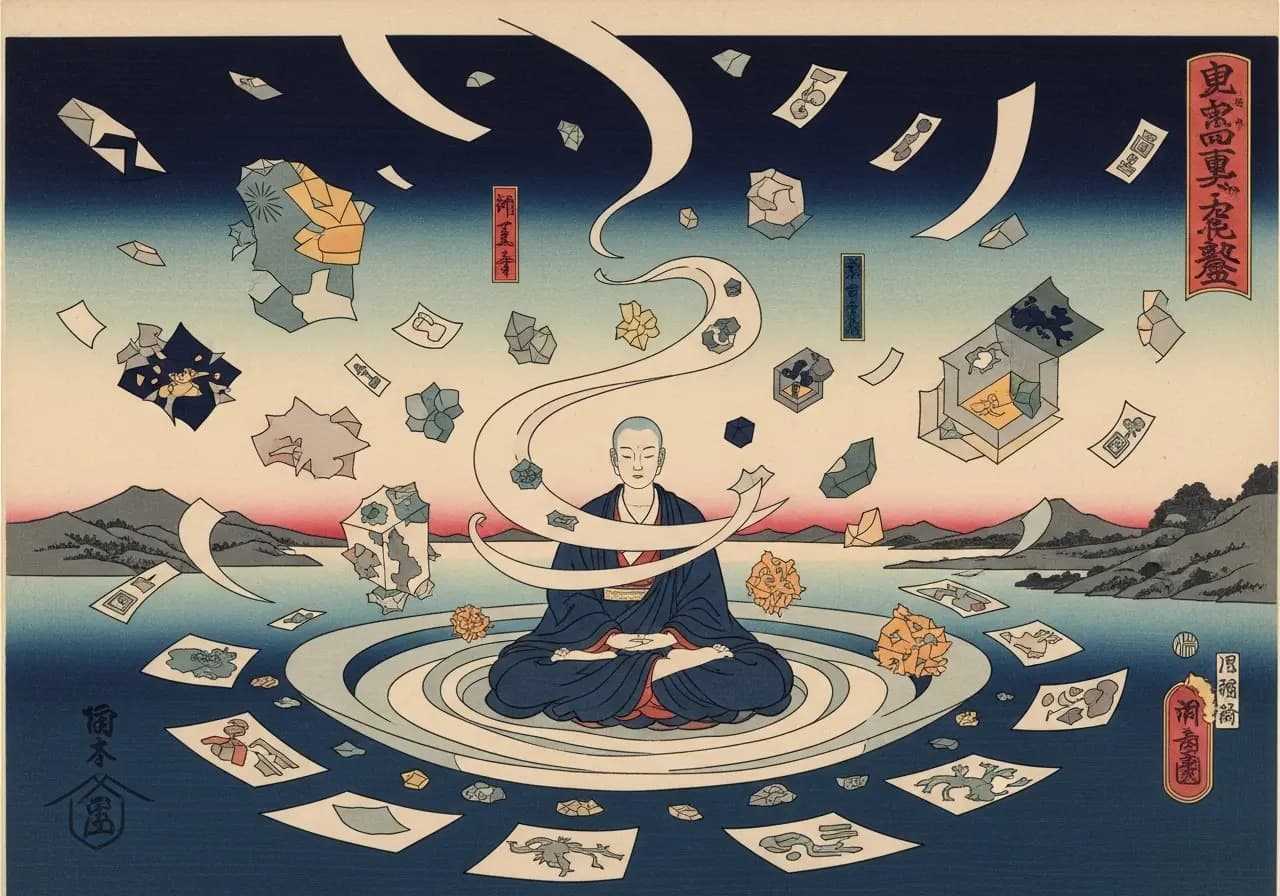
Unlearning
Episode 165 of the Secular Buddhism Podcast
Hello and welcome to another episode of the Secular Buddhism Podcast. This is episode number 165. I'm your host, Noah Rasheta, and today I'm going to talk about the process of unlearning.
Keep in mind you don't need to use what you learn from Buddhism to be a Buddhist. You can use what you learn to be a better whatever you already are.
If you're interested in learning more about Buddhism, check out my book, No Nonsense Buddhism for Beginners, available on Amazon, or listen to the first five episodes of the podcast. You can find those easily by visiting SecularBuddhism.com and clicking on the "Start Here" link.
If you're looking for a community to practice with and to interact with, consider becoming a patron by visiting SecularBuddhism.com and clicking the link to join our community.
The Quote That Started It All
Alan Watts used to say that a scholar tries to learn something every day, but a student of Buddhism tries to unlearn something every day.
I mentioned this in the last podcast episode, and I've had this thought on my mind regarding this quote. What does it mean to unlearn? I thought it would be fun to share some of my thoughts around this topic.
If you look up the definition of learning, it's the acquisition of knowledge or skills through experience, study, or by being taught. And I like to think of unlearning as defined as the surrender of unskillful knowledge or unskillful habits through experience, study, or being taught.
So in this sense, why would it be beneficial to surrender knowledge? I like to think of this in the Buddhist context of non-attachment. And think of this again in the context of truths.
Understanding Different Types of Truths
In my original book, Secular Buddhism, I talked about how truths come in different flavors, different types of truths. If I recall, I talked about universal truths, personal truths, and conditioned truths.
Universal Truths
Let me use a simple analogy here with hot sauce. A universal truth would be: for example, hot sauce when placed on food makes that food more spicy. That's something that's applicable to any form of measurement. That is a consistent truth. If you put hot sauce on food, that food is going to be more spicy than if it doesn't have hot sauce on it.
Personal Truths
Then you have personal truths. The personal truth may be, for me, that hot sauce tastes better on scrambled eggs than ketchup does. This is a personal truth. I've come to understand that it's personal because I've tested both hot sauce and ketchup on scrambled eggs, and I prefer the taste of hot sauce.
But I have observed others who have also tested both—my wife actually, who prefers ketchup on scrambled eggs and says that tastes better than hot sauce. So it's easy for me to understand: okay, then this is a personal truth. It works for me, it doesn't work for her, and her truth is the opposite. Ketchup tastes better on scrambled eggs than hot sauce, according to her experience.
Conditioned Truths
Then you have the third type of truth, which I call conditioned truth. These are truths that arise based on views that may be held by a specific group or a specific culture in the context of a specific time.
For example, the "truth" may be when someone expresses: "You're not a real Mexican if you don't eat hot sauce on your food." Now, oddly enough, this is an expression that I've only ever heard among non-Mexicans poking fun at Mexicans who don't like spicy food. But again, these are views that are held within a certain group.
Think of beliefs during the Middle Ages, for example, with regards to the Black Plague and cures for it. There was a time that someone would have told you that it is a truth that if you have the Black Plague, bloodletting and putting leeches on your body to suck out the bad blood is a way to treat this disease that's going around. Well, that would be an example of a conditioned truth. In the context of a certain place and time, people believed that is true. And it's not outside of that context. In fact, it's not true when you look at it through the scientific method, but that's how conditioned truths work.
Another example of a conditioned truth would be the societal norms or views that we have that say: when a baby is born, you get blue balloons if it's a boy, and pink balloons if it's a girl. Therefore, blue is the color of boys, pink is the color of girls. That is a conditioned truth.
Now, there is truth to it—you don't need to simply dismiss it because there's real practicality behind it. It would still, depending on who you are congratulating when they have a baby, it may be inappropriate to send them a pink dress if they just had a boy, or if they had a girl to send them whatever the opposite would be, something that's typically viewed as for boys. But deep down inside, you know there's really no truth to it. It doesn't matter if the baby's wearing a pink dress, whether it's a boy or a girl. It means nothing about anything. It's just a conditioned view. It's a conditioned truth.
Separating Skillful from Unskillful Views
So those are the three truths, or three ways to look at truths. For me, this process of unlearning starts with learning to separate the skillful views that I have versus the unskillful views that I have.
Skillful view is the first of the Eightfold Path. The Eightfold Path consists of right view, or skillful view, or wise view as I like to refer to it. And it's essentially this: it's looking at all the views that you have—the view you have of yourself, of others, of reality—and then putting it through this filter: Is this skillful or is this unskillful? Where did these truths come from? Is it a universal truth? Is it a personal truth that I hold? Is it a conditioned or societal truth that I hold?
Three Contexts for Unlearning
The process of unlearning correlates to three different things.
First Context: Growth Mindset versus Fixed Mindset
The first is the growth mindset versus the fixed mindset. If you're familiar with this concept, a growth mindset means you believe that your skills and knowledge can develop or can increase over time, while a fixed mindset means you typically believe that knowledge and skills are fixed. If you're not good at something, you might just believe you'll never be good at it.
For example: "Oh, I've tried meditation and I'm not good at it. I'm too easily distracted, therefore meditation is not for me." That may be an example of a fixed mindset that says, "I can't ever be good at this thing." And it totally fails to recognize that the growth mindset approach would be: "Well, I can practice it and over time I can be good at it."
I recognize this with really anything, right? Watching the Olympics recently, I was thinking, "Man, figure skating looks so difficult." But I know that if I were to spend time doing it—a significant amount of time and a significant amount of practice—I could be good at it. Maybe not an Olympian, but way better than I am now, which is I can't do it at all.
I think it's easy to think about it like this when we think about skills and knowledge. These are things that you spend time doing and you can get better at them. That, in a nutshell, is the growth mindset versus the fixed mindset. So for me, the process of unlearning is seeing where I get stuck, where I have the fixed mindset, and unlearning that truth—"oh, I'm like this, I can never be good at that."
Second Context: Habitual Reactivity versus Skillful Action
The other context of unlearning correlates to habitual reactivity versus skillful action. This is something common in Buddhism: the understanding that as we grow up and we start to develop habits, we become habitually reactive. So when this happens, I do that.
For example, somebody calls you a name, you feel angry. That's a habitual response. Is there any deep truth in that? No, it's just a conditioned view that you're not supposed to be called names. That's maybe a conditioned truth, right? So then when I am called a name, I automatically feel a certain way. And what we're trying to understand here is that skillful action may be the opposite or a different approach—doing what is appropriate for a specific set of circumstances and time.
You can see this with another quick example in businesses, especially with technology. Imagine the difference between Blockbuster Video, for those of you who remember it, and Netflix.
At one time, Blockbuster was the source where you would go to rent movies. You'd walk in there and they would have all the movies you wanted to watch on VHS. You'd pick out the movie and rent it, go home and watch it, and bring it back. It was a very successful model and a very successful company.
But time and the industry and technology changed things. DVDs came along, and Blockbuster evolved for a while and had DVDs as well. Netflix came around at that time and started with a new model where you didn't have to go to the store. You could go onto a website, which was a more efficient way to pick the movie you're going to watch, and they would mail it to you. You would get a DVD in the mail.
Well, as technology continued to evolve, Netflix evolved with it and changed their model entirely—from mailing out DVDs to a streaming platform. Today it's almost hard to imagine that there was a time when Netflix was sending out DVDs in the mail. You'd tell someone this and they'd be like, "What are you talking about? Netflix is the big streaming company where you watch movies online."
Well, that wasn't always the case. But Netflix was able to unlearn the model that was working when they realized this isn't going to continue working. So they evolved. And that process of unlearning led to learning and adapting to a new model.
For me, that's at the heart of this notion of unlearning: being stuck with something the way it is and saying, "No, this is how it is. We're gonna stick with this because this is how it is." Then history or things around you change and you don't evolve with it, and you fizzle out. That's exactly what happened to Blockbuster versus Netflix. So that's another way of thinking about this process of unlearning.
Third Context: Certainty versus Doubt
The third way is correlating this notion of unlearning to the Buddhist teaching of doubt. And here we have the teaching of Zen Master Hakuin, who said: "Great doubt, great awakening. Small doubt, small awakening. No doubt, no awakening."
This is another important thing to have in mind. When we don't doubt, we remain ignorantly sure of ourselves. With blinded certainty about the world around us, our mind becomes fixed and set with ideas and misconceptions about how things are. And this certainty is precisely what we must drop in order to start experiencing a more skillful view of reality and of ourselves and others.
So this notion of unlearning correlates to certainty and doubt.
How to Practice Unlearning
How do we practice unlearning? Well, one method that Zen Master Hakuin used was the expression: "Is that so?"
"Is that so?" introduces an element of uncertainty to any scenario. The idea here is that a thought arises: "This is this and that is that." And then you can add at the end: "Is that so?" It's a way of introducing doubt to everything. This plays a little bit off of the notion of "Who knows what is good and what is bad?" right? We don't know what's coming next, so: Is this a good thing? I don't know. Is it so? Is it a bad thing? Is it so?
The Story of Hakuin
This actually comes into play in a story with Hakuin. One time, a girl whose parents owned a food store that lived near Hakuin discovered that the girl was pregnant. The parents were angry at her. She didn't want to confess who the father was. But after a lot of pressure and harassment by the parents, she finally said: "It was Hakuin."
The parents were extremely angry, and they went to the Zen master. And his response was: "Is that so?"
That's all he would say. The child was born, and then the parents brought the child to Hakuin. By this time, he had essentially lost his reputation as a Zen master or whatever. But he still practiced and did everything. He didn't care about his reputation. It didn't trouble him that he had lost it, even though everyone was talking behind his back: "Oh, that's Hakuin. Yeah, apparently he's the father of that child."
Hakuin took care of the child. He was able to spend time raising the child and doing everything that the child needed. And it wasn't until years later, when the girl couldn't stand the lie any longer, that she finally told her parents the truth: the real father of the child was this young man who worked in the fish market. She hadn't wanted him to get in trouble, or for whatever reason.
The mother and father immediately went to Hakuin and they asked him for his forgiveness and apologized. They asked if they could have the child back, and by now the daughter was willing to be a mother. Hakuin smiled and willingly yielded the child, saying: "Is that so? I'm glad to hear that this child now has his or her father."
I think this is an example of allowing ourselves to introduce uncertainty into the equation. Now, this isn't to say that Hakuin was thinking, "Oh, maybe I am the father." It's not that. He was saying, "Maybe this is what's best for this child. I'll go along with it. My reputation doesn't matter."
Like I talked about in the last episode, episode 164, "Sticks and Stones, Nothing to Defend," I think we see echoes of this. Hakuin was not troubled by the accusations because he knew he had nothing to defend. He knew perfectly well what he had or hadn't done.
So he was able to do what felt like the skillful thing, which in this moment was: "I'm going to care for this child because this child is probably rejected at home by a mother who doesn't want to raise it and by grandparents who now think poorly of this child because they think it's mine. So this poor child—I'm going to raise it." And that's what he did, without any consideration to a story that he had to defend about his honor or his reputation or things like that.
He did what was skillful in that moment. And he also did what was skillful in the moment when it came to return the child. I think there's a neat story to be learned in that.
The Heart of the Teaching
Again, this isn't about approaching these concepts from the perspective of right and wrong. We're approaching from the perspective of doing what is skillful versus unskillful.
And to me, that is what is at the heart of this overall teaching of learning versus unlearning. Unlearning is the surrender of unskillful knowledge or unskillful habits through experience, study, or by being taught.
That's all I have for this podcast episode, but I look forward to sharing more thoughts in another episode soon. Thank you for listening, and until next time.