

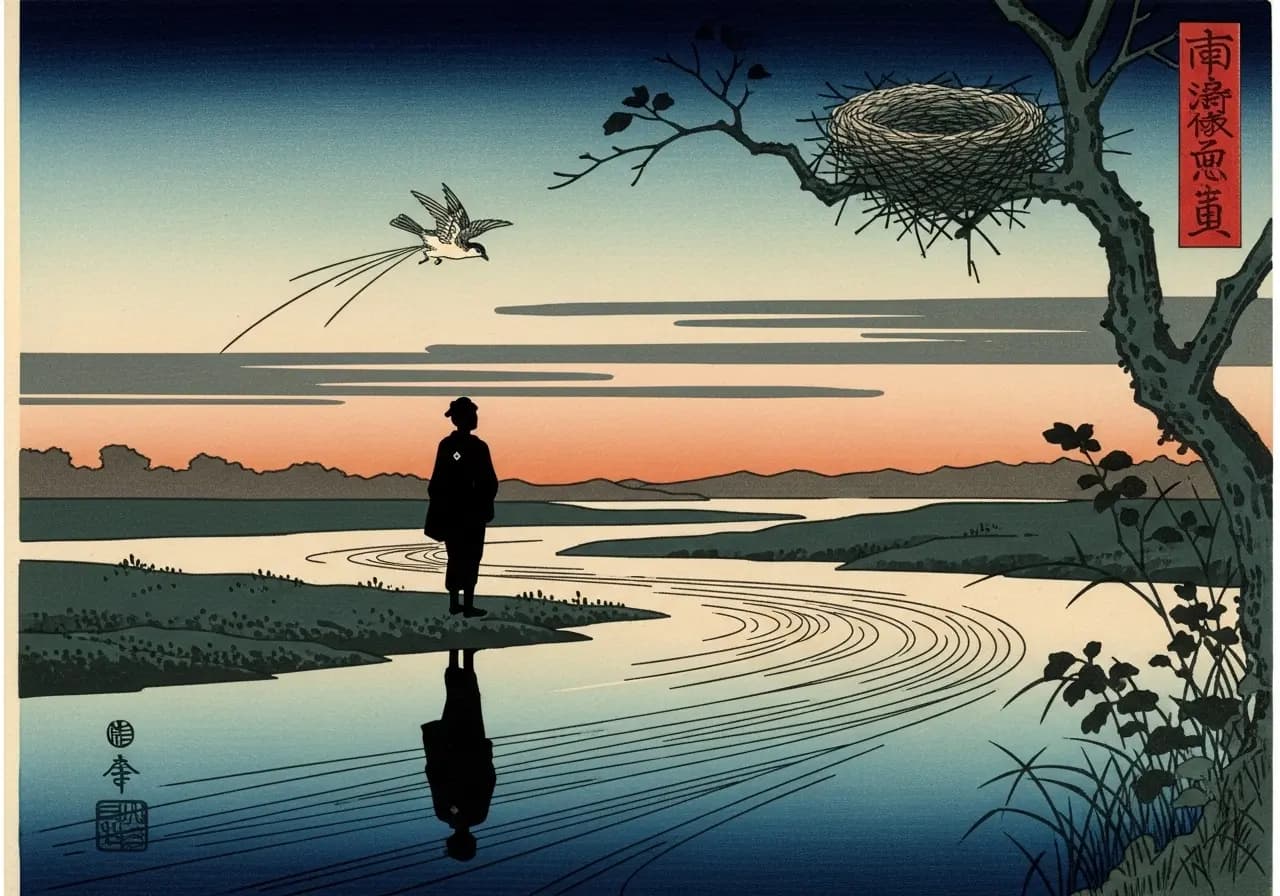
Thrown Out of the Nest
Episode 164 of the Secular Buddhism Podcast
Hello and welcome to another episode of the Secular Buddhism Podcast. This is episode number 164. I'm your host, Noah Rasheta.
Today I'm going to share some thoughts regarding the Buddha's final teaching. As always, keep in mind: you don't need to use what you learn from Buddhism to be a Buddhist. You can use what you learn to simply be a better whatever you already are.
If you're interested in learning more about Buddhism, check out my book, No Nonsense Buddhism for Beginners, available on Amazon, or listen to the first five episodes of this podcast. You can find those episodes by visiting SecularBuddhism.com and clicking on the link that says "Start Here."
If you're looking for a community to practice with and interact with, consider becoming a patron and supporter of the podcast by visiting SecularBuddhism.com and clicking on the link that says "Join Our Community."
A Note About Our Community
This week I wanted to share some of my thoughts regarding the Buddha's final teaching. This comes from the book Old Path, White Clouds. As part of the podcast supporters group on Patreon, we have a study group and we read a book assignment every week. The book we've just finished is Old Path, White Clouds, and that's where some of these thoughts come from.
On Sundays, I do a live Zoom call with podcast listeners and supporters. We have discussions around specific topics, and all of the topics I'm sharing today come from conversations we've had on these Zoom calls. While the podcast comes out once every few weeks—not as often as I'd like—the real conversation is ongoing. It takes place on Sundays at noon. If you want to be more engaged with the topic or with Buddhist practice, that might be a great place to start. You can check that out if you become a supporter of the podcast. That information is on the website.
I wanted to start with that because that's where these topics are coming from. Over the last two or three weeks, we've been discussing different ideas, and these ideas have come together in what I want to share in this podcast episode.
Leaving the Nest
First is this notion of leaving the nest. I'm thinking about this for a few reasons. I'm in Arizona this week teaching a powered paragliding course, and in a way, the process of teaching someone how to fly involves a moment where the proverbial being "kicked out of the nest" takes place—in a literal way with this. You're teaching someone to fly, but at some point they're going to have to learn to attempt that first solo flight where they're all alone. That's kind of like being kicked out of the nest.
There's a quote by Pema Chödrön where she says, "To be fully alive, fully human, and completely awake is to be continually thrown out of the nest." I like this expression. The notion of being thrown out of the nest.
Life has a way of throwing us out of the nest. Sometimes you leave the nest because you were ready and you wanted to. Sometimes you're thrown out of the nest. Sometimes you slip and fall out of the nest. Sometimes lightning strikes the branch and the nest comes flying down. There are many reasons—or causes and conditions—that can put us in the place where suddenly we are out of the nest.
This is something I think we need to take into consideration when we're trying to apply Buddhist concepts and ideas into practice: this notion that life is always throwing us out of the nest, and this happens in many ways.
You become comfortable in the womb, and then suddenly you're thrown out of the nest—you're born. You're just starting to get comfortable as a toddler, and then you've got to go to school. You're comfortable being on your own, and then suddenly you fall in love. Or you're comfortable being in a relationship, and suddenly the relationship ends. Or you're comfortable with a job, and then suddenly the job fires you, or the company goes bankrupt. Things happen. We're constantly being thrown out of the nest—the nest being wherever you are that feels comfortable at the moment. That's the whole notion of the nest, right? It's the place of comfort.
And what happens when suddenly you're not in that place of comfort?
The Buddha's Final Teaching
So that's one idea I want you to hold in mind as I approach this topic—the notion of leaving the nest and the Buddha's last teaching.
The Buddha's last teaching took place when he was roughly eighty years old, towards the end of his life. Throughout all this time, he had gathered a significant number of followers and people who wanted to learn his ways and his teachings. One of the great concerns they had as he was getting older and getting closer to the end of his life was fear: "What are we going to do once you're gone? Once the teacher's gone, then what happens?"
One of his final teachings was this: "Be an island unto yourself." The notion is that you can take refuge in yourself. You will be your own next teacher. It's essentially what he was telling his followers and his disciples. I think there's a profound lesson in that, and I want to expand on it.
But first, let me go back to some of these other thoughts I've had in our previous Sunday Zoom calls—topics we've discussed as a group. One of them that I think correlates with everything is the notion of "the other side."
This emerges from a story I've shared on the podcast before: the story of a gentleman trying to cross a river. He can't find a spot to cross, but he notices a monk sitting on the other side. He yells out and asks him, "Hey, how do I get to the other side?" The monk looks around a little bewildered and says, "You are on the other side."
That's a funny story that has a very profound implication, especially in Buddhist practice. As Jon Kabat-Zinn says, "Wherever you go, there you are." The place where you are is different for you than it is for someone else based on perspective. In this case, the monk on the other side was completely accurate in saying, "You are on the other side," because according to his perspective, that's exactly where this person was.
Perspective and Presence
I think when we take this thought and consider what it means, it's like the Japanese proverb that says, "The reverse side also has a reverse side." I think a lot of times we focus on where we want to be. But the journey—where we're going and where we want to be—it starts with awareness of where you are now.
Buddhism very much emphasizes this notion that the journey is the goal. And if that's the case, where you are now is more important than where you will be later—certainly because where you are now influences where you will be later. Rather than putting all the focus on the end goal, you focus on the present and where you are right now.
Going back to the analogy of the man standing at the edge of the river: to recognize "I want to be on the other side," there has to be this profound acceptance of the fact that I am on this side—which is the other side if I were standing over there.
Now, that's not to say "Okay, well then you stay where you are and you don't have to do anything." It's not that. It's saying that to be skillful with whatever you're going to do next, to get to where you want to go next, you have to be keenly aware of where you are now.
I think Buddhist practice is, in some ways, essentially becoming keenly aware of where you are. It's very much a practice of understanding.
The Nature of Where You Are
This applies not just to your physical location—where you're physically standing—but in terms of what you're experiencing in life. We all have different phases that we go through, right? When you're experiencing certain emotions, that emotion you're experiencing is where you are. That's the thing you're experiencing.
There's always this focus to be other than where we are. We want to be over there, right? On the other side of the river. I'm over here experiencing grief or sadness, but I want to be over there experiencing joy or contentment. This teaching flips all that on its head. It's saying: "Don't focus on there. Really come to terms with understanding why you are here."
Change is inevitable. If you're here, eventually you'll be somewhere else, and wherever you are will always be here. So tying all this back into the Buddha's final teaching: he said to the monks who were concerned, "What happens when you die? Who's gonna be our teacher?" His teaching was that you can be an island unto yourself. In other words, you can take refuge in your own self. You can be your own greatest teacher.
The Refuge Within
I really like this thought because: how do we arrive at this place where we start to feel a greater sense of refuge in ourselves? I think it comes through introspection and through understanding. When we strive to get to know ourselves and the nature of our own minds, we start to feel a sense of compassion and a sense of trust in ourselves. That's very much the definition of refuge, right? When you're in a storm, a place of refuge is the place where you can go to get out of the storm, to seek shelter, to feel safe. What greater place is there to feel refuge and to feel safe than with yourself and your own mind?
We spend so much time—really, everything that we do—we do it alone. Sure, you have family and you have friends and you have social circles and interactions, but really, the nitty-gritty, day-to-day experience of being alive is a very lonely process. It's you experiencing the emotions that you're experiencing, having the thoughts that you're having. At night when you go to bed, you're laying there with you and your thoughts, right? Until you fall asleep. And then while you're sleeping, it's you and your dreams. It's always just been you with you.
I think that correlates again with this final teaching that the Buddha was trying to help his followers understand: you're it. It's you at the end of the day. It's all you, and the greatest teacher you've been looking for is actually you.
Now, that's not to say you can't benefit from having other teachers. No doubt these monks were benefiting from having the guidance and teachings of their teacher, the Buddha. We have this in school, right? If you go to school, you benefit from learning from your teacher. But think about any subject. One of my favorite topics in school was history, and I really enjoyed hearing the lectures from my history teacher. But then came a time when I could start researching on my own, watching documentaries, and reading books. That gave me a very rich understanding of history. In that sense, I was my own teacher. If I wanted to learn more, all I had to do was keep reading or keep watching or doing things on my own. In that sense, you kind of become your own teacher.
I think that's what the Buddha was pointing at here at the end of his life. "You don't need me. Sure, I've guided you, but really, all you've needed all along is a deeper understanding of you."
Inner Peace and Self-Knowledge
When you know yourself to the point where you understand your habitual reactivity, where you understand to some degree why you are the way you are, why you think what you think, why you say what you say, why you do what you do—there is an anchoring that can take place with that inner peace that I think we all strive for. That inner peace comes from being at peace with you. It's when you are at peace with you that you have that inner peace. It cannot be external. It won't happen because of a relationship you have with someone or a teacher-student relationship. Nothing can give that to you until you gain that relationship with yourself—the relationship you have with your thoughts, with your feelings, with your emotions, with your actions. All of that comes together to create this strong sense of refuge and peace.
I think that's what the Buddha had. I think you see this in other leaders like Thich Nhat Hahn, both inside and outside of the Buddhist tradition. I think there are people who have complete inner peace, but that peace is anchored in the peace they have with themselves, the understanding they have with themselves.
I guess that's really what I'm trying to get at with sharing these thoughts.
Bringing It Together
So the three concepts I had in mind are these:
First, the notion of leaving the nest. We're all leaving the nest all the time, in different ways. Sometimes it's dealing with a flat tire. Sometimes it's dealing with the loss of a loved one. Whatever it is, life is continually throwing us out of the nest.
Second, the notion that the reverse side also has a reverse side—or that wherever you go, there you are. It's the recognition that I am on the other side of the river, even though I'm on this side, because it's all based on perspective. Whatever I'm experiencing is what I'm experiencing. It doesn't need to be any other way. I can be at peace with whatever I'm experiencing, whether it be pleasant or unpleasant emotions. It doesn't matter. I'm trying to have a deeper sense of understanding of where I am at this precise moment in time.
And third, the correlation between love and understanding. Through an increase in understanding, there's naturally an increase in love. Therefore, there should be a significant amount of energy that we're willing to invest in trying to understand—whether it be others, or especially ourselves. Through that understanding of ourselves, we can do what the Buddha advised: we can reach the point where we take refuge in ourselves, where we become like an island unto ourselves.
To some degree, yes, you always need everything and everyone else because of interdependence. But as far as love, validity, and approval, I only need me. I've got my own back. And that sense of peace that arises from having your own back—I guess that's what I wanted to emphasize in this podcast episode.
Closing
Hopefully, these ideas resonate with you. Again, these are topics we talk about on the Zoom call every Sunday. If you're ever interested in joining one of those and seeing what that's like, reach out and join us. You can find the information on the website.
For now, that's all I have for this podcast episode. I hope everyone's doing well, and I look forward to recording another podcast episode sometime soon.
Take care, and until next time.
For more about the Secular Buddhism Podcast and Noah Rasheta's work, visit SecularBuddhism.com