

The Backwards Law
Episode 161 of the Secular Buddhism Podcast
Hello and welcome to another episode of the Secular Buddhism Podcast. This is episode number 161. I'm your host, Noah Rasheta, and today I'm going to talk about the backwards law.
As always, keep in mind: you don't need to use what you learn from Buddhism to be a Buddhist. You can use what you learn to simply be a better whatever you already are.
If you're interested in learning more about Buddhism, you can check out my book, No Nonsense Buddhism for Beginners, available on Amazon, or listen to the first five episodes of the podcast. You can find those five episodes easily by visiting SecularBuddhism.com and clicking on the "Start Here" link.
If you're looking for a community to practice with and interact with, consider becoming a patron and supporting the podcast by visiting SecularBuddhism.com and clicking the link to join our community.
The Pink Elephant Experiment
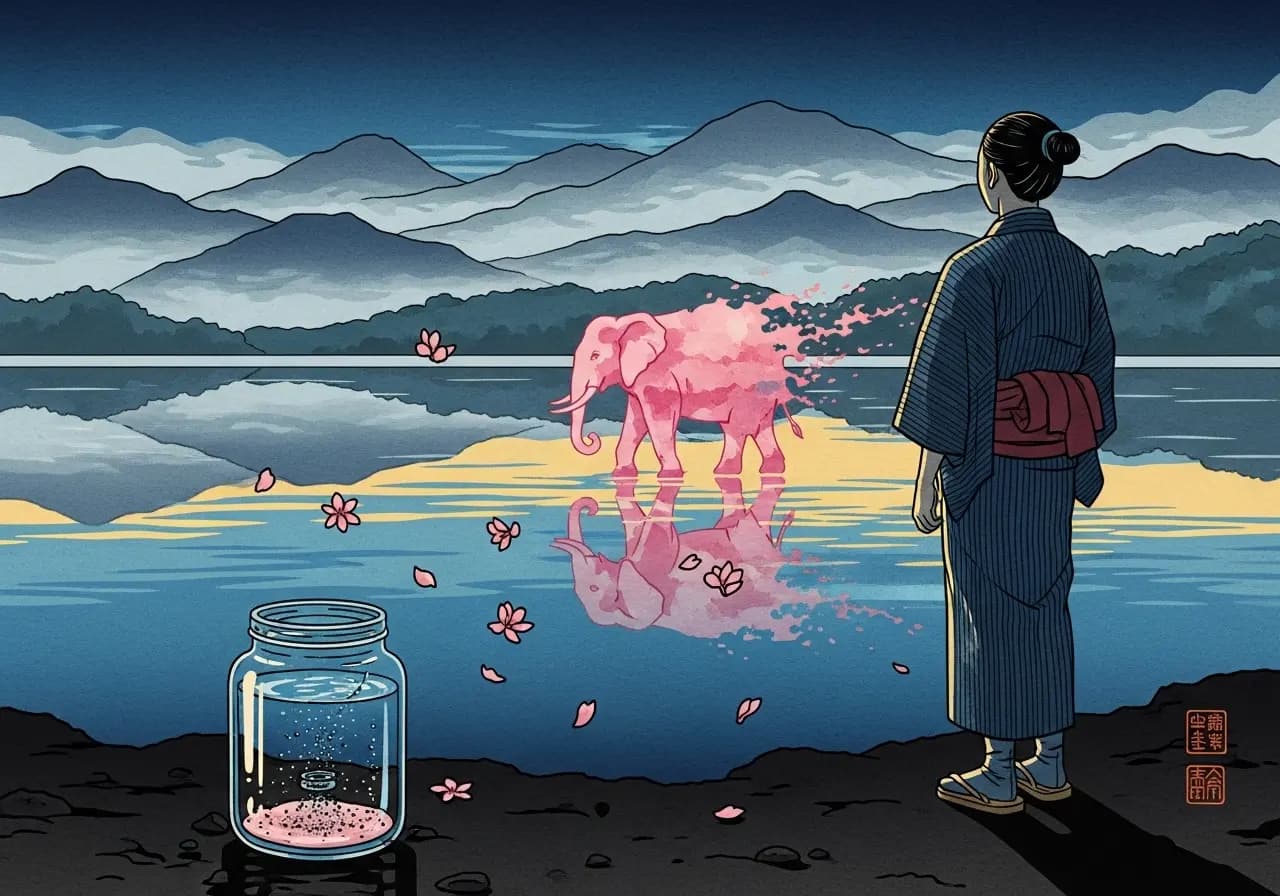
So, for today's podcast episode, I want to start out doing a little thought experiment. I'd like for you to try really hard right now to avoid picturing a pink elephant in your mind. So if you're ready, please do not under any circumstances visualize or think of a pink elephant in your mind.
Were you able to succeed?
Odds are that the moment I said to not think of it, you did think of it—because you had to think of it to not think of it, right? And this is what is sometimes referred to as the Pink Elephant Simile. The idea is that the more you try to not think of it, the more you end up thinking of it. The more you try to get rid of the thought, the more the thought persists.
I think this pink elephant can represent—from the Buddhist perspective—the idea of dissatisfaction. The harder we try to be less dissatisfied, the more dissatisfied we become. If we're trying to be more happy, could it be that trying so hard is exactly the reason why we are not happy?
This dilemma is sometimes referred to as the law of reversed effort, or, as Alan Watts called it, the backwards law. That's why I selected it as the topic for today's podcast. I think it's a really neat concept, and I want to share some of my thoughts regarding the backwards law.
Understanding the Backwards Law
The backwards law proposes that the more we chase after something, the more difficult it becomes to catch it, and the more disappointed we'll feel because we haven't caught it. In other words, the harder we try, the less likely we are to succeed.
And this seems to go against everything that our culture tells us—everything that society tells us. We see it in movies and in stories across time, the message that if we try hard enough, we might actually get the thing that we want.
I want to be clear as I talk about this concept: I'm not talking about self-help or career goals or striving for what we could call worldly things. I'm talking about the Buddhist perspective on this topic, and that is the idea that dissatisfaction is what arises when we want things to be other than how they are. Wanting to avoid discomfort in life—being the biggest of these desires. We want life to go just how we want it to go.
Using the analogy of the pink elephant, if we want to stop thinking about it, we have to stop wanting to not think about it. That's kind of the situation that we're in with this backwards law. We give up the desire to get rid of the image in our minds. And then the thought—like a cloud that appears, lingers, and then disappears in the sky—that thought of the pink elephant likewise will eventually dissipate.
How Does It Work in Practice?
So how does this concept of the backwards law work in practice? How exactly do we get what we want by not trying to get what we want? Even saying that seems almost ridiculous and a little bit absurd.
And remember, this is not about worldly things like money or if you want a nicer car. Just as an example, let's say I decide I want to be able to run a marathon. There are things that I can do that will make it more likely for me to achieve that goal. I can start exercising, I can train, I can prepare myself, and then eventually I can run the marathon and I will be more likely to succeed at it because I have the desire to do it. So I'm not referring to that type of craving or that type of desire. I don't think we need to relate the backwards law to things like that.
It applies to the deeper things—the things that we truly want in life. And here's the dilemma: What is it that we truly want in life? Well, that may be the very start of our problem. We don't really know what we want. We just know that we want things to be other than how they are.
Alan Watts spoke to this dilemma really well. He said there are two reasons why you don't really know what you want. Number one: you have it. Number two: you don't know yourself because you never can. Just as a knife doesn't cut itself, fire doesn't burn itself, and light doesn't illuminate itself.
So here we find this dilemma again. If I am the observer, can I truly observe myself? Because observing is what I do. I tried to point to this in a previous podcast episode with the notion of: if you could ever open up your mind and peek to see what's behind the curtains, what would you actually see? I think I would see myself peeking behind the curtains, looking to see what I would actually see. Right? That's the dilemma that we're in.
And that, in essence, is the concept of the backwards law. How do we actually get the thing that we really want?
The Search Is the Problem
What if what we're seeking is actually obscured by our search for the thing that we're seeking? Very much like that light that's trying to illuminate itself. We think that not finding whatever it is we're looking for is the problem. But what if it's the searching itself that's the problem?
Alan Watts talks about this in one of his lectures. He mentions that when we try to fall asleep, sometimes the very effort of trying to fall asleep is what keeps us awake. The effort that we exert to try to fall asleep actually keeps us awake. Well, what if it works like this with searching? We may be looking for something that can't be found.
I think this is what I meant in a previous podcast episode where I talked about the pursuit of happiness. Happiness is a good example here. There's the pursuit of happiness, and then there's freedom from the pursuit of happiness. When we no longer pursue happiness, that's when we're actually finally free to experience it—because we can experience whatever it is we're experiencing in that moment. And that's what this backwards law is all about.
If you want to get comfortable with being alive, then stop running from discomfort. We don't become more comfortable by eliminating discomfort. We achieve it by becoming more comfortable with discomfort. That is the backwards law.
The Message of Lack
Our society seems to have placed a strange message in our psyche. I don't know if it's a cultural thing. I don't know exactly where we get this, but there's this sense that something is missing. You lack something, and if you can ever obtain it, then life is going to be good. So meanwhile, you just keep trying really hard to find that thing that's missing.
We might go chasing after it thinking it's money or fame or power, or love, or happiness, or—from the Buddhist perspective—the elimination of discomfort. But what if we can't find it?
Mark Manson, in his book The Subtle Art of Not Giving an F, says: "Pursuing something only reinforces the fact that you lack it in the first place." Perhaps that's the problem that arises: when we start to sense that something is lacking in life.
This is where I think being present and practicing acceptance become such powerful tools. We often find ourselves in the present moment, and we find that in the present moment, it seems like the present moment is not enough. Something is missing. But we don't know what's missing because, again, we don't really know ourselves all that well.
The Oracle and the Lake
It's kind of like the story of a person who goes to visit the oracle—an oracle that can answer any question you bring. This person asks, "Oracle, what is the meaning of life?" The oracle says, "I will answer your question, but first you must go to a lake that is three days' journey from here and bring me water from the center of that lake." So the person sets off on the three-day journey. After three days, they arrive at the lake and they gather water from the center. Then they return back to the oracle.
The person says, "Here is the water from the center of the lake." The oracle says, "Thank you. Now, do you still want to know the meaning of life?" And the person says, "Actually, I don't think I do anymore." The point of the story is that in the process of seeking the answer, you either find it along the way or you realize that you don't need it.
The person who's been obsessed with finding the meaning of life finally arrives and has spent so much time on the quest that the question itself has dissolved.
Non-Striving: The Muddy Jar
So how do we not try? What is non-striving?
The analogy here is that if you take a jar with muddy water in it and you agitate it, it stays agitated. You can't clear the water by agitating the jar. In fact, the agitation of the jar is what keeps the water murky and cloudy. But if you put it down and you leave it alone and you quit trying, with time the water becomes clear as the sediment falls to the bottom.
And that's where this notion of not trying kicks in. I think it's important to illustrate here that in the act of putting the jar down, you're actually doing something. You're leaving it alone. So that's a form of action. It's a form of action that on the surface seems like inaction, but it isn't. The action of not doing something is doing something. That's what happens with the jar of murky water. I'm going to put it down, I'm going to leave it alone, and that's the thing that I'm doing. I'm leaving it alone.
So that's the backwards law, and I think this analogy works well when I think about the relationship I have with my own thoughts, with my own feelings, with my own emotions—the ones I welcome to the table and the ones that in the past I used to fight and shoo away.
Then the backwards law comes in, and I realize—again, this is echoed in other Buddhist stories—the thing that you're fighting gets stronger. What makes it stronger is that you're fighting it. That's what gives it strength. The more you fight it, the stronger it becomes. That's the whole story of the sticky hair monster, right? And the Buddhist story of the sticky hair monster, I think, fits really well with this notion as well.
But what happens if I stop fighting? Again, this is the action of non-action, which is an action. And it takes effort to not do anything. Or perhaps we could call this skillful effort, finding that middle way—somewhere in between trying too hard and not trying hard enough.
There's this notion that sometimes not trying is a form of trying, and that may be the skillful way to try. I think that's what this law is trying to help us understand. And I think it gets really powerful when you think about this in the context of pursuing happiness, for example, or pursuing the thing that we think we want—often without really even knowing what is the real thing that I actually want.
The Tennis Match
I do want to end this with a story first, and then I'll end with a quote. But this story happened many years ago when we had Jonah, our foreign exchange student from Germany. He occasionally listens to the podcast, so hi Jonah, if you listen to this. Perhaps you'll recall this story.
Jonah and I were playing tennis once, and Jonah had told me that he's a really good tennis player, and I dabbled with tennis—I'm a decent player. So we went to play tennis. And as the match started, tennis is one of those games where you can win because you're superior in skill to the person that you're playing against, but you can also lose because you're trying too hard. And that's exactly what was happening to Jonah for the first half of our game.
I think because he had already told me he was better than me, he wanted to send that message very clear. He was trying trick shots and doing all the things. And if he didn't hit it quite right, he would hit the net and lose the point. So here we were where I'm actually winning, but it's not that I'm winning—it's that he's losing. You know, there's a difference. It's not that I had the good hit; it's that he had a bad hit, and his bad hit gives me a point.
Somewhere through the match, in frustration, he said, "You told me you're not that good at tennis. Why are you beating me?" And I laughed and I said, "It's because I'm not trying to beat you. You're trying to beat me, which is why you're not beating me. Quit trying to beat me. Just play tennis the way that you play. You're a better player than me. Don't try the trick shots; just play your normal tennis."
And that was the game changer. Halfway through the match, suddenly he was much better than me. He was hitting the ball the normal way, and I couldn't keep up. He ended up winning the overall match.
And that experience stuck with me. That is exactly what this notion of the backwards law is. Here Jonah was trying too hard. He was trying to win. All he had to do was just play—play the game. He was going to beat me if we played the game, but he struggled to beat me if he was going to try to beat me, because he was beating himself. And that's the irony in this. That's the backwards law.
The Mystery of Life
I think it goes hand in hand with this quote from Alan Watts that I want to end with: "The mystery of life is not a problem to be solved, but a reality to be experienced."
I think if we can approach life as an experience, as I mentioned in a previous podcast episode with the notion of the game of emotions—if I look at life as something to be experienced, then every experience that arises, every Tetris piece that shows up is the right piece. I may not like the piece. It doesn't have to mean that you like everything. It may be an unpleasant thing, but the point wasn't to get more of the pleasant and less of the unpleasant. The point was to experience the full range. And then you can suddenly find yourself having life experiences and a sense of joy and gratitude for the experience because of the uniqueness of the experience—not because of the pleasantness or unpleasantness.
I've experienced this recently, going through stages of loss—loss of a friend, loss of my dad. These are very meaningful milestones in life. And I'm grateful that I know what this feels like—the sorrow and the pain that you feel when you lose someone that you love. It's not pleasant, but it's actually a beautiful thing. I didn't know what that felt like before. And perhaps I'll have to feel that again at some point in life, because that's the way life is, right? You never know who you're going to lose.
But what I do know is I feel a sense of joy and a sense of gratitude for the fact that I am here experiencing it at all. And as Alan Watts says, to me that is the mystery of life. It's not a problem to be solved. It's not an equation I need to master. It's a reality that I get to experience, and here I am experiencing it.
And the backwards law can be one of those concepts that helps you to experience it in a more skillful way—very much like playing a game of tennis without trying to win. Ironically, in that process of not trying to win, you're going to do better than if you are.
So those are the thoughts I wanted to share with you, and I hope that these thoughts give you something to think about throughout the week. That's all I have for this podcast episode, but I look forward to sharing more thoughts in a future podcast episode.
Thank you for taking the time to be here and to listen. Until next time.
For more about the Secular Buddhism Podcast and Noah Rasheta's work, visit SecularBuddhism.com