

Gratitude and Patience
Episode 160 of the Secular Buddhism Podcast
Hello and welcome to another episode of the Secular Buddhism Podcast. This is episode number 160. I'm your host, Noah Rasheta, and today I'm going to share some thoughts regarding gratitude and patience.
Welcome
As always, keep in mind you don't need to use what you learn from Buddhism to be a Buddhist. You can use what you learn from Buddhism to simply be a better whatever you already are.
If you're interested in learning more about Buddhism, check out my book, No Nonsense Buddhism for Beginners, available on Amazon, or listen to the first five episodes of this podcast. You can find those easily by visiting secularbuddhism.com and clicking on the Start Here link.
If you're looking for a community to practice with and interact with, consider becoming a patron of the podcast by visiting secularbuddhism.com and clicking the link to join our community.
Gratitude Beyond the Pleasant
On the heels of Thanksgiving, a holiday that was celebrated here in the United States earlier this week, I thought I would share some thoughts regarding gratitude and specifically gratitude from the Buddhist perspective.
We live in a culture that tends to feel gratitude for only the pleasant things in our lives. The Buddhist approach is different. The Buddhist approach is to feel gratitude for all things that happen in life, even the unpleasant ones.
Jack Cornfield, in an interview with the Huffington Post, said: "In certain temples that I've been to, there's actually a prayer that you make asking for difficulties. May I be given the appropriate difficulties so that my heart can truly open with compassion."
Imagine asking for that.
Cornfield ties gratitude to mindfulness. To be mindful, he said, is to see the world as it is without judgment. It is responding to the world rather than reacting to it. In this sense, gratitude helps us to be fully present and attentive to our surroundings.
Furthermore, in the Kaṭannu Sutta, translated by the monk Thanissara Bhikkhu of the Thai Forest tradition, the Buddha said the following regarding gratitude:
"Now what is the level of a person of no integrity? A person of no integrity is ungrateful and unthankful. This ingratitude, this lack of thankfulness is advocated by rude people. It is entirely on the level of people of no integrity. A person of integrity is grateful and thankful. This gratitude, this thankfulness is advocated by civil people. It is entirely on the level of people of integrity."
We see in this quote that the Buddha makes a connection between gratitude and integrity. And one of the definitions of integrity—one that I think is particularly useful for this conversation—is the definition that states integrity as the quality or state of being complete or undivided. I'd like to emphasize that notion of undivided.
I like this definition when thinking about gratitude because we often think about gratitude for the pleasant things, where that's a divided perspective. You know, I divide the pleasant and the unpleasant, and now I'm thankful for the pleasant. But what if I don't? What if it's undivided? What if I'm grateful for both the pleasant and the unpleasant?
The Parable of the Horse
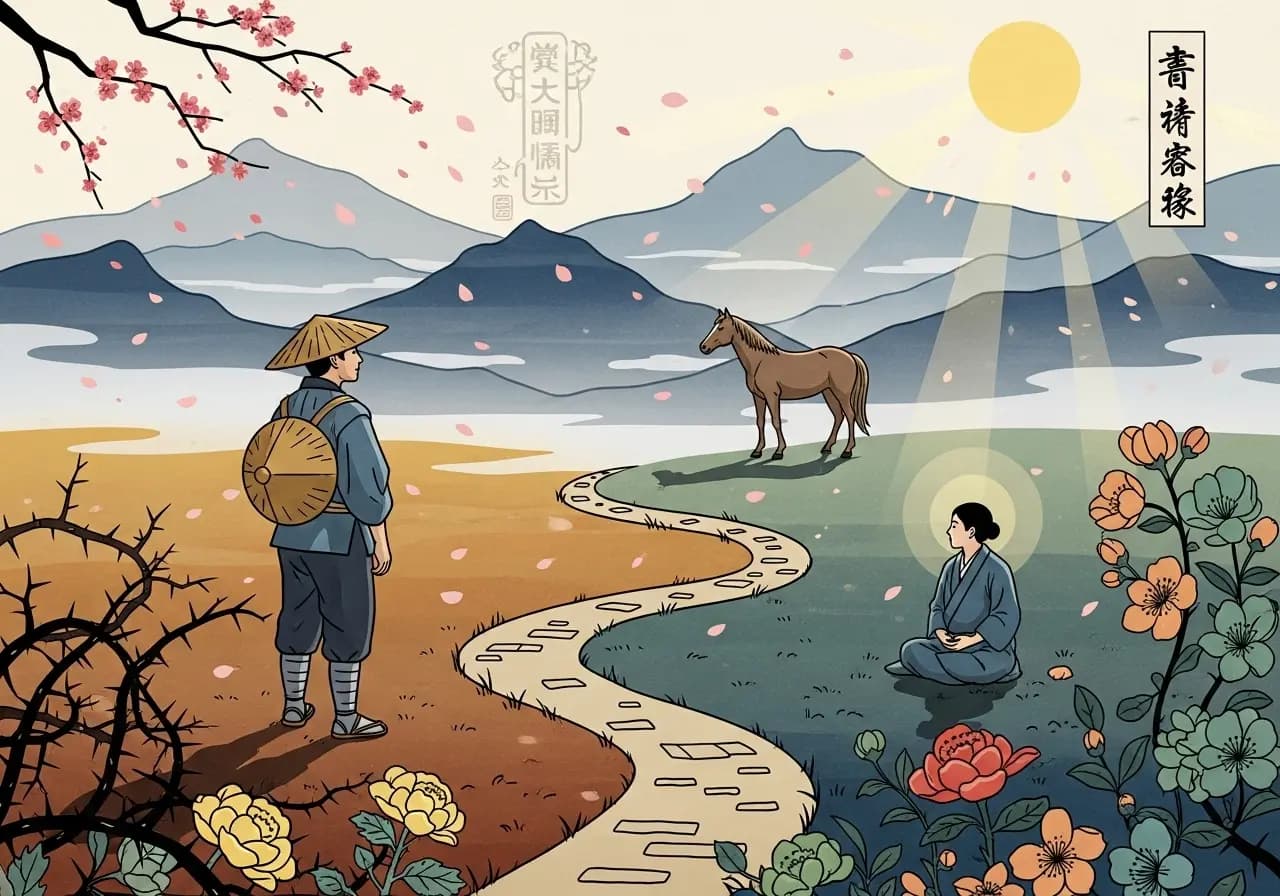
We see this in the famous story of the horse—"Who knows what is good and what is bad?" I've mentioned this multiple times in the podcast, but the essence of the story is that as one event unfolds, we don't fully understand how that correlates or leads to the next moment. There are two perspectives as all this unfolds. There's the farmer who simply has an undivided view and just says, "Who knows what is good and what is bad?" He treats both the pleasant and unpleasant moments as they unfold with equanimity.
And then there's the perspective of the neighbor. As each event unfolds, the neighbor divides the moment: "This is a good one. Oh, now this one is a bad one." And he makes the mistake of having a short-sighted view of the whole picture of what's actually taking place.
It's in this story of the horse and "Who knows what is good and what is bad?" that we start to understand that the complete picture—the undivided picture—entails both the pleasant and seemingly good moments of the story and also the unpleasant and seemingly bad moments of the story. We don't want to make the mistake of dividing everything up into good and bad, saying "this is a good moment" and "that one's a bad moment."
I think when we start to see the big picture, like we do in the story, we feel a sense of gratitude for the complete picture. In the case of the story, when you have the wider view or the wider perspective, you can feel gratitude for the broken leg because that broken leg prevented the son from going off to war. There's gratitude for losing the horse and gratitude for gaining the additional horses the horse came back with. There's gratitude that takes place on both sides of that spectrum of what we want to divide into pleasant and unpleasant.
Looking Back with Gratitude
Now I've experienced this looking back at my own stages of life. Some of the most unpleasant and seemingly bad moments have ended up being crucial in the story of twists and turns that have led me to where I am today—living a life with much more contentment and joy than I ever thought was possible prior to those unpleasant events.
The truth is, I wouldn't go back and change those unpleasant and painful experiences. And even more than that, I feel a sense of gratitude for them now where I didn't before. I think it takes time and perspective to gain that view. I certainly wasn't grateful for them as they were happening. But again, like the farmer in the story, when things are happening, it's very easy to get caught up in that one moment. "This is how I feel about this moment, and this moment feels unpleasant. I don't like it." And we fail to try to see ahead: "Well, what could this lead to in the future?"
Now, in the future, looking back, it is much easier to say, "Well, I'm grateful that that happened and I wouldn't go back and change it." And that's true. But if I were back in that one moment, I don't know that I would have had the perspective to say, "I'm going to continue enduring through this. It has allowed me now in the present moment to recall those past moments and say: 'Well, now anytime I'm experiencing any form of difficulty or unpleasantness—or life gives me a Tetris piece that I don't want—I can look back and say, "I didn't know where that piece back then was going to lead, but it led to a much better place." So I need to remember that now as I'm encountering this specific difficulty or unpleasant situation that I may be dealing with. I don't know where it leads.'"
That perspective—holding space to that uncertainty or that curiosity about what's going to come of this—can give rise to a sense of gratitude for the difficulty that I'm experiencing in that present moment. And I think that's important to think about.
The Six Perfections and Patience
In Buddhist terminology, there's a word called paramita, which means perfection or completeness. The Mahayana Buddhist texts contain many references to a list of six paramitas, or six perfections of character and understanding. In other traditions, like the Theravada Buddhist tradition, the path has a total of ten perfections, or ten paramitas.
The monk Thanissara Bhikkhu describes these perfections as perfections of character necessary to achieve enlightenment. If you practice Buddhism or study Buddhism, you'll at some point encounter the six or the ten paramitas. So I want to talk about each of them real quickly.
The first one is generosity. The second one is proper conduct. The third is renunciation. The fourth is wisdom. The fifth is diligence. The sixth is patience. The seventh is honesty. The eighth is determination. The ninth is loving-kindness. And the tenth is equanimity.
Today I want to focus specifically on the sixth one: patience.
In the case of patience, we know that patience is an antidote to greed, which is considered a poison from the Buddhist perspective. And the correlation with gratitude is that gratitude develops patience.
Imagine a person that's grateful for, let's say, the phone that they have right now. They're less likely to feel the impulse to go and replace that with a new one anytime a new one comes out. The desire to have a new one is considerably less than the desire of someone who is not grateful for the phone that they have.
Greed and Gratitude
I thought about this recently. I've been watching the Netflix series called Narcos: Mexico. This interests me for several reasons. I was living in Mexico during the time of the fall of the narcos, when there was the original kingpin who was like the leader of leaders. His fall created a vacuum of power, and the various regions started fighting for more territory and more strength. That's been what we all know now as the War on Drugs that's been plaguing Mexico since the 1980s and early 1990s.
So for me it was fun to watch the show and get some of the scoop on the story of the names and people involved in this whole process, because quite frankly, I knew some of them. I had friends in high school whose parents were involved in the narco world. I remember a friend in high school—their 15 years celebration, which is a big celebration in Mexican culture—I remember someone came by from an opposing cartel and shot up the party. None of my friends were there, but I remember that someone from our school happened to. And other little instances like that.
So anyway, long story short, I do feel a curiosity about this story. As I was watching this, I couldn't help but think: what would the lives of these traffickers be like had there been more gratitude in their lives and less greed? I think one of the catalysts for taking unskillful action is being ignorant of the greed that we have for things. I want this. And we don't take the time to think: "Why do I want this? For example, power or money. Maybe they would have never ended up as narcos."
I think greed often arises from a sense of not having enough, or when we compare ourselves to others and conclude that we don't have as much as everyone else has. Gratitude, on the other hand, assures us that what we have is enough.
It seems that greed and gratitude cannot peacefully coexist. And I think if we experience a greater sense of gratitude, we're less likely to take unskillful action that's fueled by greed. I couldn't help but think that as I was watching this show. And I think the same line of thought applies to jealousy, regret, resentment, and many other strong negative emotions.
A Short-Sighted View
Perhaps a lack of gratitude simply means that we're not paying enough attention and we start to see life through a narrow view. When we have a short-sighted view of life, we end up taking it for granted. We complain when life isn't working out as we want it to work out.
But when you zoom out and take that longer view, you may realize how incredible it is that we even exist at all. We can start to see the world as a place of belonging and as a place of connection. And I think gratitude can help with this—to gain this perspective.
The Buddhist teacher Norman Fisher says: "We are sitting within Buddha's heart, releasing ourselves to that aspect of ourselves that deeply belongs to the universe and is grateful for it."
So again I ask: Are we grateful for all of it? Both the pleasant and the unpleasant? And if we're not, what would it be like to shift that focus and to actually start to feel genuine gratitude for the complete picture—the whole story, the seemingly good and bad moments that take place in our lives?
Cultivating Gratitude
How do we actually cultivate gratitude? Well, to cultivate a mind of gratitude, I think the most important element is maintaining a daily practice. This can be in the form of meditation where we think about the things that we're grateful for, or using the assistance of a journal to write these things down. But as we practice gratitude, we begin to be better at feeling gratitude, and perhaps most importantly, feeling it naturally. And feeling it for all the Tetris pieces that life is going to offer us, not just the ones that we wanted.
Imagine being able to feel genuine gratitude for the things that we don't want, for the difficulties that arise. That's the invitation I want to leave you with from this podcast episode.
Remember, mindfulness and gratitude go hand in hand. The more mindful we become of the impermanent and interdependent nature of things, we feel a natural sense of gratitude for being here in the present moment, experiencing each of these unique moments.
I would encourage you to set aside some time every day to practice. You can set an alarm on your phone or on your watch and just pick a random time—like one p.m. or something—and try this every day for a little while. When that alarm goes off, ask yourself: "Right now, what is one thing I'm grateful for?" Or two things. Or three things. Whatever it is, but keep the practice simple so that you can continue to do this with consistency and ultimately develop a new habitual way of thinking—one that is much more grateful.
The Negativity Bias
When our focus shifts to the things that seem to be going wrong, try to remind yourself: "Well, yeah, but what's also going right?" You know, we have what's called the negativity bias, which means we will focus and highlight the negative. It's a survival instinct, and we've evolved to be this way. But those are key moments where I become keenly aware and focused on the one negative thing. That's the reminder—that's the trigger to say, "Okay, yeah, but what are the good things that I'm not seeing?"
Like in the parable of the strawberry, the gentleman is hanging from a rope with tigers up at the top and alligators down at the bottom. He's hanging on a vine, and there's a mouse gnawing at the vine. And he casually looks and notices a strawberry, tastes it, and it's the sweetest strawberry he's ever had.
There's no denial in that moment of the predicament that he's in—which is, "I don't know how long this vine will last before I plummet to my death. If I try to crawl out of it, there's no crawling out of it because I'm going to go right up to where the tigers are." That's the situation that we all find ourselves in: the inevitable death that awaits us, the uncertainty of its timing, and the strong emotions that can arise from the realization of that predicament.
And yet in the midst of all of that, there are strawberries. There are pleasant good moments where you might just realize: "Wow, life is actually—yeah, it's got all this and that, but it's also really good right now."
Cultivating Patience and Gratitude
So developing a greater sense of patience and gratitude won't happen overnight. But with consistent practice, gratitude will indeed grow, and patience will also grow. And these will end up being more habitual ways of experiencing reality.
That's patience and that's gratitude from a Buddhist perspective. And that's all I have for you for this episode. But I look forward to sharing more thoughts on Buddhist concepts and ideas in another episode later.
Thank you for taking the time to listen. Until next time.
For more about the Secular Buddhism podcast and Noah Rasheta's work, visit SecularBuddhism.com