

Truth in the Context of Time
Episode 16 of the Secular Buddhism Podcast
Hello. You are listening to the Secular Buddhism podcast, and this is episode number 16. I'm your host, Noah Rasheta, and today I'm talking about truth in the context of time. So let's get started.
Welcome
Welcome to the Secular Buddhism podcast. I'm excited to announce something new. Within the next few weeks, the Secular Buddhism podcast is going to be forming part of a non-profit organization called the Foundation for Mindful Living. This is something I will be playing a part in, and part of the overall scope of this new entity is to create content and opportunities for people to learn to live more mindfully. This means there will be opportunities for retreats, workshops, books, and many other tools available in the future for anyone interested in learning about Secular Buddhism or just learning to live mindfully. I'll update you with information about this as it becomes available. It's just something I'm excited about and wanted to let you know that it's in the works. This entire thing that I'm putting together will be operating under a non-profit organization very soon, so I'm really excited about that.
Of course, before we start, a reminder from the Dalai Lama: "Do not try to use what you learn from Buddhism to be a Buddhist. Use it to be a better whatever you already are." Please keep this in mind as you listen and learn about the topics and concepts discussed in this podcast. And remember, if you enjoy the podcast, please feel free to share it, write a review, or give it a rating.
Let's Jump In
Now let's jump into this week's topic. In last week's podcast episode, I spoke a little about the concept of faith and doubt—specifically the faith to doubt, at least within the Buddhist worldview. This week, I've been thinking about truth, which we discussed a few weeks ago. I highlighted the difference between what I call conceptual truth versus empirical truth, and I wanted to elaborate on this a bit more based on a conversation I had with a friend.
The idea is this: when we're talking about truth, there are at least two major kinds. On one hand, there are truths that are true regardless of what I believe, and on the other hand, there are truths that are true because of what I believe.
Two Types of Truth
Empirical Truth
An example of the first type—a truth regardless of what I believe—is an empirical truth. This is the kind of truth that's true whether or not humans exist on the planet. That's an easy way to think about it. For instance, when the moisture in the air saturates to the point where it can no longer hold water, rain begins to fall. This happens whether or not we believe it, and whether or not there are humans on the planet. It's simply something that happens. That's an empirical truth—a truth that exists independent of our beliefs.
Most of the truths we deal with day to day in our lives, though, aren't empirical truths.
Conceptual Truth
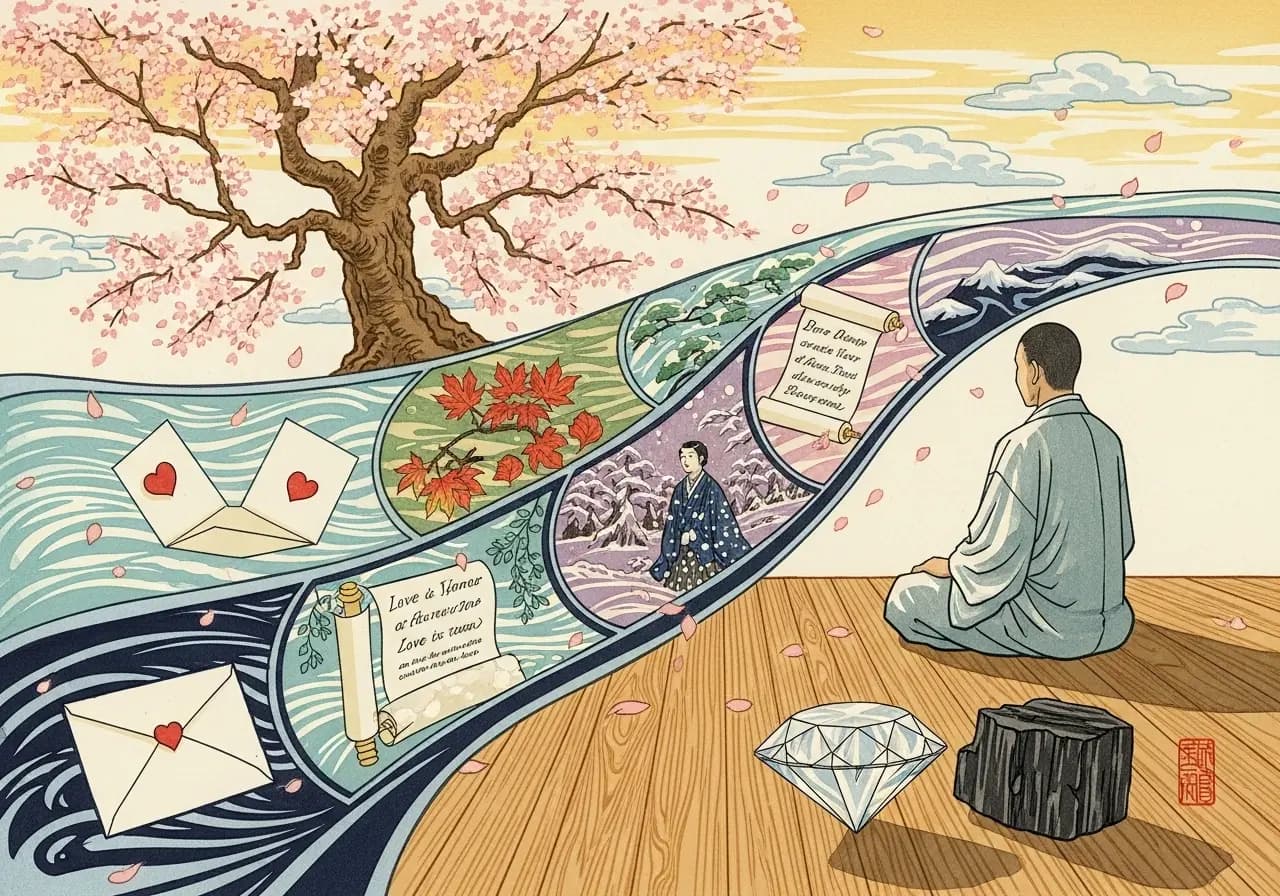
These are conceptual truths. These are truths that are true because we believe them. The example I gave before was the value of gold versus silver, or really, the value of any precious gem. It's true that a diamond is worth more than coal, but that's a conceptual truth. It's only true because we believe it. There's no inherent value in a diamond versus a piece of coal. A diamond becomes valuable and gains worth because, as humans, we've collectively decided that a diamond is valuable. We've assigned it a specific value. That's an example of a conceptual truth.
Truths and Time
I wanted to elaborate on this a bit more from the previous podcast where I discussed truth, because truths are contingent upon space and time. In Buddhism, we talk about space and time. Everything exists in space and time. In terms of space, all things are interdependent—we've talked about that. In terms of time, all things are impermanent.
Usually when I'm discussing impermanence with someone, we think about the opposite of impermanent being permanent. That makes sense, but it's more than that. I think a better, or maybe easier, way to understand the concept of impermanence is to think of it as something fixed and permanent versus something fluctuating and changing. Impermanence isn't just about things ending—it's about constant fluctuation and change. That's the way to understand it.
How does that apply to the way we view conceptual truths? That's really the heart of what I want to get at today. The whole conversation started with a friend in my ministry program who had read an old love letter. This letter contained very compelling language about being in love. It said things like, "I'm so happy that we're finally together. I'll never leave your side. You're the soulmate I was looking for." But here's the thing: seven months after that letter was written, the relationship had ended in divorce.
The context of the conversation was this: in a world where all things are impermanent, where all things are constantly changing, how do you make sense of things like love? How do you make sense of promises? What about the promises we make in wedding vows? Any promise that seems long-term feels like a permanent thing. How does that work in the context of impermanence?
A Personal Story
I wanted to discuss this because it got me thinking. In fact, I'd been thinking about this for a couple weeks after that conversation. I went through a similar experience to what my friend experienced in my own life.
Without giving too many personal details, essentially what happened is there was a point in my own marriage that was very rocky. There had been a breach of trust, and things got really difficult. I wasn't sure the marriage was going to survive. Right before entering that tough phase, I spent some time on Mother's Day. I got these post-it notes and I thought I would write 100 things I love about you—one thing per post-it note. My idea was to put these all over the wall and surprise her. It took me a while to complete the project, and there was no appreciation for it when she saw it. I felt kind of silly for even doing it.
I didn't think much of it after that because, like I mentioned, we entered a pretty rocky phase soon after. I wasn't sure we were going to survive, that the marriage was going to survive. Long story short, many months—maybe even years—later, I came across one of those post-it notes. It had somehow stuck in one of my binders, or maybe it was in a book as a bookmark. I can't remember exactly where I saw it, but I remember seeing it and having this immediate thought: "Wow, I guess what I wrote back then was all fake. It was all a lie because I didn't know that at the time something was going on in my marriage. My marriage wasn't what I thought it was. It was a fraud, so to speak."
I had this feeling of conflict with what was true now versus what felt true then versus what felt true in between. It was an interesting and fascinating experience to sit and contemplate this notion of truth relative to time.
The Answer
I had to analyze and conclude that it wasn't a lie and it wasn't fraud. When it was expressed, it was absolutely true. I didn't know that it was going to be only a month later when things would get really rocky, when neither one of us was even sure we wanted to be with each other anymore. But at that point, that became the new truth—the truth that we weren't sure we even wanted to be together. And then years after that, we reached a point where we were committed and decided, "You know what, we do want to make this work." That became the new truth as well.
At every point along that spectrum, all of those emotions were true. It was true that I had this intense desire to make it work and be with my wife. And it's true that at another point, I didn't want to be with my wife. I didn't want it to work out. And it's true that at yet another point, I did want to be with her and wanted to make that work.
I thought of my friend's letter. I think we do this a lot in life. We project the truth of the present and apply it to a truth in the past or even in the future, where it's not relevant. We take the concept of something that was true yesterday and we don't understand that it may not be true today.
I think we do this with beliefs, with views, and with tastes. It may be that as a kid I liked hot dogs and now I don't. It's true that I love hot dogs, and it's true that I don't love hot dogs. It's just contingent upon the context of time.
Our tendency is to take the present-day truth and apply it to the span of time—past and present—and that's where things can get a little rocky. I think that's where this notion became difficult for my friend to see that letter. She thought it was all a lie because she knew that seven months later, the marriage would be over and all those words were now empty and meaningless and no longer true. When the reality is—as hard as it may be for us to accept—they were true. They were just true in the context of the time in which they were written. They're not true now, but they were true at one point.
Looking at Our Own Lives
I thought about this a lot in other contexts of time in my own life—beliefs that I've had. At one point in my life, I believed certain things that I don't believe now. I'm sure at one point in my life in the future, I may believe things that I don't believe now, or I may not believe things in the future that I do believe now. These will be my truths, but they're always going to be relevant in the present moment.
When you take a concept like promises—how does this work? In a world that's ever-changing, what's the point of ever making a promise? Let's say my promise is to be faithful to my spouse, for example, or to be a certain type of dad for my kids. That's a long-term promise or commitment, and why would you make a promise that's long-term in a world that's ever-changing?
I think the answer is that you don't. You don't make a promise in the long term. What that means for me is that I don't view it as, "I am eternally committed to my spouse." Rather, I'm eternally committed in the present moment. Right now, this is the promise, and it's an ongoing promise that's continually renewed. It's continually renewed in the moment-to-moment experience of life.
That might seem a little strange because you think, "Well, but it sounds more noble to say I'm going to love you forever." But if you really think about it, love doesn't work that way because it's not permanent. When you fall in love, the person you fell in love with changes over time, and you change over time. You have two people who are constantly changing, living in a world of constant change, and somehow the emotion of love is supposed to be this permanent thing. But it's not. It's also changing. It's fluctuating.
The way it actually works is you're constantly falling in love with the person you're committed to stay in love with. In fact, I think that's what makes it work. Realizing that it's constant—that every day, your spouse is the person you're learning to love. Every day, the new version of them. Every hour, every minute. The moment I make that a stagnant thing, it deteriorates the love I have for her.
It would be very easy to say, "Well, you're not the person I fell in love with seven years ago when we got married," or eight years ago or nine years ago, whatever it is. The thing is, you're absolutely right. That's not the same person I married. Guess what? I'm not the same person they married either.
This doesn't just apply to relationships and love. This applies to everything.
Change in Careers and Life
I think with careers, this is common too. When I graduated from college, I wanted to be a filmmaker, and I was for a while, working on television commercial production. One day that evolved. And whatever I was at the time is what I was at the time. That, for me personally, has evolved year after year, it seems. I've done a lot of different things.
You take someone who's been in a career their whole life, and then one day they look back and say, "I got into the wrong career because what I wanted should have been this or should have been that." But that's not true. You did exactly what you thought you wanted to do when you did it. The difference is that as you've changed and evolved over time, the idea of what you thought you wanted hasn't.
Then it makes you think that the truth in the present is the same as the truth of the past. That's where it becomes tricky. The truth is what changes. Maybe truth isn't the right word here. We could say life or reality. Using the word truth, life, reality—these are all somewhat interchangeable. But the concept to grasp here is impermanence. Impermanence means constant change. That means that whatever was true at one point in the past may not be true today. And if you really want to be liberated by this knowledge, you need to understand that what you hold to be true today also may not be true in the future.
Freedom in the Present
This is a very powerful way of experiencing reality in the present moment. It's understanding that I'm experiencing my own conceptual truths in the present moment, and they are completely relevant here and now. They may not be relevant in the future, and they may not be relevant when compared to the past. If you're honest with yourself, you'll realize that's exactly true. That's exactly how it works. There are so many things in your past that I'm sure are no longer relevant now—ways you used to be, things you used to think, beliefs you used to believe. These evolve and change over time.
It limits our ability to grow when we have a fixed mindset that decides, "Whatever is true now, I'm going to hold as permanent and extend it into the past and future." The healthy way of viewing the present is in a state of flow. Rather than a fixed mindset, it's a growth mindset.
Carol Dweck talks about this concept of fixed mindset versus growth mindset. In fact, I think that's the title of her book. You should check that out. In terms of parenting and how we experience life, the idea is that the moment we try to make things fixed, we hinder and limit our ability to grow. Because growth, as the name itself implies, is change. It's the only way that you grow—by changing. As soon as there's no growth, then that's death. Life is the process of constant change. The moment you're not changing, that means you're dead. You're done. There is no more change.
Yet somehow we attach to this idea of trying to grasp life and make it a fixed concept. I want all my truths to be fixed. I want my sense of self to be a fixed sense of self. Who I was in the past is who I am now, and it's who I will be in the future—and that's just not true. Who I was yesterday may be irrelevant to who I am today, and it might be very different from who I am in the future. Because that's the nature of change. That's the nature of life, reality, and truth. It's constantly changing.
The Heart of It All
What I wanted to ultimately get at in this podcast episode is this concept of truth relative to space and time—specifically time.
I hope that you can set aside some time in your day or in your week to explore what truths were true to you in the past that are no longer true today. If you really want to get something out of this, try to spend some time looking at the things that you hold on to as fixed truths today, and look at them with the perspective that they may not be fixed truths in the future. Because that's the nature of change. The nature of truth is that it's constantly changing. All of our conceptual truths work this way. Conceptual truths are always relative to time.
Going back to the example of the diamond: think about it—the value of a diamond or the value of gold versus silver. In terms of being a truth, it's relative to space and time. Alter the equation of space and time. Let's go back to, I don't know, anywhere on earth 10,000 years ago, and now the truth of the value of gold versus silver is different. Go back 20,000 years ago, 50,000 years ago, a million years ago, and these things just change. Truth changes. Truth evolves.
That's really what I wanted to get at in this podcast episode—and the sense of freedom that comes from letting go of the fixed part of truth.
Letting Go of the Grip
You can hold on to your truths. First, recognize that your truths—are they conceptual, or are they empirical? Once you've done that and you realize, "Wow, all my truths that are so important to me are actually conceptual truths," then you let go of the grip a little bit.
The next step is to take those truths and understand that they are actually truths that are relative to space and time. They're true to me here and now, and they may not be in the future. You can analyze that yesterday's truth may not be true today.
Then you let go of that grip a little bit more. What happens when we let go of the grip is that we're left with this sense of freedom. Freedom to move around and to flow with the nature of reality, which is the nature of change. You change with it. That's where this sense of freedom comes from.
The moment we become fixed and we hold things like truth or reality as fixed things, then we start to encounter problems. Because the nature of reality and the nature of truth isn't fixed. It's impermanent, which means it's constantly changing.
Closing Thoughts
I hope that makes sense. Many of you have reached out to me in the last few weeks, and I really appreciate it. It means a lot to me to hear that these podcasts are making a difference in your lives. When I first encountered and started studying Buddhism, it became a topic that helped me experience life in a new perspective that was so liberating. I think what it boiled down to is this: I had the freedom to just be me, to accept myself as I am in the present moment. Even more beautifully, it gave me the ability to see others for who they are in the present moment—with whatever their conceptual truths are in that moment. Then you just feel compassion for people.
I knew that I wanted to make this something more regular. I wanted to be able to teach Buddhism and teach these concepts of mindful living. I'm really excited that I'm going to have that opportunity now through this non-profit that we're forming, the Foundation for Mindful Living.
Thank you guys for being a part of this journey with me. This podcast has been very instrumental in allowing me to build up what I'm trying to do in life, and I'm very grateful for each one of you who takes the time to listen to this, who shares these podcasts, who writes reviews, and who reaches out to me. It's really meaningful. So thank you, thank you, thank you.
I look forward to the next podcast episode sometime next week. Until next time.
For more about the Secular Buddhism podcast and Noah Rasheta's work, visit SecularBuddhism.com